

creating anomalies
Switzerland
Joined February 2026
- Tweets2.5K
- Following932
- Followers506
- Likes4K






Pinned Tweet
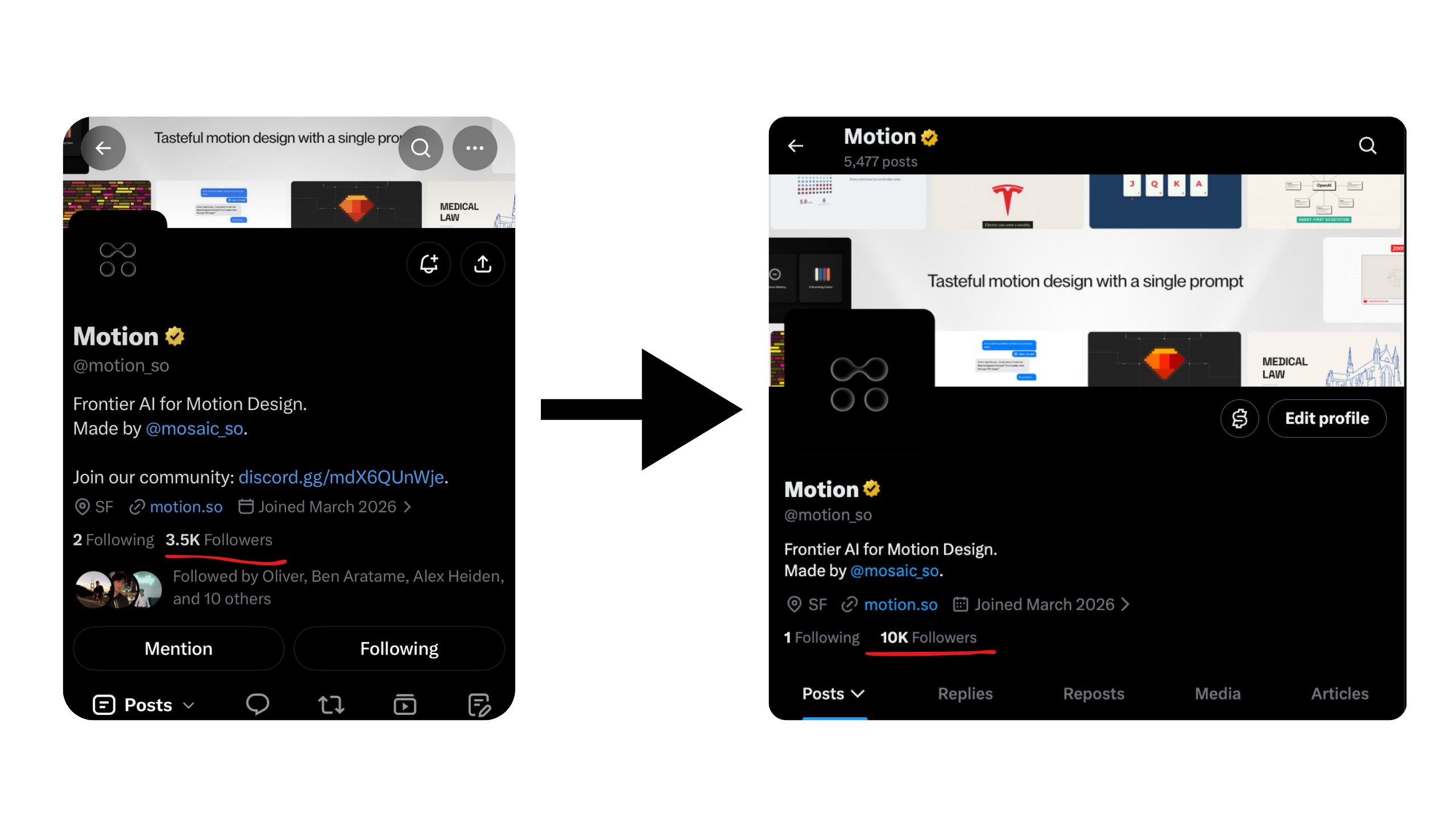
I grew Motion’s X account from 3.5K to 10K followers in a month.
If I had to do it again, I’d start by finding more ways to show the same product.
We’ve introduced Motion as:
“Claude for motion graphics” → 146K views
“Motion in Claude” → 1.9M views
“Claude for marketing” → 90K views
“The Apple for launch videos” → 3.7M views
Same underlying product. Different reasons for someone to care.
Here are the rules I’d use again:
Give each post one specific use case.
A designer making motion graphics and a founder making a launch video can use the same product. But they need to see different examples before it feels relevant to them.
I’d choose who the post is for before writing the opening or picking the demo.
Make the video earn the hook.
“The Apple for launch videos” sets a pretty high expectation. The video has to make that comparison feel reasonable.
I’d pick the strongest output first, then write an opening the demo can actually back up.
Give the product more than one launch.
Our first angle got 146K views. “Motion in Claude” got 1.9M.
I wouldn’t treat the response to one announcement as the final verdict on the product. I’d test another use case, another example, or another way of explaining it.
Keep the promise specific when a post works.
If someone follows after seeing a launch video, I’d give them more useful launch-video examples: different styles, what went into making them, and what they can try themselves.
That gives them a reason to stay after the post that brought them in.
The next thing I want to understand is how many of those new followers actually try Motion and make something with it.
anthropic said it themselves in the s-1
one of their biggest growth opportunities is the gap between what claude can do and how many people actually use it
anthropic still has a distribution problem
if they have one, your startup definitely does lol

My quick takeaways on the Anthropic S-1:
1. This is a historical moment
2. $6.6M in revenue per employee!! Hard to even comprehend how good that is but Anthropic is AI native as it gets so makes sense.
3. I always thought OpenAI would drop their S-1 first
4. Customers spend about 9x more after a year. Net Revenue Retention is approximately 900% as of Sep 30, 2026. Good SaaS companies brag about 120%.
5. Cowork is growing faster than Claude Code did. Goes to show you the demand for consumer products. Duo will probably rip.
6. 3 years ago this company did $41M in revenue. In the first six months of 2026, it did $16.3 billion. I don't think anyone has a mental model for that curve yet, I sure don’t.
7. Nearly half of revenue comes through cloud marketplaces. About 48% comes from customers buying through them. Big companies buy where their budget already lives, and the lesson for founders selling to enterprises is to get listed where your buyers already spend.
8. Their run rate formula is published: the last 28 days of usage times 13, plus subscriptions times 12, which i guess is the new ARR math for founders?
9. It looks like They're merging Cowork into Claude dot au which tells you the chat box era is ending and the "go do the work for me" era is here.
10. Thousands of Anthropic employees are about to become liquid at once, so expect the biggest wave of new AI startups and angel checks San Francisco has ever seen. Reminds me when Facebook went public but this is way bigger.
Let’s go!
11. Buried in the filing, Anthropic says the gap between what Claude can do and how widely it's used is one of its biggest growth opportunities, so the company itself is telling you the models are ahead of the market and someone has to close that gap for dentists, landlords, and plumbers.
12. Whatever happens, exciting times to be building in AI.
most launches are the biggest fail ever because they're always made to get a bunch of views, but they're never optimized for actually bringing in sales or conversions.
there's a reason for that, and it's been in marketing books for decades.
cialdini calls it social proof. when people aren't sure about buying something, they look at what people like them are doing.
a polished launch video is the brand talking about itself. people watch it, but it doesn't make them trust you.
that's why ugc works. a normal person on their phone showing how the product helped them is basically a friend recommending it.
influencers work the same way, but only if their audience already trusts them on that topic. if they don't, you're just paying for views....
byron sharp's point is that people buy the brand that comes to mind first, not the best one. one launch won't get you there. posting real people and real results over and over will..
Amine Obeidat retweeted

"pessimism of the intellect, optimism of the will"
- gramsci
optimists prepare for the outcome they want
pessimists prepare for every version of it
plan like a pessimist
execute like an optimist
every founder says distribution is the hard part
then they bring me in 2 weeks before launch
first thing i do is read the replies and dms they already got. the positioning is in there
then i start replying under the accounts their buyers follow, way before launch day
creators get briefed on the problem
and launch day isn't the end. most of the reach comes after

100 grok bots for startup marketing
launches, ugc, distribution, ads. tag @bot to add any of them

we once spent a lot of money on a launch
big influencers, a sick video, copy we rewrote 20 times
got a ton of views and barely any signups
a few weeks later i posted something random in 5 min and it made more money than that whole launch
what i figured out:
people on x don't care about your product, they care about what it does for them
so the posts that convert have 3 things:
- a real number in the hook
- the exact problem it solves for them
- a quick demo of it actually working
nobody buys an iphone because of apple's launch post.
they buy it after watching someone show them what it can do
i copied @ryangrowthh's grok bot content system for my own x
6 bots now run my content pipeline. here's the setup 👇


i built a content team out of ai bots this week
one finds what's blowing up in my niche every morning
one reads my analytics and tells me what flopped
one goes through my bookmarks and turns them into ideas
one writes the posts. one fact checks them and roasts my takes
i just approve and hit post
honestly the fact checker is my favorite. it's already caught a wrong number in one of my posts


Startup founders please read this:
they think 18 hour days = more work done
the data says otherwise
→ stanford found output barely grows past ~50 hrs a week. 70 hrs got about the same output as 56
→ after 17-19 hours awake your brain performs like someone at 0.05% blood alcohol
→ top performers maxed out around 4 hours of real deep work a day
→ 55+ hr weeks are linked to a 35% higher stroke risk
so you're not grinding, you're paying people to produce slop and burn out
hours spent ≠ work done
most people could finish faster, but when the goal is filling hours the work just stretches to fill them