





Amir Kabbara retweeted

Distillation is all you need to run frontier models for free on your device

This is f*cking insane: OpenAI co-founder Andrej Karpathy says a tiny 1B model can beat most of today's giant LLMs.
"A 1B model can be much more effective than most current LLMs. 90% of current models waste a ton of capacity and money on remembering stuff that doesn't matter"
In 64 seconds he explains why intelligence lives in the system around the model, not in its size.
Memorized Internet → Cognitive Core → Tools → Feedback Loop → Agent That Works
Save this before it gets lost in X's algorithms.
Everything below is free:
Neural Networks: Zero to Hero
Karpathy's own course, from scratch
karpathy.ai/zero-to-hero.htm…
nanochat
Karpathy's "best ChatGPT that $100 can buy"
github.com/karpathy/nanochat
Effective Harnesses for Long-Running Agents
The system around the model, by Anthropic
anthropic.com/engineering/ef…
Effective Context Engineering for AI Agents
What to feed the model and what to cut
anthropic.com/engineering/ef…
All of this costs $0
99% will keep waiting for a bigger model.
The 1% who build better systems will win with a smaller one.
Bookmark it and start with the first link tonight
Papr is now most accurate on LongMemEval: 96.0% accuracy in one turn.
Good memory isn't recalling one old chat. It's knowing what changed: your new job, an updated preference, what happened first.
Papr does it fast and in a token efficient way.

Amir Kabbara retweeted

Anthropic's three takeaways on agent memory:Do the simple thing that works.
Papr is memory as a layer for any agent: → access control on each memory → a knowledge graph, not flat files → maintenance outside the agent loop → works with any model
Amir Kabbara retweeted
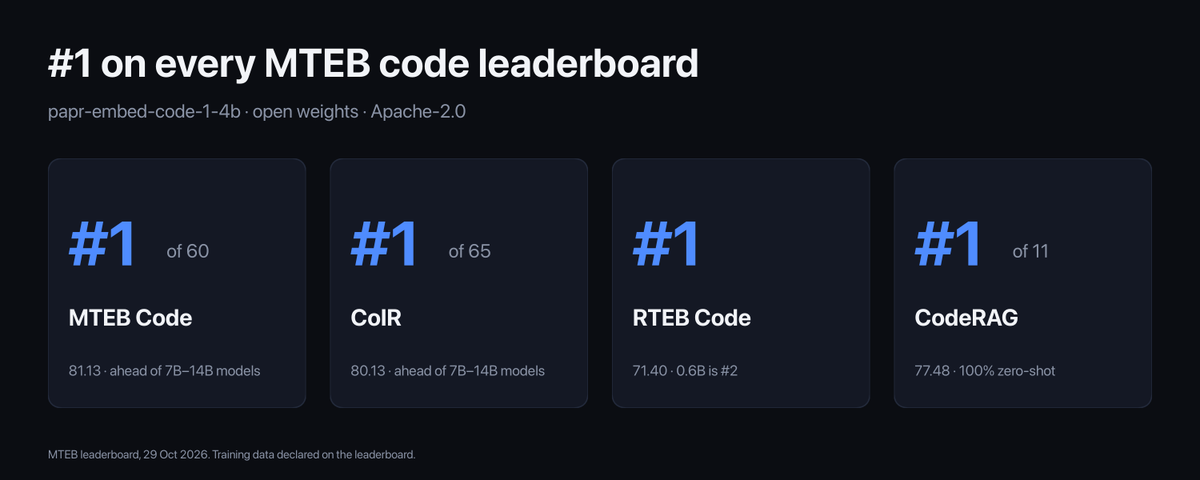
Our papr-embed-code 4b model is #1 for code retrieval and yes it's open source open weights
teapaw.org/i/grok/share/bGVnYWN5_…

Coding is the biggest use case for LLMs, and most of the tokens a coding agent burns go to searching and reading code, not writing it. Every wrong file it opens costs you money, time and context.
So we fixed retrieval at the root. We trained our own graph-native embedding models, tuned them for code, and they're #1 in code retrieval. They're open source and open weights. Enjoy

Amir Kabbara retweeted
We trained our own graph-native embedding models optimized it for coding and hit state of the art in code retrieval. It's open source open weights.
Thanks to our investors @e14fund @Techstars, BAG Ventures, Tachles VC, IM Fund and @googledevs for supporting us on our journey.

Working on GTM? Join this free workshop to work together on automating our gtm workflows

Think of one GTM task you never want to do by hand again.
Meeting prep? CRM updates? Follow-ups?
Bring it to our webinar Thu Oct 29. If there’s time, we’ll automate yours live. paprai.substack.com/p/stop-b…

Amir Kabbara retweeted

Think of one GTM task you never want to do by hand again.
Meeting prep? CRM updates? Follow-ups?
Bring it to our webinar Thu Oct 29. If there’s time, we’ll automate yours live. paprai.substack.com/p/stop-b…
Amir Kabbara retweeted
I Built a Papr Work App to Manage Childcare for Seattle Kraken Game Nights. It Took One Conversation. paprai.substack.com/p/i-buil…
Amir Kabbara retweeted

Dusting off this tweet from April because this gap in shared understanding of LLM capability is *widening*. It's now less "two groups of people speaking past each other" and more a sharp funnel.
- Napkin math somewhere around 6B people (~75% of the population) have barely come in contact with LLMs at all.
- Around 1-2B (~20%) are casual and infrequent users of free-tier ChatGPT-like products. This group sees derpy chatbots and treats them a bit like a better Google search, a writing aid, or etc. Maybe an agent tries to book you a flight. I have non-tech friends who (reasonably, imo) say they have not much use for it at all. Even many professionals outside of math&code are in this tier. For example, execs and many other functions spend a lot of their time talking to other people, so while they understand what is happening intellectually, it is still second-hand and a bit abstract.
- Now we get to professional use of frontier-grade LLMs in math&code. Somewhere around 20M people (0.2%) see first-hand that large, complex projects that used to take them weeks/months can now be completed by agents with a prompt. Building apps, copying apps, translating apps, decompiling apps from binaries... This has all happened very quickly and recently - less than 1 year ago, I was writing code manually by hand, typing memorized computer code commands into a code editor character by character, occasionally pressing Tab to autocomplete a little chunk of code.
- And finally we get to the ~5,000 people (~0.00006%) with access to frontier-grade systems internally. The external world has seen the preview. It looks like swarms of thousands of agents collaborating over weeks on software mega projects: minting zero days, running cyber attacks and defenses at machine speeds, discovering new science, advancing the frontier of mathematics. Things that would have taken top professionals in the industry years of work. Meanwhile, human review and comprehension are starting to fall behind. For example, people are still involved in the "archeology" of the OpenAI-HF incident from many months ago. Mathematicians may be poring over the 722 manuscripts on frontier mathematics for a while.
The funnel is driven by a combination of factors:
1. The impact scales with ambition, problem size, and horizon. A question with a paragraph answer barely stresses the system. You need a reservoir of big, difficult problems that you really care about. This aspect drives the consumer / professional dimension of the funnel.
2. The jaggedness of the system (which I have written about a lot separately). Capability peaks in domains that are digital, verifiable and economically valuable. This is because LLM capability emerges from reinforcement learning on verifiable rewards on a curated environment mixture driven by revenue potential. This aspect primarily drives the area (e.g. math&code) dimension of the funnel.
3. Access. Free-tier, paid-tier, internal.
So this is the weirdness of the moment. The general public has mostly not interacted with these systems. When they have, it looks like a derpy chatbot. The majority of professionals still see only a modest uplift. And a small sliver of professionals are experiencing the vertigo of the curve going vertical. And it is all happening at the same time.

Judging by my tl there is a growing gap in understanding of AI capability.
The first issue I think is around recency and tier of use. I think a lot of people tried the free tier of ChatGPT somewhere last year and allowed it to inform their views on AI a little too much. This is a group of reactions laughing at various quirks of the models, hallucinations, etc. Yes I also saw the viral videos of OpenAI's Advanced Voice mode fumbling simple queries like "should I drive or walk to the carwash". The thing is that these free and old/deprecated models don't reflect the capability in the latest round of state of the art agentic models of this year, especially OpenAI Codex and Claude Code.
But that brings me to the second issue. Even if people paid $200/month to use the state of the art models, a lot of the capabilities are relatively "peaky" in highly technical areas. Typical queries around search, writing, advice, etc. are *not* the domain that has made the most noticeable and dramatic strides in capability. Partly, this is due to the technical details of reinforcement learning and its use of verifiable rewards. But partly, it's also because these use cases are not sufficiently prioritized by the companies in their hillclimbing because they don't lead to as much $$$ value. The goldmines are elsewhere, and the focus comes along.
So that brings me to the second group of people, who *both* 1) pay for and use the state of the art frontier agentic models (OpenAI Codex / Claude Code) and 2) do so professionally in technical domains like programming, math and research. This group of people is subject to the highest amount of "AI Psychosis" because the recent improvements in these domains as of this year have been nothing short of staggering. When you hand a computer terminal to one of these models, you can now watch them melt programming problems that you'd normally expect to take days/weeks of work. It's this second group of people that assigns a much greater gravity to the capabilities, their slope, and various cyber-related repercussions.
TLDR the people in these two groups are speaking past each other. It really is simultaneously the case that OpenAI's free and I think slightly orphaned (?) "Advanced Voice Mode" will fumble the dumbest questions in your Instagram's reels and *at the same time*, OpenAI's highest-tier and paid Codex model will go off for 1 hour to coherently restructure an entire code base, or find and exploit vulnerabilities in computer systems. This part really works and has made dramatic strides because 2 properties: 1) these domains offer explicit reward functions that are verifiable meaning they are easily amenable to reinforcement learning training (e.g. unit tests passed yes or no, in contrast to writing, which is much harder to explicitly judge), but also 2) they are a lot more valuable in b2b settings, meaning that the biggest fraction of the team is focused on improving them. So here we are.
I was manually doing LinkedIn outreach. Tools to automate it cost a ton for founders like me. So I built my own LinkedIn Outreach app with @papr_ai
It helps me find relevant people to engage with, handles invites, follow-ups, and drafts replies I approve. It runs on my laptop. It's now a free community app on Papr that anyone can use, fork and personalize with a click.
p.s. papr agents created this video for me
I was manually doing LinkedIn outreach. Tools to automate it cost a ton for founders like me.
So I built my own LinkedIn Outreach app with @papr_ai It helps me find relevant people to engage with, handles invites, follow-ups, and drafts replies I approve. It runs on my laptop. It's now a free community app on Papr that anyone can use, fork and personalize with a click.
p.s. papr agents created this video for me

Meet the Papr Agents. Like ninjas, having a thoughtful conversation while working hard in the background
Amir Kabbara retweeted
The art and meticulous craft behind every design decision at papr. Must read :)
Amir Kabbara retweeted
In 2007, Yahoo's entire search-ads sales team ran on one guy's Excel macros.
The company hired a PM and twenty engineers to rebuild the sales tools that Jim used to run his work. I was that PM, Tree Li :) was my partner in crime.
Jim was doing the work. He just wasn't allowed to build the software that ran it.
Last night a room full of GTM builders in San Francisco at the AWS Loft came to talk about the 2026 version of that problem at the GTM Unblocked Event. Then they built things. Then they told us what they thought — on camera, unedited.
Akash Aithal, who runs outreach on Apollo, Dripify and Octopus CRM:
"With all these tools I don't have 100% control of what I do. Here, I have control over what I did — and I have more confidence here."
Another GTM builder:
"What I'm used to right now — it does the work, but I don't get to manage it, see it, or know how it works. It almost feels like a personal CRM."
That's the whole thesis, said better than our slides said it. AI didn't transform GTM. It added another tab, and you're still the glue between the chat window, the CRM, LinkedIn, and a sheet for review.
The most useful feedback was the harshest. One person couldn't get her mini-app ICP to run.
Another told us: "We didn't know that we had to customize it."
Customization is the entire point of what we're building. That one's on us. Both are being fixed this week.
Rent the rails you run on — Stripe, Salesforce, deliverability. Own the rest and personalize it.
Thank you Amir Kabbara and Corey Badcock for hosting with me, Marya Moukaddem for helping us with the media, Amazon Web Services (AWS) for allowing us to host our event at the AWS builder Loft in SF and to everyone who stayed until they kicked us out.


