






Pinned Tweet
January 23rd was the first time our robot heard "Hey Matic" and turned to look at the person who said it.
Matic Cues came from one idea: being useful is not in conflict with delight, intentionality, and purpose. A remarkable product does something you wouldn't expect it to do and makes you want to tell someone about it.
Every revolutionary product introduced an interface - the mouse made the personal computer, the click wheel made the iPod, and multi-touch made the phone.
This pattern applies to robots because of a fact that applies to none of those objects: a robot is never with you. A computer is under your hands; a phone is in your pocket; a robot is in the next room, under the table you're eating at. Every interface we've inherited assumes the device is within reach. A robot is the first consumer object where that's false.
And that's why it turns to face you: a device that's never within reach has to find you. You don't tap a robot. You don't learn an app for a robot. You tell it what you want, and if it's somewhere in particular, you point. Voice carries what. Gestures carry where.
How we built it, in the thread:


the oldest theft there is isn't of money, it's of life, an afternoon at a time.
After 9 years. 16K+ family homes. 500M sqft inside real homes covered, we know home robots are being built in wrong order.
So we built Matic the way nature grows a child.
Finally, sharing our vision:
1. Why robots get stuck at the demo
2. Why labs can't ship robots
3. Why we started with eyes, not hands
4. The 99.999% rule in robotics
5. Where Matic is going next
1. Why most robots get stuck at demos
Robot demos look brilliant in a room arranged around its limitations: familiar lighting, predictable furniture, nothing troublesome on the floor.
A family’s home makes no such accommodations. There are cables, toys, shifting rugs and, occasionally, dog poop. Yes, humanoids will need to avoid that too.
Repeating a task under familiar conditions of uncluttered floors is not the same as handling an unfamiliar home with all its chaos.
2. Why labs can't ship robots
SLAM (Simultaneous Localization and Mapping) is how a robot maps its surroundings and locates itself within them. Ask most academics and they'll tell you it's a solved problem.
But real homes are the most chaotic spaces that exist.
There are glass doors that look like open doorways, mirrors, stairs, rugs, charging cables, and Legos placed all around.
So ask yourself: if indoor mapping and navigation is "solved," where are the robots? Why aren't airports, hotels and grocery stores full of them?
Calling it “solved” misses the question families actually care about: can I leave this thing alone and trust it?
3. Why we started with eyes, not hands
Nature doesn't give birth to a fully working human. We took our cue from how nature develops humans: capabilities built on one another.
Children learn to see before they learn to grab, and to grab before they learn to plan and handle the unexpected.
Perception comes first. Manipulation follows. More complex responsibilities come after that. At every stage, the robot must earn the next job by doing its current one well enough.
Before asking a robot to pick up a sock, we wanted it to understand where it was, where the sock was, and how to reach it.
Most of the industry started at the top, with humanoids. We started at the bottom, with a robot whose job is to see and move through a home precisely with 1cm accuracy in any lighting condition.
Floor cleaning gave that foundation an immediately useful job. It forced us to confront navigation, clutter, privacy and everyday reliability before reaching for more complex chores.
The floor cleaner isn’t a detour from our larger ambition. It is how we’re building toward it.
4. The 99.999% rule in robotics
At 90%, one in ten decisions is wrong, and a robot makes thousands in a single clean. That's the robot that bumps, gets lost, and falls down the stairs.
Every extra nine is a new mountain. The failures get rarer, harder to find, and exponentially harder to fix. They barely even happen until they happen in your home.
Matic's visual SLAM runs at 99.999% in 16K+ homes. We’re the ONLY unsupervised home robot at scale with pure vision-only full autonomy. If you ask us, the gap between 80% and 99.999% is where our 9 years of engineering went.
We close that gap inside real homes. When Matic handles something imperfectly, it saves a short clip and keeps it on the device. It only leaves if the family chooses to share it. If they do, it gets labeled, fed back into the model, and every Matic gets smarter, including theirs.
Families control what leaves their homes. We do the work of making the product better.
Better robots earn trust > trust brings more homes > and more homes teach the robot more.
5. Where Matic is going next
Phase one was perception and it's nearly done. Matic has covered 500 million square feet, 400K miles in thousands of real lived-in homes.
Now phase two is going to be about manipulation. And our idea is to build a robot that doesn't just move through your home, but acts in it to eliminate even more chores.
Each step must be useful today, not justified by something we promise tomorrow. The evolution of Matic is the revolution.
The goal isn’t to put the most impressive humanoid in your living room.
It’s giving your family time and energy back through robots that earn your trust, protect your privacy, and help without becoming another responsibility.
More time for each other. Less work getting in the way.
That’s Matic.
Get yours today at maticrobots.com
6/TEAM
i love my team! These are the people who make Matic, Matic. I am SUPER grateful to them, to all our customers, and to everyone who tested for us before we launched.
We're just getting started!!!!

5/THE TELL: You know an interface is real when your own testers get lazy.
"Too lazy to grab my phone… so said hey Matic near the door of my room and it worked 😯" Navneet ten minutes later: "Same, I am using voice so much. It worked 12 ft away while vacuum was running."

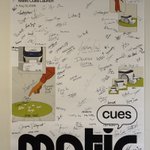
4/VOICE WAR ROOM: This wall is how App got built. And after launch, we erased it. We're a company that believes in clean surfaces


3/GRACEFUL FAILURE: The part I'm proudest of is what happens when it doesn't work.
A new interface is judged by its failures. When Matic can't find what you pointed at, it doesn't buzz, error out, or send you back to the app. It drives over to you and asks: "Show me where?"
Asking a better question isn't failing, It's conversing and that’s inherently human.
2/ TEACHING AN INTERFACE: You can't ship a new interface in one day. You have to teach it in steps.
Step one was Live Activities: robot progress on the lock screen, so checking on a clean stopped meaning unlocking a phone and opening an app. Break the reflex of reaching for the phone.
Step two was voice naming: when you set up your map, you don't type room names.... you just say them. Voice was a conversation before it was ever a command. By the time "Hey Matic" arrived, talking to your robot already felt normal.

Amy Mathews retweeted

everyone on X wants to train AI models. it's the "fun" part, but also the easiest part.
we just shipped voice + gesture control as an OTA update to 10k+ real homes, and training was the smallest slice of the work.
a LOT has to happen between "the model works" and "it works in your home." here's that gap 🧵


Hello world, this is “Hey Matic”
Introducing Cues: Voice & Gesture control for Matic
We raised $115M and spent 9 years to make the world’s first intuitive home robot
Say you spilled coffee: Point to the spill and say, "Hey Matic, clean this" and it will hear, see, locate in 3D, and go clean on its own.
Matic comes with a lot of features:
1. Say "Hey Matic" - it locates your voice, turns, and looks at you
2. Say "Hey Matic, follow me" and start walking. Matic will follow behind
3. Say "Hey Matic, go clean the living room". Since it knows your house map, it navigates and just does it
It's so easy, a 5 year old and an 80 year old can use it and it understands 75 different languages.
Matic has 8x the airflow, specialised cleaning algorithms for rugs, corners, toekicks, mopping, etc and cleans better than any other robot vacuum.
Also keeps improving with software updates.
13,000 families use and love Matic.
WIRED magazine gave it a 10/10 (the only hardware to receive this rating in a decade)
Buy yours at maticrobots.com and if you don't love it after 6 months, we'll give you a full refund.
To celebrate our launch, we're cleaning 300 homes with Matic in San Francisco and New York City.
Comment "Matic" below, we'll send you the link to sign up and come to your doorstep to clean your home with Matic.


I just realized that it’s truly wonder, whimsy, and curiosity that make life worth living. Reality erodes them. Age erodes them further. But you gotta grab them back anyway.


