






2026 US Midterm Senate Predictions:
1. R flip Michigan.
2. D flip Maine, North Carolina, Ohio, Texas.
3. R hold Iowa, Kansas, Nebraska.
4. Outcome 50/50.
5. I'm only unsure about Texas and Michigan.


Election Predictions #3
With just 10 days until election day, the latest polls show that Democrats' only path to victory hinges on winning three critical states: Wisconsin, Michigan, and Pennsylvania. Both Wisconsin and Pennsylvania are currently toss-ups. Here's a breakdown of potential outcomes:
1. If Democrats win all three states, they will reach the necessary 270 electoral votes, making the outcomes in Nevada and Arizona irrelevant (see image 1).
2. If Democrats lose Pennsylvania, Republicans will reach 270 (assuming they win Georgia), and the results in Arizona and Nevada won't matter (see image 2).
3. If Democrats lose Pennsylvania but win Georgia (which seems unlikely at this point), Nevada will become the deciding factor (see image 3).
4. If Democrats win Pennsylvania but lose Wisconsin, Arizona will decide the election - and it currently leans Republican (see image 4).
Bottom line: Pennsylvania is shaping up to be the most crucial state. Democrats must win all three - Wisconsin, Michigan, and Pennsylvania - while Republicans only need to win Pennsylvania or secure both Wisconsin and Arizona.


292
Thoughts on Israel war #48: USS Carney
October 19, 2023, just 12 days after October 7, marked the first Houthi missile and drone attack toward Israel.
The attack was intercepted by USS Carney, an American guided-missile destroyer that had entered the Red Sea just one day earlier.
Carney had departed Florida on September 27, on a scheduled deployment planned long before October 7. On October 18, it passed through the Suez Canal into the Red Sea, heading toward the U.S. 5 Fleet's area of operations. The following day, while sailing through the northern Red Sea, it encountered and intercepted the Houthi barrage.
Carney was not stationed there to defend Israel from an anticipated Houthi attack. It was conducting a previously scheduled deployment.
According to a U.S. Navy, October 19 began as a routine day for Carney's crew, until the engagement suddenly began around 4PM local time. During the following 10 hours, Carney intercepted four land-attack cruise missiles and 15 drones.
The attack was a surprise. Israeli intelligence had no advance warning of this particular launch and did not anticipate that the Houthis possessed such capabilities.
The missiles were directed toward Eilat, which did not have adequate air defenses at that moment. Israel was focused on threats from Gaza and Lebanon.
Such a surprise attack could have inflicted major casualties, including among people just recently evacuated from northern Israel and the Gaza envelope.
It was a coincidence that a capable American destroyer on a previously scheduled deployment happened to be in the right place at exactly the right time to intercept the first major Houthi barrage toward Israel.
Following October 19, Carney remained in the region, intercepting additional Houthi missiles and drones, including those threatening commercial vessels.
April 2024: Another coincidence
After approximately 6 months of combat operations in the Red Sea, USS Carney was preparing to return home.
On April 6, 2024, Carney passed through the Suez Canal into the Mediterranean. On April 9, it arrived in Palermo, Sicily, for a regularly scheduled port visit. The ship was already heading west toward its home port in Florida when, on April 10, the U.S. military decided to turn it around in anticipation of an Iranian attack against Israel.
On April 13-14, Iran launched its massive missile and drone attack against Israel. Carney, along with USS Arleigh Burke, participated in the defense from the Eastern Mediterranean, successfully intercepting a few Iranian ballistic missiles.
Once again, Carney happened to be in the right region at the right time. The Americans simply had suitable warships already nearby and repositioned them when the threat became clear.
Twice within 6 months, the same American destroyer happened to be in a position to defend Israel against major missile attacks, first from the Houthis and then from Iran.


Thoughts on Israel War #47: MOU #3 - "2/3 of Defensive Weapons"
As part of the anti-Israel smear campaign, J.D. Vance said on June 18, 2026, at the White House: "Over the last three months, two-thirds of the defensive weapons that have protected your homeland have been built by American hands and paid for by American tax dollars".
reuters.com/world/middle-eas…
Since the statement used so many modifiers, it raised my internal red flag. Where is it coming from? What are "defensive weapons"?
Overall, the U.S. provides a baseline of $3.8 billion in military aid annually, not cash but contracts. This makes up about 15% of Israel's defense budget, and the figure is on track to fall below 10%. So 15% does not sound like much, but "two-thirds" sounds significant, as if American hands and American dollars are the majority of Israel's defense.
The origin of this "two-thirds defensive weapons" argument appears to be the May 21 Washington Post report. According to the report, the U.S. fired more than 200 THAAD interceptors and more than 100 SM-3/SM-6 naval interceptors defending Israel, while Israel fired fewer than 100 Arrow interceptors and about 90 David's Sling interceptors.
washingtonpost.com/national-…
But this should be taken with a grain of salt. The Washington Post report is based on anonymous U.S. officials describing what they say are Pentagon assessments. The underlying assessment was not made public, we do not know who those officials were, and we do not know if the information was reported accurately. Also, Israel's interceptor-use numbers are classified, so the U.S. officials do not really know the full Israeli side of the equation anyway.
The same report said a U.S. official claimed the U.S. "shot around 120 more interceptors" and "engaged twice as many Iranian missiles".
So the math is probably this:
If you count recent high-end missile-defense engagements, "two-thirds" may be plausible only because "engaged twice as many Iranian missiles" implies roughly a 2:1 U.S.-to-Israel ratio.
If you count actual interceptors fired, even by those reported numbers, the numbers point more to about 60-62% U.S., not two-thirds. So even under that framing, "two-thirds" is a lie.
If you count Israel's whole "defensive weapons" inventory, the claim becomes misleading or unsupported. Israel's air-defense network is mixed. Iron Dome was developed by Israel, though the U.S. has been a production partner since 2014; David's Sling and Arrow were developed jointly with the U.S.; and the U.S. provides $500 million annually for Israeli and joint missile-defense programs.
Let's analyze:
1. Counting interceptors fired or missiles engaged is not the same as counting defensive value.
THAAD was deployed to Israel as a temporary backup for Israel's core multi-layer anti-ballistic missile defense shield. It was also deployed to the Gulf.
If THAAD fires many interceptors per target, Vance's "two-thirds" becomes almost meaningless.
Two to five interceptors were often required to take down a single missile in the Iran war context. It measures U.S. ammunition burn rate, not necessarily successful defense share.
2. For long-range Iranian ballistic missiles, Israel's Arrow system is the more natural strategic/top-layer defense.
If a missile is first engaged by Arrow and missed, and then THAAD fires multiple interceptors later, counting THAAD shots as if they were the core protection exaggerates the U.S. role.
3. The framing also completely ignores Hezbollah firing rockets and drones at Israel's north during the same broader period. Israel's defensive reality was not only Iranian long-range ballistic missiles. It was also the northern front, where Israel's own systems, forces, and civilian-defense infrastructure were part of the defense picture. That disappears from Vance's "two-thirds" framing.
On top of that, while the U.S. deployed THAAD launchers to Israel, Israel deployed Iron Dome batteries to the Gulf. Israel also implemented the civil early-warning, notification, and alarm system for some Gulf countries. This also protected Americans in the area.
reuters.com/world/middle-eas…
So Vance's statement appears to be based on a report about interceptor burn, but he presented it as if it describes Israel's defensive weapons or Israel's overall defense dependency.


1
363
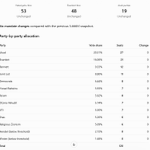
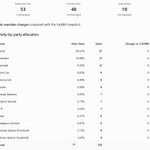
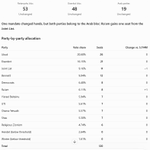
Counting Israel elections. After 956K votes counted the right block is still above 60 (63-50) but Arab parties are heavily undercounted.

1
1
808

