

Tradition, Design, Soul. A newsletter on Moorish-Andalusian design. Read ‘Designing the Neo-Moorish Home’: https://teapaw.org/t.co/Yf2RrdqJwa
Al-Andalus
Joined May 2025
- Tweets3.6K
- Following454
- Followers10.3K
- Likes8.8K




Pinned Tweet
The Alhambra is the Nasrid residence most visitors come to Granada to see, and it was never the only one. The plain below the city, known as the Vega, was dotted with country estates called almunias, and the city itself held residences built to the same standard.
Ibn al-Khatib, writing in the fourteenth century, listed fourteen royal properties along the Genil alone. Eight were villages, most of them fortified, and the rest were residences and gardens.
An almunia combined a place to stay with a working estate. It stood on the edge of a city and held farmland, pastures, mills, and sometimes tile kilns, alongside the pavilion where its owner received guests.
The owners were the ruler, his family, and wealthy townspeople, and tenants and governors ran the land. The Arabic word, al-munya, is glossed as “the desire” or “the orchard,” and both meanings fit.
Ibn al-Khatib reckoned the irrigated land of the Vega at about 560,000 marjales, roughly 29,400 hectares, and put about 298,000 of them in the hands of the sultan, the mosques, and pious endowments. That is a little over half.
Three of these buildings survive in a form that can still be read. The Alcázar Genil and the Cuarto Real de Santo Domingo were almunias at the edge of Granada. Dar al-Horra is a residence inside the city, in the Albaicín.
They date from the early thirteenth century to the fifteenth, and the oldest was founded before the Nasrids ruled Granada at all.
Taken together they show that the Nasrids built on an inherited model. A principal room, a pool in front of it, and a garden or orchard beyond appear in all three.
The Alhambra is the most elaborate version of that arrangement, and it was one version among many.
Read more in detail here: theandalusianedit.substack.c…


The Andalusian Edit retweeted
The Cuarto Real de Santo Domingo was the Almunia de la Almanjarra, an estate on the edge of the city built in the last quarter of the thirteenth century under Muhammad II.
Dendrochronology dates its wooden ceiling to after 1283, and an archaeological report from 2016 places the start of building in the final decades of the thirteenth century, on top of what appear to be Almohad defensive remains.
The plan repeats the one at the Alcázar Genil. A square hall of double height is flanked by two narrow side rooms, and the far wall opens through three large windows toward the river.
They differ in setting.
The Alcázar Genil stood free on the plain with its pool before it, and the Cuarto Real was built into a tower on the defensive line of the city.


The Alhambra is the Nasrid residence most visitors come to Granada to see, and it was never the only one. The plain below the city, known as the Vega, was dotted with country estates called almunias, and the city itself held residences built to the same standard.
Ibn al-Khatib, writing in the fourteenth century, listed fourteen royal properties along the Genil alone. Eight were villages, most of them fortified, and the rest were residences and gardens.
An almunia combined a place to stay with a working estate. It stood on the edge of a city and held farmland, pastures, mills, and sometimes tile kilns, alongside the pavilion where its owner received guests.
The owners were the ruler, his family, and wealthy townspeople, and tenants and governors ran the land. The Arabic word, al-munya, is glossed as “the desire” or “the orchard,” and both meanings fit.
Ibn al-Khatib reckoned the irrigated land of the Vega at about 560,000 marjales, roughly 29,400 hectares, and put about 298,000 of them in the hands of the sultan, the mosques, and pious endowments. That is a little over half.
Three of these buildings survive in a form that can still be read. The Alcázar Genil and the Cuarto Real de Santo Domingo were almunias at the edge of Granada. Dar al-Horra is a residence inside the city, in the Albaicín.
They date from the early thirteenth century to the fifteenth, and the oldest was founded before the Nasrids ruled Granada at all.
Taken together they show that the Nasrids built on an inherited model. A principal room, a pool in front of it, and a garden or orchard beyond appear in all three.
The Alhambra is the most elaborate version of that arrangement, and it was one version among many.
Read more in detail here: theandalusianedit.substack.c…


The Cuarto Real de Santo Domingo was the Almunia de la Almanjarra, an estate on the edge of the city built in the last quarter of the thirteenth century under Muhammad II.
Dendrochronology dates its wooden ceiling to after 1283, and an archaeological report from 2016 places the start of building in the final decades of the thirteenth century, on top of what appear to be Almohad defensive remains.
The plan repeats the one at the Alcázar Genil. A square hall of double height is flanked by two narrow side rooms, and the far wall opens through three large windows toward the river.
They differ in setting.
The Alcázar Genil stood free on the plain with its pool before it, and the Cuarto Real was built into a tower on the defensive line of the city.
The Alhambra is the Nasrid residence most visitors come to Granada to see, and it was never the only one. The plain below the city, known as the Vega, was dotted with country estates called almunias, and the city itself held residences built to the same standard.
Ibn al-Khatib, writing in the fourteenth century, listed fourteen royal properties along the Genil alone. Eight were villages, most of them fortified, and the rest were residences and gardens.
An almunia combined a place to stay with a working estate. It stood on the edge of a city and held farmland, pastures, mills, and sometimes tile kilns, alongside the pavilion where its owner received guests.
The owners were the ruler, his family, and wealthy townspeople, and tenants and governors ran the land. The Arabic word, al-munya, is glossed as “the desire” or “the orchard,” and both meanings fit.
Ibn al-Khatib reckoned the irrigated land of the Vega at about 560,000 marjales, roughly 29,400 hectares, and put about 298,000 of them in the hands of the sultan, the mosques, and pious endowments. That is a little over half.
Three of these buildings survive in a form that can still be read. The Alcázar Genil and the Cuarto Real de Santo Domingo were almunias at the edge of Granada. Dar al-Horra is a residence inside the city, in the Albaicín.
They date from the early thirteenth century to the fifteenth, and the oldest was founded before the Nasrids ruled Granada at all.
Taken together they show that the Nasrids built on an inherited model. A principal room, a pool in front of it, and a garden or orchard beyond appear in all three.
The Alhambra is the most elaborate version of that arrangement, and it was one version among many.
Read more in detail here: theandalusianedit.substack.c…
The Andalusian Edit retweeted
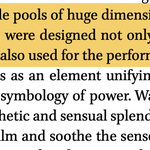
The pool at the Alcázar Genil was not a small ornamental feature beside a palace. At approximately 121 metres by 28 metres, it covered more than 3,000 square metres, nearly half the area of a modern football pitch.
Its scale allowed water to function as infrastructure, scenery, and spectacle at the same time. It helped irrigate the estate, reflected the architecture, shaped the experience of visitors, and was also used for aquatic performances.
The author goes on to explain that, in al-Andalus, water was not an accessory to architecture. It was one of architecture’s essential materials, used to cool spaces, reflect light, create sound, sustain gardens, and make power visible.

The Alcázar Genil was founded in 1218 by Sayyid Ishaq ibn Yusuf, an Almohad governor, as a country estate outside the walls of Granada beside the river Genil.
The date places the palace near the end of Almohad rule in al-Andalus. The defeat at Las Navas de Tolosa in 1212 had weakened the regime, and in 1228 the caliph al-Ma’mun withdrew to the Maghreb and left the peninsula to local rulers.
One of them, Muhammad ibn Yusuf ibn Nasr, known as Ibn al-Ahmar, had been proclaimed ruler at Arjona in 1232. He briefly held Jaén, Córdoba, and Seville, and in 1236 he helped Ferdinand III of Castile take Córdoba. His entry into Granada is told in two ways.
One account has the city’s notables invite him in May 1237, and another has a revolt led by the Banu Khalid storm the citadel in April 1238 and declare him ruler.
He moved the seat of government from the old Zirid citadel on the Albaicín hill to the Sabika hill, where he began the Alhambra. In 1246, after a seven-month siege of Jaén, he agreed to surrender the city and pay Castile an annual tribute of 150,000 maravedís.
What the Nasrids inherited was a complete estate. The written sources are sparse and the physical remains fragmentary, but studies of the site date an early Almohad intervention to the riverbank, with retaining walls and a reworked Zirid bridge, and place the estate between the river on the north and the road to Armilla on the east and south.
Researchers read the pool and the layout around it as Almohad work, with the pool as the central element of the almunia.
Read more in detail here: theandalusianedit.substack.c…

The pool at the Alcázar Genil was not a small ornamental feature beside a palace. At approximately 121 metres by 28 metres, it covered more than 3,000 square metres, nearly half the area of a modern football pitch.
Its scale allowed water to function as infrastructure, scenery, and spectacle at the same time. It helped irrigate the estate, reflected the architecture, shaped the experience of visitors, and was also used for aquatic performances.
The author goes on to explain that, in al-Andalus, water was not an accessory to architecture. It was one of architecture’s essential materials, used to cool spaces, reflect light, create sound, sustain gardens, and make power visible.
The Alcázar Genil was founded in 1218 by Sayyid Ishaq ibn Yusuf, an Almohad governor, as a country estate outside the walls of Granada beside the river Genil.
The date places the palace near the end of Almohad rule in al-Andalus. The defeat at Las Navas de Tolosa in 1212 had weakened the regime, and in 1228 the caliph al-Ma’mun withdrew to the Maghreb and left the peninsula to local rulers.
One of them, Muhammad ibn Yusuf ibn Nasr, known as Ibn al-Ahmar, had been proclaimed ruler at Arjona in 1232. He briefly held Jaén, Córdoba, and Seville, and in 1236 he helped Ferdinand III of Castile take Córdoba. His entry into Granada is told in two ways.
One account has the city’s notables invite him in May 1237, and another has a revolt led by the Banu Khalid storm the citadel in April 1238 and declare him ruler.
He moved the seat of government from the old Zirid citadel on the Albaicín hill to the Sabika hill, where he began the Alhambra. In 1246, after a seven-month siege of Jaén, he agreed to surrender the city and pay Castile an annual tribute of 150,000 maravedís.
What the Nasrids inherited was a complete estate. The written sources are sparse and the physical remains fragmentary, but studies of the site date an early Almohad intervention to the riverbank, with retaining walls and a reworked Zirid bridge, and place the estate between the river on the north and the road to Armilla on the east and south.
Researchers read the pool and the layout around it as Almohad work, with the pool as the central element of the almunia.
Read more in detail here: theandalusianedit.substack.c…
How War, Water, and Faith Shaped the Andalusian City of Ronda is now live on Jeff Fong's (from @yimbyaction) Urban Proxima.
This essay looks at what the city’s Islamic-era buildings were built to answer. A frontier gate and walls, a 231-step stairway down the gorge to the river, and a hammam below the old town.
Read more in detail here: urbanproxima.com/p/how-war-w…


The Andalusian Edit retweeted
The Alcázar Genil was founded in 1218 by Sayyid Ishaq ibn Yusuf, an Almohad governor, as a country estate outside the walls of Granada beside the river Genil.
The date places the palace near the end of Almohad rule in al-Andalus. The defeat at Las Navas de Tolosa in 1212 had weakened the regime, and in 1228 the caliph al-Ma’mun withdrew to the Maghreb and left the peninsula to local rulers.
One of them, Muhammad ibn Yusuf ibn Nasr, known as Ibn al-Ahmar, had been proclaimed ruler at Arjona in 1232. He briefly held Jaén, Córdoba, and Seville, and in 1236 he helped Ferdinand III of Castile take Córdoba. His entry into Granada is told in two ways.
One account has the city’s notables invite him in May 1237, and another has a revolt led by the Banu Khalid storm the citadel in April 1238 and declare him ruler.
He moved the seat of government from the old Zirid citadel on the Albaicín hill to the Sabika hill, where he began the Alhambra. In 1246, after a seven-month siege of Jaén, he agreed to surrender the city and pay Castile an annual tribute of 150,000 maravedís.
What the Nasrids inherited was a complete estate. The written sources are sparse and the physical remains fragmentary, but studies of the site date an early Almohad intervention to the riverbank, with retaining walls and a reworked Zirid bridge, and place the estate between the river on the north and the road to Armilla on the east and south.
Researchers read the pool and the layout around it as Almohad work, with the pool as the central element of the almunia.
Read more in detail here: theandalusianedit.substack.c…
The Andalusian Edit retweeted
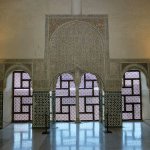
Details matter. Alcázar Genil, Granada.


The Alhambra is the Nasrid residence most visitors come to Granada to see, and it was never the only one. The plain below the city, known as the Vega, was dotted with country estates called almunias, and the city itself held residences built to the same standard.
Ibn al-Khatib, writing in the fourteenth century, listed fourteen royal properties along the Genil alone. Eight were villages, most of them fortified, and the rest were residences and gardens.
An almunia combined a place to stay with a working estate. It stood on the edge of a city and held farmland, pastures, mills, and sometimes tile kilns, alongside the pavilion where its owner received guests.
The owners were the ruler, his family, and wealthy townspeople, and tenants and governors ran the land. The Arabic word, al-munya, is glossed as “the desire” or “the orchard,” and both meanings fit.
Ibn al-Khatib reckoned the irrigated land of the Vega at about 560,000 marjales, roughly 29,400 hectares, and put about 298,000 of them in the hands of the sultan, the mosques, and pious endowments. That is a little over half.
Three of these buildings survive in a form that can still be read. The Alcázar Genil and the Cuarto Real de Santo Domingo were almunias at the edge of Granada. Dar al-Horra is a residence inside the city, in the Albaicín.
They date from the early thirteenth century to the fifteenth, and the oldest was founded before the Nasrids ruled Granada at all.
Taken together they show that the Nasrids built on an inherited model. A principal room, a pool in front of it, and a garden or orchard beyond appear in all three.
The Alhambra is the most elaborate version of that arrangement, and it was one version among many.
Read more in detail here: theandalusianedit.substack.c…

Details matter. Alcázar Genil, Granada.
The Alhambra is the Nasrid residence most visitors come to Granada to see, and it was never the only one. The plain below the city, known as the Vega, was dotted with country estates called almunias, and the city itself held residences built to the same standard.
Ibn al-Khatib, writing in the fourteenth century, listed fourteen royal properties along the Genil alone. Eight were villages, most of them fortified, and the rest were residences and gardens.
An almunia combined a place to stay with a working estate. It stood on the edge of a city and held farmland, pastures, mills, and sometimes tile kilns, alongside the pavilion where its owner received guests.
The owners were the ruler, his family, and wealthy townspeople, and tenants and governors ran the land. The Arabic word, al-munya, is glossed as “the desire” or “the orchard,” and both meanings fit.
Ibn al-Khatib reckoned the irrigated land of the Vega at about 560,000 marjales, roughly 29,400 hectares, and put about 298,000 of them in the hands of the sultan, the mosques, and pious endowments. That is a little over half.
Three of these buildings survive in a form that can still be read. The Alcázar Genil and the Cuarto Real de Santo Domingo were almunias at the edge of Granada. Dar al-Horra is a residence inside the city, in the Albaicín.
They date from the early thirteenth century to the fifteenth, and the oldest was founded before the Nasrids ruled Granada at all.
Taken together they show that the Nasrids built on an inherited model. A principal room, a pool in front of it, and a garden or orchard beyond appear in all three.
The Alhambra is the most elaborate version of that arrangement, and it was one version among many.
Read more in detail here: theandalusianedit.substack.c…
The Andalusian Edit retweeted
Andalusian polymath Lisan ad-Din Ibn al-Khatib al-Andalusi describes Muhammad I of Granada (Founder of the Nasrid dynasty) as someone who liked a stoic-like life, he was wise and a brave warrior.

ALT A Companion to Islamic Granada by Bárbara Boloix-Gallardo

ALT Muhammad I (red tunic and shield) depicted leading his troops during the Mudéjar revolt of 1264–1266 in the Cantigas de Santa Maria