
Payments at Uber, Facebook, Twitter, and most importantly Obopay.
Palo Alto, CA
Joined May 2009
- Tweets2.2K
- Following70
- Followers799
- Likes21K



Pinned Tweet
Unlike other drupes, the coconut seed is unlikely to be dispersed by being swallowed by fauna, due to its large size.
2
Andrew Row retweeted

The golden years of AirBNB were a temporary arbitrage on depreciation.
There was a universe of beautiful well-maintained properties and hosts that had not been worn down by short term guests.
And the AirBNB hosts didn’t properly estimate the cost of depreciation to maintain that standard, so costs were irrationally low
That era fundamentally cant return, it was a temporary arbitrage opportunity
There was once a supply of fairly pristine unused space and now there’s not
If a space does manage to hit the 2014 standard, it must charge a lot more to fight depreciation
And at that point a hotel is generally better
Andrew Row retweeted

CEOs are uniquely prone to AI psychosis because they’re sufficiently distant from the last mile of work that still has to happen to generate most value with AI.
So when they play with AI, they see the happy path results, often not considering the next 10 or 20 things that have to happen to get sustainable results from agents.
“Look I made this awesome product prototype”. Yes but you didn’t have to review the code before it went into production and fix a bunch of issues.
“Look I generated a contract”. Yes but you didn’t verify all the terms before it goes out to the counterparty and didn’t have to wire up all the past contracts to work with.
The best thing you can do as a CEO is to use AI a *ton* to figure out the real implications of agents in the enterprise, and come out the other side with an appreciation for both the upside and the real work that goes into them.

Andrew Row retweeted

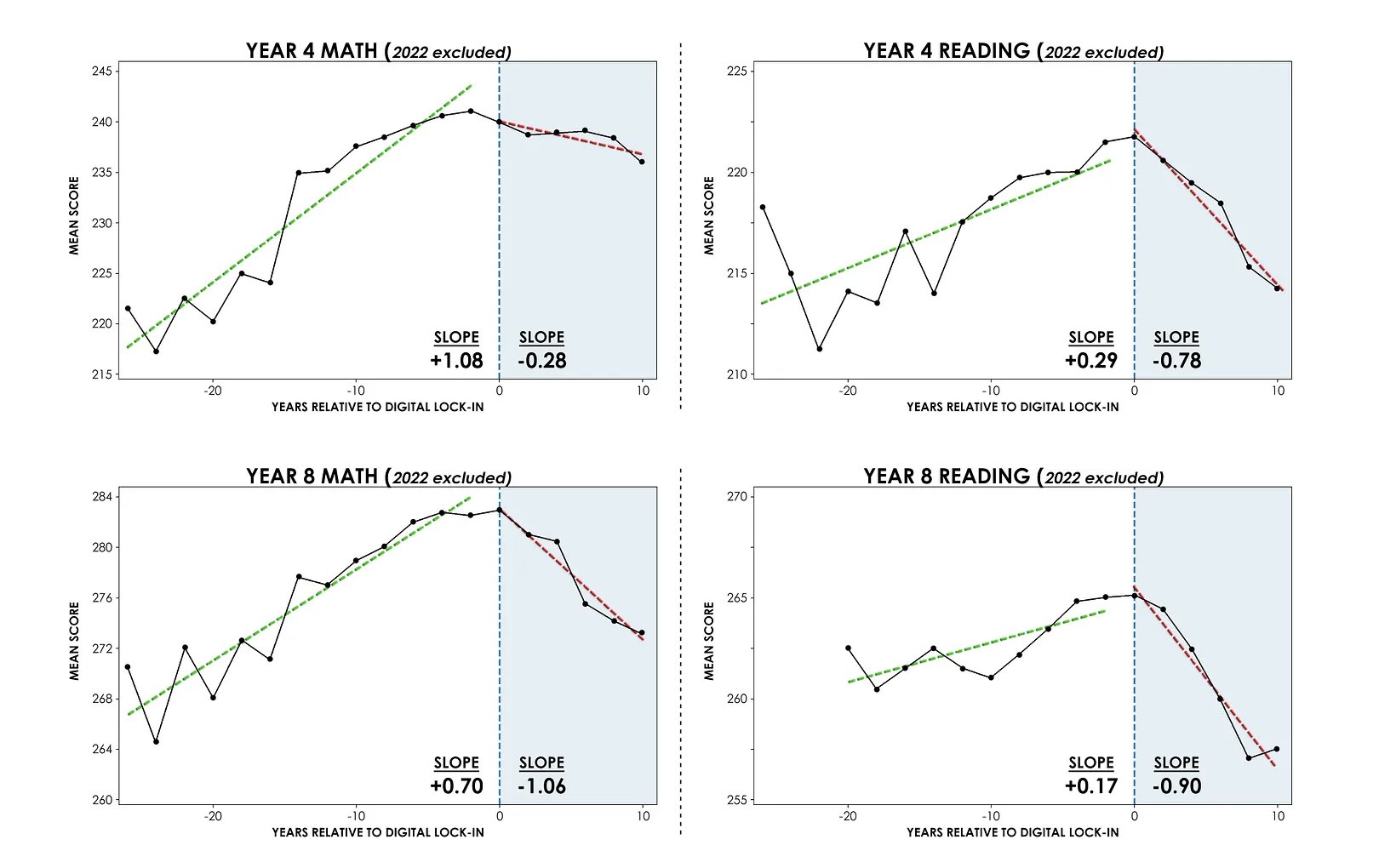
Still more evidence that EdTech harmed American education: Across states, the year that the state imposed mandates requiring computers/tablets, that's the year that test scores stopped rising and in most cases started falling.
From Jared Cooney Horvath
thedigitaldelusion.substack.…

Andrew Row retweeted

I taught during the rise of Chromebooks in classrooms and it was a nightmare
Kids cheating rampantly, Googling every single fact, refusing to read assuming that copy and pasting things from Wikipedia counted as an answer
Students were regularly able to circumvent controls to watch porn, play video games, and watch movies or YouTube in class
Students used shared Google Docs to gossip, bully each other, and plan crime (not joking)
Everyone knew it was a disaster but the district refused to stop using them because “this is the future, kids need to learn computers”, plus massive amounts of funding were tied to them
Mandatory testing was done on the computers and they were used for IEP accommodations so they were unavoidable
Eventually, things got so bad that despite vigorous protests from parents and administrators, I went almost entirely analog, requiring students only use paper and textbook except for state mandated tests
That worked really well until COVID, where remote learning once again became mandatory
Even after the return to classrooms administration required everything be accessible online at all times, so there was no longer any option to stop the digital distractions
A true nightmare for teachers and a system that has radically failed students

Andrew Row retweeted

The attention crisis is so dire at schools right now that film professors can't even get their students to finish movies, and the kids don't even look up the plots of the movies they skip, so students fail basic in-class quizzes like "what happened at the end of the movie?"


Great, now you have to be over 6 feet just to be a robot.

NEWS: Boston Dynamics has just released a new video of its upgraded next-generation humanoid robot called Atlas.
• 4 hour battery. Self-swappable for continuous operation
• 6 feet 2 inches tall
• Weight: 198 lbs
• 56 total degrees of freedom
• Now fully electric, ditching older hydraulic systems
• New lightweight mix of aluminum and titanium components
• 110 lbs weight capacity (66 lbs sustained)
• Can reach up to 7.5 ft
• Constantly evaluates its surroundings and adjusts its posture, balance, and grip in real time
• Hands that can reconfigure as needed. Tactile sensors feed data back into the system, helping apply the right amount of force
• Brain is powered by Nvidia chips
1
91
Andrew Row retweeted

I write this with concern: crypto is congratulating itself for gaining legitimacy—integrating with TradFi and celebrating a sense of arrival—precisely as its conceptual blind spots are widening. There is euphoria in the air, but also a lack of humility and historical knowledge about how financial systems were designed, what problems regulation actually solved, and whether crypto is quietly recreating those same failures under new guises that are harder to detect.
The framing offered by @dannyryan—and amplified by @hasu—is one example of this conceptual slippage: treating counterparty risk as if it were a decentralization story.
Let’s be clear: decentralization has nothing to do with counterparty risk.
In TradFi, you can have zero decentralization and still substantially mitigate counterparty risk; that is the entire point of clearinghouses and CCPs.
Conversely, even in (sort of) technically “decentralized” systems— at the ledger layer—you can still have massive counterparty risk at the economic and governance layer (e.g., borrowers defaulting in lending protocols, stablecoins failing to honor redemptions, AMMs becoming insolvent under stress, oracle failures that cascade into mass liquidations, and governance multisigs or token whales looting).
Counterparty risk is the risk your economic partner can’t perform their obligation.
Blockchains may mitigate operational settlement risk, but they do not eliminate economic risk, which is the core of counterparty risk. Confusing the two is like confusing plumbing with creditworthiness: just because the pipes are (sort of) distributed doesn’t mean the borrower can pay you back.
A blockchain might have helped with transparency of CDS exposures in 2008, but it could not have stopped the real cause: widespread default on physical mortgages and the collapse of real-world collateral.
In fact, DeFi can make counterparty risk *worse.* Even if on-chain positions are transparent, you cannot verify beneficial ownership—especially in environments with shadow positions, synthetic exposure, or secondary-market trading among anonymous accounts. Entire clusters of wallets may be:
- controlled by the same entity,
- coordinating as a collusive group, or
- economically entangled in ways no smart contract can see.
On-chain transparency does not reveal who ultimately stands behind an account, what liabilities they have off-chain, or how interconnected their positions are. This is the classical condition of hidden counterparty exposure.
Crypto has already been hell-bent on making stablecoins and other instruments freely tradeable among anonymous accounts in deep secondary markets. But this amplifies the problem: we have no idea whether these “independent” counterparties are financially linked, risk-correlated, or part of the same economic actor.
And no—systems like “Proof of Personhood” do not solve this. Beneficial ownership is an economic relationship: you can verify that two accounts correspond to two human beings and still have no insight into whether they share a balance sheet, a fund, a creditor, or a coordinating syndicate off-chain. (As I show in Compressed to 0: The Silent Strings of Proof of Personhood, this problem arises even for systems built expressly for identity verification) [1].
Why am I so worried? DeFi is in danger of recreating the opacity of shadow banking while convincing itself it has solved risk and accountability.
Now, is there a future where capital-D Decentralization—true decentralization beyond control of the pipes to the information that flows through them—could mitigate some of these risks? Where we can have better risk management (including counterparty risk), and even reimagining systems of credit for greater breadth and depth?
Yes. But that is not the direction crypto is heading. What we see instead is an industry recreating the power structures of TradFi on a new substrate, swapping one set of intermediaries and winners for another, with less oversight and fewer guardrails.
The uncomfortable truth is this: much of what crypto has built so far could increase systemic fragility in financial markets. And in many cases, it is empowering actors far less scrupulous than the regulated incumbents the industry loves to vilify.
Did Larry Fink list “Trump Coin”—an emolument and open auction on national security? No. Did Brian Armstrong and most crypto exchanges? Yes.
Moreover, the real promise of crypto isn’t to recreate TradFi institutions, but to build better ones—institutions that actually internalize externalities and model information the way it is generated in the real world: not as isolated, atomistic transactions, but as social, coalitional, and position-dependent signals within a social network.
MEV is a clear example of the problem. It sits precisely at the intersection of information, incentives, and market design—yet the emerging market structure around it is, by all appearances, a thin replay of TradFi. It assumes atomized participants and treats transactions as independent events (the Walrasian myth). That blindness structurally advantages whoever has more resources, bandwidth, or latency, generating superlinear extractive *rents* for precisely the actors a genuinely decentralized design is meant to constrain.
A better design would treat transactions as signals emergent from social networks and communication, not as isolated atomic events. That means thinking about attention and influence at the level of coalitions—fluid, overlapping groups characterized by partial commitments within social networks. [2]
THAT’s the space in which real decentralization becomes possible: when the system can register how people actually coordinate, how information propagates, and how groups form and adapt. Without this, small informational or control edges accumulate and compound superlinearly, producing extraction-driven oligopolies far more entrenched—and far less accountable—than the ones crypto claims to transcend.
As far as I can see, crypto isn’t moving towards this design space. And it remains an open question whether the ecosystem has the conceptual depth or the crisis-forged practical experience needed to reach it: the kind of experience you only gain by working inside real financial systems when they fail at scale and confronting the human toll and socialized losses that follow.
[1] papers.ssrn.com/sol3/papers.…
[2] papers.ssrn.com/sol3/papers.…

Decentralization clicks for institutions and tradfi people when reframed as counterparty risk.
- Good point made by (I think) @dannyryan at devconnect
Andrew Row retweeted

We’ll do this once.
(1) the assets were gone; I had clear and unambiguous discussions with mgmt about this when I was briefed into the situation. Folks suggesting otherwise are delusional.
(2) yeah, over time, we learned the “portfolio” had some heat in it. But it was a portfolio built by misappropriated user assets. And it was highly speculative.
(3) that week in November 2022, assets on hand were nothing near adequate, and the founders were fabricating asset lists (and desperately chasing new investors). The coins were gone, folks. Your coins were gone. That’s why bankruptcy happened.
(4) bankruptcy dollarizes claims; this is not new or controversial.
Ok that’s it. Nothing more needs to be said.
I remain thankful that a very talented group of professionals were able to get involved and recover the level of assets they have recovered. I don’t take a view on the fees they charged. Not my call.
Thank you for your attention to this matter.
If you want to indulge in this fresh narrative construct - please demand at least a bit of intellectual honesty.
Andrew Row retweeted

Everyone keeps blaming exchanges.
Let’s be real: the problem isn’t the exchange.
It’s the illusion of liquidity.
99% of crypto doesn’t have real buyers or sellers.
It’s just market makers trading against themselves to make it look alive.
A mirage of liquidity in an empty desert.
Then volatility spikes > volume surges and the “pros” vanish.
The market makers step back.
Spreads widen. Order books thin out.
And suddenly, you’re standing alone with your bags.
That’s when “price discovery” really happens.
Not when the chart’s going up.
But when there’s no one left to buy your fantasy.
And the truth hits:
Most of these coins were never worth what you paid.
Their real price is 50–80% lower.
That’s not manipulation.
That’s reality unmasked.
So next time your favorite coin nukes,
don’t scream “exchange fault” or “MM rug.”
You just got a front-row seat to what real markets look like
when the training wheels of fake liquidity come off.
Welcome to crypto.
Where the music stops fast,
and everyone realizes the dance floor was made of thin air.
Andrew Row retweeted

Taps sign.
The largest systemic risk in crypto is that the assets all being utilized to grow DeFi are exactly correlated.
Longs on gold like PAXG got wiped out yesterday at $3200. Gold is trading above $4K but when your tokenized gold is another asset being used for DeFi collateral and reliant on liquidity providers during a massive cascading liquidation all of a sudden the onchain price will not reflect the real world price.
So to answer your question from a few weeks ago @KyleSamani the circular nature of DeFi yield farming is the greatest systemic risk to all of crypto.


Complete coincidence that it’s approximately rocket shaped I’m sure.

The Boring Company’s “Prufrock” tunneling machine can porpoise—it arrives on a truck, tilts down, and launches into the ground within ~24 hours, then resurfaces by mining onto a trailer—so you don’t need huge launch pits or cranes. It’s also designed for “zero-people-in-tunnel” operations run from a control center.

1
2
71
Andrew Row retweeted

I feel like 90% of what is in our political discourse is really just symptoms of this

Andrew Row retweeted

What’s Tether worth? A fraction of $500B - it’s more like $80 to $90B…..just do the math:
- last quarter Tether disclosed $130B of Treasuries/money markets and reverse repo. Currently that’s generating about 4% of gross yield or $5.3B per year (and rates are dropping)
- they also have $10B of secured loans. For the secured loans (presumably BTC collateralized) just assume a loan rate like 5% - so $500M per year in revenues
- the rest of their “profits” are simply mark to market gains on $17.6B of BTC and gold - nobody will pay a premium for that, you just buy those assets at their market price.
- For their $4.8B of “Other Assets” those are probably pretty dodgy and their carry value doesn’t change much, the accounting is either suspicious or they’re low risk and thus not too valuable. Let’s just assume they’re bought at book value.
Circle is currently valued at 9x ‘26 revenues. So for fun, let’s assume Tether’s treasury revenues grow 20% next year (circulation growth offset by declining rates). That’s $6.4B of NTM revenues. Add $700M of secured loan revenues that we assume will grow at 20% for fun and you get $7.1B of annual revenues.
So at Circle’s multiple, you have $64B implied valuation for the revenues. Add the $17.6B of BTC/Au at market value, plus $4.8B of “other assets” you get
$86B…
Now many will argue “but they should trade at a massive premium to CRCL…what about Paolo’s claim of a 99% profit margin”
Well that margin tells you 1) they have no meaningful infrastructure - a problem in a regulated world (and why they can’t deliver an audit or a quarterly attestation that complies with accounting principles), and 2) they pay no taxes (do you really think that will continue - especially as the Senate Finance Committee is about to hold hearings on stablecoin tax policy)
Plus, they are an un-audited, El Salvador-based (try not to laugh), which means they aren’t really regulated and likely have meaningful regulatory and litigation risk. That lack of infrastructure, credible regulation and audit means a rational investor will apply a significant discount to the business, not some silly premium.
In any event, for that $500B valuation to be true, they’d need to a 70x revenue multiple….for basically earning interest on TBills….
Not gonna happen
#tether
Andrew Row retweeted

Stripe: we just want to build the best product, not complexity for no gain
ETH ppl: but have you considered fractal L3 scaling settled on tempo L2 validium using offchain data and bonded L2 preconfirmations


How I might have built tempo as an L2
Separate tempo into multiple components:
- a zk validium OP stack L2. This avoids the problem of blob surge pricing by keeping the tx data offchain
- a tempo app layer SDK to embody all of the payment customizations they want, such as built-in memos and paying gas in any stablecoin. This is Stripe's entry point into the stack
- tempo enshrinement SDK, which is the set of standard/"TempoERC" contracts that they expect to be on any "tempo chain".
- use multiple L2s automatically under the hood in the tempo SDK. Especially fractal L3 scaling settled on tempo L2 validium and ultra scale L2s like Mega and Rise.
- using bonded L2 preconfirmations for fast finality that is absolutely good enough; don't let them tell you alt L1 "finality" is better, it's not because literally nothing stops them from rewriting alt L1 history.
Bonded preconfs are extremely promising and underexplored (Arb pioneered):
E.g. you submit a payment tx to one of the L2s supported by tempo, and in 200ms they give you a bounded provable guarantee of finality or they pay you $10M.
These kinds of preconf bonds can work on 3rd party chains supported by Tempo where Tempo doesn't run the sequencer, like Mega or Rise.
Preconfs can also offer layered structured guarantees of finality, such as "included within the next N L2 blocks, as well as within the next M L1 blocks, unless L1 gas spikes above Z gwei, in which case L1 finality is guaranteed within the next 100*M blocks". All of this with fully automatic payouts if the guarantee is not met.
Fast lanes for payments can take the form of dedicated fractal L3 specifically for certain clients or price points, or a fast lane in the core tempo L2 that offers much stronger/faster guarantees of finality.
Tempo is an exciting project run by two orgs (Stripe and Paradigm) who are exactly the kinds of serious plugged in technical actors that are primed to do the sort of cutting edge architecture discussed above.
imo they should have started with an L2 that offers immediately insufficient TPS for the whole vision and grew rapidly from there using the patterns above.
Ironic that Patrick said that users/payment customers shouldn't care what chain they use and they have decided to launch their own One True Chain when terrific multi L2/L3 architectures are readily available-- not just using tempo's own L2/L3s, but also excellent 3rd party ultra scale L2s.
It's simply a better model-- reduces risk by decoupling the payment innovations from the initial choice of chain.
It's a better model, even before discounting for the animus and drag coefficient Paradigm stoked by launching an alt L1 with disingenuous justification.
Which Stripe competitor ends up trying something like the above first? Only a matter of time.
Andrew Row retweeted

I know everyone is really bulled up on the Robinhood announcement and tokenized equities, and not to be a bear, but the conversation seems to lack a lot of nuance. I'm a long term bull but I expect near term expectations are WAY too high. So lets take a critical look.
So, how do these products actually work? Using xStocks as an example (and this looks to be how the HOOD product will approximately work too), you have an SPV out of Jersey that is regulated in Lichtenstein. To mint/redeem you have to be KYC'd with Kraken (and soon other exchanges) and that token gives any holder who KYCs the legal right to redeem for the cash value of their equity token at the OFFCHAIN price (not what it trades at on chain). Dividends are reinvested in kind / token doesn't rebase and voting rights go to the SPV. Once you have the token you can send it to any wallet / use it in defi / etc.
Notably, when you mint the token the SPV then goes and acquires the share as collateral. They can (mostly) only acquire shares during market hours. So all after hours / weekend trading will require a market maker to hold the price risk (which will be very hard or impossible to hedge) until they can mint/redeem - but even then redemption fees are at a quite high (for MM standards) 25bps. It's also true that there is a lot of regulatory risk for any defi protocol and market maker who may end up serving a US user who buys this onchain (far more than your other coins).
This means a few important things, most importantly - Market makers, because they will have to take massive amounts of weekend and after hours price risk, will have to blow out spreads that will make trading these things outside of market hours untenable for most professional traders and firms. Those firms will also, likely, pull liquidity in times of market stress on weekends and after hours. Which, if these things permeate defi lending and derivs, will create major cascading liquidation risk. Also, because you only have legal right to the cash value of the offchain price less 25bps redemption, you will see quick convergence back to the offchain price when equities markets open. That means when people buy in times of that low liquidity euphoria on weekends/after hours but the equities market then opens lower than token buyers expected, you will see quick rapid losses at open which will primarily be born by retail (also potentially gains, but less likely due to sophisticated actors).
Functionally, that means these are just not good products. They absolutely serve a use case in terms of providing access to otherwise underserved markets. That includes crypto native traders who don't want to kyc/aml (for whatever reason) at a brokerage. Also ease of transfer, fractionalized shares and better reconciliation. But only for a small subset of retail. They cannot serve a sophisticated, real, and global equities market. And they likely won't even serve the needs of the professional crypto traders who know they can get significantly better pricing and less risk elsewhere. This will be especially true on the weekends (after hours a bit easier to figure out) and onchain vs. in Cefi.
Long-term, as primary markets come onchain, collateral mobility moves to tokenized products, and traditional takers can fix their (pretty outdated) tech stacks, you'll see equities move in real size onchain and liquidity increase dramatically. There will be lots of headlines, but these existing products are likely going to be a disappointing speed bump in the trajectory we are on.
