

phd in cs @northwesternu agents to real world grounding × context × self-evolution
Joined March 2024
- Tweets169
- Following320
- Followers234
- Likes632







Jianshu Zhang retweeted

You might still remember who baked the turkey last Thanksgiving 🦃
But your home AI agent may lose that context after just a few hours of visual observation.
That’s the challenge of streaming video memory.
We introduce MORSE, self-improving agents through open-world auto-research.
When memory fails, MORSE diagnoses, reads the literature, and redesigns its memory — like a human researcher.
🔗 zhangce01.github.io/morse/

Jianshu Zhang retweeted

🍇 Introducing GRAPE-Bench: when vision degrades, does video reasoning hold?
Video models look strong on clean benchmarks. We test them in rain, snow, fog and at night: 12 synthetic corruptions, plus real footage where degradation is natural, not simulated.
Rankings change. 👇
Jianshu Zhang retweeted
📡 Introducing MORSE: a streaming video memory that reads papers to fix its own failures.
When the system keeps failing the same way, an editor agent searches papers, model cards & code for a fix, then rewrites how memory stores and retrieves evidence.
No human in the loop. 👇


Jianshu Zhang retweeted

Over the past week, I’ve been overwhelmed by the love and support of friends, industry colleagues, and people I've never met. Thank you to everyone who has shown kindness to my family and me. It means the world to me.
I came to the United States 53 years ago, and becoming an American citizen is one of the greatest gifts and proudest moments of my life. NVIDIA has been my life’s work. Building it into the company it is today alongside my colleagues has been a privilege and an honor. Nowhere but in America could a company like NVIDIA be possible. I love our country, and I love NVIDIA.
I did not live up to the standards expected of everyone at NVIDIA, and I have made serious mistakes in my personal life. I created problems for the Board that I deeply regret. I own my mistakes completely, and I am committed to cooperating with the Board’s independent investigation.
Since my departure, I’ve seen an outpouring of calls from NVIDIA’s employees, investors, business partners, and customers for me to return as CEO. Many continue to reach out to me directly as the company navigates complex technology, market, competitive, and geopolitical dynamics. NVIDIA is a once-in-a-generation company. If the Board of Directors decides that my return is in the best interest of our shareholders, our employees, the company, and America, I would be honored to answer these calls and return as CEO.
Thank you again to everyone who has shared their good wishes. I am profoundly humbled by your support. To my family: I love you, and I will spend the rest of my life being worthy of yours.
Jensen

Jianshu Zhang retweeted

Realtime-Bench ⏱️
Key findings:
- Best model (GPT-6-Astra): 36%.
- Fastest model (Jev, answers in under 1s): 8%.
- More reasoning helps only when the clock is paused.
- With a real clock, slow thinking costs the win.
- Even with time frozen, many tasks stay unsolved.
Play with it at realtimeagents.org!
Great work led by @JingyuTang621 @jiaxin_pei and team 👇

Jianshu Zhang retweeted

Spent years watching models ace a single image and completely whiff on anything that moves or changes angle. Today we’re fixing that.
Try Glimpse now, our first visual thinking model with competitive frontier performance compared to Astra on key public visual reasoning benchmarks.
Jianshu Zhang retweeted

🚀 Excited to share 3DCodeVerse: Exploring 3D Worlds as Code!
What if we could generate entire 3D worlds through executable code—fully editable, verifiable, and reusable?
We introduce 3DCodeVerse, a research ecosystem for scalable 3D generation with coding agents:
📦 2.03M code pairs, 269K+ executable 3D programs, 128K+ CAD objects, 119K+ procedural shaders, 7 languages/runtimes, and 4 generation tracks !!
🤖 3DCodeVerse Harness: A multi-agent framework that plans, generates, executes, verifies, and iteratively refines 3D programs through spatial measurements and visual feedback—all without human intervention during generation. As a proof of concept, we demonstrate the effectiveness of our data and harness:
📈 Fine-tuning Qwen3.8-27B with SFT + DPO improves execution rates from 51.9% → 92.9% on 3DCodeBench.
🏆 Our harness achieves 90% human preference over Claude Design using the same Claude Opus 5.5 backbone.
We hope 3DCodeVerse provides a foundation for scaling 3D generation through code!
📄 arXiv:arxiv.org/pdf/2610.22341
🌐 Project Page:3dcodeverse.com
💻 GitHub:github.com/gaoypeng/3dcodeve… 🤗 Dataset:huggingface.co/datasets/ilab…
#LLM #3D #Coding
Jianshu Zhang retweeted

iPhone AGI has been achieved 🔥🔥
An agent running entirely on my iPhone, with no computer connected or in the loop at any point, able to control absolutely anything on my iPhone.
✨ iPhone computer use ✨
Everything after the first message is an agent tapping and typing.
Jianshu Zhang retweeted
Surprisingly, embodied data is now scaling fast: teleop, UMI, human video.
Yet embodied models aren't scaling with it.
The bottleneck now is accurate labeling 🧑💻
Our new work turns long human & robot videos into fine-grained actions, grounded to objects, in an open yet consistent vocabulary. Raw footage → reusable skills.

🤖 Reusing skills is one possible way for embodied agents to generalize. Manipulation varies but shares a few skills: wiping a table or a window is one skill. Many works give agents skills to plan with. But where do these skills, and their data, come from?
📼 Today, VLMs mostly label videos one at a time, and nothing carries over. People don't learn that way. As experience streams in, we spot skills we know, add new ones, and reuse them later. This streaming setting matters, but it has received little attention.
🧠 VLMs may become the brains of embodied agents. So we ask: from streaming experience, can they find reusable skills and keep one consistent skill library?
🧵 Video2Skill: From Streaming Experience to Reusable Embodied Skills
Why it matters:
📈 It can label much more data for training agents.
🔁 It is planning in reverse. If a model can't find skills in what it has seen, how can it plan with them for something new?
📄 Paper: arxiv.org/abs/2609.36691
🌐 Project: andyzworks.github.io/video2s…
🤗 Data: huggingface.co/datasets/Ster…
Jianshu Zhang retweeted

Long context doesn’t solve long-horizon reasoning if the model doesn’t know what to look for.
The challenge is not simply remembering more history — it’s recovering the right history at the right time. That distinction seems increasingly important as embodied agents take on longer and longer tasks.
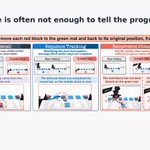
🚨 VLAs struggle on long, context-dependent tasks, so dense progress, a score at every step, matters for them.
🤔 Can progress reward models label dense progress for these context-dependent tasks?
🧭 Our work shows why they fail: not because they are blind, but because they get lost in the context. Given the right context, the same progress reward models are reliable again.
🧵 So we propose ProgressCompass, a training-free agentic system: off-the-shelf progress models + VLMs, guiding progress estimation in long tasks.
📄 ProgressCompass: Embodied Progress Reward Models Are Lost Without the Right Context
🌐 andyzworks.github.io/progres…
Jianshu Zhang retweeted

We'll be spending a lot more time trying to understand the outputs of language models. A few thoughts, tips & tricks:
Writing. Something I've had success with: Ask your LLM to explain something in ASD-STE100, it's a controlled language specification originally developed for aerospace maintenance documentation. LLMs well-versed in this language and it comes with heavy constraints on clean writing style that I often find a lot more readable. Sometimes I've tried to soften it a bit e.g. ask for "80% of the way to ASD-STE100" because the spec is quite stringent. But even better:
Diagrams / images. Instead of writing, ask your LLM to create a diagram. These can be a lot easier to process, parse, and understand. But even better:
Web pages. Ask for output "in HTML" to get a beautiful, interactive webpage. LLMs are getting really good at frontend and can create beautiful experiences, animations, etc. But even better:
Explainer videos. The output format I am most bullish on is fully custom / bespoke explainer videos generated on any arbitrary topic. Experiment with things like "Create a 3b1b style video explainer on X. Use my ElevenLabs API key for audio narration". (you'd need an API key for the latter or you can ask your LLM to find you decent free alternatives that use your local compute). This is actually starting to work!
In summary:
- As LLMs get better, they will do more and more of the legwork autonomously, and a lot more of our work will rise up the abstractions into oversight and understanding.
- Luckily, LLMs can help here too because as intelligence and code are increasingly abundant, you can ask for large, custom, discardable software artifacts (e.g. web apps, video explainers) that would have never made sense to create before. Push the boundaries here and you'll be surprised.


Jianshu Zhang retweeted

The CSB is excited to announce two new DREAM positions: Project Manager Lead and Project Coordinator. Interested in accelerating the engineering of proteins for a range of important biotechnology applications? Apply here: bit.ly/4hmlwwH
Jianshu Zhang retweeted

found the perfect use case for @typesafeai Jev:
instant compaction
in 2026, why is compaction still a summarization prompt?
Jev can make it instant by scoring every tool call and dropping what’s irrelevant
Jianshu Zhang retweeted
🚀 New paper alert: On-Policy Self-Distillation without Any Supervision !!
🧠 Can a model truly on-policy “self-distill"?
On-policy self-distillation removes the need for a stronger teacher, but still relies on an external ground-truth solution to make the self-teacher more capable.
Our new work asks: can we remove supervision altogether?
Can an LLM improve its reasoning entirely from its own generations—without ground-truth answers, verifiers, or a stronger teacher?
♻️ We introduce U-OPSD, a simple approach toward genuine self-distillation:
For each problem, the model samples multiple solutions from itself:
🗳️ Agreement identifies a likely solution through majority vote
🔀 Disagreement reveals trajectories where the model may be going wrong
🎓 The pseudo solution conditions the self-teacher, which provides dense token-level guidance along those disagreeing trajectories
U-OPSD turns self-consistency into supervision: agreement builds the teacher context, while disagreement determines where to distill.
🔓 No external supervision at all
📚 Unlabeled problems only:
🚫 GT solutions
🚫 Verifier
🚫 External strong teacher
🚫 Environment feedback
📊 Yet, across 5 math reasoning benchmarks and 6 Qwen3 settings, U-OPSD consistently improves the base model and matches or surpasses supervised SFT, GRPO, and OPSD.
🌙 Non-thinking mode:
📈 +8.5 / +10.7 over the 4B / 8B base models
🏆 +3.2 / +2.3 over GT-supervised OPSD
🚀 +7.0–11.3 over label-free self-rewarding RL methods including TTRL, RENT, and Intuitor
🧠 Thinking mode:
📈 +2.2 / +1.9 over the 4B / 8B base models
🤝 On par with GT-supervised OPSD and GRPO
🚀 +0.8–1.4 over label-free self-rewarding RL methods including TTRL, RENT, and Intuitor
Meet U-OPSD 👇
📄 ArXiv Paper: arxiv.org/abs/2608.06296
💻 GitHub: github.com/williamium3000/u-…
🌐 Project Page: williamium3000.github.io/u-o…
🤗 Hugging Face Paper: huggingface.co/papers/2608.0…
(Plz upvote if you can !!
Amazing collaboration with @ Bingyang @JoLiang17 @tian_yunjie @Di Fu and Nuno !
Grateful for all the insightful discussions and exploration together!
#LLM #OPD #OPSD #Distillation


Jianshu Zhang retweeted
🔥Excited to share our new survey on Progress Reward Modeling for Robotic Learning.
While developing ProgressLM, a reasoning model that explicitly scores progress in long-horizon robotic manipulation tasks, we found that this emerging area still lacked consistent task definitions, model interfaces, and evaluation protocols. In this survey, we organize existing work under a unified framework covering model inputs and outputs, progress-signal construction, datasets, benchmarks, and downstream use.
We also discuss several open challenges, including fine-grained physical-state understanding, non-uniform temporal progress, real-time inference, and memory for long-horizon tasks. We hope this survey provides a clearer map of the field and helps support future research in robotic progress modeling.
- Survey paper: huggingface.co/papers/2607.2…
- GitHub: github.com/sterzhang/Awesome…
- Prior work — ProgressLM (ACL 2026 Oral): progresslm.github.io/Progres…


