

I help B2B SaaS leaders build the right product from the start and get to Product-Market Fit with systematic discovery. See how: https://teapaw.org/t.co/5vBrxEuEoz
Helsinki, Finland
Joined July 2009
- Tweets742
- Following587
- Followers504
- Likes6.8K




Pinned Tweet
Code is a liability, not an asset. AI now accelerates how fast you can create that liability.
The software industry has known this for over 25 years, yet keeps forgetting.
2
1
92
I agree. Love the ‘WHY before WHAT’ framing.
The challenge I see: Even when teams invest in research and design, they often explore solutions before they really understand customer problems independently of any solution.
Users’ pain points and feature ideas aren't deep enough.

In other words, more time spent on WHY instead of what. Couldn’t agree more. Time spent on THINKING — on research, on design and on iterating/testing and validating assumptions have never mattered more.
2
1
164
The difference between good and great B2B SaaS products:
◆ Good ones solve what customers ask for
◆ Great ones solve what customers' situations demand
2
1
31
Your B2B SaaS product is just a solution. The customer problem existed before it. And will exist after it. Understanding this changes everything.
1
30
Customer problems:
• Are specific situations
• Exist independently of solutions
• Can be discovered systematically
• Have multiple possible solutions
• Change only slowly
Build software products on these principles.
28
Customer problems don’t change with new technology. Software solutions do. That’s why understanding customer problems is your true competitive advantage in complex B2B software.
23
Customer problems are like gravity — they exist whether we solve them well or not.
Software solutions are like airplanes — we can keep inventing better ones.
19
🚨 #B2BSaaS leaders:
What if I told you that 80% of your engineering efforts are wasted?
That best practices are actually holding you back?
And that there's a way to predict product success with high certainty before writing a single line of code?
Intrigued?
Buckle up… 🧵👇

For 20+ years, I’ve been obsessed with cracking the code of B2B software development.
The result?
Deductive Innovation – a revolutionary approach that will turn the #B2BSaaS industry on its head.
1
16
🚨 B2B SaaS leaders: Your product roadmap is a ticking time bomb.
60-90% of B2B SaaS companies fail. But what if you could guarantee success BEFORE you build?
I've talked to dozens of industry leaders & uncovered a shocking truth about product development.
🧵Curious? Read on👇
1
52
“Getting new customers and growing sales is my goal number one,” Product leaders at B2B SaaS companies have told me.
Sure. Sales is the lifeblood of any business.
But sales is a highly lagging indicator. 🧵1/
The laws of data by @thechrisperry sound cynical but ring so true.
When it comes to data insatiability: guilty as charged…

I've been working in data for almost 20 years and dogmatically subscribe to the following absolute laws of data:
Data insatiability: If you give anyone any data at all they will ask for more. There is no data point that is considered final and satisfactory. Never!
1
91
Ryan Singer @rjs is spot on!
“To catch and solve domain-specific usability problems, the most important thing is understanding the problem and the desired outcome first, independent of the particular design solution.”
1/6 👇
world.hey.com/rjs/19-two-kin…
1
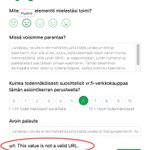
@VRmatkalla Yritin antaa palautetta sivuistanne. Palautteenantotoiminto ei toiminut, joten annan teille palautetta palautteenantotoiminnon toimimattomuudesta tätä kautta. 🤦🏻♂️
Ks. virheilmoitus oheisessa näyttökaappauksessa. Käytössä Safari 14.0 & macOS Catalina 10.15.7.

1
@VRmatkalla Harkitsen junalla matkustamista joulun aikaan riskiryhmään kuuluvan äitini luokse. Kierrätetäänkö VR:n junissa sisäilmaa? Kertyvä evidenssi viittaa siihen, että korona leviää sisäilmassa pitkälle aerosolien välityksellä, joita syntyy talven kuivassa ilmassa runsaasti.
@UniversalQandA Professor Cox, would you have believed 25 years ago that it would become possible for us to take a photo of an actual black hole from Earth? Why, or why not?
1
Spot on, couldn’t agree more: much of technical debt is really problem definition debt. It’s astonishing how little interest there is in researching and defining what the “customer problem” is, even in principle, compared to the vast interest in the “solutions”, i.e. technology.

I am convinced that a lot of “technical debt” is really “problem definition debt.” It exists because nobody took the time to define how the tool or the data would need to be used over time, even though many of those uses are easy to anticipate.
1
Do you describe your software product as simple, easy to use, intuitive, powerful, and flexible?
Those words don’t mean anything at all.
Instead, answer the questions ”what?” and ”so what?”.
gkogan.co/blog/bad-words/ by @grigoriy_kogan
#productmanagement #productmarketing

2
@Elisa_aspa Hei Elisa, katsoin juuri Applen uusinta tuotejulkistusta. Nyt alkaa todella kuumottaa, koska saadaan Apple Watch 4G-yhteydellä käyttöön Suomessa. Riemastuin jo 2017, että nyt lopulta saan THE urheilukellon—mutta petyin.😭 Nyt vuotta myöhemmin ei vieläkään mitään…😫
2
”Good ideas grow in solitude and are nourished in quiet contemplation.” —@mistermircea
Couldn’t agree more. Have witnessed it myself this summer. #real #productivity
This post is from an account that no longer exists. Learn more
Why a product designer can’t deduce the solution to a customer’s problem logically?
Vote if you agree with my conclusion on the two causes for that question! 👍👎
The poll 📶 is below ⬇️ in my response to @rjs’s tweet about feature bloat:
teapaw.org/anttilk/status/1035409…

Reason (v.)=Think rationally, find solution to a problem logically
So, if a designer can’t deduce the solution logically, either they don’t:
① actually understand the situation—often due to lack of domain knowledge—or
② understand that design is about rational problem-solving.
50%Yes, I agree. 👍😇
0%No, I disagree! 👎👿
50%Never thought about it… 🤔
4 votes • Final results