

Computational Biologist at @Stanford.
Stanford, CA
Joined September 2015
- Tweets61
- Following97
- Followers283
- Likes65


Andreas Gschwind retweeted

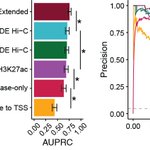
Update: scE2G is now online at @NatureGenetics!
📄 nature.com/articles/s41588-0…
Since the preprint, we added a new benchmark on a fully held-out CRISPR dataset.
scE2G continues to show state-of-the-art performance, reinforcing that it generalizes well
1/


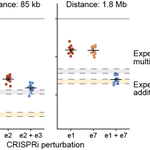
Introducing scE2G: a new model to link enhancers to target genes using single-cell data.
Excited that scE2G will enable building enhancer maps in hundreds of cell types in the human body!
Wonderful collaboration with @robin_andersson @613weilin @mayayayas and others
👇
Andreas Gschwind retweeted

How to link a non-coding disease GWAS variant to its target genes in the right cell type?
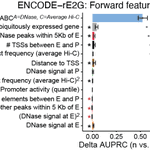
ENCODE-rE2G, now out in @Nature addresses this through optimal integration of chromatin activity and 3D contact data in 1,458 biosamples.
A huge collaborative effort spanning 6+ years led by @argschwind @jengreitz nature.com/articles/s41586-0…

Andreas Gschwind retweeted

Check out our latest work published today as cover story in @ScienceMagazine! High-speed image-enabled cell sorting (ICS) isolates cells with complex spatial phenotypes, led by @LarsMSteinmetz, @CuylenLab & @BDBiosciences
science.org/doi/10.1126/scie…
1/9

Andreas Gschwind retweeted

Delighted to share my lab’s @jdavieslab first big paper in @Nature!
We’ve developed a new 3C technique called Micro Capture-C that can generate base pair resolution 3C data nature.com/articles/s41586-0…
Andreas Gschwind retweeted

We're really looking forward to seeing fellowship applications from these new collaborations!
Postdocs - get in quick, define your own joint project between @embl & @StanfordMed and leverage the expertise from two top cell signalling experts @e_petsalaki & Markus!

Computational postdocs, check out the newest collaboration w/ @e_petsalaki & Markus Covert. Draw on their expertise & computational tools to create a predictive model of cell signalling and its regulation
Start brainstorming ASAP, the deadline is 6.6.21!
stan.md/3tcpzzl

Andreas Gschwind retweeted

So happy to see one of the chapters of my Ph.D. thesis out in @MolSystBiol. We did scRNAseq of SARS-CoV-2 infection in gut organoids and showed how the virus interferes with the host signaling! With @thalexandrov @alexandrovteam @LarsMSteinmetz @embl @BoulantLab @CarlMHerrmann

#SingleCell analyses on infected human intestinal #organoids characterize #SARSCoV2 tropism & identify viral strategies interfering with intrinsic immune responses --> bit.ly/2QDLJ0a @BoulantLab M Stanifer @thalexandrov @EMBL @DKFZ #COVID19

Andreas Gschwind retweeted

I couldn’t just walk past this Tweet, so here is some fun #dataviz
Scented candles: An unexpected victim of the COVID-19 pandemic 1/n

ALT 3 R-generated graphs: 1) Top 3 unscented candles 2017-2020 reviews: rating (1-5) on the y axis; date on the x axis; the scatterplot shows a relatively flat line across the three years. N = 1,118 2) Top 3 scented candles 2017-2020 reviews: rating (1-5) on the y axis; date on the x axis; the scatterplot shows a relatively flat line that drops off sharply after January 2020. N = 11,404 3) A bar chart with 11 bars (January-November 2020). Proportion of reviews mentioning lack of scent on the y axis; month on the x axis. January = 2%, February = 3.5%, March = 2.8%, April = 4.6%, May = 3.4%, June = 2.4%, July = 3%, August = 3.2%, September = 3.1%, October = 5.8%, November = 5.8%.
This Post is from an account that no longer exists. Learn more
Andreas Gschwind retweeted

Excellent vaccine trial tracker from Dr. Nicole Basta @IDEpiPhD and colleagues.
H/t @betzhallo
covid19.trackvaccines.org/va…

Andreas Gschwind retweeted

For those of you curious about how CRISPR-Cas9 works, check out this super-useful animation that Nature Methods produced a few years ago: nature.com/collections/txhdf…
and poster:
nature.com/collections/txhdf…
#NobelPrize2020 #NobelChem


Andreas Gschwind retweeted
We're hiring postdocs at our Stanford lab!
If you're experienced in infection biology & interested in tech development, see below for more info on a project to detect antibiotic susceptibility using magnetic levitation.
Thanks @jobRxiv, new science job site, for the mention

#ScienceJobs:
Postdoc: Detecting antibiotic susceptibility using magnetic levitation with @LarsMSteinmetz
Stanford University, USA
jobrxiv.org/job/steinmetz-la…
#Postdoc


Andreas Gschwind retweeted

single-cell tweeps. Your favorite gene may have count 0 (or much-reduced count) in the counting matrix if it is overlapping with a different gene. tools for counting discard reads fall into the overlapping features. github.com/alexdobin/STAR/is… This thread should be very useful.

Andreas Gschwind retweeted
We're looking for postdocs at our Stanford lab with experience in single-cell transcriptomics. Project#1 is understanding transcriptional heterogeneity in the human heart and project#2 probes the immunological basis of Chronic Fatigue Syndrome. More here:
stanford.io/2M9YfzP
Andreas Gschwind retweeted

Excited to share our work @NatureComms! TWMR: a Transcriptome-Wide Mendelian Randomisation approach which integrates summary-level data from GWAS and eQTLs studies to estimate the causal effect of gene expression on human phenotypes.
nature.com/articles/s41467-0…

Andreas Gschwind retweeted

A Way-Too-Philosophical Behind-The-Scenes Post:
patreon.com/posts/21037081
in which I reflect on how I can better contribute to society, using badly-drawn graphs and contrived metaphors. (click link for full post!)


Andreas Gschwind retweeted
Can genomes be organized differently? Postdoc opening in my lab at @embl to understand life's molecular organization using @SynGenome in @VolkswagenSt project with @caiyizhi and @scalefreegan. Apply by Aug 12. bit.ly/2NpEguL

Andreas Gschwind retweeted

New post: "what worries me about AI" medium.com/@francois.chollet…

Andreas Gschwind retweeted

Multi-omics in single-cells is getting real! Great work by Stephen, @RArgelaguet, et al. Great collaboration with @ReikLab teapaw.org/emblebi/status/9666303…

New #singlecellanalysis technique lets you detect changes in three ‘layers’ of molecular activity simultaneously: nucleosome, DNA methylation and transcription. Could reveal new mechanisms of #generegulation in development and disease ebi.ac.uk/about/news/announc…
