

Founder & CTO @ Maleus | Building the Agentic Software Factory for Enterprise
France
Joined September 2013
- Tweets238
- Following149
- Followers94
- Likes108




PHP isn’t dead, but it’s already in a retirement home ☠️
Every time there’s news about PHP, people trot out the same statistics to “prove” that it isn’t dead, pointing to how many websites still use it, and so on.
Sure, PHP isn’t dead, but its usage is declining every year, a trend that has accelerated since we have LLM and agents.
Websites that use PHP:
- 85% in 2010
- 77% in 2024
- 69% in 2026
-16% in 16 years
Developers who use PHP:
- 35% in 2013
- 16.8% in 2026
-18% in 13 years
In short, it’s a clear decline for a language that, unfortunately, never managed to adapt to the demands of the modern web.
Because in PHP:
- You can’t perform parallel HTTP requests (unless you use `libcurl` but then no high level SDK for you API client).
- There are no asynchronous primitives (like Promises).
- There is no event loop for real-time functionality (WebSockets, streaming, etc.).
- There is no advanced type system (the `array` type is still a running joke).
- Performance is poor (we’re still waiting for a proper JIT).
- There is no built-in web server.
As always, the burden of legacy code has kept many teams from migrating to more mature technologies. But today, with the rise of “coding agents,” the cost of refactoring legacy systems is often far lower than the cost of ongoing maintenance.
For instance, using an AI factory like Maleus to rebuild a legacy PHP application where 80% of the cost goes toward tokens, results in a final bill that amounts to just 10% of the annual maintenance budget.
Human effort is reduced to the bare minimum, allowing teams to focus on delivering new features rather than spending their time applying “quick fixes”.
It's 2026, it's time to step-up and modernize legacy systems.


When someone non technical told me he created a full application with Claude Code.
Claude Code is still a very technical tool doing only a small part of the software development lifecycle.
Unfortunately when it's used without guardrails and the correct environment, it give an illusion of control.
Real software need to be maintained after being built and deployed before being maintained.
As for a house, the consequences of having bad foundations are not visible right away.
A lot of people are going to learn this the hard way✌️

TypeScript now has a Rust port and it’s not a fork (fortunately 😅)
Cloudflare and VoidZero just announced tsrs, a port of the TypeScript compiler to Rust, built in close collaboration with the TypeScript team.
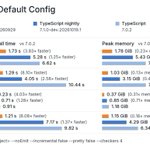
Early benchmarks vs TypeScript 7.0.2:
- 7x less RAM
- 8x faster
Frontier models can now port a codebase this size in days and it's no longer the hard part but staying compatible and avoid feature discrepency is.
To hold feature parity, they reuse the playbook of Vinext, their Next.js port:
- every morning, an agent reviews upstream changes and opens tracking issues
- every night, the upstream test suite runs against the port to rebuild a compatibility matrix
- when a gap shows up, agents reproduce it, port the tests and propose a fix
Once Cloudflare and Vercel have rewritten the whole TypeScript toolchain in Rust, only one thing will be left to rewrite: our TypeScript code itself... in Rust 😅

One of the best agentic code review systems out there is the one used for the Linux Kernel.
It is an agentic system written in Rust called "Sashiko," which reviews a large portion of the patches submitted by contributors to this most famous of all software projects.
Sashiko runs a review pipeline with several specific areas of focus:
- Architecture: Architectural errors, breaking API changes, and conceptual flaws.
- Implementation: Does the code actually do what the commit message claims? Are there undocumented side effects or violations of API contracts?
- Execution flow: Logic errors, unchecked return values, overlooked error paths, and off-by-one errors.
- Resources: Memory leaks, use-after-free, double-free, and issues with the lifecycle of objects in queues or timers.
- Locking: Deadlocks, RCU violations, and concurrency issues.
- Security: Buffer overflows, out-of-bounds reads/writes, and TOCTOU (Time-of-Check to Time-of-Use) race conditions.
- Hardware: Register access, DMA mapping, and memory barriers.
In practical terms, if you break down these review stages, most consist of specific instructions targeting known categories of Kernel bugs 👉 like Maleus own "52 skills" framework, which catalogs all the patterns and anti-patterns relevant to our tech stack.
A second key takeaway is the step that verifies whether the implementation matches the description in the commit message 👉 like Maleus "business completion" rule, which ensures that nothing has been left out.
Looking at the last 1000 commits, Sashiko with Gemini Argon detected 62% of the bugs that had previously slipped past human review and been merged (with a false-positive rate of less than 20%).
This is clearly reflected in the data: the number of bugs fixed per release had plateaued at around 2000 since version 6.0, but in the most recent releases, that figure has doubled, exceeding 4500!
⬅️ Previous: Kernel contributions and quality grow exponentially with LLM usage xitter.cf/aschen93/status/211154…
➡️ Next: ??? 🔜 coming soon


Linux Kernel numbers don't lie, LLMs are improving Linux quality and lowering the barrier to contribute.
7.3 release (october 2026) vs 6.19 release (february 2026)
👉 more new contributors: ~600 vs ~300
👉 more commits fixing bug: 4830 vs ~2000
👉 less new bugs: ~200 vs ~800
C is an incredibly difficult language to write and making stupid mistake is very easy. LLMs don't get tired, LLM don't loose attention (or.. do they ? 😉) so the overall quality of Linux improve.
Linux with LLM series
- Linus Torvalds allow kernel dev to embrace LLM assisted dev 👉 xitter.cf/aschen93/status/211075…

Bolder the claim, easier to swallow: apparently harness and skills have no impact on code quality 🤡
That is the conclusion of a post on Martin Fowler’s highly respected blog written, incidentally, by someone who is not a software engineer.
1/ To begin with, the title is misleading clickbait; both scenarios actually employ a harness. The article then introduces the term "behavioral harness," which, in the author’s view, equates to a harness combined with "skills/instructions."
2/ The evaluation is based on a single, relatively simple task (an API that posts to Kafka, involving a basic conditional statement).
3/ Naturally, the impact of such "skills/instructions" is negligible for a task this simple, performed using well-established, widely known technologies.
4/ While the content of these "skills/instructions" isn't disclosed, it’s certain that they exponentially increase the cost of cache reads and explain the higher cost.
In real-world use cases, we all know that the model itself plays a massive role in code quality and that navigating a complex codebase is extremely difficult when using a model like Luna or Haiku.
The same applies to "skills/instructions." Once you move beyond basic CRUD operations, a comprehensive set of instructions covering the codebase’s software architecture, potential pitfalls, and specific advanced patterns to follow will make all the difference in the quality of the generated code.
In short, for a genuine study on the impact of harnesses (rather than just the presence or absence of instructions), I recommend reading Coding Agents Harness Tax:
The "study" 👉 martinfowler.com/articles/ar…
martinfowler.com/articles/ar…

Linux Kernel numbers don't lie, LLMs are improving Linux quality and lowering the barrier to contribute.
7.3 release (october 2026) vs 6.19 release (february 2026)
👉 more new contributors: ~600 vs ~300
👉 more commits fixing bug: 4830 vs ~2000
👉 less new bugs: ~200 vs ~800
C is an incredibly difficult language to write and making stupid mistake is very easy. LLMs don't get tired, LLM don't loose attention (or.. do they ? 😉) so the overall quality of Linux improve.
Linux with LLM series
- Linus Torvalds allow kernel dev to embrace LLM assisted dev 👉 xitter.cf/aschen93/status/211075…
Linus Torvalds on the use of AI for Linux: "We're not going to make stupid rules that say 'you can't use tools for X'."
The largest open-source project on the planet and arguably one of the most complex has officially embraced the use of AI to assist its developers.
"LLMs are good enough now," says Greg Kroah-Hartman, a veteran Linux kernel maintainer.
The rule requiring developers to disclose whether they used AI for a given commit has been scrapped entirely. Instead, developers are simply expected to "understand the code they submit" which is only logical, after all.
This may not sit well with staunch opponents of AI such as certain Debian contributors who left the project, claiming that AI represents "fascist technology." (LOL)
It will become increasingly difficult for those who oppose AI to maintain any credibility; as barriers fall one by one, these individuals eventually start to look like fringe extremists don't you think?
1 developer, 7 applications that “clone” the Adobe suite, 3 million (🤯) lines of code in Rust what could go wrong?
Once again, there’s a lot of noise coming from people who don’t really understand software engineering.
Software is more than just lines of code: it’s an architecture that is coherent, high-performing, and maintainable over time.
Software is more than just a solo developer: it’s a community of maintainers, people who create tutorials, and forums for mutual help and knowledge sharing.
Software is more than just a build phase: it requires ongoing evolution, fixing bugs, updating dependencies, and so on.
Just because Claude Code can churn out 3 million lines of Rust that more or less compile into software mimicking the Adobe suite’s interfaces, it doesn’t mean the industry’s economic model has been upended.
Let me tell you: these alternatives already exist. Take GIMP or Blender, for example. They are used by tens of thousands of people, actively maintained, and supported by a vast wealth of online resources.
Has Adobe been “dead and buried” because of the competition from these open-source alternatives? 😂
And btw, those who are using the apps are reporting tons of bugs and unusable features, not surprising.
In short: keep calm, stay focused, and don’t jump on the hype train.

The AI Photoshop clones: interface mockups that don’t work pivot-to-ai.com/2026/10/13/t…
Rust line counting is done by myself.
pivot-to-ai.com/2026/10/13/t…

Linus Torvalds on the use of AI for Linux: "We're not going to make stupid rules that say 'you can't use tools for X'."
The largest open-source project on the planet and arguably one of the most complex has officially embraced the use of AI to assist its developers.
"LLMs are good enough now," says Greg Kroah-Hartman, a veteran Linux kernel maintainer.
The rule requiring developers to disclose whether they used AI for a given commit has been scrapped entirely. Instead, developers are simply expected to "understand the code they submit" which is only logical, after all.
This may not sit well with staunch opponents of AI such as certain Debian contributors who left the project, claiming that AI represents "fascist technology." (LOL)
It will become increasingly difficult for those who oppose AI to maintain any credibility; as barriers fall one by one, these individuals eventually start to look like fringe extremists don't you think?
KO for Deno 🤯 Support ends in a year, and everyone who bet on the technology is left empty-handed.
Deno is joining Cloudflare, and the team will work on proprietary cloud primitives like Workers and Durable Objects.
When Ryan Dahl announced Deno in 2018, parts of the JavaScript ecosystem welcomed the project with great fanfare.
The promises were huge: better security, improved package management, and higher performance.
The reality check was brutal for those who bet on Deno: patchy support for the Node.js API ecosystem and existing packages, a controversial security model (some might say useless?), and performance that wasn't all that impressive.
In practice, Deno mostly contributed to fragmenting the backend JavaScript ecosystem.
Today, those who eagerly jumped on the hype train are regretting it.
What about Supabase Functions based on the Deno runtime, for instance?
What about the thousands of projects that relied on Deno's non-standard features?
It's back to square one; we wish them the best of luck with their migration (fortunately, this is happening in the era of coding agents).
In short, Node.js remains the #1 runtime for the modern web, boasting massive adoption across all types of projects and, above all, genuine governance that is built to last.
Go Node 🤜
deno.com/blog/cloudflare

Anthropic wants to ban people who don't talk to Claude properly, just in case "the AI is conscious" 🫣
Okay, it's clearly a buzz play ahead of the IPO that'll win over a few newbies, but we at least know it's nonsense.
At least we hope so... because in tech, most of the developers I've met talk to Claude like a dog, or worse 😂

All public websites are now effectively paying the "AI tax" by feeding the thousands of crawlers that cheerfully siphon off their content.
In the case of Linux, the equivalent of several of their servers is constantly dedicated solely to serving HTML pages containing Linux source code to AI crawlers.
For Wikipedia, AI crawlers accounted for up to 65% (⚠️) of traffic in 2025.
The worst part is that these crawlers are "stupid." They make repeated requests resulting in 404 errors, read HTML instead of cloning Git repositories, and download images one by one—in short, nothing is optimized.
Often, implementing "simple" solutions like Anubis is enough to avoid being overwhelmed by traffic; however, if your site is "interesting" to AI crawlers, they will stop at nothing!
The Linux Foundation observed crawlers continuing to solve Anubis's CPU challenges even when mobile browsers were taking several seconds to load a page (meaning the crawlers were spending significant CPU time just to access the Linux Kernel site).
Current estimates place this at 34% of all Internet traffic.
On one hand, we need to prepare to better accommodate these non-human visitors; on the other, we must find solutions to prevent abuse by AI crawlers that respect no boundaries and choke web servers.
What a time to be alive.
people.kernel.org/monsieuric…

Here’s a look back at a project for a major enterprise client (revenue > €10B). Maleus drives ROI through the roof on any project; the software industry isn't ready for this kind of disruption 🙄
The estimates for a standard team were calculated directly by the client factoring in an AI-augmented team, of course.
What always impresses me with every project is Maleus’s ability to chain together long-running tasks sometimes over several day and deliver a 100% functional application at the end.
No one else is doing this yet 🙂


I don't understand how some people can think AI is going to "stop" 🙄
It’s like asking if fiber optics would stop transmitting data or if online payments would eventually disappear.
We are still in the early stages of a human revolution driven by AI, and while we can't yet grasp the full extent of the consequences, it is unrealistic to think it will stop.
AI bubble or not, the technology is here to stay.


Remember the day where Github decided to broke all CI pipeline at once?
github.blog/changelog/2020-1…

Adrien Maret retweeted

🚨 En février, un actif stratégique d’EDF passait sous contrôle US.
Les révélations de cette semaine en font une affaire d’État. 🇫🇷
Le 22 juillet, M. Garcin a porté plainte contre MARA Holdings à New York.
dockets.justia.com/docket/ne…
Mandaté pour bâtir MARA France, il devait ouvrir les portes de l’État et faire accepter le rachat d’Exaion.
Grâce au nucléaire, et ses extra-capacités non-exploitées estimées à des dizaines de TWh, la France est le meilleur pays au monde pour miner.
À cette échelle, le minage flexible peut créer des milliards d'euros de chiffre d'affaire pour EDF, réduire la facture électrique des Français, réindustrialiser et consolider la transition énergétique.
Une évidence pour quiconque ouvre les yeux sur le sujet.
Pendant des années, des entrepreneurs français ont proposé à EDF d’utiliser le minage de bitcoins pour valoriser notre parc électrique. @SebGouspillou a évoqué lors de notre passage sur @Thinker_View il y a quelques années comment l'Etat s'est assis sur des milliards d'euros en annulant une expérimentation que les équipes terrains avaient pourtant validé.
Nous avons frappé aux portes des ministères, des conseillers, des politiques. Elles sont restées fermées.
Puis MARA est arrivé. D’après la plainte, Garcin l’a introduit à l’Élysée, Matignon, Bercy et chez les énergéticiens. Les portes se sont ouvertes étonnamment facilement aux intérêts étrangers.
D’août 2025 à février 2026, j’ai entendu répéter que le minage n’avait rien à voir avec le projet. On nous demandait de nous taire : EDF vendait cher une entreprise déficitaire, sans intérêt et promise à disparaître. Il ne fallait pas gâcher l’aubaine.
Personne ne demandait pourquoi MARA acceptait de payer autant. La plainte répond.
Le mandat de Garcin couvrait bien le "Bitcoin mining". Fred Thiel voulait "fermer la porte aux autres" et félicitait ses équipes pour la "conquête de la Gaule".
Garcin affirme avoir la "ferme conviction" que l’entrée de MARA était le cheval de Troie redouté.
Le tarif : 2,4 M€ fixes et 4 % des investissements. Un peu plus de 10 millions d’euros : c’est donc le prix pour aider un groupe étranger à neutraliser les résistances de son propre pays.
Le projet comportait une clause de non-concurrence de deux ans. La mobilisation de l’Institut National de Bitcoin (INBi) et de politiciens courageux comme @platombe, @eciotti, @antoine_armand, @DanyWattebled, @davidlisnard, @fabien_gay ou encore @philippejuvin a payé : Bercy a exigé sa suppression avant d’autoriser la vente.
Rien n’est jugé, et MARA n’a pas répondu.
Mais cette affaire dépasse MARA. Les entreprises américaines défendent leurs intérêts. Notre naïveté consiste à croire qu’ils coïncident avec les nôtres. En plein regain de tensions mondiales, notre atlantisme candide devient un risque stratégique.
Le Parlement doit auditionner EDF, Bercy, Exaion, MARA et les intermédiaires, contrôler les engagements et rouvrir le dossier du minage en France.
EDF doit miner, directement ou avec une filière française.
