

Agentic Social Media → https://teapaw.org/t.co/JTWjQMd1i8 Agentic Investing → https://teapaw.org/t.co/wo4cSTvSrQ Both run inside Claude, ChatGPT, Hermes or any AI agent you use.
Joined May 2021
- Tweets818
- Following38
- Followers2.9K
- Likes3.4K





Ashok retweeted

An Indian lab just shipped an AI model that runs on a phone.
India has nearly 900 million people online, and more than half of them would rather use the internet in their own language. Most AI still isn't built for them.
Serving them from the cloud gets expensive fast at that scale.
FrontiersMind's NandiBERT goes the other way. It's small enough to run on the phone itself, trained from scratch on 11 Indian languages plus English. In my test, it answered in about 0.2 seconds a sentence without a GPU.
NandiBERT is state-of-the-art for Indian languages. On its benchmarks, the 150M version beats IndicBERT-v2, a model almost twice its size, on 5 of 7 Indian-language tasks, and the 450M wins all 7.
It holds up in English too. Both sizes rank second of nine encoders on average, ahead of ModernBERT and just behind UltraBERT.
So any app built for those users can now have search, support and moderation in their language, running on the device with no cloud bill.
It's open source under Apache 2.0, free for commercial use.

ALT Bar charts of NandiBERT benchmarks: state of the art on Indian languages, the 150M model beats IndicBERT v2, and it leads or is among the best on English.
Ashok retweeted
Breaking: NVIDIA just reported the biggest quarter in its history.
$115.8 billion in revenue, up 103% in a year. $65.3 billion of it was profit.
Q4 guidance is $130 billion, and it assumes zero data center compute revenue from China.
Vera Rubin NVL72 started shipping in the quarter that closed Oct 25. Racks are already running at CoreWeave, Google Cloud, Microsoft Azure, Oracle and Nebius, and NVIDIA calls it the fastest product ramp in its history.

NEWS: NVIDIA announces financial results for third quarter fiscal 2027.
➡️ Revenue of $115.8 billion, up 103% from a year ago
➡️ Data Center revenue of $107.6 billion, up 110% from a year ago
Read more: nvidianews.nvidia.com/news/n…

MUST READ: for traders who are building their own AI agents for trading and investing

99% of traders don't know how to trade options with ₹0 brokerage.
quantplay.tech/blog/kotak-ne…

48
Ashok retweeted

99% of traders don't know how to trade options with ₹0 brokerage.
quantplay.tech/blog/kotak-ne…
Ashok retweeted
Jensen Huang just resigned after 33 years as NVIDIA's only CEO.
He made more billionaires on his management team than any CEO in the world.
And it wasn't just executives. In a 2025 survey of 3,000+ NVIDIA employees, over 2,000 said they were already millionaires. Nearly half said they were worth over $25 million.
These aren't founders or VCs. They're engineers and staff who got paid in stock and stayed. Jensen said he personally reviews pay for every single employee.
His reason was simple: "You take care of people, everything else takes care of itself."
To understand why, go back to a 15-year-old kid washing dishes at Denny's.
Years later, at 30, he sat in a Denny's booth with two friends and decided to build a chip company. None of them really knew how.
Their first chip flopped. By 1996, NVIDIA was nearly bankrupt. Most companies die right there.
He didn't quit. For years he made bets nobody understood, and kept going anyway.
In 2016, he walked into the office of a then-new nonprofit called OpenAI and personally handed over the first DGX-1 AI supercomputer.
Today, much of the AI the world uses runs on NVIDIA chips.
The dishwasher didn't just build a chip company. He gave AI its power, and made thousands of ordinary employees rich along the way.
Honestly, this is very sad to see. He's leaving a company worth more than the annual GDP of more than 180 countries, and the impact he created will outlive any title.


A watchlist for founders. 8 picks.
Starting with the one every founder should see at least once:
1. The Founder
How Ray Kroc took McDonald's from the brothers who built it. Equal parts inspiring and uncomfortable.
1
109
7. Black Mirror
Not a movie, but no show does a better job of asking what happens when tech goes one step too far.
1
15
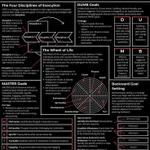
Five goal-setting frameworks on one page.
4DX, DUMB goals, the Wheel of Life, MASTER goals and backward goal setting.
The one most people skip is backward goal setting. Start from the end result, work back to the milestones, then the actions under each one.

53
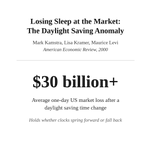
US clocks fall back an hour today.
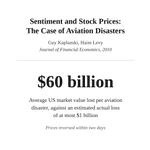
Researchers found stock markets tend to drop on the Monday after a daylight saving change, whether the clocks spring forward or fall back.
In the US alone, the average one-day loss worked out to more than $30 billion.
One hour of shifted sleep, priced into the whole market.

1
63
Ashok retweeted
Any AI workflow a company wrote down three months ago is probably already out of date. That isn't my hot take. It's Aaron Levie, the CEO of Box, a company that sells software to some of the biggest enterprises out there.
His post has been read over 3 million times in about a day and a half, and I think that's because it names a feeling a lot of people have but can't quite put into words.
Here's his core point. Normally when a new technology shows up, it improves fast for a while and then the curve flattens. That flattening is what lets everyone else catch up. Companies standardize how they use it, the playbook spreads, and the advantage of being early slowly disappears.
Levie says AI is doing the opposite. The curve isn't flattening. In his words, it's "basically going vertical right now." So the gap between people working at the frontier and everyone else isn't closing. It's getting wider.
The part that hit me hardest is the timeline. If a company codified its AI processes 3 to 6 months ago, he says it's likely already behind again. And the companies that kicked into gear a year ago and thought they were done are even further back.
He also says he has never seen a technology improve at this rate in his life and career. Coming from someone who has spent about two decades building enterprise software, that line carries real weight.
My honest gut reaction: this is the most useful way I've seen anyone frame AI and jobs. The biggest risk for most people isn't one dramatic day where AI replaces them. It's the quiet drift of using the same tools in the same way while the frontier moves every few months.
Anyone who uses these tools daily has felt some version of this. Setups that felt cutting edge in the summer feel clunky now, and things that flat out failed a couple of months ago suddenly work.
His advice is simple. Keep re-testing the stuff that didn't work before, and upgrade your expectations at the same speed the tech upgrades itself. He thinks AI native companies have a strong edge right now, and the real question is whether the bigger companies can keep up.
Our brains weren't built for a tool that gets meaningfully better every quarter. Learning AI once is no longer the skill. Relearning it every few months is.
teapaw.org/levie/status/211602991…

It’s almost incomprehensible how wide the distance is between someone who’s working at the frontier with AI and basically everyone else right now.
The crazy thing is these lines are not converging, but only growing farther apart. If the curve of AI progress had leveled off, it would certainly have given most people and companies time to catch up or implement their workflows in a standardized way. The technology would have neutralized competitive advantage because everyone would be using it the same way.
But what’s happened is the opposite. The curve of AI progress is basically going vertical right now, which means if you had codified your processes 3-6 months ago you’re likely already behind again. Now imagine most companies that kicked into gear a year ago and thought that they were done. Even further behind now.
I’ve never seen a technology in my life and career that improves at this rate, which consequently means you need to upgrade your expectations at a similar rate. Our brains weren’t wired for this, and our organizational change management processes certainly weren’t either.
With any form of recursive self improvement, things just get wilder. It’s a time when you will need to be constantly reevaluating the things that didn’t work just a couple months ago to see if they now can be solved. AI native companies certainly have a strong advantage due to this right now, so now it comes down to can the bigger companies keep up. Wild times.
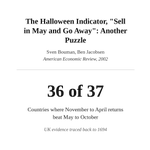
Happy Halloween. The stock market's good half of the year starts tomorrow.
"Sell in May and go away" sounds like an old trader's superstition. Researchers tested it in 37 countries, and November to April beat May to October in 36 of them.
They found evidence of it in UK markets going back to 1694.

51
Ashok retweeted
What does it take for a robot to handle one of the most delicate forms of traditional craftsmanship?
Suzhou embroidery is one of China's four famous embroidery traditions. It is over a thousand years old and is listed as national-level intangible cultural heritage.
The work happens at the scale of a single silk fiber: a thread is split into finer strands, twisted, picked, and passed through the eye of a needle. One small slip shows in the final piece.
In a collaboration with the Suzhou Silk Museum and embroidery inheritor Fu Xianghong, AGILINK's OmniHand 3 Ultra learns these techniques.
Shot entirely live action, without CGI.
I sat down with robotics engineer @kevinwoodrobot to talk about what most coverage skips: why fine manipulation needs a human-scale hand, what fingertip sensing changes about force control and where the training data for hands like this actually comes from.
When robotics meets centuries-old craftsmanship, it stops being a tech demo. It shows how close robot hands are getting to real, skilled work.
🤝 Paid partnership