

Python || AgenticAI 🛠️ || Sharing Content 📝 || Techy from Hyderabad 🚀 || DM ✉️ for Collab https://teapaw.org/t.co/sk8GgQoJwm
Joined August 2025
- Tweets6.6K
- Following721
- Followers5.4K
- Likes9.8K




Pinned Tweet
A few weeks ago, I started turning the Kubernetes commands I use every day into something I could actually keep as a reference.
Days of writing.
Reviewing commands.
Creating diagrams.
Simplifying explanations.
Going through every page again and again.
It finally became a 20-page Kubernetes Handbook. ☸️
I decided to give it away for free to DevOps & Kubernetes learners.
Less Googling. More practicing. 🚀
📘 Free download: asynctrix.gumroad.com/l/olpg…

Binance security incident 🚨
A compromised DevOps laptop may have led to access to a service container.
→ Unauthorized withdrawals
→ ~$6.3B estimated impact
→ ~$3B frozen on-chain
→ No evidence of private-key leakage
→ User funds remain safe
Investigation ongoing.

Binance's initial investigation suggests that the security incident may involve a compromised DevOps engineer’s laptop, which allowed an attacker to gain access to a service container and submit unauthorized withdrawal transactions. We have found no evidence of any wallet private key leak. We will share a detailed technical post-mortem once the investigation is complete and the facts are fully verified.
The estimated total impact sits at around $6.3B. We have worked with blockchain partners to freeze affected assets, with ~$3 billion frozen on-chain so far.
Binance will cover all losses from the SAFU fund and the company’s funds. User funds are safe. We will also publish an updated Proof of Reserves once the remediation is complete.
As an immediate precaution, Binance has:
- temporarily suspended deposits and withdrawals while security checks are completed;
- revoked the affected address authorisation;
- engaged law enforcement and blockchain intelligence partners to trace and recover funds.
Our teams are working around the clock to resolve this issue safely and thoroughly. We are working closely with our law enforcement partners to confirm the identity of these criminals and bring them to justice.
Please rely only on official Binance channels for updates. Please feel free to contact Binance Customer Support if you have any further questions.
binance.com/en/support/annou…


AsyncTrix retweeted
34. Route 53 Routing Policies ⚔️
Same domain.
Different routing requirements.
Which one do you choose?
→ Simple - One destination
→ Weighted - Split traffic between resources
→ Latency-based - Send users to the Region with the best network latency
→ Failover - Primary → Backup when the primary is unhealthy
→ Geolocation - Route based on user location
A simple way to remember:
One destination?
→ Simple
Split traffic?
→ Weighted
Best latency?
→ Latency-based
Primary + backup?
→ Failover
User location matters?
→ Geolocation
Route 53 isn't just DNS resolution.
It can also control how DNS queries are answered. 🌐


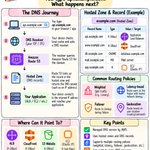
33. You type "api.example.com".
What happens next? 👀
Your browser needs to find Where is this application?
That’s where DNS comes in.
The basic journey:
Client
→ DNS Resolver
→ Route 53
→ Hosted Zone
→ DNS Record
→ Application
Route 53 supports routing policies such as:
→ Simple
→ Weighted
→ Latency-based
→ Failover
→ Geolocation
You can also use Alias records to point DNS to supported AWS resources:
→ ALB
→ CloudFront
→ S3
And remember:
Route 53 doesn't run your application.
It helps DNS resolve your application’s name to the right destination. 🌐
Once this flow clicks,
AWS DNS becomes much easier.

AWS Route 53 Routing Policies 👇
34. Route 53 Routing Policies ⚔️
Same domain.
Different routing requirements.
Which one do you choose?
→ Simple - One destination
→ Weighted - Split traffic between resources
→ Latency-based - Send users to the Region with the best network latency
→ Failover - Primary → Backup when the primary is unhealthy
→ Geolocation - Route based on user location
A simple way to remember:
One destination?
→ Simple
Split traffic?
→ Weighted
Best latency?
→ Latency-based
Primary + backup?
→ Failover
User location matters?
→ Geolocation
Route 53 isn't just DNS resolution.
It can also control how DNS queries are answered. 🌐
33. You type "api.example.com".
What happens next? 👀
Your browser needs to find Where is this application?
That’s where DNS comes in.
The basic journey:
Client
→ DNS Resolver
→ Route 53
→ Hosted Zone
→ DNS Record
→ Application
Route 53 supports routing policies such as:
→ Simple
→ Weighted
→ Latency-based
→ Failover
→ Geolocation
You can also use Alias records to point DNS to supported AWS resources:
→ ALB
→ CloudFront
→ S3
And remember:
Route 53 doesn't run your application.
It helps DNS resolve your application’s name to the right destination. 🌐
Once this flow clicks,
AWS DNS becomes much easier.
AsyncTrix retweeted
33. You type "api.example.com".
What happens next? 👀
Your browser needs to find Where is this application?
That’s where DNS comes in.
The basic journey:
Client
→ DNS Resolver
→ Route 53
→ Hosted Zone
→ DNS Record
→ Application
Route 53 supports routing policies such as:
→ Simple
→ Weighted
→ Latency-based
→ Failover
→ Geolocation
You can also use Alias records to point DNS to supported AWS resources:
→ ALB
→ CloudFront
→ S3
And remember:
Route 53 doesn't run your application.
It helps DNS resolve your application’s name to the right destination. 🌐
Once this flow clicks,
AWS DNS becomes much easier.
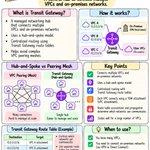
32. Why Does Transit Gateway Matter? 👀
You have 50 VPCs.
Do you really want to manage
a growing mesh of VPC Peering connections?
Transit Gateway gives you a central hub.
VPC A ─┐
VPC B ─┤
VPC C ─┼→ Transit Gateway
VPC D ─┘
→ Hub-and-spoke networking
→ Centralized routing
→ Route-table based segmentation
→ Scales better than a peering mesh
Simple mental model:
VPC Peering → Point-to-point
Transit Gateway → Central hub
That's where Transit Gateway becomes useful. 🚀

Understand Route 53 👇
33. You type "api.example.com".
What happens next? 👀
Your browser needs to find Where is this application?
That’s where DNS comes in.
The basic journey:
Client
→ DNS Resolver
→ Route 53
→ Hosted Zone
→ DNS Record
→ Application
Route 53 supports routing policies such as:
→ Simple
→ Weighted
→ Latency-based
→ Failover
→ Geolocation
You can also use Alias records to point DNS to supported AWS resources:
→ ALB
→ CloudFront
→ S3
And remember:
Route 53 doesn't run your application.
It helps DNS resolve your application’s name to the right destination. 🌐
Once this flow clicks,
AWS DNS becomes much easier.
32. Why Does Transit Gateway Matter? 👀
You have 50 VPCs.
Do you really want to manage
a growing mesh of VPC Peering connections?
Transit Gateway gives you a central hub.
VPC A ─┐
VPC B ─┤
VPC C ─┼→ Transit Gateway
VPC D ─┘
→ Hub-and-spoke networking
→ Centralized routing
→ Route-table based segmentation
→ Scales better than a peering mesh
Simple mental model:
VPC Peering → Point-to-point
Transit Gateway → Central hub
That's where Transit Gateway becomes useful. 🚀
AWS Transit Gateway Simplified 👇
32. Why Does Transit Gateway Matter? 👀
You have 50 VPCs.
Do you really want to manage
a growing mesh of VPC Peering connections?
Transit Gateway gives you a central hub.
VPC A ─┐
VPC B ─┤
VPC C ─┼→ Transit Gateway
VPC D ─┘
→ Hub-and-spoke networking
→ Centralized routing
→ Route-table based segmentation
→ Scales better than a peering mesh
Simple mental model:
VPC Peering → Point-to-point
Transit Gateway → Central hub
That's where Transit Gateway becomes useful. 🚀
31. Why Does VPC Peering Get Difficult at Scale? 👀
Connecting 2 VPCs is simple:
VPC A ↔ VPC B
That's VPC Peering.
But what happens when you have 50 VPCs?
You end up managing many point-to-point connections and routes.
That's where Transit Gateway helps.
VPC Peering
→ Simple point-to-point connectivity
Transit Gateway
→ Centralized hub for many VPCs
Start simple.
Scale smart. 🚀
