




Pinned Tweet
What fits on one DGX Spark, and what needs two. Only models I ran myself, one user, real prompts.
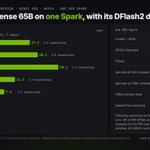
One Spark: Qwen3.8-Flash-Next at 66 tok/s on JSON. Nemotron 3.5 Bolt at 96 with its draft model. A dense 27B at 11.
Two Sparks: DeepSeek-V4.1-Flash (763B) at 103 tok/s, but only 7-9 GiB stays free on each Spark. MiniMax-M3.1-Flash (428B) at 27-29 with 2.15 bpw, 20-22 with 3.06 bpw. Qwen3.8-Flash-Next goes from 66 to 99.


Qwen4 is coming.
Deeper knowledge. Richer world understanding. Stronger coding and agentic capabilities.
Built for real-world tasks — from complex coding and knowledge work to front-end builds and professional software workflows.
Qwen4-Max is now in preview on Alibaba’s Token Plan. You can also get early access to the new model on QwenWork, Qoder, Qwen APP, and QwenStudio.
Put it to the test on a real problem. Show us what you build. 👀
Token Plan: qwencloud.com/pricing/token-…

3
123
Nous Research's Arete-27B is Qwen3.8-27B fine-tuned to drop the CCP framing on political topics.
I quantized it to NVFP4 with NVIDIA's own recipe for Qwen3.8-27B: 20 GB, 13 tok/s on one DGX Spark and 9 tok/s at 128K.
It keeps most of its quality: GPQA Diamond 80.3% and IFEval 83.0%, against 81.8% and 85.5% for BF16.

2
1
107

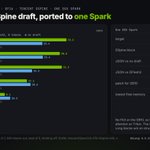
Tencent's SGLang plugin for the DSpine draft needed FA3, and the GB10 in a DGX Spark has no FA3, so I patched it to use Triton.
Qwen3.8-27B on one DGX Spark now gets 33 tok/s on JSON and 31 on code, against 23 with DFlash2 and 4.5 with no draft.
Its 16-token blocks win on structured text but lose on prose: 8 tok/s on stories, against 10 with DFlash2.

Recipe for one DGX Spark: github.com/atakann/dgx-spark…
Patch sent upstream: github.com/Tencent/DSpine/pu…
FlashInfer as the draft backend gave garbage output on the GB10, so the patch uses Triton.

94
Ripple-65B Preview runs on one DGX Spark at 20 tok/s on code, with Ricursive's NVFP4 build and the DFlash2 draft on vLLM nightly.
With DFlash2, speed varied by task: 28 tok/s on rewrites, 7 on stories.
It scored 90.0% on IFEval and 69.2% on GPQA Diamond, but thinking cannot be turned off and a quarter of the GPQA answers hit my 16K token limit.


Congrats to @RicursiveAI on Ripple-65B Preview, their first open model 🎉
It was trained on NVIDIA B300 GPUs & sharpened with open NVIDIA Nemotron post-training datasets.
Download the NVFP4 checkpoint from Hugging Face and run locally on DGX Spark 👉 huggingface.co/ricursiveAI/R…

Recipe for one DGX Spark (vLLM, no trust-remote-code): github.com/atakann/dgx-spark…
1
56
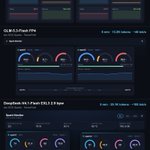
Three models built a live monitor for my DGX Sparks with the same prompt and the same coding agent, each in 5 to 6 minutes.
Qwen3.8-Flash-Next ran on one Spark (TP=1), GLM-5.3-Flash and DeepSeek-V4.1-Flash on two Sparks (TP=2).
DeepSeek made the most complete page, even at 2.9 bits per weight, so it is my favorite of the three.
Qwen called my 200 GbE link 100 GbE, GLM correctly labeled it 200 GbE.

Qwen wrote 17.5K tokens at about 50 tok/s, GLM 13.2K at about 46 tok/s, DeepSeek 25.1K at about 105 tok/s.
All three ran in opencode 2.2.5 inside a Docker sandbox, with thinking off. For the image I ran each app again with the same simulated metrics, so the pages differ only in what each model wrote.
154

DeepSeek-V4.1-Flash on two DGX Sparks built the same live monitor in 5 minutes, from the same prompt I gave Qwen3.8-Flash-Next and GLM-5.3-Flash.
The setup: an EXL3 2.9 bpw build on TensorFold, TP=2 over QSFP, opencode 2.2.5 in a Docker sandbox, thinking off.
25.1K tokens at about 105 tok/s, over twice GLM-5.3-Flash on the same Sparks. Of the three, I think DeepSeek gave the best result, even at 2.9 bits per weight.
5
12
1,557


GLM-5.3-Flash on two DGX Sparks built the same live monitor in 6 minutes, from the same prompt I gave Qwen3.8-Flash-Next yesterday.
The setup: NVIDIA's FP4 build on TensorFold 1.1.9, TP=2 over the QSFP link, opencode 2.2.5 with all permissions on, inside a Docker sandbox, thinking off.
13.2K tokens at about 46 tok/s while writing. The video runs in real time for 12 s in the middle, where a typo breaks App.jsx and the model finds and fixes it; the rest is sped up 8x.
This time the link label is right: 200 GbE.
6
22
2,461

Two OCR models on one RTX 4090 read 755 pages of OmniDocBench with almost the same score: MiniCPM-OCR 1.0 in 6.4 minutes, Xiaomi-OCR-0 in 10.8.
Overall score on the 755 English pages of OmniDocBench v1.6: Xiaomi-OCR-0 95.2, MiniCPM-OCR 1.0 94.9. MiniCPM ran at 1.97 pages/s, Xiaomi at 1.17.
Each model ran with its makers' pipeline on one vLLM nightly. Xiaomi finds the page layout with PaddleX first, then reads each region.
The picture is a page of NIST FIPS 197, the AES standard. Both read the matrices and formulas right. MiniCPM puts the equation numbers on their own lines.

3
7
326

Qwen3.8-Flash-Next on one DGX Spark built this live monitor for my two Sparks in 6 minutes.
The setup: NVIDIA's FP4 build on vLLM with MTP, opencode 2.2.5 with all permissions on, inside a Docker sandbox, thinking off. It wrote a FastAPI backend with tests and a React app with Vite, and kept the dev server running, so the page changed after each edit.
17.5K tokens at about 50 tok/s while writing. The video runs in real time for 12 s in the middle; the rest is sped up 8x.
One mistake: it labels the link 100 GbE. The QSFP link between the two Sparks is 200 Gb/s.


