

Founder, https://teapaw.org/t.co/904G6eDonQ / Former Editor-in-Chief, The Jerusalem Post / 🇺🇸🇮🇱 / Pretty Jewish. No big whoop. / [email protected]
Jerusalem, Israel 🇮🇱
Joined September 2008
- Tweets77.5K
- Following9.1K
- Followers344K
- Likes29.5K





Pinned Tweet
Last Thursday, I stood in the Oxford Union and delivered the closing argument in a fiery debate about Israel.
Arguing against the proposition that “Israel never truly wanted peace with Palestine,” my colleagues @emilykschrader, @HenMazzig, @EinatWilf and I entered the chamber knowing that we would be facing a largely hostile audience, but determined to make our case nevertheless.
By the end of the evening, we heard from several students that we had, in fact, changed their minds — a reminder that calm, substantive argument can still move people, even in the most challenging environments.
This is the text of my speech. I will share the video as soon as it’s available.
___________________
Madam President,
Members of the House,
Ladies and gentlemen,
It falls to me to bring our case, and this debate, to a close.
My colleagues have ably set out the long history of Zionist and then Israeli efforts to achieve peace with the Palestinians: the compromises proposed, the territorial concessions offered, and the repeated willingness of Israeli leaders and the Israeli public to take extraordinary risks in pursuit of that goal — risks all too often paid for in Israeli blood.
Our opponents, for their part, have offered a very different story. We have heard painful accounts of dispossession — and they are indeed painful, Dr. Karmi. We have heard selective readings of history and arguments that deny any genuine Jewish claim to the land that both peoples call home. We have heard contortions of logic and inversions of truth that seek to explain away every Israeli overture, every negotiation, every concession, as something other than it appeared to be.
And that brings us to the real question before this House tonight.
Because we are not being asked whether Israeli governments have fallen short in their efforts to bring about peace. Some have, while others — including those described earlier — have offered dramatic and far-reaching concessions to bring peace about.
We are not being asked whether Israeli and Palestinian leaders have, at times, missed opportunities that might have brought peace closer. They have.
We are not even being asked whether Palestinians — and Israelis — have suffered due to the absence of peace. They have.
No, the motion before this House tonight is far more extreme. It posits that Israel never wanted peace with Palestine.
Never.
Never?
Not Rabin?
Not Peres?
Not Barak?
Not Olmert?
Not the hundreds of thousands of Israelis who filled public squares in support of peace?
Not the millions who voted for leaders promising territorial compromise?
Not the Israeli parents of every generation who, knowing all too well the cost of war, hoped and prayed and dreamed that their children would be the first to finally know peace?
Never?
Ladies and gentlemen, our opponents have spent this evening asking you to believe something striking: that when Israelis spoke of and prayed for peace, they didn’t mean it. That when Zionist and Israeli leaders offered concessions for peace, they didn’t mean it. That when millions of Israelis voted for peace, they didn’t mean it, either.
This is not an argument about Israeli policy. It is an argument about Israeli motives, about the Israeli soul.
And the difficulty for our opponents is that they have chosen the wrong people.
Because there is no value more essential to the Jewish national soul than peace.
The Jewish tradition is suffused with the quest for peace. It courses through our religious texts, animates our prayers, and inspires our vision of a more perfect world.
It was the prophet Isaiah who envisioned a future in which peace reigned among nations, uttering those immortal words:
“And they shall beat their swords into plowshares, and their spears into pruning hooks; nation shall not lift up sword against nation, neither shall they learn war anymore.”
Every single day, for two millennia, Jews have ended their daily prayers with supplications for peace. The Talmud goes so far as to say that shalom, peace, is one of God’s names, elevating it from an earthly aspiration to the realm of the divine.
It is no surprise, then, that when the earliest Zionist thinkers contemplated the Jewish state they sought to create, they envisioned it at peace.
Socialists and liberals, revisionists and traditionalists, they differed profoundly in their visions of the state to be. Yet across those divisions ran a remarkably consistent belief: that the Jewish national home should one day live at peace with its neighbors.
That aspiration found perhaps its clearest expression in Israel’s Declaration of Independence, issued as five Arab armies advanced upon the nascent state.
Even in that moment of existential peril, Israel’s founders proclaimed:
“We extend our hand to all neighboring states and their peoples in an offer of peace and good neighborliness, and appeal to them to establish bonds of cooperation and mutual help with the sovereign Jewish people settled in its own land.”
And indeed, for generations of Israelis, that aspiration has been not merely a line in a founding document. It has been a sought-after reality, a national ideal, and a deeply personal hope.
I am a relic of the 1980s.
The first word I learned on my first day of primary school in Jerusalem was shalom, peace — an experience shared by all Israelis, including those in this room, on both sides of this debate.
I remember watching, wide-eyed, as Yitzhak Rabin and Yasser Arafat shook hands on the White House lawn, certain that a new era of peace was upon us.
I remember standing in a massive crowd with my father and younger sister as we were swept toward the gates of the Knesset, Israel’s parliament, to pay our respects to Rabin, felled by an assassin’s bullets in his pursuit of peace.
I remember the wave of Hamas suicide bombings that claimed the lives of hundreds of Israelis, including two young girls from my neighborhood — one year my junior — killed in a Jerusalem pizzeria.
And I remember how, even in the midst of that surge of murderous terror, even in the wake of a prime minister’s assassination, Israelis pivoted not to the right but to the left, electing a leader who had explicitly campaigned on a platform of territorial concessions for peace and granting Ehud Barak one of the largest margins of victory in Israeli history.
But Israel never wanted peace?
Never?
Really?
Ladies and gentlemen, that claim crumbles under the weight of documented history.
One can argue that peace has proven elusive.
One can argue that opportunities have been missed.
One can argue that terrible mistakes have been made.
One can even argue that, today, after October 7, the appetite for territorial concessions in the interest of peace is vastly diminished.
But to argue that Israelis never wanted peace is not a serious reading of history.
It is a denial of history.
Indeed, it requires us to believe that millions of people, across multiple generations, did not truly mean what they said — to one another, to their neighbors, and even to God — about one of their most heartfelt aspirations.
For if every expression of peace was merely a ruse, every offer a deception, every aspiration a lie, then we are left with a familiar accusation — that what Jews said was never what Jews meant.
But beneath much of what we have heard here tonight lies an even deeper, and darker, argument.
It is an argument that has animated not only some of the views expressed in this chamber, but too often the positions of Palestinian leaders throughout this conflict.
It is not really about peace negotiations.
It is not really about diplomatic proposals.
It is not really about Camp David or Oslo or Annapolis.
It is about legitimacy.
Because if one denies that the Jewish people have any genuine claim to this land, if one believes that Israel should never have come into being and should cease to exist today, then no Zionist or Israeli offer, no matter how sincere or expansive, can ever be enough.
Peace itself becomes impossible, because one side’s very existence is regarded as an affront, an injustice, a blight to be erased.
But that is not the motion before this House.
You are being asked whether Israel has ever truly wanted peace with Palestine.
And if millions of Israelis marched for peace, voted for peace, and were willing to take far-reaching and deeply painful risks for peace, then the answer to that question is self-evidently yes.
Ladies and gentlemen, the tragedy of this conflict is not that peace has never been sought.
The tragedy is that peace has been sought, and yet proven so painfully difficult to attain.
The tragedy is that two peoples with deep and abiding ties to the same land have so often found themselves unable to reconcile their competing aspirations.
That is a tragedy, and it is one that we should all hope and pray comes swiftly to an end, for the sake of all who live in that cherished land.
But it is not evidence that peace was never desired.
And it is certainly not evidence that an entire people spent generations engaged in an elaborate collective deception about one of their most deeply-held hopes — one that goes to the very depths of their national soul.
For all its mistakes, for all its failures, for all the opportunities lost along the way, Israel has wanted peace.
Jewish tradition says so.
History says so.
The lived experience of generations of Israelis says so.
And I hope this House will say so as well.
I urge you to reject the motion.
Thank you very much.

🇮🇱 FINAL ISRAEL ELECTION RESULTS 🇮🇱
A total of 5,613,156 valid ballots have been tallied.
These are the final results:
Likud - 27 seats
Yashar - 21 seats
Beyachad - 12 seats
Joint Arab List - 11 seats
Democrats - 8 seats
Ra'am - 8 seats
Israel Beitenu - 7 seats
United Torah Judaism - 7 seats
Otzma Yehudit - 7 seats
Shas - 6 seats
Religious Zionism - 6 seats
Netanyahu coalition - 53 seats
Change bloc - 48 seats
Arab parties - 19 seats
Israel's Shin Bet says its investigation of possible foreign interference in this week's election was not prompted by any political party or actor, noting that the investigation is targeted and must not be taken "to impugn or accuse an entire community of voting in a manner that was undemocratic or unlawful."
All "double envelope" votes cast in Israel's election — on the part of soldiers, diplomats, and others — have now been tallied. The provisional results will be announced shortly.
BREAKING: Israel Central Elections Committee Chair Justice Sohlberg directs Shin Bet to investigate allegations of foreign interference in this week's Israeli election.
The "double envelope" votes — those of Israeli diplomats, soldiers, and others who voted in locations other than their local polling places — are being tallied at this time.
Israel Police rejects claims of voter fraud after Netanyahu's Likud says election was "stolen" by Arab parties:
"Election Day took place with few irregular incidents related to voting integrity... There is no investigative or intelligence basis for these claims."
via @lee_ayash
🎙️ I'll be on @TimesRadio with @KaitBorsay in about 15 minutes, around 8:25 PM UK time, to discuss the outcome of the Israeli election and what happens next.
Do tune in.
Starting now!

Confused by yesterday’s Israeli elections?
Join us at 1 PM ET, when I'll be in conversation with Yeshiva University's @DrEricaBrown to break down the election results, what happens next, and what it all means for Israel and world Jewry.
Register at yu.edu/electionrecap

Confused by yesterday’s Israeli elections?
Join us at 1 PM ET, when I'll be in conversation with Yeshiva University's @DrEricaBrown to break down the election results, what happens next, and what it all means for Israel and world Jewry.
Register at yu.edu/electionrecap
There is no mechanism for a party to receive only one seat in the Knesset.
The current threshold is 3.25% of the overall vote, equivalent to four seats, which has left several parties hovering at or just below the cutoff due to the high turnout in yesterday's election.

What Olivia said :)

I was expecting Israel to be a little America—mostly English-speaking, a land full of convenience.
What I found was distinctly Middle Eastern—the people are brash, speak with their hands, and often don't know a lick of English. There are stray cats everywhere, mopeds, and graffiti. The street signs are in Hebrew, English, and Arabic. There is a mosque on prime beachfront property in Tel Aviv.
There is every kind of citizen imaginable. I saw Ethiopian Jews serving in the IDF. While touring an ancient Jewish site, I ran into a group of Arab schoolchildren also there to learn. I met a Mizrahi cab driver whose parents fled Morocco in the 50s.
Douglas Murray famously made Americans irate when he flamed Dave Smith on an episode of Joe Rogan for having never traveled to Israel—but he’s right. Visiting Israel shows you just how wrong the west is about the Jewish state.
Just go there.


🎙️ I'll be on Al Jazeera English in about 15 minutes, around 11:10 AM ET, to discuss the results of the Israeli election.
Do tune in.
While Trump and Netanyahu have developed a close relationship, the U.S.-Israel alliance is deeper than any personal bond between a president and a prime minister and it will endure no matter who prevails in Israel’s election.
From my conversation with @NBCNews’ @ChristineRomans.
To state the somewhat-obvious:
Barring any dramatic shifts due to the “double envelope” votes, neither bloc has the number of seats needed to form a governing coalition — unless they manage to poach parties or individuals from the other side or renege on campaign promises.
🇮🇱🗳️ All votes cast in yesterday’s Israeli election have been counted.
Now the double envelopes — several hundred thousand votes of soldiers, diplomats, etc. — will be tallied.
Here is the current breakdown:
Likud 26
Yashar 21
Beyachad 12
Joint Arab List 12
Democrats 8
Israel Beitenu 7
Ra’am 7
United Torah Judaism 7
Otzma Yehudit 7
Shas 7
Religious Zionism 6
Netanyahu bloc 53
Change bloc 48
Arab parties 19
There is reason to believe the “double envelope” votes may shift things somewhat.
There are more of them this election than there have been in the past — around 600,000, equivalent to 14-15 seats — due to the increase in the number of reservists voting from army bases and posts.
The parties most likely to be affected are the Arab and Haredi parties, which are underrepresented among reservists and are bound to take a hit. There is a chance that the change bloc — which has made universal conscription one of its main issues — may benefit, but that may be offset somewhat by votes going to right-wing parties.
We should have a clearer sense of things tomorrow.

🇮🇱🗳️ All votes cast in yesterday’s Israeli election have been counted.
Now the double envelopes — several hundred thousand votes of soldiers, diplomats, etc. — will be tallied.
Here is the current breakdown:
Likud 26
Yashar 21
Beyachad 12
Joint Arab List 12
Democrats 8
Israel Beitenu 7
Ra’am 7
United Torah Judaism 7
Otzma Yehudit 7
Shas 7
Religious Zionism 6
Netanyahu bloc 53
Change bloc 48
Arab parties 19
Fun fact:
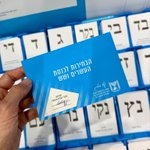
Israel is a high-tech country, but its voting system is very low-tech.
You go into a booth, take a little piece of paper with your chosen party's name printed on it, put it in an envelope, seal it, and drop it in a box.
Every vote then needs to be counted manually.
And now for the real results!
The votes from Israel's election will be counted through the night.
Only 29,379 votes from 128 polling places have thus far been accounted for.
You can track the process — including the breakdown by party — in real time at votes26.bechirot.gov.il

And now for the real results!
The votes from Israel's election will be counted through the night.
Only 29,379 votes from 128 polling places have thus far been accounted for.
You can track the process — including the breakdown by party — in real time at votes26.bechirot.gov.il
Here's something:
None of the exit polls show Ben-Gvir's Otzma Yehudit party significantly increasing its share of the vote.
It is hovering between 6 and 7 seats; it has 6 in the current Knesset.
For all the talk about Israel swinging right, the numbers don't bear it out.
Benjamin Netanyahu has almost certainly lost his majority in parliament.
But it may be too soon to count him out, and the effort to destroy Iran’s nuclear program remains a mission he wishes to complete.
From my conversation with CNN’s @RichardQuest this evening.