
Member of the load-bearing staff
Joined October 2009
- Tweets2.2K
- Following899
- Followers2.5K
- Likes11.2K




Aws Albarghouthi retweeted

The bitter lesson of ML is that scale eats all. The bitter lesson of PL is that [efficient] brute force eats all.

The results from Anthropic + Theorem feel like a “bitter lesson” moment for formal verification. They just went for semantics-level proofs. No fancy program logics, proof techniques or algorithms. Just bare metal proofs with a vanilla Hoare logic over RISC-V.
Aws Albarghouthi retweeted
in 1948, Turing introduced "unorganized machines", machines that learn, which we now call neural nets.
in 1949, in "Checking a large routing", Turing introduced formal verification (Floyd-Hoare triples).
Today, neural nets do formal verification. Pretty wild.
Aws Albarghouthi retweeted

This seems like a good time to remind everyone that northeastern is hiring tenure track faculty in formal methods and ai. Apply!
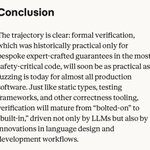
The trajectory is clear


New on our Frontier Red Team blog: using Claude to formally verify software at large scale.
Formal verification can prove that code is free of certain bugs, but historically it has only been feasible for small codebases (or required a lot of expert time).
With AI models, however, this is beginning to change. In collaboration with @theoremlabs, we used Claude to prove security properties in over one hundred real-world open-source libraries over the span of a few weeks.
Read our research in full here: anthropic.com/research/forma…

Aws Albarghouthi retweeted
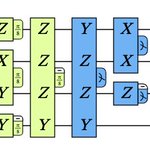
I've discovered that all popular quantum computing SDKs / compilers have serious bugs when it comes to handling angles -- floating point strikes again!
IBM's Qiskit, Google's Cirq, Rigetti's quilc, IQM's Qrisp, NVIDIA's CUDA-Q, Xanadu's PennyLane, qBraid's SDK, ...
🧵1/n
Aws Albarghouthi retweeted

Models are sycophantic, and when they do challenge faulty or incorrect inputs, they're ambiguous and ineffective.
In a new paper w/ multilingual co-authors, we find that people may view LM responses that push back, yet still end up believing false content is true.

ALT A screenshot of the top half of the first page of a paper titled "Pushback in a Haystack: Language Models Respond to Factual Errors Ambiguously and Ineffectively" with authors Li Lucy, Myra Cheng, Svenja Guhr, Kabir Ahuja, Orevaoghene Ahia, Sameep Chattopadhyay, Yike Wang, Valentin Hofmann, Noah A. Smith, Yulia Tsvetkov
Aws Albarghouthi retweeted

More cake to celebrate Francis Halzen’s well-deserved Nobel Prize @NobelPrize ! 🎂 Proud to be part of UW–Madison Physics @UWMadPhysics, where extraordinary science continues to happen. Here’s to more discoveries—and more milestones worth celebrating—in the years ahead!


I used to Claude to build some security tool. It built the thing. Then at some point it realized it’s debugging a security tool and the guardrails kicked in 😂
I've discovered that all popular quantum computing SDKs / compilers have serious bugs when it comes to handling angles -- floating point strikes again!
IBM's Qiskit, Google's Cirq, Rigetti's quilc, IQM's Qrisp, NVIDIA's CUDA-Q, Xanadu's PennyLane, qBraid's SDK, ...
🧵1/n
IMO, any future experimental claims should come with the entire software stack. Otherwise, take them with a grain of salt and a shot of Guadalajara's heaviest offerings.
5/n
Aws Albarghouthi retweeted
New blog post on PL perspectives by Max Willsey:
Equality Saturation: An “incomplete” project
blog.sigplan.org/2026/10/01/…

