


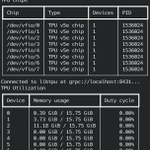
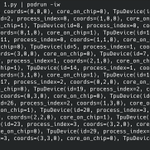


If you really want to boost your TPU performance, keep in mind that data isn't fetched immediately after a DMA is issued, which means that on TPU v7x you can technically issue your output DMA about 280 cycles before the data is ready.

Ayaka Mikazuki retweeted

Closed source is dead.
REA lets Claude Code or Codex take apart any app, all the way down to the binary, and explain exactly how a feature works.
- Native apps, Electron apps, websites, APKs, firmware, even smart contract bytecode
- Shows the evidence for every claim
- Then builds its own version of the feature
25,000+ GitHub stars in a single day. 100% open-source.
github.com/morluto/rea

Pallas TPU's top-k implementation keeps a known bug because the fix was deemed expensive, but I made it bitwise correct and faster.
doi.org/10.5281/zenodo.23287…
Ayaka Mikazuki retweeted

claude and I rewrote xprof in rust: github.com/Locamage/xprof-rs, after seeing @ayaka14732's tweet about something similar. Significantly faster for all of the pages/tasks, with both server/cli support. Super helpful for speeding up kernel optimization loops

Love how folks from some mysterious orgs casually start a Pallas TPU bug report with "tested on TPU 7x" while those of us living off TRC are still treasuring our TPU v4 quota
Ayaka Mikazuki retweeted

I'm really disappointed in OpenAI, recently codex has gotten way less reliable and lots of other issues.
First, I thought they "had compute" and now 20x plans are still paused while Anthropic the company with "not enough compute" lets people still buy them.
Second, I have multiple codex accounts and each single one of them keeps facing problems. I run agents for long periods of times, and it sucks when I come back to a error saying "Servers overloaded" and my entire agent gets paused. This has gotten to the point where at the worst times (around 10pm ET) I'm receiving this every 5-10 minutes.
Third, GPT 6 Sol is disappointing. It's either nerfed or something else is up, as this model can't understand basic things I say. And before the GPT 6 Sol & Luna launch, Astra got nerfed to the ground. Astra basically couldn't do anything meaningful.
Fourth, Anthropic gives better limits. I never thought I'd say this but Anthropic gives you higher limits than OpenAI if you use Opus 5.5. GPT 6 Sol burns through my limits 3x faster than Opus 5.5 does.
@thsottiaux I don't know what is happening at OpenAI but this is not a good look, the entire community likes you and the team at OpenAI. But this is really not ok, we need some clarification, fixes to these issues, and resets to compensate.
A large part of what I've done with Codex recently boils down to me saying, "Fixing this ourselves by patching the binary is way faster than waiting for Google to fix it internally. Go do it," and then going to grab a cup of coffee.
Today I rewrote my own XProf implementation in Rust using Codex. For a profile with 380K events, load time dropped from 12.6s to 7.2s, search latency improved from 502ms to 400ms, and a 291 MB XPlane that previously crashed now works.

Ayaka Mikazuki retweeted

I'd like to be a mathematician. The problem is I'm just not good enough at math compared to Fields medalists. So I'm thinking of starting my own petition banning Fields medalists from doing any work in math else it misaligns math and stops people like me from going into the field.


Ayaka Mikazuki retweeted

you can ask AI to explain like you are 5 but you won't get time with Terence Tao to do the same
Ayaka Mikazuki retweeted

I put together a mega write-up on GPT-6 Astra & looped transformers.
How looped transformers / recurrent depth works, cost-tradeoffs, whether it hides reasoning traces, with lots of figures and a tour of recent looped transformer research.

Some updates on my TPU v4 BarnaCore compiler: it now automatically manages full-program control flow and incorporates a hardware-validated scoreboard. For the UTF transcoder, this reduced the device program from 128 to 96 bundles, with almost no manual bundle scheduling required.
Ayaka Mikazuki retweeted

To be clear, the bad parts here:
1. Telling someone to drop an author just because he is a competitor with your company is pressuring him to commit academic fraud!

drama summary for those confused:
- Aug 15th: Tristan Buckmaster & Levent Alpöge make progress on a few important math problems
- they do NOT have a proof for the $1,000,000 Millenium Prize problem. BUT, they do claim to have a proof for a similar (non-Millenium) Navier Stokes problem that could help lead the way there
- Levent works at Anthropic, but this research was independent of his work there, with a mix of GPT and Claude models. Tristan is not related to Anthropic.
- Early Sep: Rumor spreads to OpenAI that Anthropic has solved a major problem. Tristan emails OpenAI to clarify. without revealing the problem they solved or how they did it.
- After hearing of the rumor, OpenAI started researching Navier Stokes with a new internal model.
- Sep 6th: OpenAI's Sebastien Bubeck tells Tristan that they solved the $1,000,000 Millenium Prize Navier Stokes problem. The approach is very similar to Tristan & Levent's approach to the non-Millenium problem.
- Tristan is suspicious of the timing, as only few others were trying this approach. OpenAI says the model didn't access his user data directly, but leaves unanswered whether Tristan's chat conversations were part of the training.
- OpenAI says they would partially credit Tristan for the $1,000,000 discovery (even though Tristan did not solve the $1,000,000 problem) — but only if they remove Levent as an author, as he works for Anthropic.
- Sep 8th: Tristan refuses to remove Levent, and rushes to publish their results independently.
Currently unclear is whether Anthropic had a separate solution for the $1,000,000 problem, or whether the rumor was about Tristan & Levent's independent research.

Ayaka Mikazuki retweeted

Machine translation is not solved and it will take a while for it to be done arxiv.org/abs/2609.04173

Today I recreated the TPU Topology Visualizer and open-sourced it on GitHub:
ayaka14732.github.io/tpu-top…


Ayaka Mikazuki retweeted

Announcing that GPT-6 Astra has pushed the prime gap to 186, with Lean formalization!
I was 9 when I first heard the twin prime conjecture. Its elegance and Yitang Zhang’s legendary story have always stuck with me. A truly surreal night, being the first to see our model make progress, pushing 246 all the way down to 186, on a problem I’ve revered since I was a kid.
For me, it felt like witnessing a new era of intelligence being born, made possible by everyone at @OpenAI!
