

WWII battlefield guide based in The Netherlands. I lead tours across Europe, sharing the stories of the men who fought, where they fought.
The Netherlands
Joined January 2010
- Tweets3.5K
- Following309
- Followers12.7K
- Likes10.8K




For two years these three soldiers stood above Gold Beach while the British Normandy Memorial was built around them.
David Williams-Ellis's bronze was unveiled at Ver-sur-Mer on 6 June 2019, the 75th anniversary of D-Day. The memorial opened on 6 June 2021. To get his British Tommies right, coming off the landing craft at a run, Williams-Ellis needed fit young men who could hold a charging pose, so he modelled them on a professional footballer and a ballet dancer. The wall that now encloses them carries the names of the 1,746 killed under British command on D-Day itself. The 160 columns beyond hold 22,442 names, everyone who died under British command in Normandy between 6 June and 31 August 1944.

For 81 days in 1972, South Vietnam fought to retake Quảng Trị. This church stood in the way, on the road the paratroopers had to come up.
It was built in 1955 for the Catholic families of Long Hưng, a village on Highway 1 just outside the town.

North Vietnam had captured Quảng Trị that spring, and its troops made the church one of the positions they held against the South Vietnamese Airborne Division coming up from the south.
The fighting left almost nothing of the town. The church lost its roof but kept its walls, and it was left standing as a ruin.

The Battlefield Explorer retweeted
A visit to the Eagles Nest overlooking Berchtesgaden, our last stop and literally a highlight of the tour. Tomorrow we are all heading home and it it was an absolute pleasure to guide this Engeland to the Eagles nest tour for @WWIImuseum with @BattlefieldDisc
The man who navigated this B-29 across the North Atlantic in 1980 used the sextant he had carried on B-29s out of Saipan in the Second World War.
It is B-29A 44-61748, It's Hawg Wild, in the American Air Museum at Duxford. It flew from Kadena on Okinawa with the 371st Bomb Squadron, 307th Bomb Group, during the Korean War, then spent twenty-three years on the Navy weapons range at China Lake, California. In February 1980 Skip Cregier flew it east from Tucson.
With the compass system unreliable and no radio beacons in range, Henry Ramey fixed their position from the sun and moon as far as Iceland. It landed at Duxford on 2 March 1980.

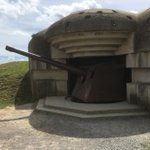
Three of the four guns at Longues-sur-Mer are still in their casemates. No other German coastal battery in Normandy kept its original guns.
They are 150mm naval guns, set back from the cliffs between Gold and Omaha beaches and directed from a fire control post on the cliff edge. Bombing before D-Day cut the telephone cables between the two, so on 6 June 1944 the gunners worked from visual signals. They opened fire on HMS Bulolo, the Gold Beach headquarters ship, which moved off. HMS Ajax silenced the battery by mid-morning.
The crews repaired their guns and turned them on Omaha, until the French cruiser Georges Leygues and USS Arkansas knocked out one gun and damaged two others. The next morning all 184 men of the Kriegsmarine garrison surrendered to the 2nd Battalion, Devonshire Regiment.

This tomb took twice as long to build as Napoleon's empire lasted.
It stands in an open crypt beneath the dome of Les Invalides in Paris, designed by Louis Visconti. The sarcophagus is often called porphyry, but it is red quartzite from the shore of Lake Onega in Russia, the country where the Grande Armée was destroyed in 1812. Napoleon died on St Helena in May 1821.
In 1840 the Prince de Joinville brought his remains home aboard the frigate Belle Poule, and on 15 December they entered Les Invalides. The tomb was nowhere near ready.
The coffin lay in the side chapel of Saint-Jérôme for twenty years, and Visconti died before the work was finished. Napoleon was finally moved into the sarcophagus on 2 April 1861.

Six Tiger IIs were abandoned at La Gleize in December 1944. This is the only one that was not cut up for scrap.
It is Tiger 213 of schwere SS-Panzer-Abteilung 501, fighting with Kampfgruppe Peiper. Under SS-Obersturmführer Dollinger it defended the Wérimont farm above the village until tanks of the 3rd Armored Division shot away a third of its gun. When Peiper's men withdrew on foot on the night of 23 December, the tank stayed behind with the rest of their heavy equipment.
In 1945 the Americans cleared the battlefield, and the other Tigers went for scrap. In July, Jenny Geenen-Dewez, wife of the local innkeeper, bought 213 from the salvage crews for a bottle of cognac. It was towed to the square beside the presbytery. In November 1951 the Belgian army helped move it to the spot where it stands today. Over the years it was stripped of most of its sheet metal fittings. Of the track guards, only the front fenders are original.
Second day of our Battle of the Bulge tour today, with four clients from the Netherlands.

Easy Company, 506th Parachute Infantry Regiment, dug in among these trees north of Bastogne on 20 December 1944. The hollows still run in a line through the Bois Jacques, though nobody can be certain which are the original holes.
The company faced Foy across open fields and held this line through the coldest weeks of the winter. The worst came from German shelling, which burst in the treetops and sprayed fragments down into the positions. On 3 January 1945 Joe Toye was caught in the open. Bill Guarnere ran out to drag him clear and was hit by the next shell. Both men lost their right leg.
Today we walked the Easy Company line with a group of four from the Netherlands.

The German guns covering this stretch of Omaha Beach stood just forty yards from the high-water mark.
This is Le Cavey, at the eastern end of Omaha Beach, in the American Fox Green sector. The German strongpoint, Widerstandsnest 61, housed an 88mm anti-tank gun in a concrete casemate, now converted into holiday accommodation.
According to American accounts, two Sherman tanks knocked out the 88mm within half an hour of the landings. But a 50mm gun in an open emplacement continued firing along the beach.
Staff Sergeant Raymond Strojny of F Company, 16th Infantry Regiment, 1st Infantry Division, watched it destroy three Shermans. After taking over a bazooka, he crossed a minefield alone and fired six rockets from a forward position. The final round detonated ammunition near the gun, silencing it.
Strojny received the Distinguished Service Cross for his actions on 6 June 1944.

None of the buildings held by the British at the north end of the Arnhem bridge survived the battle. That includes the large private house where Lieutenant Colonel John Frost set up the headquarters of the 2nd Parachute Battalion on the evening of 17 September 1944.
He chose it for the view from its upper rooms. Brigade headquarters took the office building next door. On the Monday Frost moved across to command the whole force at the bridge. On 20 September he was wounded in the leg and carried down to that building's cellar, among some two hundred wounded. That evening, with the building on fire, a truce was arranged to bring them out.
Today we stood on this spot with two American guests on our Arnhem tour.

Easy Company crossed the Wilhelmina Canal at Son on planks laid over the wreckage of a blown bridge. The tanks behind them needed something stronger, and British engineers built it overnight.
They The Germans blew the road bridge as the 506th Parachute Infantry reached it on 17 September 1944. The Guards Armoured Division got to the canal at about 21:00 the next evening, and Royal Engineers started bolting a Bailey bridge across the gap. At 06:15 on 19 September the first tanks rolled over it. That afternoon Panthers of Panzer-Brigade 107 got within 150 metres of the new bridge before a single 57mm anti-tank gun, just landed by glider, stopped them.
Today we stood here with a Dutch group on an Easy Company tour for Joel Stoppels Battlefield Tours.

Easy Company veterans came back to the Bois Jacques on 10 June 2005 for the unveiling of this monument. Seventeen of them made the journey.
It stands where the old Bastogne railway, now a cycle path, crosses the road from Foy to Bizory. In December 1944 this was the right flank of the 101st Airborne's 506th Parachute Infantry Regiment, where it met the 501st. Easy Company dug its foxholes in the woods to its right on 20 December. The left plaque names fourteen men of the company. Thirteen were killed in the fighting around Bastogne. The fourteenth, Eugene Jackson, died on a night patrol at Haguenau in February 1945, the last man Easy Company lost in the war.
We stood here today with a group from England on our Bastogne tour.

Four days after France signed the armistice in June 1940, the man who had just conquered it came back to look at this bunker. Twenty-four years earlier he had carried messages along this ridge as a lance corporal.
The concrete command post stands in the fields behind Fromelles, on Aubers Ridge, built by the 13th Bavarian Pioneer Company. Between March 1915 and September 1916 runners of the 16th Bavarian Reserve Infantry Regiment, the List Regiment, brought orders here. One of them was Adolf Hitler. On 26 June 1940 he returned with Max Amann, his old sergeant major, and Ernst Schmidt, a fellow runner, and Heinrich Hoffmann photographed the visit for the press.
Whether the bunker existed when he served here is less certain than the local story. Some researchers date it to after the List Regiment left for the Somme in September 1916, which would mean he first saw it in 1940.

Easy Company’s last fight under Dick Winters as its commander was fought here, at the Crossroads between Heteren and Randwijk.
Before dawn on 5 October 1944 Winters took a squad of 1st Platoon to find the Germans who had fired on one of his patrols. With reinforcements he had about thirty-five men. He found at least a company behind the dike, attacked with fixed bayonets and broke it. Corporal William Dukeman was killed before the charge. Eighteen more men were wounded by German artillery as the platoon pulled back to the dike.
On 9 October Winters left the company to become executive officer of 2nd Battalion. His successor, Lieutenant Moose Heyliger, was shot by one of his own sentries within weeks. Easy Company went into Bastogne under Lieutenant Norman Dike.
We walked this field today on an Easy Company tour with two Americans.

Easy Company never stayed at Schoonderlogt. The picture of Dick Winters under this gate made the estate famous anyway.
The farm stands on the Island near Elst, the low ground between the Waal and the Lower Rhine that the 101st Airborne held after Market Garden. From late October 1944 it housed the headquarters of the 506th Parachute Infantry Regiment. Winters was a captain by then, moved up from Easy Company on 9 October to executive officer of the 2nd Battalion. Four days earlier he had led thirty-five men of Easy and Fox Companies against a far larger German force at the Crossroads near Randwijk.
Today we stood at the gate with a guest from the States on our Easy Company tour.

Sixteen columns, one for each Allied aircraft that came down in Neder-Betuwe during the Second World War. Between them they carried 132 men. Sixty-six were killed. 1/4

Flak set it on fire and left the pilot, Lieutenant James Spurrier, unconscious. His co-pilot, Second Lieutenant Edward Fulmer of the 43rd Troop Carrier Squadron, held it steady until the paratroopers had jumped. 3/4

