

Love the Lord. Love each other. Love learning together.
Joined August 2011
- Tweets6.7K
- Following1.2K
- Followers680
- Likes53.7K


Bryan R Daniel retweeted

Data centers in Loudoun County, Virginia: “We get $1.2 billion a year in local tax revenue, about 40% of all of our tax revenue...on 3% of our land”
Buddy Rizer, the county's economic development chief, explained how “data center alley” grew:
“We would have never looked at having 55 million square feet of data center, 230-some buildings. That was not the plan. The plan was to utilize the fiber loop, the internet exchange, to utilize a reclaimed water line, and buildings that were already built. That was the plan, right? And so that made a lot of sense.”
“But, you know, fast forward, today we are largely dependent on that. We get $1.2 billion a year in local tax revenue, about 40% of all of our tax revenue. And while that looks overwhelming, data centers take only about 3% of all of our land in the county. So it’s quite a return on investment. You know, 40%, $1.2 billion, on 3% of our land.”

SpaceX’s Arizona data center, per a county supervisor: “We could be reducing property taxes across the board in Cochise County, the entire county, by 20%”
Frank Antenori, whose district includes the site, brought up the county’s tax math during a live Q&A:
“Here’s just something to just chew on. Arizona has an expenditure limit requirement that is placed on counties. If we exceed that expenditure, we have to rebate back to the taxpayers a certain amount.”
“So, if we’re receiving revenue in from SpaceX, by law, we have to offset that to the taxpayers. We have the potential to reduce, based on the projected revenue they’re creating, as much as 20%.”
“Let me just say it again. We could be reducing property taxes across the board in Cochise County, the entire county, by 20% to offset for the revenue here, because we can’t spend all that money. So, we have to give that money back to the taxpayers. The law says we have to.”
“So, you could see a potential significant impact to local property taxes. What that is, I don’t know. We’re going to have to do the math on it. But the law, if we have this large increase in property tax revenue, we have to balance those rates. So that will reduce dramatically the property tax burden of every resident in the county.”
“The construction sales tax, which also is the TPT, the transaction privilege tax, the retail tax, and the jail excise tax. So that will be part of the construction tax. We could literally use that money to pay the jail off in 2 to 3 years, as opposed to the 13 to 20 years.”
“So this could be a revenue to eliminate the half-cent sales tax in 2 to 3 years. We can get rid of that half-cent sales tax.”
Bryan R Daniel retweeted

The AI land panic is wildly out of proportion.
By 2030, the land footprint of every data center in America, plus the land around the buildings, is expected to be about the size of Rhode Island.
Meanwhile, corn grown for ethanol occupies an area about the size of New York State—all for a fuel that is probably dirtier than the gasoline it replaces.
humanprogress.org/the-ai-lan…


Bryan R Daniel retweeted

Everyone knows that China is lapping us in building out electricity generation.
But I didn’t realize the US & China spend roughly ***the same amount of money on the grid per year***
Our regulatory system is so broken.


There are a couple of like little mini questions I'd like to ask as a baselining of BAAJA debates:
A) Why do you believe that the US is spending ~ the same on the grid as China and getting 20x less capacity?
B) How much electricity does it take to full electrify the economy? How much grid does it take? How much less land does it take if you use higher voltage lines?
C) What are the current sources of capacity value, and how do they saturate to maintain resource adequacy?
D) Map out for me what 90% clean looks like with just wind, solar, batteries, and gas. How much gas capacity do you need to maintain grid reliability?
E) What if the tariffs go away and you add emissions policy down the line. What is possible per dollar in 3 years with and without permitting reform?
F) The permitting laws being reformed only apply to major federal projects. Should it be harder to build public infrastructure or private infrastructure?
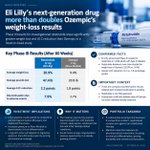
🚨 Eli Lilly just reported remarkable results for its next-generation obesity drug!
In a Phase III trial involving 1,298 adults with Type 2 diabetes, experimental retatrutide more than doubled the weight loss achieved with Ozempic 2 mg.
After 80 weeks:
💉 20.9% weight loss vs. 9.4% with Ozempic
⚖️ 47.4 pounds lost vs. 20.9 pounds
🩸 2.2-point A1C reduction vs. 1.8 points
But there’s an important trade-off: treatment discontinuations due to adverse events were 7.9% vs. 2.7%.
These are company-reported results, and retatrutide is not yet FDA-approved. The comparison is with Ozempic’s diabetes dose, not every available obesity treatment.
Why this excites me: We’re moving beyond simply losing weight toward more powerful treatments for obesity and metabolic disease.
For investors, Lilly is demonstrating why its pipeline may be as important as its blockbuster drugs already on the market.
The next generation of metabolic medicine is arriving—and the competition is accelerating.
#EliLilly #Retatrutide #Obesity #Diabetes #Biotech #MedicalInnovation

Bryan R Daniel retweeted

Tesla has released new FSD (Supervised) safety data.
Miles per major collision:
• Teslas Driven With FSD (Supervised): 6,006,200
• Teslas Driven Manually (Active Safety Features): 2,031,221
• Teslas Driven Manually (No Active Safety Features): 845,915
• U.S. Average: 660,164
Total major collisions:
• Teslas with FSD (Supervised): 1,579
• Teslas driven manually with Active Safety: 17,775
• Teslas driven manually without Active Safety: 239
• U.S. average: 4,989,713
Total miles logged:
• Teslas with FSD (Supervised): 9,483,790,215
• Teslas driven manually with Active Safety: 36,104,958,020
• Teslas driven manually without Active Safety: 202,173,600
• U.S. drivers overall: 3,294,031,000,000
Tesla vehicles with FSD (Supervised) engaged experienced ~9x fewer major collisions than those driving without it on.
This is North America data across all road classes (highway and non-highway). The data reflects a rolling twelve-month aggregation of miles and collisions.

Bryan R Daniel retweeted

BREAKING: AstraZeneca reports major breakthrough in stomach cancer treatment, with its experimental drug reducing the risk of death by 53% compared with chemotherapy in a late-stage trial.


Bryan R Daniel retweeted

Kicking off another triple header in Texas 🇺🇸
Cover art by Margherita Caspani 🎨 ➡️ bit.ly/US_GP_2026_CoverArt

Lessons from the Silicon Valley | Berkeley Exec Ed executive.berkeley.edu/thoug…
Jamie Dimon on the Biggest Risks Facing the Global Economy | WSJ Leaders... youtu.be/glrthhLyJr8?is=J0gl… via @YouTube
⚡ Microsoft reportedly walked away from a major UK AI data-center agreement because electricity might not be available until the 2030s.
Think about that.
The AI demand exists.
The capital exists.
The technology exists.
But the POWER doesn’t.
The reported withdrawal from Nvidia-backed Nscale’s Loughton project highlights what may become the biggest constraint on AI infrastructure: time-to-power.
And that’s where Texas has a tremendous opportunity.
🔥 Natural gas
☀️ Solar + wind
⚡ New transmission
🔋 Battery storage
🏗️ Power-ready industrial sites
Texas has the ingredients to support enormous growth across AI, manufacturing and industrial electrification.
But energy resources alone aren’t enough. Projects still need secured generation, grid connections, water and permits.
AI may be the demand story.
Deliverable electricity is becoming the competitive advantage.
The next AI winners may not be those who announce the most gigawatts.
They’ll be the ones who can actually turn them on.
#AI #Texas #Energy #DataCenters #Infrastructure #EconomicDevelopment

The three keys to creating value through your network youtu.be/VEK8qsmUZDQ?si=3vYH… via @YouTube