

The Meeks ✍️
Earth
Joined September 2024
- Tweets18.9K
- Following1K
- Followers727
- Likes37.2K



Betta retweeted

gfermah
𝗿𝗲𝘀𝗼𝗹𝘃𝗲𝗱 𝗲𝗽. 𝟭: 𝗳𝗿𝗼𝗺 𝗵𝘂𝗺𝗮𝗻 𝗿𝗲𝘀𝗼𝗹𝘂𝘁𝗶𝗼𝗻 𝘁𝗼 𝗮𝘂𝘁𝗼𝗺𝗮𝘁𝗲𝗱 𝗺𝗮𝗿𝗸𝗲𝘁𝘀
𝗰𝗮𝗻 𝗽𝗿𝗲𝗱𝗶𝗰𝘁𝗶𝗼𝗻 𝗺𝗮𝗿𝗸𝗲𝘁𝘀 𝘀𝗰𝗮𝗹𝗲 𝘄𝗶𝘁𝗵𝗼𝘂𝘁 𝗵𝘂𝗺𝗮𝗻𝘀?
imagine thousands of new prediction markets being created every day.
some ask about politics, others cover crypto, sports, technology and events happening around the world.
now imagine having to manually write the rules for each one, monitor the relevant information and decide when the outcome is clear enough to pay winners.
that is a lot of human work. and it becomes a bigger problem as the number of markets grows.
this is the challenge @fermah_xyz is trying to solve through its work with @ultramint_xyz .
the interesting part of @vanishree_rao's explanation in the first episode of resolved is that prediction markets have an infrastructure problem beyond trading.
we already have tools like clobs and amms to match orders and manage liquidity. but a market also needs a clear way to define an event and establish its final outcome.
without that, even a smooth trading experience can end in uncertainty.
fermah's approach is to turn market rules into executable workflows.
instead of relying entirely on someone to monitor an event, the system can be given instructions on:
- which sources should be checked
- what evidence qualifies as a valid outcome
- when to check for updates
- what steps to take if the expected information is unavailable
the creation process also starts with a plain-language description. an engine helps structure it into a market title, rules and sources of truth, while the resolution engine uses those rules to guide the eventual decision.
this is where the universal resolution engine becomes important.
it is not just about making another prediction market interface. it is about building infrastructure that other markets can use to handle the work behind their outcomes.
ultramint is the first production prediction market built around this approach.
there is also a reason not to assume that adding ai automatically solves everything. prediction market resolution needs consistency. a wrong decision can affect funds, user trust and the credibility of the entire platform.
automation has to be reliable, and it has to be affordable enough to support a large number of markets.
i think the long-term opportunity here is bigger than simply making market creation faster. if the underlying resolution process becomes reusable, developers could focus more on the markets and experiences they want to build instead of recreating the entire backend.
but one part i'm particularly curious about is market disputes.
i have a question for the next episodes:
if a market's rules are technically followed but the outcome still feels unfair to participants, who gets the final say?
because scaling prediction markets is one thing. making people trust their results is another.
@7wealthh
Betta retweeted

What happens to disputes that are too small or expensive to take to court?
A $1 disagreement might seem insignificant, but multiply that by millions of people interacting across the internet. As digital transactions and AI agents grow, resolving these everyday disputes could become a much bigger challenge.
That's why I find Albert Castellana's vision for @GenLayer interesting:
Not just resolving one $100 million dispute, but finding a way to address 100 million $1 problems.
Yesterday was for institutions,today will be for retailers (you and I)
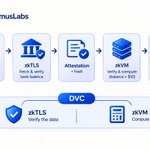
➤ Prove your bank balance is above $10
Imagine you want to join a financial application that requires users to have at least $10 in their bank account.
The application doesn't need to know your entire financial history nor see every transaction you've made. It only needs to know whether your balance meets the requirement.
➥ how can you prove that?
Explaining this will make you understand Data Verification and Computation (DVC).
Firstly, the user retrieves their bank balance through a zkTLS process then
@primus_labs helps generate an attestation about the data and a hash that can be used to connect the data to that attestation.
The attestation is important because it provides evidence about where the information came from.
➤ Yet, we still have another problem.
How do we calculate whether the balance is above $10 without simply trusting the user's claim?
*This is where the computation side comes in.
The attestation and the relevant data are passed to a zkVM program, then check's if the data matches the attestation, verifies the attestation and then runs the required calculation.
In this example, the program checks whether the balance is greater than $10.
The resulting proof can demonstrate that the condition was satisfied without publishing the user's entire bank statement as the public result.
➤ Why does Primus need both technologies?
zkTLs and zkVM solve different parts of the problem.
> zkTLS helps establish that the financial data is authentic.
> zkVM executes the computation and generates proof of the result.
Without data verification, the application could be calculating on information that isn't trustworthy(zkTLs)
Without computation, the application may still need to expose the underlying data just to check a simple condition (zkVM)
This is the whole idea behind DVC.
Verify the data. Compute on it. Prove the result.


Can exchanges prove what they actually hold? 'Proof of Reserve'
@primus_labs Proof of Reserves solution is worth it.
If you've been around for a while, you already know why Proof of Reserves in crypto matters.
When people deposit their assets with a centralized exchange, they want to know whether the exchange actually holds the assets it claims to hold. That's the meaning of proof of reserve
➤ The Challenge.
An exchange may have balances spread across different platforms, wallets and custodians, some of that information is on-chain, while some of it sits behind private APIs and internal systems.
How do you verify the complete picture without asking the institution to expose all its sensitive information?
➥ This is where Primus brings its DVC architecture into the picture, here's how it works:
i. zkTLs helps retrieve and authenticate off-chain financial data from its original source.
For example, an institution could use it to verify balances reported by a centralized exchange API.
The important part is that the institution doesn't need to publish its private API credentials or expose every account detail just to establish that the data came from the claimed source.
ii. Primus uses a Trusted Execution Environment (TEE) to handle sensitive data during computation.
iii. The data can then be passed to a zkVM network, where the required aggregation and computation are performed and a proof is generated.
Instead of simply publishing a number and asking everyone to trust it, the institution can provide a reserve result backed by cryptographic verification.
➥ Why Primus is building this?
Financial transparency and financial privacy shouldn't have to fight each other.
Institutions need a way to demonstrate that their reported reserves are supported by authentic data.
At the same time, they shouldn't have to expose private credentials and operational details to the public.
Primus isn't just helping retrieve financial data but working towards a way to verify and compute on that data, then present a result people can check.
For a market where trust is still a major concern, that kind of infrastructure matters alot.

Betta retweeted

Okay , 3 @rarelistio GTD giveaway
Follow @rarelistio and @mr_wayne_2
Tag 2 friends
Like , retweet and drop evm
Winners in 24hrs .

I so much like Shola Allyson > Tope Alabi> BBO🙂↔️
Happy Sunday internet gangsters.
GM
@rarelistio

9
12
168
Betta retweeted

>> Primus and the Work That Happens Behind a Verified Result <<
When people use an online service, they usually see the final result.
They do not see all the work required to make that result reliable.
The same thing happens when information is verified through blockchain infrastructure.
Someone requests a piece of information, receives a proof and uses it.
But there is another part of the process worth understanding: who actually helps produce that proof?
Primus @primus_labs has a network designed to involve multiple attestors in its verification process.
This is an important part of its infrastructure because producing reliable evidence should not be viewed as a simple request followed by an automatic answer.
Now, let me explain it better 👇
> What are attestors?
Think of attestors as participants responsible for helping verify information requested through the Primus Network.
Imagine a business that wants to confirm a particular piece of information from an online service.
Rather than treating verification as a task performed by an ordinary application alone, the application can submit a task to the Primus Network.
The network returns a task ID and assigns attestor nodes to carry out the required zkTLS process.
These participants work with the application to obtain the relevant information and produce an attestation. The result includes a signature and additional information that can help the application identify and verify the completed task.
The important distinction is that the application is not simply receiving a statement from an unknown source.
It receives evidence produced through an organised verification process.
> Why involve a network?
A single service can collect information and present it to an application, but the receiving application still needs a reliable way to establish where that information came from.
A network-based approach introduces a separate group of participants into the verification process.
Primus coordinates the task, assigns attestors and provides the evidence needed for the next stage.
This creates a clearer separation between the application requesting information and the participants helping to verify it.
It also gives the infrastructure a way to coordinate verification work instead of treating every request as an isolated activity handled entirely by the application.
> What happens after verification?
Producing an attestation is not necessarily the end of the process.
An application may need to use the verified information to make a decision. For example, it might check whether a condition has been satisfied before allowing a user to proceed.
Primus's Data Verification and Computation approach can connect the attestation to further computation.
Its DVC demonstration describes how verified information can be passed into a verification program, where the source evidence is checked before the application carries out its own calculation.
This means the network can help establish the evidence, while the application remains responsible for deciding what that evidence means for its particular purpose.
> Why this part deserves attention
Most discussions about Primus focus on what users can prove.
The network responsible for helping produce those proofs deserves attention too.
A useful verification system needs more than an interesting cryptographic idea. It needs a process for accepting requests, assigning work, producing evidence and allowing applications to check the result.
Primus is building this infrastructure around its attestor network and verification tools.
There is still an important distinction between having multiple attestors and guaranteeing that every possible failure or dishonest behaviour is eliminated. Security depends on the network's actual design, participation rules and verification mechanisms.
🤝 Paid partnership


>> Primus and Bringing Verified Website Information Into Private Applications <<
Blockchain privacy is usually discussed in terms of hiding balances or transaction details.
But there is another challenge: how can a private application use outside information without making that information public?
Imagine applying to join a private digital community.
The community may need to confirm that you belong to a particular organisation.
That information sits on an external website, not on the blockchain. Publishing your entire profile just to prove one fact would expose far more than the application needs.
Primus explored a way to address this with HashCloak through an integration for the Aztec Network.
> Bringing outside information into a private environment
Aztec is designed for applications that support private transactions and private execution.
However, those applications still need reliable information when their rules depend on records outside the blockchain.
A private application might check whether someone belongs to an organisation on GitHub, whether a trading pair is active on an exchange, or whether an account meets a defined condition.
These facts exist on websites that the blockchain does not control.
Primus uses zkTLS to verify information obtained from supported web sources. HashCloak worked with Primus to build an attestation verifier that allows Aztec smart contracts to check those proofs.
This connects information held on ordinary websites with applications designed to keep user activity private.
> How it works
The user first obtains a Primus attestation for the information the application needs.
The attestation carries evidence about the source and the data returned from it.
The relevant information can then be used inside Aztec's private execution environment. The verifier checks the attestation's signature, confirms that the data came from an approved source, and checks that the private information matches the attestation.
The application can then apply its own rule.
For example, it could confirm that a person belongs to a specified organisation before granting access to a private section.
HashCloak's demonstrations include checking GitHub contributor information and confirming whether an OKX trading pair is marked as live. These are examples of the integration, not claims that Primus has launched a ready-made membership or exchange application.
> Why this matters to users
Suppose someone qualifies for a private community because they belong to a particular organisation.
The community needs to check that requirement, but it may not need the person's complete profile or unrelated account activity.
A person can provide evidence for a specific decision without automatically making all their supporting information public.
The integration supports two ways of handling attested information.
Hash-based attestations can anchor data integrity.
Commitment-based attestations are useful when information needs to remain hidden initially and may be checked or revealed later, such as in sealed bids or voting.
> A wider use for Primus
The HashCloak collaboration shows Primus bringing verified web information into an environment built for private applications.
It gives applications a way to use external information while respecting the user's privacy.
There are limits.
A proof can confirm that specific information came from an approved source and matches the attestation.
It does not decide whether an application's rule is fair, guarantee that the source's records are complete, or make every website compatible.
The central idea is that an application should be able to check whether a requirement has been met without asking people to reveal everything about themselves.
Primus is helping connect ordinary websites with private blockchain applications, so useful information can be verified without making every detail public.
@primus_labs

What's happening on @Enter_Elysium
@slymzcrew any plans?


free mint alpha 📢
Bad Ape by @artnesh
@BadApes is bringing 2,500 unique ape characters to Robinhood Chain.
here's what you need to know:
→ supply: 2,500
→ mint: free
→ mint date: december 1
follow and engage with the project.
raffle might come soon.
keep your eyes on this one. 🦍

Betta retweeted

I'm currently looking for a job and open to new opportunities.
I'm willing to learn, take responsibility, and start small while growing.
If you know of any vacancies or can refer me, please reach out.
Even a repost could make a difference. I'd truly appreciate the support.


📢 Early Call
Talk to my hand (TTMH ) by @kalimitan
Supply:- 8888
Chain:- Robinhood
Mint Price:- Free
Mint Date:- TBA
➥ To position?
Register here :- ttmh.wtf
Join the server 👇 discord.gg/ZKWjYy8Ng

WAIT! WAIT! WAAAIIT! 👀✋
Have you completed your registration yet? If not, do it NOW while we’re still on the ground! 👇🏻
👉🏻 ttmh.wtf
Also, collaborations with different CMs and communities are OPEN! If you’re interested in securing GDT spots for your community, contact @OfureBless91740.
📅 Mint date: 2nd or 3rd week of December (tentative).
The final date will be announced on our OpenSea page.
Don’t sleep on this. 👀

There's a new version of this post
The machines outlived their makers. The network is still running. #AFTERBYTE
@Afterbyteunits

The machines outlived their makers.
The network is still running.
The next civilization starts here.
Whitelist applications are open.
Apply now:
afterbyteunit.xyz
Betta retweeted

Giving out 5x gtd for @rarelistio
Follow, turn on post notis, drop evm below
Picking winners in 24 hrs gl

Betta retweeted

10 gtd giveaway for @beavzclub
Follow, retweet and drop wallet
I'll pick the winners in 1hr.
Betta retweeted

Primus: Securing Communication Between Services
Every time two applications exchange information, one important question comes up:
How do they know they are communicating with the right service?
Modern applications depend on APIs, external servers and different software systems to exchange data. If these connections are not properly secured, unauthorized parties could gain access to sensitive communication.
This is where Mutual TLS (mTLS) becomes important.
Unlike traditional TLS, where the server authenticates itself to the client, mTLS requires both sides to prove their identities using digital certificates.
Primus's Network Core SDK supports mTLS, giving developers an additional security layer when connecting to services that require mutual authentication.
Why is this useful?
- Two-way authentication: Both communicating services verify each other's identity.
- Stronger access control: Only clients with trusted certificates can establish an authenticated connection.
- Secure communication: Helps protect information exchanged between connected services.
Think of a Web3 application communicating with a private enterprise API. Before exchanging information, both systems can verify that the other is trusted.
This is an important part of building reliable data infrastructure.
The takeaway: Verifying information matters, but securing the channel through which that information travels matters too.
Primus is building tools that address different parts of this trust problem.
@primus_labs

Can exchanges prove what they actually hold? 'Proof of Reserve'
@primus_labs Proof of Reserves solution is worth it.
If you've been around for a while, you already know why Proof of Reserves in crypto matters.
When people deposit their assets with a centralized exchange, they want to know whether the exchange actually holds the assets it claims to hold. That's the meaning of proof of reserve
➤ The Challenge.
An exchange may have balances spread across different platforms, wallets and custodians, some of that information is on-chain, while some of it sits behind private APIs and internal systems.
How do you verify the complete picture without asking the institution to expose all its sensitive information?
➥ This is where Primus brings its DVC architecture into the picture, here's how it works:
i. zkTLs helps retrieve and authenticate off-chain financial data from its original source.
For example, an institution could use it to verify balances reported by a centralized exchange API.
The important part is that the institution doesn't need to publish its private API credentials or expose every account detail just to establish that the data came from the claimed source.
ii. Primus uses a Trusted Execution Environment (TEE) to handle sensitive data during computation.
iii. The data can then be passed to a zkVM network, where the required aggregation and computation are performed and a proof is generated.
Instead of simply publishing a number and asking everyone to trust it, the institution can provide a reserve result backed by cryptographic verification.
➥ Why Primus is building this?
Financial transparency and financial privacy shouldn't have to fight each other.
Institutions need a way to demonstrate that their reported reserves are supported by authentic data.
At the same time, they shouldn't have to expose private credentials and operational details to the public.
Primus isn't just helping retrieve financial data but working towards a way to verify and compute on that data, then present a result people can check.
For a market where trust is still a major concern, that kind of infrastructure matters alot.
Seven days inside the Primus infrastructure
Last few days, we moved beyond the individual technologies and looked at how the @PrimusLabs network helps developers put them to use.
➤ Those that I find interesting 👇
i. AlphaNet is Primus's decentralized attestor network that supports zkTLS verification tasks.
ii. Attestors are computing nodes that participate in the verification process, helping verify data from websites and generate cryptographic attestations.
iii. Data templates make things easier for developers by providing reusable descriptions of data requests and the response fields they need.
iv. SDKs give developers the tools to connect their applications to Primus without having to build everything from scratch.
v. Smart contract verification allows applications to check attestations on-chain before relying on them to make decisions.
vi. And then there's DVC, which separates data verification from application-specific computation.
Looking at all these pieces together, I got to understand one thing.
The cryptography is only one part of the picture.
You also need the network that supports it, the tools developers can work with, a way to verify the results, and integrations that allow applications to actually use the data.
Because let's be honest, a powerful technology that developers struggle to use won't go very far.
Primus is building around both sides of that challenge:
> making data verifiable while
> providing the infrastructure developers need to put that capability to work.
That's what makes its infrastructure worth exploring.

Betta retweeted
The real challenge with tokenized assets isn't just putting them on a blockchain. It's making those assets usable across networks without introducing unnecessary trust and liquidity constraints.
I've recently started exploring Cancore @Cancore , and one thing that stands out is how its architecture approaches cross-chain settlement.
Cancore describes itself as the Liquidity OS for Tokenized Finance, connecting Canton with EVM networks through a self-custody platform.
Two mechanisms are worth understanding.
1. Atomic settlement through HTLCs
Cancore's documentation explains how Hash Time-Locked Contracts can coordinate a swap between two networks.
For example;
Alice first generates a secret and hashes it using SHA-256.
She locks Token A in an HTLC on the first network, with Bob as the recipient.
Bob verifies the hash and locks Token B on the second network using the same hash, but with a shorter timeout.
Alice then claims Token B by revealing the original secret.
Bob can use that revealed secret to claim Token A.
If the secret is never revealed before the relevant timeouts expire, both parties can reclaim their locked funds.
The important part is that neither party needs to simply trust the other to complete the exchange.
The contract conditions govern the claims and refunds.
2. Cross-chain movement without a shared bridge pool
Cancore's Zero-TVL Bridge takes a different approach.
It uses intent-based execution and independent fillers rather than relying on a shared pool of funds locked inside the bridge.
A user signs an intent describing the desired cross-chain transaction.
A filler fulfils the request on the destination network in exchange for the source asset.
Users can choose a filler and see the price before signing.
Zero-TVL does not mean liquidity is unnecessary.
It means the bridge itself does not depend on a shared pool of locked funds to facilitate these transactions.
> Where agentic trading fits in
Cancore also documents a model where an AI agent can propose a trade, while the wallet owner reviews and signs the request.
The agent does not receive the user's private key or sign on their behalf in this approval-based flow.
The documentation also describes a separate bot-based approach that can trade within user-defined limits.
That capability is marked as a preview, with some components still requiring setup from source.
This distinction matters because automation should not automatically mean unrestricted access to someone's assets.
What I'm finding worth examining in Cancore is the combination of cross-chain settlement, liquidity execution and controlled automation.
Each addresses a different part of making tokenized assets more useful across networks.
I'll be following the project's development and exploring its architecture further.
@Cancore
🤝 Paid partnership

free mint alpha 📢
Bad Ape by @artnesh
@BadApes is bringing 2,500 unique ape characters to Robinhood Chain.
here's what you need to know:
→ supply: 2,500
→ mint: free
→ mint date: december 1
follow and engage with the project.
raffle might come soon.
keep your eyes on this one. 🦍


Too late to GM?
Amigos casamingos, we go again today @rarelistio


Betta retweeted
>>Primus and Making Fiat-to-Crypto Trades Safer With Verified Payments<<
Moving between traditional money and cryptocurrency is still not as simple as sending a token from one wallet to another.
Someone may want to buy crypto using a bank transfer or sell crypto and receive local currency.
In both cases, two systems are involved. The bank transfer happens through a traditional payment service, while the crypto moves through a blockchain.
The challenge is making sure both sides complete their part of the deal.
In a peer-to-peer trade, a buyer can send money and wait for the seller to release the crypto.
The seller faces the opposite concern. They may be asked to release crypto before receiving payment.
Screenshots and payment messages can be misleading, so neither side should have to rely only on the other person's promise.
Let me explain this further 👇
> Connecting a bank payment to an on-chain release
Primus has explored an on-ramping and off-ramping approach that combines zkTLS proofs with an on-chain escrow.
The idea is to make the release of crypto depend on evidence of the traditional payment, rather than a message from the buyer saying the transfer has been made.
The seller first places the crypto into a smart-contract escrow.
The funds are held by the contract while the trade is pending.
The buyer then sends the agreed amount through an existing payment service, such as a bank or supported payment platform.
After payment, the buyer uses Primus to generate a proof based on information returned by that service.
The proof can establish details such as who sent the money, who received it and the amount transferred.
The smart contract checks the proof against the conditions of the trade.
If the details match, the escrow releases the crypto to the buyer.
If the evidence does not satisfy the agreed conditions, the release should not happen.
The contract can follow its timeout or dispute rules instead of treating an unsupported claim as a completed payment.
> Why the proof matters
The important part is not simply uploading a payment screenshot.
A screenshot can be edited, and a notification can be misunderstood. Primus uses zkTLS to produce cryptographic evidence tied to information returned by the relevant website or service.
This gives the receiving application a way to check the source of the payment information.
The buyer does not hand over banking passwords, and the seller does not rely on a typed confirmation.
The bank or payment service handles the fiat transfer.
Primus helps verify the relevant information from that service.
The smart contract controls the release of crypto according to the conditions written into the escrow.
> A bridge between two financial worlds
This approach could make peer-to-peer crypto purchases and sales easier to coordinate, especially in markets where people commonly use bank transfers to move between local currency and digital assets.
However, the proof only confirms the specific payment information it was designed to verify.
It does not guarantee that every payment provider is supported, eliminate chargebacks or resolve every dispute automatically.
A real service would still need rules for failed transfers, reversals, delays and refunds.
Primus has described this as an on/off-ramp use case, not as a claim that a universal live service is already available.
People need a safer way to connect the money they already use with the assets they want to receive.
By linking payment evidence to escrow release, Primus is exploring how trust can be built into the handoff between traditional payments and blockchain transactions.
@primus_labs
🤝 Paid partnership

>>Primus and the Idea of Making Online Support Portable<<
A creator can spend years building a community on one platform.
People subscribe, attend live sessions and become familiar faces.
But when that creator opens a new community somewhere else, those relationships do not automatically follow.
A loyal Twitch subscriber may want to join a creator's separate fan club, attend a private event or receive a special benefit on another platform.
The new platform may have no way to know that this person has supported the creator for months.
Their history stays behind, and they may have to start from zero.
Primus @primus_labs has a small but interesting example that points towards another approach.
And it goes thus 👇
>> Making an existing subscription verifiable
Primus's public zkTLS demo repository includes a project called Twitch Subscription Demo.
It explores how subscription information from an existing online service can be used in a verification process.
Imagine a streamer who wants to give long-time subscribers access to a separate online club.
The creator could set an eligibility rule based on an active subscription or a particular subscription history.
The challenge is that the new club does not control Twitch's records.
It cannot simply inspect a user's account whenever it wants.
Asking people to hand over their passwords would also be an unreasonable way to prove membership.
Primus helps turn supported information from a website into a verifiable attestation.
Through zkTLS, the information can be checked against the original website's secure data exchange.
Another application can then verify the relevant claim instead of relying only on a screenshot or a statement typed by the user.
>> Why this could matter to online communities
The idea is not limited to streaming. Online communities are spread across membership sites, learning services, gaming platforms and social networks. People build histories in those places, but the records often remain inside the platform where they were created.
A verifiable record could help another service recognize a contribution that happened elsewhere.
A creator launching a new community could recognize existing supporters.
An event organizer could check whether someone meets a membership requirement.
A digital community could offer benefits based on an established subscription.
These are potential applications, not features Primus has announced as a ready-made creator membership product.
The public repository demonstrates a Twitch subscription workflow.
Each new platform and eligibility rule would still need its own integration and verification setup.
>> Proving enough without exposing everything
There is a meaningful difference between proving a membership claim and opening an entire account to another service.
A new community does not need someone's password, payment details or unrelated account activity just to decide whether they qualify for a benefit.
A well-designed verification flow can focus on the information needed for that decision.
The receiving application must still define its eligibility rules, and the proof only establishes the supported information it was designed to verify.
It does not prove that someone is a good fan, guarantee identity in every context or transfer a Twitch subscription to another service.
>> A different side of Primus
This example highlights a side of Primus that receives less attention when conversations focus mainly on finance and blockchain transactions.
Online activity can carry value too.
A subscription or membership can represent time, commitment and support.
Primus is exploring how information held by existing websites can become useful evidence elsewhere.
That could help online communities recognize people's existing contributions without requiring them to expose their full accounts every time they move to a new platform.
