


Rebecca retweeted

A measured apology can save a deal, preserve relationships and open doors. In the legal profession, how we speak and treat one another matters. Remember, today’s opponent may be tomorrow’s most important connection. Choose your words wisely.
#JSC #TheLawyersLawyer
Rebecca retweeted
Dr. Robert Kirunda examines the balance between investor returns and Uganda’s national interests in oil and gas fiscal design, highlighting why revisiting PSAs and UNOC’s role is critical as Uganda approaches first oil.
#JSConversations
Rebecca retweeted

The CEO of Uganda’s largest telecoms company was asked to talk about technology. She talked about mindset instead.
I was at the Business Networking Breakfast at Rotary’s 7th All Africa Zone Institute in Kampala yesterday, where Sylvia Mulinge, CEO of MTN Uganda, gave a keynote that deserves a wider audience than the room it was given in. Her opening question set the tone: are we leading the businesses of tomorrow with the mindsets of yesterday?
Three ideas stuck with me:
1/ First, a business never sustainably outperforms the mindset of its leader, so the real transformation is mental before it is technological.
2/ Second, "potential is not performance": Africa has to stop describing itself by what it could become.
3/ Third, coverage is not inclusion. Her own numbers make the case: MTN Uganda’s 4G network covers 88.6% of the population, yet fewer than half of its 26.4 million subscribers are active data users. Across Sub-Saharan Africa, the GSMA says 66% of people live under a mobile broadband signal and do not use it.
She also applied Rotary’s Four-Way Test to algorithms and data, which may be the shortest AI ethics framework I have come across. In the Q&A with Jimmy Mugerwa she told SMEs that AI can now produce the poster they once paid a designer or an agency for. As someone who has run a digital agency for 24 years, I agree on the cost and disagree on the conclusion: AI has made posting almost free, but it has not made positioning any easier.
I have unpacked the full keynote, the numbers behind it and where I would push back on my blog:
moseskemibaro.com/2026/11/27…
Which of her three challenges is hardest in your organization: reinventing before you are forced to, building people and not just businesses, or growing beyond yourself?
#AfricaRising #Leadership #Rotary #DigitalInclusion #AI #ArtificialIntelligence #Rotary #MTNUganda #Uganda
@mtnug @sylmulinge @Rotary @rotaryd9213 @rotaryd9214 – at Uganda

Rebecca retweeted

BREAKING: Senegal have been awarded the Africa Cup of Nations title after successfully appealing against the decision to strip them of it
Sky's @RobHarris has the latest
trib.al/WKvvwK9
Rebecca retweeted

يا جمال الكلمة والمنطق والحجة ... سنين طويلة يحاضر علينا الغرب بتعالي، هذه المرة الشاب السعودي محمد أيوب يقدم لهم محاضرة لا تنسى في قمة المناخ حين تقدمت المملكة العربية السعودية للحديث بالنيابة عن الدول العربية، حضور وثقة وعقلانية مبهرة ومفرحة.
Rebecca retweeted
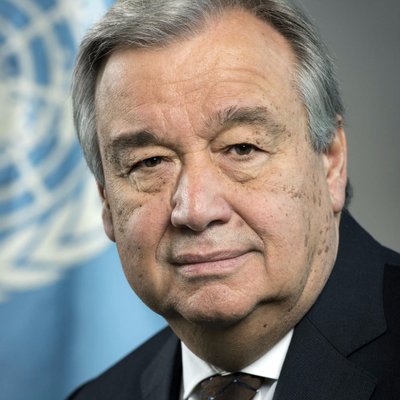
AI must be safe & inclusive.
That was the consensus amongst scientists, experts & representatives of governments & companies here at the AI Safety Summit.
AI must be shaped by humanity, with humanity & for all humanity.
Rebecca retweeted

I have listened to Zanetor's speech over and over again, and three things she demonstrated perfectly are:
1. Diplomacy isn't submission, courtesy doesn't require compliance, and respect isn't silence.
2. Effective diplomacy sometimes requires making people uncomfortable.
3. You can acknowledge someone's authority without surrendering your own dignity. And that's one sophisticated diplomatic skill!
There is a particular kind of strength in quiet authority, controlled defiance, and the ability to communicate displeasure without losing your elegance and composure.
Notice what this approach achieved. 👏

Rebecca retweeted
BREAKING: COP31 President Murat Kurum confirms that the final draft agreement at the summit will not be approved.
If no new final draft is proposed, talks will have to be suspended and reconvened at the following summit in Ethiopia next year, which has only happened once before.
Rebecca retweeted

Our Head of Communications Infrastructure and Services, Rebecca Mukite (@bekietem), represented Uganda at the ITU Plenipotentiary Conference 2026 in Doha, Qatar, contributing to discussions on digital cooperation and how telecommunications improve people’s lives.
Through our work with the International Telecommunication Union (@ITU), we support Uganda’s interests in global digital dialogue, knowledge exchange, and cooperation.
#ConnectedUg2030 #DigitalUganda
@MoICT_Ug @JustineLumumba @UCC_ED @Bbossa
🤖 Made with AI

Rebecca retweeted

Dr Specioza Wandira Kazibwe is saying that you must have those uncomfortable conversations before falling in love .., Ask questions Banange , you no longer want to ask questions..👇🏾👇🏾👇🏾
Rebecca retweeted

While we continue our discussions to advance the technologies of tomorrow at #Plenipot, our efforts must also ensure we put meaningful connectivity within everyone's reach - today. itu.int/itu-d/reports/statis…

Rebecca retweeted

With bold action & collective vision, AI can achieve a net-positive impact in humanity’s battle against climate change.
ITU Deputy SG @tlamanauskas outlines the Antalya AI Pledge launched at the #COP31 High-level Green Digital Action Roundtable.
itu.int/hub/2026/11/is-cop31…

Rebecca retweeted

Doing the right thing will rarely get applause…do it anyway

On the morning of January 20, 1953, Harry S. Truman completed his presidency and walked out of the White House. He had no motorcade. He had no government office to move into. He had no staff. He had no pension.
The Former Presidents Act, which would later provide salaries and offices to retired American presidents, did not yet exist. He had, in the way of regular income, an army pension from his service as a captain of field artillery in the First World War. The figure was one hundred and twelve dollars and fifty-six cents a month. He boarded a train at Union Station with his wife. He went home to Independence, Missouri.
Truman's approval rating, at the end of his presidency, was approximately thirty-two percent — among the lowest exit ratings of any modern American president. The Washington press, which had been hostile to him for most of his second term, treated his departure as a relief. The general assessment, both inside the city he was leaving and in much of the country, was that the Truman presidency had been a failure.
He went home and lived the way the country had told him to live.
He bought a Chrysler that summer. He and Bess got into the car themselves. They drove from Independence to Washington, then to New York, then back. A former president of the United States was filling his own gas tank at roadside stations, signing autographs for the truck drivers who recognised him.
The Pennsylvania state police pulled him over for driving too slowly. He answered his own phone in Independence. He responded personally to thousands of letters from people who wrote to him. He walked the streets of his hometown every morning at a pace fast enough that the reporters who attempted to follow him sometimes had to jog to keep up.
He did not write bitter memoirs. He did not give interviews attacking his successor. He did not, in any visible way, attempt to rehabilitate his own legacy. He simply continued, in Independence, Missouri, to be the same person he had been before the presidency.
While he was doing this, the things he had done as president began, very slowly, to look different from how the country had judged them at the time.
He had signed Executive Order 9981 in 1948, ending racial segregation in the United States armed forces — a step he had taken over the explicit opposition of substantial parts of the American military establishment and the Southern wing of his own party, on the grounds that he had decided it was the right thing to do.
He had committed the United States, through the Truman Doctrine and the Marshall Plan, to actively contesting Soviet expansion in postwar Europe and to underwriting the reconstruction of the Western European countries that had been destroyed in the Second World War.
The Western Europe that exists today — the long arc of peace and democratic stability that has held across that continent for more than seventy years — exists in significant part because Truman, in the late nineteen-forties, decided that the United States was going to pay to rebuild it.
He had also, in November of 1945, become the first president of the United States to formally propose to Congress a system of national health insurance.
The proposal had been savaged. The American Medical Association had denounced it, in language that became standard for the period, as socialised medicine. The conservative coalition in Congress had buried it. Truman had reintroduced it. It had been buried again. By the time he left office in 1953, the failure to pass any version of the national health insurance plan was, in Truman's own subsequent description, one of the most personally bitter defeats of his presidency.
He went home anyway. He walked the streets of Independence. The years passed.
On the thirtieth of July, 1965, twenty years after Truman had first asked Congress to pass a national health insurance plan, President Lyndon B. Johnson did something American presidents had not previously done at the signing of major legislation. He did not sign the bill in Washington. He did not stage the ceremony in the Rose Garden or the Oval Office or any of the standard locations the executive branch typically used for these events.
Instead, he flew Air Force One to Kansas City, drove to Independence, Missouri, and signed the bill in the auditorium of the Harry S. Truman Presidential Library.
The bill was the Social Security Amendments of 1965. It created Medicare and Medicaid.
Truman, then eighty-one, sat next to Johnson at the signing table. When Johnson rose to speak, he looked at the former president seated beside him and said, in the recorded opening lines of his remarks that day:
"The people of the United States love and voted for Harry Truman, not because he gave them hell — but because he gave them hope."
Johnson then signed the bill into law and handed the signing pens to Truman and Bess. He described Truman, in the speech that day, as the real daddy of Medicare.
Six months later, in January of 1966, Johnson returned to the Truman Library for a separate ceremony. He brought with him the first two Medicare cards that had been issued by the United States government. The first card was assigned to Harry S. Truman. The second was assigned to Bess W. Truman. Johnson handed them to the couple personally.
The man who had been told, twelve years earlier, that the work was wasted had received the legal evidence that the work had not been wasted. It had simply needed to wait.
Truman lived for another six and a half years after that. He died on December 26, 1972. He was eighty-eight years old. The most recent surveys of professional American historians rank him, depending on the methodology, somewhere between the sixth and the ninth most effective president in the country's history.
He had not been a different person at the end of his life than he had been when he took office. He had not campaigned for the rehabilitation of his own reputation. He had not softened his record to win approval. He had simply stayed, after his presidency, in the small Missouri town he had come from, and let the work he had done continue to mean what it had meant when he had done it.
History has a long memory.
It had taken, in his case, about twenty years for it to begin to catch up.

Rebecca retweeted
Member States at #Plenipot 2026 elect Adel Darwish as @ITU Deputy Secretary-General.
pp.itu.int/2026/en/elections…

Rebecca retweeted

So excited! What an honor to be entrusted once again with leading @ITU. Over these next four years, let’s work together to turn commitments into connections & connections into opportunities for everyone everywhere!

Rebecca retweeted
ITU Member States re-elect Doreen Bogdan-Martin as @ITU Secretary-General at #Plenipot 2026.
pp.itu.int/2026/en/elections…


Rebecca retweeted

LOML 😍: Dad today is your off, take care of the kids, I will be home soon.
Me: Darlin' don't worry kids are happy with Dad.
Me with Kids at home ⤵️⤵️
