

PhD student @CollegeRidley. Researching Judaism and Hellenism in 1 Peter. I teach @ Erikson-Tritt Theological College. American expat in Indonesia.
Papua, Indonesia
Joined December 2014
- Tweets1.8K
- Following686
- Followers281
- Likes3.4K







Today I spent time at the Netherlands Institute in Turkey, a research center “dedicated to the study of the (historical) cultures and societies of Anatolia.” Definitely worth visit if you’re ever passing through Istanbul. nit-istanbul.org/ – at Beyoğlu, İstanbul

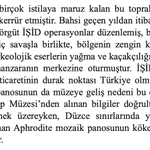
This from Güzin BİLİR, JMR 17 (2024), p. 9, is an excellent example of why we must be cautious about artifacts of unknown provenance in museums. Here's an Aphrodite mosaic panel that ended up in museum near ancient Prusias ad Hypium but origin in Syria, seized on route to Europe!

On a related note, someone should write a book (something with a journalistic flavor like _Veritas_ by @arielsabar would be excellent) exploring the illicit antiquities trade--in particular the impact that ISIS had on it in the years following 2013.
I am super excited to spend the next 2 days at the @dai_weltweit Deutsches Archäologisches Institut (German Archaeological Institute) in Istanbul. It’s the oldest and most extensive specialized library for classical studies in Turkey.


Today I visited the Hagia Sophia in Istanbul. So many layers of history! I was disappointed not to be allowed on the first level—only Muslims were allowed there. I wish they would allow people of other faiths to go and pray, especially since it was Christian church for so long! – at Fatih, İstanbul


Ben Carr retweeted

My new (and best) book is published!
Download and read it for free here:
viewer.content-select.com/pd…
@mohr_religion


I am grateful to spend this week researching at the world-class David H. French Library of @theBIAAnkara The best library in all of Turkey for studying Asia Minor, the ancient Mediterranean and beyond!
#PhDing – at Ankara, Türkiye


Spent 10 hours yesterday at this place. If you are ever in Türkiye you absolutely have to go. Hittite, Phrygian, Hellenisitc, Roman, and more!
Museum of Anatolian Civilizations
maps.app.goo.gl/sgmDoQ9VYekQ…

Stones from an ancient Paphlagonian temple of Zeus Bonitenos are reused and built into modern homes, barns, and garden walls!
Kastamonu'da müze gibi köy: Paflagonya Rotası’nda saklı kalan antik miras taskoprupostasi.com/kastamon…

I visited the Hellenistic period rock-cut tombs of the Pontic kings in ancient Amaseia today. – at Amasya, Türkiye

A Byzantine wall (parts of which date to the Hellenistic period) encompassing old town Antalya. Paul stopped for coffee here: “When they had spoken the word in Perga, they went down to Attalia. [And after stopping at Strbx] From there they sailed back to Antioch …” Acts 14:25 – at Antalya, Türkiye


Privileged to spend the afternoon at the Research Center for Mediterranean Civilizations (AKMED) in Antalya, Turkey. What a gem of a library! @AKMED_Antalya – at Antalya, Türkiye


2nd row depends on what it’s for: 1 w/ brisket or pulled pork, 2 w/ BLT, 3 w/ butter & jelly, 4 w/ Puck cheese spread, 5 scrape and then straight butter it, 6 trash.


I am surprised to say this, but I am really enjoying this by Andrew Burnett. He’s a great story teller and I am learning a lot about using coins as sources. Another great resource by @CambridgeUP

Kudos to @CambridgeUP for this book. Especially helpful in its (1) focus on later developments of stoic thought, (2) grouping of texts both diachronically and thematically (logic, physics, and ethics), making it easy to find relevant texts. Required reading for NT Studies!

Italicization of terms within titles according to @ChicagoManual 18: CMS no longer recommends reverse italics (i.e., roman type) for terms within italicized titles that would themselves be italicized in running text. See CMS 8.175. I’m calling this “blended italics.”
#PhDing


Ben Carr retweeted

#Jews #Judaism #Israel
There is so much confusion on here and elsewhere about what Christianity does and/or ought to believe about Jews/Judaism/the modern state of Israel.
1. Jesus and many of the earliest Christians would have claimed an ancestry that traces back through the tribes to Jacob, Isaac, and then Abraham.
a. Not only this—but because they emphatically believed that God had called the historical people of Israel both to be blessed and to be God’s means of blessing the rest of the world—they would have insisted that this ancestry was theologically loadbearing. Salvation did and—in God’s purposes, by God’s grace--*had* to come from the Jews. That was the plan all along.
b. In this connection, to insist upon *radical* distinctions in identity and practice between pre-exilic and post-exilic, second-temple and rabbinic Jews/Judaism, is historically ignorant.
2. Because Jesus and the earliest Christians believed that Israel as a whole had decisively broken the covenant and was thus in a state of covenant cursedness, and because they believed that Jesus was renewing the covenant, they thus also believed that one had to join *Jesus* to be a part of the covenant renewal.
a. In this regard, the earliest Christians did not think that “the Church” had simply *replaced* Jews/Israel—after all, Jesus and most of the earliest Christians were Jews. Rather, they believed that the covenant people of God had in a sense narrowed to Jesus and his people and then opened back up to include as many people as would put their trust in Israel’s Messiah, Jews and Gentiles.
b. Paul (esp. the letter to the Romans) and many of the other earliest Christians continued to insist upon the “salvation-historical priority” of Jews. They were broken and sinful as the rest of humanity. But they really were chosen. Nevertheless, because they too shared Adamic humanity (as it were), they were always going to break the covenant (as a nation). This thus meant, despite the meaningfulness of the election, that they too would need to participate in the death and resurrection of the Messiah through baptism (i.e. to put their trust in Jesus) in order to participate in God’s salvation in the present and in the ultimate future.
3. Gentiles who put their trust in the Messiah are included in the people of God on equal footing. They are children of Abraham.
a. In this regard, Paul thinks (esp. Romans 11) that the Jew-plus-Gentile people of God in the Messiah are the renewed Israel, the people of the covenant. They are the children of Abraham, and so on.
b. The latter point rules out the notion that Jews apart from the Messiah are still the people of God without qualification. The people of God are those in the Messiah, Jews and Gentiles.
c. If a Jew apart from the Messiah were to say to (e.g.) Paul the apostle: “But what about the election, what about the gift of Torah, etc.?” Paul would say: “Yes!—but because you too share Adam and Eves’ nature, you broke the covenant and incurred the curse. Thus, for life in the present and in the ultimate future, you have to put your trust in the Messiah’s curse-bearing death and covenant-renewing resurrection and outpoured Spirit!”
d. And if a Gentile were to say: “This is now *my* religion. *You* are only a Jew, etc.!” Paul would say: “Gentile in the Messiah, you were included by God’s grace and remain a ‘non-natural branch’ Israelite. You are *not* the root; and you do not uphold the root; rather, the root upholds *you*. And the root is Jesus himself *precisely as Israel’s Messiah*” (Rom.11)!
4. Because of all of this—call it what we want—“Christianity” is simply eschatological, messianic Judaism (into which Jews and Gentiles have been included by participation in the death and resurrection of Jesus through baptism etc).
5. Some of course will still operate under the profoundly false assumption--going back early into the Church’s history and reaching particularly potent expression in e.g. Augustine and Luther—that “Christianity” is antithetical to “Judaism” because the latter is about earning God’s love/salvation. Let that go. It’s just historically and theologically wrong.
6. But all of this also means that the way that Christians think about the modern state of Israel is radically complexified.
a. Of course, scripturally, culturally, and morally, Jews and Christians doubtless have much in common.
b. And more than a few reasons can be given for being concerned about the well-being and stability of Jews (and others) in the modern state of Israel following the Holocaust.
c. But it will not do simply to say “Well, they were chosen. They were elect. They are the people of God.” That is simply not a/the Christian position. The people of God are all those in the Messiah, Jew and Gentile.
d. But, of course, they—as all people—are made in the image of God, and there might be any number of other historical and ethical reasons to be concerned about the current state of Jews within and without the land of Israel.
e. Now, to lots of (mostly) men out there: I get that your nationalism is impatient with what you perceive to be a previous generation’s uncritical support of the modern state of Israel—running afoul of the point I make in C above—but your lazy and wicked anti-Judaism and anti-Semitism serves us even worse.