

E anche oggi il Corriere...
Joined June 2012
- Tweets57.5K
- Following625
- Followers662
- Likes97.6K





ANDU🎗️🇺🇦🇮🇱 retweeted

That the Communist hammer and sickle isn’t commonly regarded as evil and offensive as the Nazi swastika is a failure of education.

“Dear Italian students, who today take to the streets carrying flags with the hammer and sickle and wearing T-shirts emblazoned with ‘CCCP’,” began an open letter in Italian by Lithuanian expat Neringa Budryt.
“I would like to ask you a question: do you truly know what the symbols you carry represent? And do you know what would have happened to many of you had you openly demonstrated in countries living under the oppression of communist regimes?
Let me tell you something. It is easy to display a red flag when, for you, communism is merely an abstract idea of equality, social justice, and rebellion against the system. It is easy to wear a T-shirt with "CCCP" on it when you have never experienced the reality of a communist regime.
We come from that part of Europe where communism was not a T-shirt, a symbol of rebellion, or a romanticized notion of equality. It was the system in which we lived—a system we never chose.
We know the history of Soviet repression, Stalinist purges, the Gulags, and mass deportations. Above all, we know the word "Siberia"—a place to which thousands of innocent people were forcibly deported, simply for thinking differently.
In Siberia—amidst freezing cold, starvation, and forced labor—many lost their lives; those who survived carried the scars of that experience forever. Entire families were torn apart, and generations were denied the chance to live freely in their own homeland.
In the countries of the Soviet bloc, censorship, political police, surveillance, and the suppression of dissent drastically curtailed individual freedoms.
We grew up in a system where state control permeated even our daily lives. At school, we were required to wear the red necktie of the "Pioneers." We were monitored; they tracked where we went and even whether we attended church. Even faith—a choice that should belong to an individual’s own conscience—could become a cause for suspicion.
We used to celebrate Christmas with our windows blacked out, to ensure no one would see us and report us. Because it was forbidden—just like so many other things: jeans, rock music, and all the symbols of a Western lifestyle. My mother returned from a Soviet labor camp. And do you know what happened to her? She was barred from continuing her education because she had been labeled an enemy of communism.
Under a communist regime, you could not protest. You risked arrest, imprisonment, interrogation, persecution—and, in certain historical contexts, even death. In the Soviet Union and other communist regimes, political dissent could cost you your freedom and your life.
Demonstrations independent of the authorities were not a guaranteed right; they were often suppressed by force.
That is why it strikes me to see young Italians proudly displaying the hammer and sickle—symbols associated with regimes that persecuted and imprisoned millions of people.
Today, you are free to take to the streets, shout against the government, criticize institutions, and wave your flags precisely because you live in a democracy that grants you these freedoms. Under an authoritarian regime of that kind, protesting against those in power could have landed you in prison.
This is not about denying the existence of social injustices, inequalities, or the right to fight for a better world. You are free to take to the streets to demand a more just society—but you should not idealize a system that denied so many people the very things you are free to exercise today: the right to choose, to believe, to speak, and to dissent. Before wearing a T-shirt with "CCCP" on it, listen to those who experienced that world. Talk to the deportees and their descendants; read the accounts of those who endured the gulags and forced exile to Siberia. Learn what it meant to be stripped of your freedom, your home, your loved ones—and even any prospect of a normal life—simply because of your background or your beliefs.
Before waving the hammer and sickle, please, study history thoroughly.”

ANDU🎗️🇺🇦🇮🇱 retweeted

Trotsky – The Myth.
Ask a Western leftist which communist he admires, and you often get the same answer: Trotsky. The intellectual. The orator. The true revolutionary, betrayed by Stalin. If only he had won…
Look at the young Trotsky in the picture: round glasses, wild hair, burning eyes. Many young leftists today would recognize themselves in him. The look hasn’t changed. Neither has the certainty.
So let’s look at what he did when he had power.
Born in 1879 in what is now southern Ukraine, Trotsky was a brilliant writer and a spellbinding speaker. In October 1917, he played a central role in organizing the Bolshevik seizure of power.
Then Lenin made him Commissar for War, and he built the Red Army, directing it from an armoured train that rushed from front to front.
Deserters were shot. Military discipline was enforced through executions. Blocking detachments were deployed to stop retreating soldiers, and former tsarist officers recruited into the Red Army were kept under surveillance by political commissars. Their families were sometimes held hostage to guarantee their loyalty.
Cruelty knows no limits when you have no doubts.
In 1920, the Red Army marched on Warsaw. It was stopped on the Vistula.
That same year, Trotsky published an entire book, Terrorism and Communism, explaining why revolutionary terror was necessary. He wanted labour militarized too: workers organized like soldiers, subjected to military discipline and compelled to serve the needs of the state.
In 1921, the sailors of Kronstadt – once hailed as the pride of the revolution – demanded free elections to the soviets. Trotsky supported the suppression of the revolt. Thousands were killed in the assault or executed afterwards.
Then he lost the power struggle to Stalin.
Expelled, exiled, forced abroad. From there, he wrote that the revolution had been betrayed – by Stalin, never by himself.
He ended up in Mexico City, where he stayed for a time with Frida Kahlo and Diego Rivera. And so the Western romance took shape: the exiled prophet, the revolutionary betrayed, the road not taken.
In August 1940, a Soviet agent who had gained his confidence entered his study and struck him with an ice axe.
The machine Trotsky had helped build had come for him too. His killer later received the Soviet Union’s highest honour.
Trotsky was not the alternative to Stalin. He was the same machine – only with better prose. He never rejected the terror. He rejected losing control of it.
The "good communist" is always the one who lost.
Next: Stalin.


The Butchers – The Men Who Ran the Soviet Terror.
Moscow, a winter night in 1937. Long past midnight in the Kremlin, a man with a pipe sits at his desk under a lamp. In front of him, a stack of typed lists – names, one per line. He runs a blue pencil down the pages. A tick. A note in the margin. Sometimes a name crossed out, sometimes one added. The same pencil he uses to edit film scripts and poems.
His officials stay awake at home, next to the phone, in case he calls before dawn.
Hundreds of lists. Tens of thousands of names. On a single day, December 12, 1937, he and Molotov approved more than three thousand death sentences. Then, historians tell us, they went to watch a film.
But Stalin didn't invent the machine. He perfected it.
In August 1918, Lenin sent a telegram to his comrades: hang at least a hundred kulaks – hang them so that people see it for hundreds of kilometers around. Trotsky, the "good communist" of Western nostalgia, ordered the families of officers taken as hostages.
The founders gave the orders. Then the machine needed men – men who would build the apparatus, fill the camps, write the confessions and pull the triggers. And sooner or later, it devoured many of them.
1. Dzerzhinsky – the Founder. "Iron Felix," a Polish noble's son, who built the Cheka in 1917.
2. Trotsky – the Myth. The revolutionary Western intellectuals still romanticize, who wrote a whole book defending terror – until the machine he helped build killed him with an ice axe.
3. Stalin – the Editor. The man at the desk, with the blue pencil, long past midnight.
4. Yagoda – the Builder. The Gulag as an economy: canals dug by prisoners who died by the tens of thousands. Then shot by his own machine.
5. Vyshinsky – the Prosecutor. "Confession is the queen of evidence" – so he got confessions. "Shoot the mad dogs!" at the show trials, then the Soviet seat at the United Nations.
6. Yezhov – the Butcher. The Great Terror, the quotas, the Polish operation – then shot, and erased from the photographs.
7. Beria – the Strategist. Katyn, the atomic bomb, the deportations – and a predator. Shot by his own colleagues three months after Stalin's death.
8. Blokhin – the Executioner. In the spring of 1940, at Kalinin, he personally shot thousands of Polish prisoners over a few weeks, in a leather apron and cap.
9. Serov – the Hunter of Poland. He crushed the Home Army, lured the leaders of the Polish Underground State to "talks" and had them tried in Moscow. Then Hungary in 1956, and the first chairman of the KGB.
10. Andropov – the Modernizer. Dissidents sent to psychiatric hospitals instead of camps: softer, quieter – same goal: erasing people. The first secret police chief to rule the country.
11. Epilogue – The Chekists Never Left. From the KGB to the FSB to the Kremlin.
Why name them? Because their whole work was erasure – of people, of records, of memory. Remembering is the opposite of what they did.
And erasure didn't die with them. Today it rarely needs a bullet. It is called cancelling, deplatforming, debanking, lawfare. The inconvenient person isn't shot – he is removed: from his job, his bank account, his platform, the conversation. Yezhov needed a retoucher. Today a terms-of-service update does the job.
For Poles, these are not names from a history book. They are the names behind our grandparents' graves – and that is why we recognize their heirs.


ANDU🎗️🇺🇦🇮🇱 retweeted

Idem per l'attentatore di Modena, subito a dire che era laureato
Basta stare qua sopra un po' per capire che avere millemila lauree e titoli non esime da essere persone di merda, soprattutto se usati per zittire chi non è d'accordo con loro

Molti parlano del curriculum di #SiherYoussef, ma siete impazziti? Il suo curriculum, se mai, sono le parole che ha espresso: il 7 ottobre ha scritto «Allah è grande» e definito legittimo l’attacco terroristico. Ha ripetuto «dal fiume al mare» e pubblicato articoli osceni. E ora è indagato. Vedremo.
ANDU🎗️🇺🇦🇮🇱 retweeted
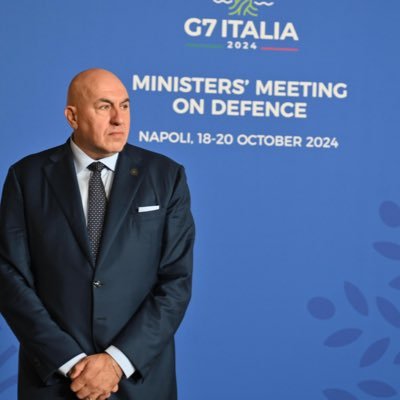
I miei complimenti al collega @Piantedosim ed alla @poliziadistato per aver individuato l’ideatore del movimento 17 ottobre.
Non un emarginato ma una persona molto introdotta e che aveva avuto molte più occasioni di lavoro e collaborazioni di gran parte dei suoi coetanei.
Da quotidiani ad enti pubblici, ha frequentato il gotha dell’intelleghentia italiana. E si sono visti i risultati.
ANDU🎗️🇺🇦🇮🇱 retweeted
What this shows is that kissing Trump’s ass always fails. He reacts only to pressure. In this case terrible US polling, screaming Republicans, and catastrophic damage being done to US defense companies

⚡️Starshield operations restored to speeds of more than 400 km/h, Ukraine's Defense Ministry says.
"We record a speed of more than 400 kilometers per hour, the connection is stable," the ministry said.
kyivindependent.com/starshie…


ANDU🎗️🇺🇦🇮🇱 retweeted

Nel 1917, la nipote di un decabrista sente un gran rumore in strada e manda la servitù a vedere che cosa stia succedendo.
Poco dopo, la servitù torna:
— C’è la rivoluzione, signora!
— Oh, la rivoluzione! Magnifico! Anche mio nonno era un rivoluzionario! E che cosa vogliono?
— Vogliono che non ci siano più ricchi.
— Strano… Mio nonno voleva che non ci fossero più poveri.
(Una vecchia barzelletta sulla rivoluzione bolscevica del 1917. Ogni riferimento e ogni somiglianza sono puramente casuali. 🌚)


ANDU🎗️🇺🇦🇮🇱 retweeted

Va bene, lo inoltro anch'io.
xitter.cf/rtl1025/status/2112495…

🗣️ "Io non sopporto più queste persone, conosco un sacco di gente che viene da tutto il mondo, che si impegna e alle 5 del mattino viene qua a lavorare. Se tu vieni qua e distruggi il mio paese, te ne torni a casa tua a calci in c**o". È lo sfogo di un giovane per le vie di Milano in seguito alle violente proteste degli ultimi giorni. "Io non sopporto più questa gente. Ho 23 anni, voglio vivere nella mia città. Dobbiamo iniziare noi a ribellarci" continua il ragazzo. Il video è stato ripubblicato da Matteo Salvini con il commento: "Difficile dargli torto".
📹: @matteosalvini via Instagram
ANDU🎗️🇺🇦🇮🇱 retweeted

Etnie e razze esistono e sono differenti tra loro
La televisione tedesca @dwnews ha realizzato un documentario sugli immigrati nei sobborghi di Parigi.
Le telecamere si sono concentrate su due gruppi che vivono nella stessa area.
Da una parte, circa settantamila cinesi francesi. Nel sobborgo nord di Parigi, Aubervilliers, hanno costruito il più grande centro di distribuzione all'ingrosso di abbigliamento in Europa.
Il loro stile di vita è molto semplice:
si alzano all'alba e lavorano fino a tardi, gestendo piccoli laboratori, negozi e trasporti merci. Guadagnano e reinvestono tutto nel business, e quando incontrano difficoltà se la cavano da soli.
Di solito sono discreti e tranquilli, raramente chiedono sussidi speciali al governo, né scendono in strada a creare disordini. In decenni, sempre più famiglie hanno comprato case e fatto crescere i loro affari.
Dall’altra parte, la comunità di immigrati nordafricani che vive nello stesso quartiere. Nel complesso, il loro inserimento economico locale è relativamente arretrato. Ma il documentario ha catturato un cambiamento sottile ma reale dell’atteggiamento: un sentimento che vede chi si mantiene da sé come una minaccia si sta diffondendo piano piano.
Secondo le osservazioni contenute nel filmato, alcuni che hanno fallito nell’integrazione tendono a considerarsi vittime, convinti che la società gli debba troppo. Ma quando girano la testa e vedono i cinesi accanto a loro, l’atteggiamento cambia. Non solo non imparano come fare business, ma vedono i cinesi come concorrenti.
Da dove nasce esattamente questa ostilità? Il conflitto più concreto sta nel fatto che: più i cinesi vivono bene, più la narrazione da vittima diventa difficile da giustificare.
Tutti sono immigrati, tutti affrontano le barriere di una terra straniera. Persino i cinesi, quando sono arrivati, non sapevano nemmeno parlare francese, figuriamoci avere contatti locali.
Se qualcuno lavora quattordici ore al giorno e riesce a tirare avanti un po' alla volta, allora quella frase “non ce la facciamo solo per l'ingiustizia del mondo esterno” diventa difficile da dire con convinzione.
Una persona che si arrangia in silenzio spesso ferisce gli occhi di chi è abituato a incolpare l’ambiente.
Uno scollamento più profondo sta nella comprensione della ricchezza.
Nella mente di molti che pretendono, la ricchezza è una torta fissa e limitata.
Non vedono come quei negozi all’ingrosso siano riempiti con scatoloni di merci uno dopo l’altro,
vedono solo che i negozi cinesi fanno soldi, e pensano che sia a loro scapito.
E poiché i cinesi sono abituati a tollerare, in caso di dispute scelgono spesso di calmare le acque,
questo squilibrio mentale presto si trasforma in problemi di sicurezza reali.
Rapine, pedinamenti, aggressioni di strada: uno dopo l’altro, colpiscono questo gruppo di persone che vuole solo vivere tranquillo.
Sostenere se stessi con le proprie mani, accumulare ricchezza con la reputazione: in qualsiasi società sana, è la dignità più basilare. Ma se qualcuno è abituato a usare l’identità di vittima come moneta corrente,
quella persona che silenziosamente rende la sua vita migliore spesso diventa il primo bersaglio.


ANDU🎗️🇺🇦🇮🇱 retweeted

Non c’è un movente chiaro. Il profilo dell’hacker è quello di un giurista. Le uniche tracce digitali sembrano essere le impronte del pm Di Cicco sul suo telefono. La cerchia dei sospettati si riduce a un numero ristrettissimo di persone, molto vicino a uno.ilfoglio.it/cronaca/2026/10/…


