

Web3 market maker | 6y exp | 50+ CEX/DEX | Exchange setup in 1 day | 24/7 ops, 99%+ uptime
Dubai, Global
Joined April 2022
- Tweets119
- Following107
- Followers163K
- Likes631









Pinned Tweet
@bitmakerfi has a new home online.
We’ve rebuilt our website to give a clearer view of how we approach market making, from preparation and trading infrastructure setup to live deployment, optimization, monitoring, and expansion.
→ 6 years in the market
→ 50+ integrated exchanges
→ 40+ active clients
→ 35 professionals
→ 99% uptime
→ 24/7 execution
All brought together in one place.
Explore the new Bitmaker website ↓
🌐 bitmaker.fi

Rates, credit conditions, dollar funding, and risk appetite shape available depth, spreads, order flow, and inventory risk in an order book.
Our latest article looks at how those conditions reach live execution.

Trading adds another feedback loop.
A liquid market gives users, operators, and capital providers an executable price for entering, exiting, hedging, and valuing their exposure. That price feeds into decisions about holding, staking, allocating capital, and building on the network.
Network economics emerges through repetition:
— people use the network
— fees are paid
— infrastructure is maintained
— incentives are distributed
— the market prices participation
@bitmakerfi focuses on the trading layer: liquidity, execution quality, and market monitoring as those feedback loops play out.
Fees price scarcity: blockspace, computation, data availability, or an application service.
@ethereum’s upcoming Glamsterdam testnet includes gas-pricing changes intended to reflect execution and state-growth costs more closely. A fee market works when the price follows the resource being consumed.
Thanks to @ProofOfLiq for bringing together so many great teams. Looking forward to the next edition!

And that’s a wrap for our Singapore Edition!
Thank you to everyone who joined us, here’s a look back at the event.
Shoutout to our co-hosts @inkonchain, @NexusMutual, @RockawayX, @dawninternet and event partners @Figure, @EmberProtocol, @bitmakerfi, @Arch_Prime for making this edition possible.
Prediction markets put every layer of a trading venue under pressure.
Our new article looks at how liquidity, execution, market surveillance, and settlement behave when new information can reprice a contract within seconds.

It was a pleasure to join Proof of Liquidity Singapore during TOKEN2049.
Good conversations, familiar faces, and new connections. Thanks to @ProofOfLiq for organizing the event and bringing everyone together.
Looking forward to the next one!
A look back at Proof of Liquidity Singapore during @token2049.
A packed venue, familiar faces, new connections and conversations that went well beyond the conference floor.
Thanks to everyone who joined us and made this edition possible.
See you at the next one.

A trading firm can hold a money market fund, earn yield on that position, and still need credit to trade. Bringing that asset into a collateral workflow has traditionally meant moving through separate custody, funding, and settlement processes.
On September 28, @FTDA_US and @Bybit_Official launched a programme that lets eligible institutional clients use tokenised money market fund shares as off-exchange collateral for trading credit. The fund shares remain in custody while the client can access USDT or USDC credit on the venue.
The collateral covers the exposure created by trading. The cash leg still needs to settle alongside it. In September, major UK banks completed interbank transactions using tokenised deposits, showing how commercial bank money can move through a digital settlement workflow.
Together, these developments bring more of the trade lifecycle into the same operating environment:
trade agreed → collateral allocated → eligibility and valuation checked → exposure recalculated → payment and asset transfer settled
As prices and positions change, the collateral requirement changes as well. The process therefore depends on clear rules for asset eligibility, valuation sources, haircuts, custody, substitution, credit limits, and the transfer of assets between participants.
Tokenisation allows collateral and cash to move through a shared digital workflow. The value appears when the trading desk, custodian, and venue can work from a current view of the same balances, positions, and settlement obligations.
For execution infrastructure, this raises the standard for market data, reconciliation, reporting, and operational control. @bitmakerfi works on that market-facing layer by managing live execution, tracking balances and positions, and keeping venue state aligned with the trading system.

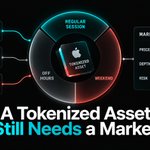
RWA market design continues after issuance through every decision to buy, sell, redeem, or hold.
Pricing, custody, valuation, redemption, and secondary liquidity each shape that experience. @bitmakerfi works on the trading layer through order-book liquidity, execution quality, and market monitoring after an asset enters public trading.
Bitmaker retweeted

Seoul set the bar high.
Here’s a look back at Proof of Liquidity during @kbwofficial.
Next stop: Singapore on Oct 8.