

I'm for individual liberty, limited government, and free markets. Anti-populist. https://teapaw.org/t.co/xfvQudydrM | @bobweeks.bsky.social | “Post-truth is pre-fascism”
Wichita, KS
Joined May 2008
- Tweets36.2K
- Following1.6K
- Followers3.5K
- Likes9.5K





HAMILTON REVISITS MARSHALL'S INFAMOUS TOWN HALL MOMENT AS VANCE RALLIES GOP
One-Sentence Summary: Democratic U.S. Senate candidate Adam Hamilton visited voters in Oakley, Kansas, where Republican Sen. Roger Marshall abruptly ended a contentious 2025 town hall, highlighting their contrasting approaches to constituents as President Donald Trump and Vice President JD Vance campaign to help Marshall win reelection.
Key Takeaways:
• Hamilton's Oakley appearance intentionally revisited Marshall's controversial March 2025 town hall.
• Marshall left the meeting after facing criticism about Trump and Musk, describing the audience as unusually rude.
• The confrontation occurred in a strongly Republican county where Trump received nearly 85% of the 2024 presidential vote.
• Marshall subsequently characterized town halls as potentially dangerous, an explanation Hamilton has turned into a campaign issue.
• Hamilton's Oakley meeting emphasized listening to ordinary Kansans, including farmers concerned about agricultural policy.
• Political scientist Bob Beatty believes the Oakley incident could become a defining moment if Marshall loses.
• Trump and Vance have personally campaigned for Marshall, demonstrating the national Republican Party's interest in defending his seat.
• The race illustrates competing approaches to campaigning: national partisan mobilization versus direct engagement with constituents.
Best Quotations:
• Roger Marshall: "This is one of the rudest audiences I've ever had."
• Adam Hamilton: "They're good, decent people who want leaders that listen to their concerns."
• Bob Beatty: "A U.S. senator is expected to be able to handle questions in a town hall in Oakley, Kansas."
• JD Vance: "I believe that Kansas has no better friend in Washington than Doc Marshall."
Article Summary: As Kansas enters the final week before the November 3, 2026, election, Democratic Senate candidate Adam Hamilton is using one of Republican incumbent Roger Marshall's most controversial moments to make a point about political leadership: elected officials should listen to their constituents, even when the questions are uncomfortable.
On October 25, Hamilton visited Oakley, a small western Kansas community that became nationally known after Marshall abruptly ended a contentious town hall on March 1, 2025.
During that approximately 40-minute meeting, residents challenged Marshall over actions taken by President Donald Trump and billionaire Elon Musk. Frustrated by the audience, Marshall complained that it was among the rudest he had encountered before leaving.
The incident attracted particular attention because Trump had received nearly 85% of the vote in the surrounding county in 2024. Even in overwhelmingly Republican territory, Marshall encountered serious dissatisfaction.
Marshall subsequently faced criticism for avoiding public town halls. In August 2026, he told the Junction City Post that town halls had become unproductive and dangerous for participants, staff members, and himself.
Hamilton deliberately returned to the scene of that controversy.
Speaking to residents gathered in Oakley, Hamilton joked about Marshall's characterization of town hall audiences as dangerous. Rather than avoiding questions, Hamilton encouraged residents to describe their concerns and took notes as they spoke. One farmer raised concerns about agricultural policy.
Hamilton's visit was part of a statewide bus tour that included Olathe, Atchison, and Wichita. However, his appearance in Oakley attracted particularly strong media interest because of its symbolic importance.
Washburn University political scientist Bob Beatty described the visit as a smart campaign decision. He suggested that Marshall's 2025 town hall could become a historically significant moment if Hamilton wins the election.
Meanwhile, national Republican leaders are investing political capital in Marshall's reelection.
Trump held a rally near Wichita on October 19, and Vice President JD Vance appeared in Topeka on October 26, his second Kansas visit during the campaign. Both Republicans praised Marshall and portrayed Hamilton as too liberal for Kansas.
Vance emphasized Marshall's background as a rural physician, telling supporters that Kansas had no better friend in Washington.
The article presents two contrasting campaign strategies. Marshall is relying heavily on support from national Republican leaders to energize conservative voters. Hamilton is emphasizing personal contact with Kansans and portraying himself as more willing to hear criticism.
The larger significance is that a Senate race once considered relatively secure for Republicans has attracted national attention as a potentially competitive contest affecting control of the Senate.
The election will determine whether Hamilton's approach to voter engagement can overcome Kansas's longstanding Republican advantage.
Bayless, Kacen. "Hamilton Revisits Marshall's Infamous Town Hall Moment as Vance Rallies GOP." The Wichita Eagle, 27 Oct. 2026

TRUMP'S FINAL WEEK BEFORE THE MIDTERMS: SEVEN RALLIES, SEVEN DAYS, AND A FACT CHECK
Between October 25 and October 30, 2026, President Donald Trump held seven rallies in Michigan, Mississippi, Texas (twice), Ohio, South Carolina and Florida to push turnout for Republicans in the final stretch before Election Day on Tuesday, November 3. He had a real talking point: the government reported that the economy grew at a 3.4% annual rate in the third quarter, and he announced it from the stage. He also unveiled a rollback of Biden-era methane rules in Lubbock, welcomed a tanker of Venezuelan crude at the Port of Corpus Christi, and used the same stump script almost every night: Rep. Ilhan Omar supposedly "used a fake name," Democratic Senate nominees were "communists," and inflation was "1.7%." Our fact check of 59 claims found 4 accurate, 25 misleading, 11 false and 19 that can't be verified. The rallies also had unscripted moments, including a ten-minute Michigan appearance by the father of a 9/11 hero, Nicki Minaj on stage and a heckler Trump told to "shut up, dope." Link following.


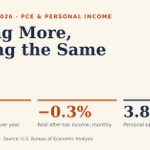
PAYING MORE, BUYING THE SAME: WHAT SEPTEMBER'S INFLATION AND INCOME REPORT SAYS ABOUT YOUR WALLET
Once a month, BEA publishes a report that tracks three things every household feels directly: how much Americans earned, how much they spent, and how fast prices rose. The price piece is the Personal Consumption Expenditures (PCE) price index, the inflation gauge the Federal Reserve uses to judge whether it is meeting its 2% target. It differs from the more familiar Consumer Price Index (CPI) mainly because it covers a broader range of spending, including what insurers and government programs pay on people's behalf, and because it adjusts for people switching to cheaper products.
Thursday's report covered September. It arrived the same morning as the government's first estimate of third-quarter GDP, which showed the economy growing at a 3.4% annual rate, and one day after the Fed held interest rates steady. Read on its own, the September report tells a less cheerful story than the GDP headline: prices rose faster, after-inflation income fell, and Americans kept spending by saving less. Link following.


FACT CHECK: Did Adam Hamilton lie about Roger Marshall having a pregnant woman arrested over medical debt?
VERDICT: MOSTLY FALSE - The Facebook post uses a technically correct legal principle to reach a conclusion contradicted by documented events.
CLAIM: Adam Hamilton's campaign advertisement must be a lie because police cannot arrest people for unpaid debts.
THE FACTS:
1. The arrests really happened.
A September 8, 2026, New York Times investigation examined thousands of pages of Kansas court records and found that Roger Marshall and his medical practice sued more than 700 patients over unpaid medical bills.
In 81 cases, patients were arrested after missing court appearances. Marshall's attorneys requested arrest warrants in numerous cases (Kliff, 2026).
These are documented events, not inventions by Adam Hamilton.
2. The pregnant woman in the advertisement is real.
Meischa Zimmerman was sued over a $3,596 medical bill from a cesarean delivery.
She arranged approximately $50 monthly payments but sometimes struggled to pay. Marshall's practice charged 18% annual interest.
In 2011, Zimmerman was arrested while eight months pregnant, with her two-year-old daughter at home.
Court records show she was arrested three times in connection with the debt litigation (Kliff, 2026).
3. The Facebook post misunderstands how debt-related arrests occur.
Its basic premise is correct: Americans cannot ordinarily be imprisoned simply for owing consumer debt.
But creditors can sue debtors. Courts can order debtors to appear for proceedings. Failure to comply with those orders can result in arrest warrants.
The distinction matters:
• Zimmerman was not legally arrested merely for owing $50.
• Her arrests arose from court proceedings involving medical debt.
• Marshall's attorneys pursued the lawsuits and sought arrest warrants.
• Judges authorized the warrants, and law enforcement executed them.
The fact that judges issued the warrants does not erase the creditor's role in initiating and pursuing the legal proceedings.
4. Marshall disputes the advertisement's characterization.
Marshall's attorneys argue that Zimmerman was arrested for missing court appearances, not missing a payment, and that her total debt was substantially more than $50.
Hamilton's attorneys defend the advertisement.
The precise characterization of the $50 payment is disputed. But the underlying medical-debt litigation and arrests are documented (Kaminski, 2026).
5. There is an important new development.
On October 29, 2026, a class-action lawsuit was filed accusing Marshall and his former practice of charging unlawful 18% interest on patients' medical debts.
Zimmerman is the lead plaintiff. These allegations have not yet been adjudicated (Hogg, 2026).
CONCLUSION:
The Facebook author correctly explains that ordinary debt is a civil matter but overlooks the judicial process through which debt collection can lead to arrest.
Hamilton's advertisement may reasonably be criticized for simplifying the circumstances of Zimmerman's arrest. Calling the entire story a "BIG FAT LIE," however, ignores extensive documentary evidence.
The central facts remain: Marshall's practice sued hundreds of patients, his attorneys sought arrest warrants, and dozens of patients were arrested in connection with those proceedings.

END NOTES
Kliff, S. (2026, September 8). A doctor sued 700 patients for debts; 81 were arrested. Now he's a senator. The New York Times.
nytimes.com/2026/09/08/us/po…
Kaminski, A. (2026, October 1). Hamilton asks Marshall to cease and desist from threats of frivolous litigation. Kansas Reflector.
kansasreflector.com/2026/10/…
Hogg, D. (2026, October 30). Marshall sued for charging callous and predatory 18% interest rate on medical debt in Kansas. Kansas Reflector.
kansasreflector.com/2026/10/…

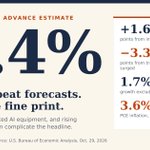
THE ECONOMY GREW 3.4% LAST QUARTER. HERE'S WHAT'S UNDERNEATH THAT NUMBER.
Gross domestic product, or GDP, is the government’s broadest measure of the economy: the value of everything produced in the United States, adjusted for inflation. Every quarter, BEA publishes three estimates of it. The first, the “advance” estimate, comes about a month after the quarter ends and is built on incomplete data. It gets the headlines. It also gets revised.
Thursday’s advance estimate for July through September showed the economy growing faster than forecasters expected, and faster than at any time in the past year. It arrived five days before the November 3 midterm elections, one day after the Federal Reserve held interest rates steady with two officials voting for a hike, and at the same minute as a separate report showing inflation rising again in September. Here is what the report says, and what it doesn’t. Link below.


The History This Political Meme Doesn’t Want You to Know
This Facebook meme illustrates how political propaganda can use historical facts to create a fundamentally misleading impression. Its central trick is simple: It assumes that the Republican and Democratic parties of the 1860s were ideologically identical to the parties of today.
They weren’t.
The meme correctly credits Republicans with leading the fight for the 13th, 14th, and 15th Amendments, which abolished slavery, established birthright citizenship and equal protection, and prohibited racial discrimination in voting. Democrats of that era largely opposed these measures. Abraham Lincoln’s Republican Party deserves enormous historical credit for its role in ending slavery and advancing civil rights.
But the meme conveniently ignores what happened during the following 160 years.
During Reconstruction, Republicans championed federal protection of civil rights, while Southern Democrats defended white supremacy and resisted racial equality. Over the 20th century, those political coalitions underwent a profound realignment.
Franklin Roosevelt’s New Deal helped attract Black voters to the Democratic Party. Democratic Presidents John F. Kennedy and Lyndon Johnson subsequently championed landmark civil rights legislation. Meanwhile, conservative white Southern voters increasingly moved toward the Republican Party, particularly as national Democrats embraced civil rights.
This transformation was gradual and complicated, not a magical overnight exchange of party identities. Nevertheless, its historical significance is undeniable.
The meme also contains factual distortions. The 15th Amendment did not establish voting rights “for all.” Women remained excluded from the franchise in most states, and racial discrimination continued to prevent many Black Americans from voting. Nor did 100% of congressional Republicans support the amendment; several voted against it.
The Obamacare comparison is especially revealing. In 2010, every Republican in the House voted against the final Affordable Care Act legislation, while approximately 87% of Democrats supported it. The meme presents this as evidence against Democrats without explaining why opposition to expanding health insurance should be considered a political virtue.
Ultimately, the fundamental question is not which political party deserves credit for what its members did in 1865. Historical accomplishments belong to the people who achieved them, not automatically to politicians who inherit their party labels generations later.
The meaningful question is what today’s politicians believe, what policies they support, and how their actions affect Americans now.
History should help us understand the present, not serve as a substitute for examining it.
The meme concludes with the instruction, “Please keep quiet.”
A better instruction would be: Please learn the entire history.

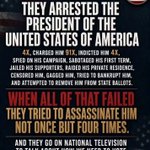
WHO IS "THEY"?
This meme packs a lot of anger into one word: they. Read it carefully and you'll see that "they" are a single, coordinated villain who arrests, indicts, censors, sues, and then, when that fails, sends gunmen. It's an effective story, but it collapses once you ask who actually did each of these things.
The indictments didn't come from a political party. They came from grand juries: ordinary citizens who heard evidence and voted. In New York, twelve jurors, selected with input from Trump's own lawyers, reached a verdict. The "four arrests" were the routine booking procedures that every criminal defendant goes through. You can believe those prosecutions were unwise or politically motivated, and many reasonable people do. But that is an argument about prosecutorial judgment, not proof of a single conspiracy. The meme turns dozens of separate prosecutors, judges, jurors, and agencies into one hand.
The assassination claim is where the story does its real work, and where it is weakest. The men who tried to kill Donald Trump were not agents of the Democratic Party. Investigators found no political organization directing them. They were disturbed individuals acting on their own grievances, the same kind of people who have targeted presidents of both parties for more than 150 years. To say "when all of that failed, they tried to assassinate him" is to accuse tens of millions of fellow citizens of attempted murder by association. If someone made that kind of accusation against conservatives after an attack on a Democrat, the people sharing this meme would rightly call it a smear.
Look at how the story actually ended, too. If a ruthless machine were out to destroy one man, it did a poor job. Trump stayed on every ballot after the U.S. Supreme Court ruled unanimously in his favor. He campaigned freely, won the election, and took office. The federal cases were dropped, and the other proceedings wound down through ordinary legal channels. Courts ruled for him and against him, and he appealed. That is not what tyranny looks like. That is what a working system looks like, one in which even a powerful man must answer charges and even a charged man can win the presidency.
"Jailed his supporters" leaves out why. The people convicted after January 6 were charged for specific acts, including assaulting police officers, and many pleaded guilty. You can debate the sentences or the pardons, but they weren't jailed for supporting a candidate. Millions of Trump voters were never charged with anything.
Finally, the meme mocks the idea of "saving democracy." But democracy isn't one party's slogan. It's the habit of settling disputes through votes, courts, and argument rather than by casting opponents as would-be killers. A message that teaches Americans to see their neighbors as murderers works against that habit, whichever side it comes from.
Be angry about unfair treatment if you believe it happened. But name the actual people and actions, and leave the assassins out of it. They answer for their own crimes, not for half the country.

DEPORT IMMIGRANTS? OH YES. BUT NOT THIS GUY.
One-Sentence Summary: David French exposes selective Christian compassion when conservative supporters of mass deportation demand mercy for an ally arrested by ICE.
Article Summary: Samuel Sey, a Ghanaian-born Christian commentator, supported Trump's deportation policies until ICE arrested him in October 2026. Authorities allege he overstayed his authorization; his family says he pursued legal residency in good faith.
His detention prompted sympathy from conservative figures who previously rejected similar compassion for undocumented immigrants. French argues their reaction exposes the hypocrisy of condemning empathy until someone familiar suffers.
French emphasizes that immigration enforcement involves presidential discretion. Mass deportation is a policy choice, not an unavoidable legal requirement. He cites research finding that only 20% of deportees during Trump's first 18 months back in office had criminal convictions.
French advocates effective border enforcement combined with opportunities for established immigrants to obtain legal status. His central argument is moral: Christians should extend compassion and due process to strangers and opponents, not merely friends.
French, David. "Deport Immigrants? Oh Yes. But Not This Guy." The New York Times, 29 Oct. 2026.
HINEMAN'S CASE AGAINST SEN. ROGER MARSHALL
#ksleg #KSPolitics #KSSen
@KansasGOP @KansasDems @RogerMarshallMD @Hamilton4Kansas

For the full editorial by for Kansas House Republican Majority Leader Don Hineman, see:
wichitaliberty.org/politics/…

𝗕𝗼𝗯 𝗪𝗲𝗲𝗸𝘀 🇺🇸🗽🇺🇦🙀☕️ 🐾🥬🥡 retweeted

An epoch failure of political courage, an abdication of leadership, and a shirking of constitutional duty that will and should define Mitch McConnell's legacy.
He spoke of the "long game" but sometimes the test that matters is today, and in the long run, there's no do over. – at Brookmont, MD

Former Rep. @Liz_Cheney (R-WY) says she believes President Trump would have been convicted if Sen. Mitch McConnell (R-KY) decided to convict: "I think if he had voted to convict, we would have had enough Republicans who would have followed him that he would've been convicted."
KANSAS REPUBLICANS FALSELY BLAME ADAM HAMILTON FOR METHODIST CHURCH SPLIT
@KansasGOP | @KansasDems | @RogerMarshallMD | @Hamilton4Kansas
One-Sentence Summary: Wichita Eagle columnist Dion Lefler rejects Kansas Republicans' claim that Senate candidate Adam Hamilton caused the United Methodist Church split, arguing Hamilton actually sought compromise.
Lefler, a longtime participant in Methodist governance, explains that approximately 25% of United Methodist congregations left between 2019 and 2023 amid disputes over LGBTQ inclusion.
Hamilton, pastor of the Church of the Resurrection, supported the "One Church" plan, which would have allowed regional and local decisions about LGBTQ clergy and same-sex weddings. The proposal failed in 2019, largely because of opposition from American traditionalists and African delegates.
Lefler argues that Hamilton attempted to preserve denominational unity rather than destroy it.
He criticizes the Kansas GOP for relying on accusations from Jim Garlow, a conservative California pastor and former Trump faith adviser whose expertise concerning Methodist affairs Lefler questions.
Lefler also highlights the irony of Republicans attacking California political influence while promoting a California-based minister.
Lefler, Dion. "KS Republicans Falsely Blame Adam Hamilton for Methodist Church Split." Wichita Eagle, 28 Oct. 2026.

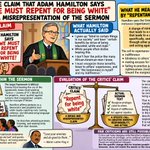
THE CLAIM THAT ADAM HAMILTON SAYS "WE MUST REPENT FOR BEING WHITE" IS A MISREPRESENTATION OF THE SERMON
@KansasGOP | @KansasDems | @RogerMarshallMD | @Hamilton4Kansas
Critics of Adam Hamilton have used his 2020 sermon to claim Hamilton says we must repent for being white. Here is what the transcript actually shows, drawn from the relevant sections.
WHAT HAMILTON ACTUALLY SAID
Hamilton speaks in the first person about his own experience and then generalizes:
- He states that he grew up "blind to certain things in our society" and has "certain benefits by virtue of being educated, white and male."
- He notes that white people often dislike hearing this.
- He contrasts his own lack of fear when stopped by police with the fear commonly experienced by African-American men he knows.
- He concludes that he must recognize those benefits/privileges, listen to others' experiences, and see "the brokenness in myself and my indifference."
- He defines the needed response with the Greek term metanoia (repentance): a change of mind that leads to a change of heart that leads to a change of actions-specifically, seeing the world through other people's eyes and acting against injustice.
The call to repentance is directed at indifference, blindness to others' pain, making excuses for injustice, and failing to practice justice (mishpat), righteousness (tzedakah), and kindness (hesed) toward the marginalized. He applies this to himself first and to the church broadly. He does not say that the mere fact of being white is a sin requiring repentance, nor does he call for people to repent "of being white."
CONTEXT WITHIN THE SERMON
- The larger framework is biblical: Exodus (God hearing the cry of the oppressed), Amos (God wanting "justice-oceans of it"), Micah 6:8, the prophets, Jesus' protest against systems that marginalized people, and the example of Moses.
- Hamilton affirms protests as a democratic and prophetic tool while clearly rejecting riots, looting, violence, and dehumanizing language toward police.
- He describes attending protests, listening, and seeking unity rather than division.
- He criticizes broad-brush statements such as "all cops are bad" and quotes Martin Luther King Jr. on loving enemies and non-cooperation with evil.
EVALUATION OF THE CRITICS' CLAIM
The claim collapses a specific call-to recognize unearned advantages, listen, and repent of indifference or complicity in injustice-into the far broader assertion "repent for being white." That is not what the text says. Hamilton's language is about privileges that often accompany being white (and educated and male) in the American context he is describing, and about the moral responsibility that follows. It is not an ontological claim that whiteness itself is sinful.
Critics can fairly disagree with Hamilton's diagnosis of systemic problems, his emphasis on privilege, or his political and social conclusions. They can argue that his framing is one-sided or insufficiently attentive to other factors. Those are substantive critiques. The specific charge that he teaches people must "repent for being white," however, does not match the words or the structure of the sermon.

THE ART OF THE DEAL: JARED KUSHNER'S HACKED PHONE REVEALED HIS SECRET NEGOTIATIONS-INCLUDING MORE THAN $700 MILLION IN TRANSFERS
One-Sentence Summary: Investigative journalist Matthew Cole alleges that Jared Kushner secretly obtained access to approximately $2 billion in accounts funded by Saudi Arabian and United Arab Emirates leaders while serving as a senior White House adviser, raising serious questions about foreign influence, financial disclosure violations, and potential bribery.
Key Takeaways:
• Dutch intelligence allegedly monitored Kushner's iPhone beginning in early 2018 after discovering evidence of Russian penetration of the device.
• Gulf leaders allegedly provided access to approximately $2 billion across multiple foreign accounts during Kushner's White House tenure.
• Approximately $750 million reportedly entered a UAE account controlled by an Emirati foundation, with Kushner allegedly holding signatory authority.
• Another approximately $1 billion was allegedly placed in an Israeli account, with part of the money reportedly routed through Cyprus.
• Cole alleges the arrangements served diplomatic and political objectives, while one account was reportedly designated for Kushner's personal benefit.
• Kushner's attorneys deny the existence or his knowledge of the alleged accounts and deny wrongdoing.
• The article raises possible disclosure, bribery, and foreign-agent issues but does not establish that any crime occurred.
Article Summary: In an excerpt from his forthcoming book, Princes and Thieves, published by Vanity Fair on October 22, 2026, Matthew Cole describes a clandestine financial network allegedly connecting Jared Kushner, senior Middle Eastern leaders, and billions of dollars in secret bank accounts.
The investigation began with an intelligence discovery. In late 2017, Dutch military intelligence recruited a Russian intelligence operative who provided access to servers containing information stolen by Russian hackers. Investigators discovered screenshots from Kushner's iPhone X.
By early 2018, Dutch intelligence had exploited a vulnerability that enabled agents to monitor Kushner's phone screen. They reportedly observed him accessing a UAE bank account that had received hundreds of millions of dollars through an Azerbaijani bank.
Cole describes two principal accounts:
• Account Alpha: Beginning in 2017, Saudi and Emirati interests allegedly transferred approximately $750 million into an account at First Abu Dhabi Bank. The account was owned by Watani Al Emarat Foundation, a government-funded Emirati charity that sources say also facilitated covert military and intelligence financing. Kushner allegedly possessed signatory authority, although he did not personally own the account.
• Account Beta: By spring 2018, UAE leader Mohamed bin Zayed allegedly arranged approximately $1 billion in transfers through Azerbaijan into an account connected to Israel's central bank. Cole's source characterized the allocation as intended for Kushner's personal benefit. The article alleges that Israeli Prime Minister Benjamin Netanyahu exercised oversight and that Ambassador David Friedman facilitated communications about transactions. Some money reportedly passed through Cyprus.
Cole also describes a third, separate account established to finance possible Israeli military assistance to the UAE during an Iranian attack.
The alleged arrangements developed amid intersecting political ambitions. Saudi leader Mohammed bin Salman sought to consolidate his path to the throne. Mohamed bin Zayed wanted American support for regional priorities, including opposition to the Iran nuclear agreement. Kushner sought a Middle East diplomatic breakthrough that would normalize relations between Israel and Arab governments.
According to Cole, the Gulf leaders initially discussed contributing more than $10 billion to a foreign-policy fund that could also support Trump's political objectives, including his promised border wall. That broader proposal reportedly collapsed, but the smaller financial arrangements proceeded.
The article raises several potential legal issues.
First, as a senior White House adviser with access to classified information, Kushner had financial disclosure obligations. Cole argues that undisclosed foreign bank access could have violated federal reporting requirements.
Second, the alleged arrangements could implicate laws governing foreign influence and bribery if Kushner accepted financial benefits in exchange for using his government position to advance foreign interests.
A former prosecutor involved in the Mueller investigation told Cole that even a promise to advocate for foreign leaders could potentially create criminal exposure if exchanged for financial benefits.
However, important qualifications remain.
Kushner's attorneys categorically denied knowledge of the alleged accounts and maintained that he complied with all applicable laws. Friedman likewise denied knowing about or participating in the purported financial arrangements. Kushner's counsel also stated that his arrangements with foreign officials were approved by President Trump and served American interests.
The article relies heavily on confidential sources and intelligence accounts. It does not reproduce the underlying bank statements, intercepted screenshots, or financial records. Consequently, its detailed allegations should not be confused with independently established findings or proven criminal violations.
The investigation nevertheless poses a significant accountability question: Did a senior American official use undisclosed, foreign-funded financial arrangements while conducting United States diplomacy, and did foreign governments receive favorable treatment in return?
Cole, Matthew. "The Art of the Deal: Jared Kushner's Hacked Phone Revealed His Secret Negotiations-Including More Than $700 Million in Transfers." Vanity Fair, 22 Oct. 2026
COMPARING JOBS GROWTH: BIDEN'S FINAL 19 MONTHS VS. TRUMP'S FIRST 19 MONTHS
Every month, the Bureau of Labor Statistics (BLS) reports how many jobs the U.S. economy added or lost. Six charts below use that data to compare two specific stretches of time: the last 19 months of Joe Biden's term (roughly July 2023 through January 2025) and the first 19 months of Donald Trump's second term (roughly February 2025 through August 2026). Lining these two periods up side by side, month one against month one, is one way to compare the pace of job growth under each.
By both measures shown here - total nonfarm payrolls and private-sector payrolls - job growth was slower in the first 19 months of Trump's second term than in the final 19 months of Biden's term, whether measured by monthly average or cumulative percentage growth. The gap is wider in total jobs than in private-sector jobs alone, which traces back to opposite trends in government employment during the two windows. How much weight to put on that pattern, given the caveats above, is where reasonable people will disagree.


Analysis:
wichitaliberty.org/politics/…
