Creator | Video maker | Love playing with AI tools | Creativity is my middle name
New York, USA
Joined May 2022
- Tweets26.5K
- Following988
- Followers2.6K
- Likes30.5K


Bonsai 🌳 retweeted
Claude Code is building your 3D game blind
when it checks the game in a browser, Playwright MCP gives it the page tree. a Three.js game in that tree is one word: canvas. no hero, no floor, no bug
that's how you get "fixed" on a hero that still spawns underground
make it do 4 things before it says done:
1. look: browser_take_screenshot after every change. real pixels, not the tree
2. read: put hero position, current animation and fps in window.__game. browser_evaluate reads them as numbers
3. check: browser_console_messages. a broken model file shows up there first
4. move: press_key only taps a key. add a walk() helper so walking can actually be tested
screenshot, numbers and console agree → next change. not before
the CLAUDE.md block and the prompt are in the reply
the loop checks the game. the hero walking around in it comes from my 3d game hero guide ↓

Claude Code is building your 3D game blind
when it checks the game in a browser, Playwright MCP gives it the page tree. a Three.js game in that tree is one word: canvas. no hero, no floor, no bug
that's how you get "fixed" on a hero that still spawns underground
make it do 4 things before it says done:
1. look: browser_take_screenshot after every change. real pixels, not the tree
2. read: put hero position, current animation and fps in window.__game. browser_evaluate reads them as numbers
3. check: browser_console_messages. a broken model file shows up there first
4. move: press_key only taps a key. add a walk() helper so walking can actually be tested
screenshot, numbers and console agree → next change. not before
the CLAUDE.md block and the prompt are in the reply
the loop checks the game. the hero walking around in it comes from my 3d game hero guide ↓
Bonsai 🌳 retweeted
Anthropic published a paper on proving which AI model wrote an answer
To show this cryptography already works in the real world, they named one blockchain: @Mantle_Official
That's not a coincidence. I went through Mantle's last two years, and it reads like a rehearsal for exactly this problem:
1. Why an AI lab cares
When you get an answer from an AI API, you can't check which model actually produced it. The one you paid for, or a cheaper one? You trust the label
FlashProve, Anthropic's research prototype, fixes that with a zkSNARK: the provider commits to its model's weights, and each answer can carry a proof that those weights produced it. Anyone can check the proof. The weights stay secret
To explain where these proofs already run, Anthropic points to "L2 networks such as Starknet or Mantle for blockchains like Ethereum"
2. What Mantle actually proves
Mantle has the same problem at a different scale. Every block, someone claims: "here is the new state of the chain, computed correctly." Why should Ethereum believe it?
The old answer (optimistic rollups): believe it by default, and give everyone 7 days to prove fraud
Mantle's answer today: every state update comes with a ZK validity proof, and a smart contract on Ethereum verifies it before the state is accepted. Ethereum doesn't believe Mantle. It checks
Swap "chain state" for "AI answer" and you have FlashProve. Same idea, different payload
3. How Mantle got there
→ Dec 2024: Mantle announces it will become a ZK validity rollup with Succinct's SP1, cutting finality from 7 days to about an hour.
→ Sep 2025: OP Succinct goes live on mainnet. State transitions are validated onchain by ZK proofs.
→ Jan 2026: Mantle announces a move from EigenDA to Ethereum blobs.
→ Apr 2026: the Arsia upgrade completes it. ETHBEAT (formerly L2BEAT) now classifies Mantle as a ZK rollup.
That last step matters. Before it, Mantle was a validium: proofs on Ethereum, data elsewhere. Now both sit on Ethereum. Fewer things to trust
4. Why this was not the easy path
Mantle was built on the OP Stack. Staying optimistic was the comfortable option, with the 7-day wait as the price
Instead, a live L2 swapped its security model, then moved its data to Ethereum on top. Two big migrations in about 16 months, with real user funds on the line
5. The detail in the author list
FlashProve's collaborators include researchers affiliated with StarkWare and with Succinct, the team whose SP1 and OP Succinct stack produces Mantle's proofs
So when an AI paper names Mantle, it isn't random. The people who learned to prove blockchains are now proving AI
6. Why this fits where Mantle is going
Mantle describes itself as institutional infrastructure for real-world assets, and lists AI agent infrastructure among its focus areas
Institutions, tokenized assets and AI agents have one thing in common: none of them can run on "trust me." That's why the hard ZK work matters for Mantle. It's the part you can show an auditor
7. The honest limits
→ FlashProve is a prototype: about 72x the GPU time of normal inference, mixture-of-experts models only, 1,024-token context
→ Mantle is still Stage 0 on ETHBEAT: contracts can be upgraded without a delay. The proofs are real; the training wheels aren't off yet
8. My take
Most people saw "Anthropic" in that paper and scrolled on. What stuck with me is the example they chose
For AI, verification is still a research paper. For Mantle, it's how every block settles
Banknotes have watermarks. Mantle has validity proofs. AI answers might be next
Don't trust - Verify

The same kind of proofs that secure Mantle can now show where an AI’s answer really came from, thanks to @AnthropicAI’s new research.
FlashProve does it without revealing the model’s weights.
ICYMI: The research names Mantle as an L2 running zkSNARKs in production, with contributions from @SuccinctLabs, Mantle’s proving partner.
A real-world proof point for what Mantle runs on every day: don't trust, verify.
And the cryptography behind it is now going mainstream.
Anthropic published a paper on proving which AI model wrote an answer
To show this cryptography already works in the real world, they named one blockchain: @Mantle_Official
That's not a coincidence. I went through Mantle's last two years, and it reads like a rehearsal for exactly this problem:
1. Why an AI lab cares
When you get an answer from an AI API, you can't check which model actually produced it. The one you paid for, or a cheaper one? You trust the label
FlashProve, Anthropic's research prototype, fixes that with a zkSNARK: the provider commits to its model's weights, and each answer can carry a proof that those weights produced it. Anyone can check the proof. The weights stay secret
To explain where these proofs already run, Anthropic points to "L2 networks such as Starknet or Mantle for blockchains like Ethereum"
2. What Mantle actually proves
Mantle has the same problem at a different scale. Every block, someone claims: "here is the new state of the chain, computed correctly." Why should Ethereum believe it?
The old answer (optimistic rollups): believe it by default, and give everyone 7 days to prove fraud
Mantle's answer today: every state update comes with a ZK validity proof, and a smart contract on Ethereum verifies it before the state is accepted. Ethereum doesn't believe Mantle. It checks
Swap "chain state" for "AI answer" and you have FlashProve. Same idea, different payload
3. How Mantle got there
→ Dec 2024: Mantle announces it will become a ZK validity rollup with Succinct's SP1, cutting finality from 7 days to about an hour.
→ Sep 2025: OP Succinct goes live on mainnet. State transitions are validated onchain by ZK proofs.
→ Jan 2026: Mantle announces a move from EigenDA to Ethereum blobs.
→ Apr 2026: the Arsia upgrade completes it. ETHBEAT (formerly L2BEAT) now classifies Mantle as a ZK rollup.
That last step matters. Before it, Mantle was a validium: proofs on Ethereum, data elsewhere. Now both sit on Ethereum. Fewer things to trust
4. Why this was not the easy path
Mantle was built on the OP Stack. Staying optimistic was the comfortable option, with the 7-day wait as the price
Instead, a live L2 swapped its security model, then moved its data to Ethereum on top. Two big migrations in about 16 months, with real user funds on the line
5. The detail in the author list
FlashProve's collaborators include researchers affiliated with StarkWare and with Succinct, the team whose SP1 and OP Succinct stack produces Mantle's proofs
So when an AI paper names Mantle, it isn't random. The people who learned to prove blockchains are now proving AI
6. Why this fits where Mantle is going
Mantle describes itself as institutional infrastructure for real-world assets, and lists AI agent infrastructure among its focus areas
Institutions, tokenized assets and AI agents have one thing in common: none of them can run on "trust me." That's why the hard ZK work matters for Mantle. It's the part you can show an auditor
7. The honest limits
→ FlashProve is a prototype: about 72x the GPU time of normal inference, mixture-of-experts models only, 1,024-token context
→ Mantle is still Stage 0 on ETHBEAT: contracts can be upgraded without a delay. The proofs are real; the training wheels aren't off yet
8. My take
Most people saw "Anthropic" in that paper and scrolled on. What stuck with me is the example they chose
For AI, verification is still a research paper. For Mantle, it's how every block settles
Banknotes have watermarks. Mantle has validity proofs. AI answers might be next
Don't trust - Verify
The same kind of proofs that secure Mantle can now show where an AI’s answer really came from, thanks to @AnthropicAI’s new research.
FlashProve does it without revealing the model’s weights.
ICYMI: The research names Mantle as an L2 running zkSNARKs in production, with contributions from @SuccinctLabs, Mantle’s proving partner.
A real-world proof point for what Mantle runs on every day: don't trust, verify.
And the cryptography behind it is now going mainstream.
Sources:
→ Anthropic, FlashProve: anthropic.com/research/prova…
→ Mantle × SP1 (Dec 2024): mantle.xyz/blog
→ Mantle moves to Ethereum blobs (Jan 2026): chainwire.org (official press release)
→ ETHBEAT, Mantle: ethbeat.org/layer2s/projects…

4
100
Bonsai 🌳 retweeted
Anthropic's Rust API passed 98% of its tests. production matched a quarter
they moved the Messages API, the one Claude Code talks to, from Python to Rust. Claude wrote the first core request path in about a week. public traffic moved in September
why the tests lied:
· ~700 integration tests got ported along with the code. an audit found 100+ assertions that quietly got weaker
· 20 on/off options make over a million combinations. nobody tests all of them
· tiny things broke parity: Python escaped emoji in tool-call JSON, Rust wrote them as is. a few bytes, a different prompt
what they did instead:
Step 1: shadow live traffic. call the model once, replay its output into both versions, compare every step before and after the model call
Step 2: never read the text. log only the shape of a diff: which step, which prompt piece, first differing byte, both lengths. one bug leaves the same fingerprint every time
Step 3: every 10-30 min a script groups the records. a coordinator agent wakes only for a new fingerprint and gives it to one worker agent
Step 4: fixes reach production only after an engineer reviews them. one agent "fixed" a missing web search description by pasting the text into files. the local check passed. the engineer said no
result: ~70% less CPU per request, ~20% faster median time to first token, zero downtime
the lesson: give agents a checker they can't talk their way around
the checker every teammate answers to is part 5 of my agent team guide ↓
Anthropic's Rust API passed 98% of its tests. production matched a quarter
they moved the Messages API, the one Claude Code talks to, from Python to Rust. Claude wrote the first core request path in about a week. public traffic moved in September
why the tests lied:
· ~700 integration tests got ported along with the code. an audit found 100+ assertions that quietly got weaker
· 20 on/off options make over a million combinations. nobody tests all of them
· tiny things broke parity: Python escaped emoji in tool-call JSON, Rust wrote them as is. a few bytes, a different prompt
what they did instead:
Step 1: shadow live traffic. call the model once, replay its output into both versions, compare every step before and after the model call
Step 2: never read the text. log only the shape of a diff: which step, which prompt piece, first differing byte, both lengths. one bug leaves the same fingerprint every time
Step 3: every 10-30 min a script groups the records. a coordinator agent wakes only for a new fingerprint and gives it to one worker agent
Step 4: fixes reach production only after an engineer reviews them. one agent "fixed" a missing web search description by pasting the text into files. the local check passed. the engineer said no
result: ~70% less CPU per request, ~20% faster median time to first token, zero downtime
the lesson: give agents a checker they can't talk their way around
the checker every teammate answers to is part 5 of my agent team guide ↓
Bonsai 🌳 retweeted
Meshy's official MCP turns Claude Code into a 3D studio
Meshy has an official MCP server now. Claude Code runs the whole 3D pipeline from the terminal, no tabs, no uploads
[setup, once]
· a paid Meshy plan. the API key needs Pro or above
· add the server with one claude mcp add command, check it with /mcp
[what Claude calls, in order]
1. meshy_image_to_3d: your avatar becomes a textured mesh. 30 credits
2. meshy_rig: a humanoid skeleton. 5 credits
3. meshy_list_animations: finds idle, walk, run, jump, wave by name. free
4. meshy_animate: all five clips in one file. 3 credits each
5. meshy_download_model: hero.glb lands in your repo
6. Claude loads it in Three.js with WASD, a follow camera and clip crossfades
the catch: rigging is humanoids only. pets and monsters need another route
my order for a first run: one avatar, five clips, GLB only. ask for GLB when the task is created, the format is fixed after that
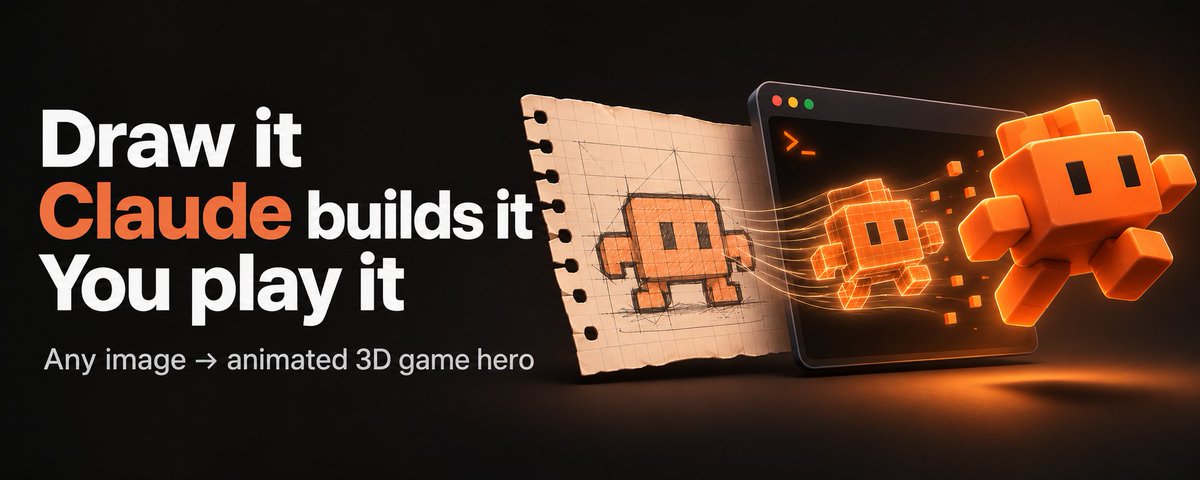
Meshy builds the hero. the right source image and the game around it are in my 3d game hero guide ↓
Bonsai 🌳 retweeted

Our designer had one deadline and four formats to deliver. So she cloned herself to get the work done.
Four of her, zero finished formats. Then she opened Picsart Flow and brought everything together on one canvas.
The article says ration every retake. Black Friday says don't:
UNLIMITED SEEDANCE 2.5 FOR 7 DAYS.
With a qualifying Picsart Ultra annual purchase 👇
picsart.com/events/black-fri…


Bonsai 🌳 retweeted
your e2e tests are already demo video scripts
goto is the opening shot. the click is the action. the final expect is the moment the result is readable. that's the whole brief a 20-second product demo needs
Claude Code runs the Playwright spec, screenshots every step and builds the clip in Remotion, one scene per step, every frame driven by code
one test, one action, one clip. the full prompt is in the reply
the test gives Claude the script. timing, stills and clean revisions are in my remotion video guide ↓
Bonsai 🌳 retweeted
Create images, videos, audio, and motion graphics in one connected workspace.
Picsart Flow brings your creative process together on an infinite canvas.
Start with a ready-made workflow, build your own from scratch, or describe what you want to Copilot.
→ Connect prompts, assets, and AI models
→ Generate and edit images, video, and audio
→ Turn ideas into motion graphics and visual stories
→ Create variations, save workflows, and reuse them
→ Collaborate with your team on the same canvas
From social content and animated stories to product visuals and full campaigns, build the workflow that fits your idea.
Explore Picsart Flow: picsart.com/create
Bonsai 🌳 retweeted
stop learning Blender just to fix one AI character
Blender's own developers built an official Claude connector. it reads your open scene and changes it through Python, live
[setup, once]
· Claude Desktop, any plan, Free included
· Blender 4.2 or later
· add Blender in connectors, install the BlenderMCP add-on, press "start MCP server"
· it runs on MCP, so Claude Code can drive it too
· nothing touches your file until you save in Blender
[what I ask it before a hero goes into a game]
1. apply all transforms, put the origin at the feet, scale the character to 1.8 m
2. rename every bone to one clean scheme so animations retarget
3. list each animation action with its frame range and flag duplicates
4. show polycount per mesh and decimate what's heavy but tiny on camera
5. find unused materials and orphan data, then purge them
6. export hero.glb with animations, +Y up, and tell me what got dropped
if you try only three: 1, 3, 6
the cleanup sits between rigging and the game. the rest of the pipeline is my 3d game hero guide ↓

Claude writes so much code at Anthropic that git stopped keeping up
May 2026: ~2,500 changes merged a day. September: 30,000+
so a team of 7 built their own source control, Scion, and moved the whole monorepo off git in 5 months
the numbers from their write-up:
· main branch history: almost 100 GB
· ~25 million checkouts a day, just for CI
· several hundred git mirrors at the peak
· the new setup: 200x less CPU and memory, checkouts in seconds instead of minutes
how they pulled it off:
Step 1: design for agents, not laptops. git assumes you work offline with a full copy. agents are always online, so the server does the heavy work and clients fetch only what they read
Step 2: let Claude redo the prototype. an early Mythos Preview rewrote their hand-written ingestion pipeline: 20x less memory, 4x faster
Step 3: engineers say "no". Claude sometimes broke core system rules to make a pattern work. humans now review the intent of each change, not every line
Step 4: give each component its own Claude. they run "superfans", Claudes in Slack channels that watch one part's logs and charts all day
Step 5: drop the global merge lock. tests run after merge, and Claude fixes conflicts faster than people spot them
their own caveat: Scion isn't for your repo. it only makes sense at tens of thousands of engineers or swarms of agents
the habit that does scale down: no two writers in the same place
you don't need Scion for 5 agents. you need one owner per file, and that's in my agent team guide ↓
your agent team quits early and calls it done
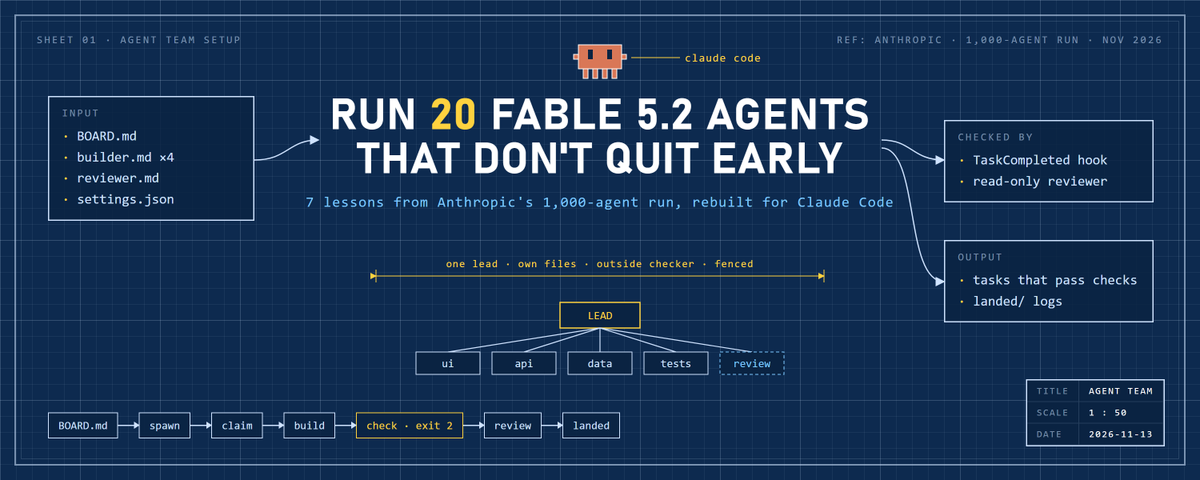
Anthropic's 1,000 Fable 5.2 agents called 47 of 60 tasks "infeasible", then proved most of them anyway
7 lessons from that run, rebuilt for Claude Code ↓
8
12
547
Bonsai 🌳 retweeted
Claude writes ~90% of Claude Code. so who checks Claude?
Addy Osmani just laid out how the Claude Code team does it. their point: without checks you can run one or two Claudes. with them, dozens
8 rules from that post you can set up this week:
Step 1: run the app, not just the tests. a skill called verify boots and drives your app, and Claude uses it before every commit
Step 2: three red rounds, then a human. Claude fixes what fails. if a check is still failing after the third try, it stops and asks
Step 3: a change can't edit its own judge. their Code Review reads REVIEW.md from the base branch, never from the PR
Step 4: let the diff pick the checks. their reliability list has 39 items, each with a trigger. Claude runs only the ones the diff matches, usually 3 to 10
Step 5: tune one reviewer instead of stacking a second, pricier one on top
Step 6: new gates start in observe mode. log what would have been blocked, clear the false alarms, then enforce
Step 7: flaky tests get no retries. no sleeps, no rerun until green. no root cause, delete it and write down why
Step 8: every miss becomes a rule, once it shows up in 2+ PRs, three agents fail to disprove it and a human signs off
the number behind all this: in Anthropic's tests, a separate grader with a rubric lifted task success by up to 10 points, most on the hardest problems
your job stops being reading diffs. it becomes defining done
that's one Claude. a team of them needs the same gate on every task, and it's in my agent team guide ↓
Bonsai 🌳 retweeted
Speed robbed a grandma in GTA VI. 4.7M people watched it
I gave the 58-second clip to Claude Code and asked for one vertical cut. here's what happened at each step
Step 1: stills, not video. Claude reads images, not video files, so it pulled a frame every 5 seconds, then one every second around the action
Step 2: two moments, picked from the stills. 1:25:27, the grab. 1:25:46, the regret. a transcript would miss the best part, because a grandma crawling after her scooter makes no sound
Step 3: the facecam isn't where templates expect it. Speed's sits mid-left: 384×240 at x=4, y=460. one crop changed, the rest of the command stayed the same
Step 4: the game crop moved off-center, 885×1020, so the grandma stays in frame
Step 5: the rules check. no cutscene, no story reveal. it was streamed after GTA VI unlocked in New Zealand, so it isn't leaked footage
the video shows it as a darkroom: film strip, loupe, crop corners, print. the footage inside is Speed's stream, credited on screen
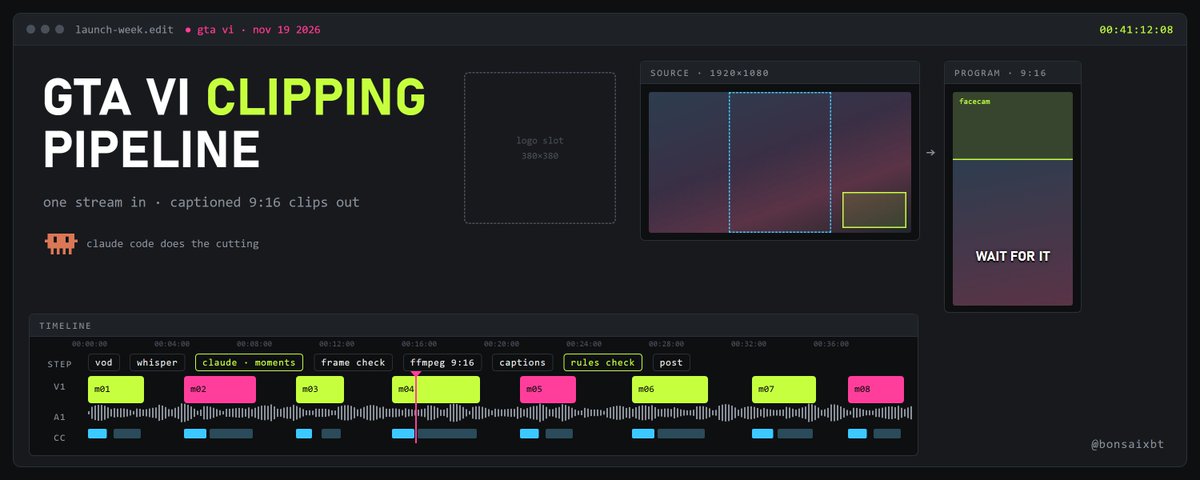
that's one moment from one stream. the pipeline for a whole VOD, with the rules and payouts, is in my gta clipping pipeline guide ↓