

Amateur Astronomer (Hobbyist) * Member: Astronomical Society of Southern Africa (ASSA) * Astronomer member: Slooh The Online Telescope * 🌍 🌒🪐🔭
South Africa
Joined January 2011
- Tweets8K
- Following985
- Followers1.1K
- Likes13.5K






Carol Botha retweeted

🌌 The Triangulum Galaxy, M33, drifts in the small autumn constellation Triangulum about 2.9 million light-years from Earth. A light-year is the distance light covers in one year, almost 9.5 trillion kilometres, so the glow in this image travelled 2.9 million years before reaching a camera.
In the sky the galaxy spans roughly 70 by 40 arcminutes, which means more than two Full Moons could lie side by side along its length, or, with an outstretched arm, a little wider than the tip of the little finger.
M33’s brightness is close to magnitude 5.7 on a scale that runs backwards, where smaller numbers mean brighter objects, the brightest stars sit near 0 and the faintest stars a dark sky reveals to the eye sit near 6.
M33 lies right at that edge, and because its light is spread thinly over such a wide disk, under a suburban sky most people see only darkness where an entire galaxy is waiting.
About 61,000 light-years across and home to tens of billions of #stars, M33 is the third largest member of our Local Group after Andromeda and the Milky Way. Near the edge of one arm glows a small red knot, NGC 604, see my image below, a stellar nursery around 1,500 light-years wide and one of the largest star-forming regions known in our cosmic neighbourhood.
🔭 Tonight M33 stands high in the south around 22:00 as seen from central Europe. Under a truly dark sky, with fully adapted eyes, some observers catch it without any optics, which makes it for them the most distant object the unaided human eye can hold.
This portrait below collected 4 h 13 min of light with my Vespera II smart telescope on my rooftop, its 250 mm focal length wide enough to frame the whole disk in one field, while the long integration slowly lifted the faint outer arms out of the noise.
🕰️ When this light left M33, the Earth was in the late Pliocene, and in East Africa the last Australopithecus afarensis walked upright through open woodland while the earliest traces of our own genus Homo were only beginning to appear. There was no fire kept on purpose, no word written, and yet the photons arriving on a small sensor tonight were already crossing the dark between two spiral galaxies.
🌍 Geologically, the planet was turning colder. Ice sheets began to grow across the northern continents, the oceans and the land were already close to their modern shapes, and grasslands kept spreading where forests had once stood.
#etexists 👽 Here the clock runs in both directions. If someone on a world inside M33 were looking toward us tonight, they would see the light that left Earth 2.9 million years ago, a planet without cities or lamps, where a few early humans were learning to survive under that same sky. Our first radio voices have travelled barely a century, and they will need almost three million years more to reach that galaxy.
🎶💃🕺 They would hear wars and fear, but also music, laughter, and a species asking big questions far beyond its reach. #WeWereHere Whatever we become, that faint signal would carry the memory of a young unfinished civilization at its crossroads, loud in its own confusion, not yet sure whether its next step leads to its collapse or to the stars.
#DeepTime Two galaxies, each seeing the other as it once was, each holding only an old letter from a neighbour it cannot visit.
#CosmicEchoes Perhaps that is the quiet gift of M33, that every glance into the night sky is a glance into memory.
Enjoy the light /@xipteras #Triangulum #astrophotography


Carol Botha retweeted

Fifty million years ago, a white dwarf in NGC 1433 was obliterated in a thermonuclear explosion. That light just reached Earth. 💥
Watch supernova SN 2026ahvu appear in Bennett 21 through Slooh’s Australia One telescope 👇
buff.ly/mJDpQOH

I have this ritual of tidying my tools before I start a project. There is stuff to catch up on since my last visit to Jupiter's moon, Io. The Moons Symphony 's LUNAR course will again become the focus of my attention. I love when I can outfox AI #solarsystem #moons #music #art

7
209
School and College education is Slooh's priority and senior students are having a Halloween ball 👻
Of course I jumped into this new Quest as soon as it was launched. My poster. My badge!
#Slooh #sloohshare #Halloween26 #onlinetelescope #OnlineEducation

47
I'm having a lot of fun setting up missions to spooky objects on Slooh. As the Moon is still quite bright now, observations of faint nebulae are tricky. This image was from a mission back in Sept 2026 when the sky was dark. #slooh #sloohshare #Halloween #onlinetelescope

3
62
Carol Botha retweeted
I am really looking forward to doing my atmospheric optics talk at the Society for Popular Astronomy meeting in Northampton on Saturday afternoon


Carol Botha retweeted

I was totally fixated on this cell near Macomb, IL on a moderate risk day, June 11th. Meanwhile new storms were quickly building to the east that I ought to have kept a closer eye on. Barely left this & its buddy behind in time to catch the tornado near Ipava a few minutes later.

Carol Botha retweeted

Come join us!

In less than a month, Vision Weekend returns to San Francisco. This time to mark 40 years of Foresight!
Across iconic locations like the USS Hornet, @internetarchive, The Fold, and Lighthaven, the weekend brings expert talks, office hours with your favorite orgs, $10K pitch competition, behind-the-scenes lab tours, 1:1 connections, a sci-fi book swap, plus our main 40th anniversary celebration in the US.
Full lineup:
Secure, Sovereign & Resilient AI
• @woj_zaremba, OpenAI Foundation
• @ilblackdragon, NEAR Protocol
• @sebkrier, Google DeepMind
• Jenny Read, ARIA
• @gladstein, Human Rights Foundation
• @zweinberg, ex ante
Neuro AI & AI for Neuro
• @SumnerLN, Merge
• Matt Angle, Paradromics
• Matthew MacDougall, Neuralink
• @maxhodak_, Science Corporation
• @JoanneZPeng, Amaranth Foundation
• @AdamMarblestone, Convergent Research
Life Unlimited: Biotech & Biosecurity
• @thekaransinghal, OpenAI
• @mattkrisiloff, Conception bio
• @hannu, Red Queen Bio
• @velychko_s, Soxogen Bio
Molecular Manufacturing, Nanotech, Energy & Space
• Ralph C. Merkle, Institute for Molecular Manufacturing
• Ivan Jayapurna, ARIA
• @schingler, Planet Labs
• @erika_alden_d, Pioneer Labs
• @ltelkins, UC Berkeley - Space Sciences Lab
New Funding & Innovation Paradigms
• @tkalil2050, Renaissance Philanthropy
• @FutureSaenko, Future Ventures
• @v_maini, Mythos
• @_mattmandel, Cosmos Ventures
Nonprofit Funding Perspectives
• @nanransohoff, Public Goods at Stripe
• @rohan_subramani, Coefficient Giving
• @seemaychou, Astera Institute
Existential Hope
• @mattbotvinick, Anthropic
• @RosieCampbell, Eleos AI Research
• @PracheeAC, Astera Institute
• @sreeramkannan, Eigen Labs
• @NicoleOzer, Electronic Frontier Foundation
+ an Anti-Debate hosted by @Liv_Boeree
With the All Access pass, you’re invited to join speakers, sponsors, fellows, and grantees at exclusive gatherings across the Bay Area, including lab tours at @E11BIO, @LongshotSpace, @calwave_energy, @DolphinLabs, and @ScienceCorp_ , plus attend our 40th anniversary soiree. A limited number remain.
Links in thread.
Powered by: @protocollabs, @eigenlabs, @paradromics, @RetroBio_, FUTO, and @d_model_ai
Carol Botha retweeted
“Slooh will be there and I am watching from very high above.”
Carol Botha, a Level 9 Slooh member, can’t be in the Canadian Rockies for the Jasper Dark Sky Festival, which runs October 16–25. So she’s following along from afar, through Slooh’s visit. You can watch too over on Slooh's Instagram!
buff.ly/JcLgR7c
#DarkSky


Carol Botha retweeted
🌌 At the Edge of the World
For as long as there have been people, they have wanted to know where they stand. Toward Scorpius and Sagittarius the Milky Way stops being a faint band and turns into structure, a river of star clouds torn open by the dust lanes of the Great Rift, and behind it all, about 27,000 light years off, sits the centre of our galaxy.
Sagittarius A* holds 4.3 million solar masses inside a region smaller than Mercury's orbit, yet no camera, not even mine, finds it in visible light, because 25...30 magnitudes of dust stand in the way. My photo shows the foreground instead: Antares burning orange inside the Rho Ophiuchi clouds, the dark tangle of the Pipe Nebula, and the bulge glow that is as close to the galactic heart as human eyes get.
🔭 Geometry decides who gets to see this properly. From Germany the galactic centre never climbs much above twelve degrees, so it sits in the thickest air the atmosphere has. From Sotavento beach, at 28 degrees north, it reaches roughly thirty three and stands clear over the Atlantic, which is part of why Fuerteventura has held UNESCO Starlight Reserve status since 2015.
🕛 A wide field like this is not one moment but many. Antares sends light that left in the 1470s. M7, the Ptolemy Cluster, shows us roughly the year 1050. The nebulae of Sagittarius reach back four to five thousand years, to the first pyramids and the Stonehenge sarsens. And the direction of the core, 27,000 years deep, points at the height of the last glacial maximum, when ice sheets covered northern Europe, mammoth herds crossed the steppe, and people in Moravia were already firing figurines out of clay.
🌍 By the planet's own clock those 27,000 years are nothing: same continents, same mountains, only ice and sea level have moved. The Sun's circuit around the galactic centre takes 225 to 250 million years, so all of human history fits inside a fraction of one galactic year.
👽 #etexists If anything is listening in there, among the millions of stars packed into the bulge, our earliest radio signals need another 27,000 years to arrive, and they arrive as a fossil. Whoever receives them hears an unfinished species, loud in its own confusion yet still unable to escape its own inventions. They will have no way of knowing how it ended. Neither, at this point, do we.
✨ #WeWereHere The old question has an answer, and the answer is a location. We are not at the centre of anything. We sit far out on a quiet arm, 27,000 light years from the crowd, looking in at a place we will never reach. That distance is not a demotion; it is the reason our sky is dark enough to ask the question at all.
#DeepTime #CosmicEchoes
✨ ✨ Whether we like it or not. Whether we accept it or not. Whether we pass a law against it or not. We’re orbiting the center of our galaxy—a binary black hole that’s hidden somewhere in the centre of the image—at a speed of 230 km/s standing on a sphere in a vacuum. All of us together—enemies or friends, kind or rude, holy or unholy. It takes us 230 million years to complete one orbit. Period. This is as close as I can get to photographing what we’re all quietly circling around.
Thanks for reading + CS /@xipteras #Sagittarius #Scorpius #astrophotography
--
Sony α7 V · Sony FE 35 mm f/1.4 GM at f/2.5, ISO 1600 · Vixen Polarie on Gitzo GT0545T · 19 × 30 s = 9.5 min total · unfiltered · Playa de Sotavento, Fuerteventura, Starlight Reserve · July 2026

Carol Botha retweeted
Plains chasing was rough for structure this year. Much of that due to my dumb choices. I stopped just once at a photogenic distance for this storm near Frankfort, KS, June 13th. Then rushed forward, thinking it might produce. Nothing but nonstop, grungy repositioning after that.

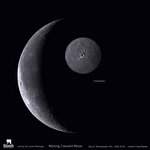
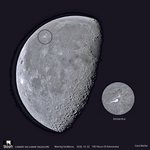
Waning Crescent Moon 22% illumination. This is quite a moment, first time seeing inside Aristarchus on one of my own images. Now, when zooming in I can actually see the hole formed by the impact as well as a very prominent ejecta ray.#Slooh #sloohshare #Moon #onlinetelescope

'My' New Perspective on the Solar System: not to scale 😆All images on my poster were captured using Slooh's telescopes. Of course I had to include Pluto😄 Earth is from one of my Sentinel 2 satellite missions via Slooh. If kids can get to play...... #Slooh #100HoursofAstronomy

100 Hours of Astronomy 2026 Slooh's Star Party inspired me to recap what I have learned this past year.
The Moons Symphony LUNAR course has definitely given me a New Perspective of the Solar System
#100HoursOfAstronomy #Slooh #TheMoonsSymphony #solarsystem #planets #Moons
