

Assistant professor @kenanflagler strategy and entrepreneurship.
Chapel Hill, NC
Joined March 2010
- Tweets7.9K
- Following2K
- Followers2.1K
- Likes39K




Pinned Tweet
Journalism ethics proposal: if you write about research, provide a link. Or at least a title.
My hot take on the AirBnB thing: they never should have called it a cleaning fee. They should have just allowed hosts to have a fixed and variable component to their pricing to accommodate whatever business model or cost structure the host chooses.
1
6
325
Andrew Boysen retweeted

One reason it's harder for AI to beat Econ than to beat Math is that most published papers in Math are correct, whereas most published papers in Econ are wrong.
What's more, if you only read papers, you get the wrong idea about what is wrong.
From the written record, you would conclude that the biggest problems with a generation of diff-in-diff studies have to do with standard errors or negative weights, when in fact the biggest problem is that most DiD studies are poorly conceived and don't satisfy the necessary assumptions for diff-in-diff to work.
Understanding of this is mainly in researchers' heads.
So very good models will stay stupid things like "if you want a causal estimate, you'll need an IV for structural change, maybe you could use distance to coast."
Andrew Boysen retweeted

De-skilling myself on doing CAPTCHAS and navigating dark patterns in customer service.


Andrew Boysen retweeted

This is such an important point. The laffer curve is not some fixed law of the universe, it depends heavily on how we structure the tax system itself.
Ending the step-up loophole by taxing gains at death is one of the most important tax policy changes we could make.


Andrew Boysen retweeted

Antidepressant treatment during ages 8-14 improves test scores at 16 (especially math), increases university enrollment at 18, and leads to higher employment and earnings at age 25-30.

Andrew Boysen retweeted

An opinion I wrote for the Boston Globe is out. It cites eight and nine figure software purchases as part of administrative bloat 2.0 in higher education. Free version. globecollegetown.substack.co…
Andrew Boysen retweeted

People often think of @RefineDotInk as an academic product.
But where using it is a real no-brainer is when a lot of money is on the line.
Here it finds fatal flaws in a pre-IPO investor roadshow (by Nikola Corporation) that turned out to be a scam.


Andrew Boysen retweeted
It is not inherently bad to publish research on the impact of AI that only refers to older models, but it requires a very careful discussion and has to be very clear to non-technical readers.
If you show AI can do something, its fine. Generally, once AI has gained an ability, it does not regress in future generations. So papers that show that AI has crossed a threshold (such as "good as a human") or that seek to establish some sort of minimum impact or effect still hold up even if they used GPT-4.
If the finding is that AI is bad or biased at something, you need to be much more careful. You cannot claim that because GPT-4 fails at something, that AI is bad at that task, because current or future models may do it. So what can you claim? These are just some examples:
1) You can just be explicit: "GPT-4 could not do X." This is a rare way to frame things because it is not really an interesting publishable paper in many cases. However, if you provide the information needed to reproduce your work, it can become a useful benchmark to measure progress.
2) You can measure trends: compare GPT-4 to GPT-5 to GPT-5.6 Sol or whatever (it is really important to include at least one reasoning model). You can then make better claims about abilities relating to this task.
3) You can make a strong, grounded argument that AI has a natural flaw or limitation that means it cannot do X, and then demonstrate evidence that this might be the case.
4) You can focus on a moderator or mediator: this sort of prompting or approach or social context or connection impacts the ability of GPT-4 to do X, and needs to be a concern for the future.
5) You can focus on humans: how do people react to AI? what are the failures and successes? what dangers or advantages or changes does it bring to us?
Again, these aren't exhaustive, but generally negative capability claims have been much less durable than positive ones.
Apparently, the place I used to get my hair cut is now also selling wallpaper (and advertising with a terrible looking email). Might be one for my corporate strategy class.

5
148
Andrew Boysen retweeted

Why would a mortgage lender launch an athleisure brand?
I have no idea.
But I am working on a write up about terrible diversification strategies, and this will definitely be an example.
Well, at least it’s not a public firm destroying shareholder value.


I’ve told a lot of people to expect talent pipeline issues from AI automation of entry level work based on what I’d seen with analogous shifts in the past, but this adds some interesting nuance.

Very happy to share a new paper with Guido Friebel, Yao Huang, Jin Li, and Andrew Zhang on how AI could change the structure of internal labor markets.
We show that cutting junior hiring when AI arrives may weaken the pipeline that creates future seniors and lead to “lost cohorts” of juniors and cycles of shortage and glut over time.

Andrew Boysen retweeted
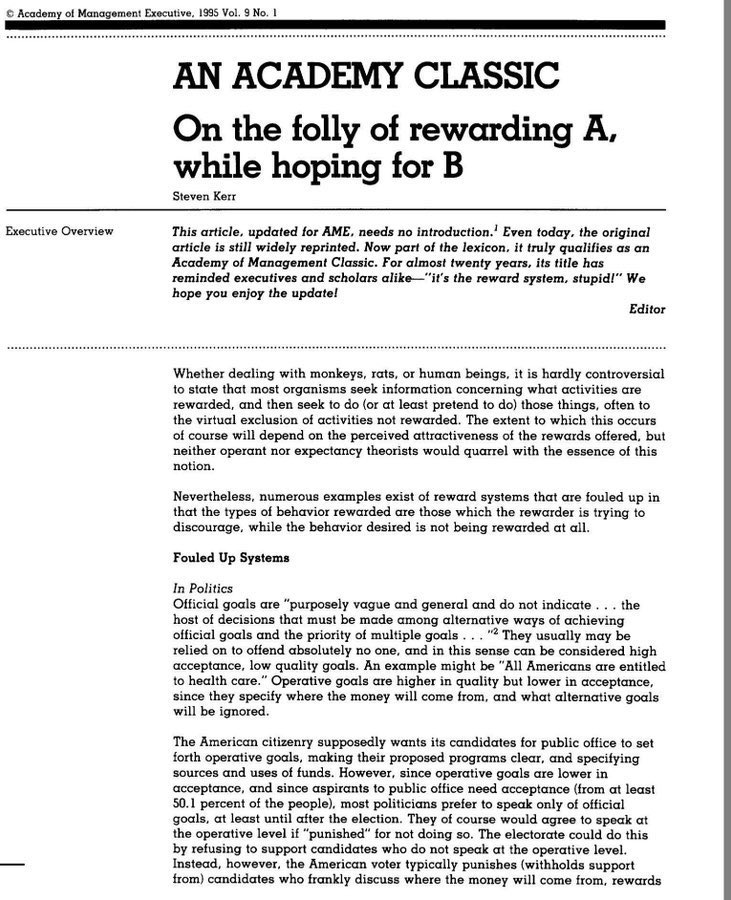
Everyone should read "On the Folly of Rewarding A, While Hoping for B” at least once.
ou.edu/russell/UGcomp/Kerr.p…

Exclusive: Meta employees are competing internally to become “Token Legends,” ranking themselves by how much AI compute they consume.
The leaderboard reflects a new status game where token usage is tied to productivity and influence. thein.fo/4cagfEP

Andrew Boysen retweeted

The most likely interaction any of us will have with the police is a traffic stop. That simple fact accentuates the import of the following question: when an officer decides to pull someone over, does race play a role? It sounds like a straightforward question. It is not. And the reason comes down to a measurement problem that has haunted this literature, and many others, for decades.
What do you need to properly explore this question? Three numbers: i) how many minority drivers were stopped, ii) how many minority drivers were on the road, and iii) how many minority drivers were actually speeding. Knowing all of these is a tall task, especially knowing who was speeding among those who were never pulled over.
I call this the denominator problem and measuring discrimination critically relies on solving it. Prior research has a bunch of creative: veil-of-darkness designs, daytime versus nighttime comparisons, benchmark approaches using census data. All clever. Yet, they do require certain assumptions that everyone is not comfortable making.
A paper that I just talked about at our student visitation day this past Friday (and I will talk about this week in my Economics for Everyone course) solves it differently. When I was back at Lyft, we leveraged records on the GPS location of every driver every few seconds. That gives us actual driving behavior — speed, location, time — for over 200,000 drivers before any police interaction occurs. We matched those records to official Florida speeding citations secured through a Freedom of Information Act request (kudos to Florida, still the only state to adhere to our FOIA).
As far as I know, this is one of those rare occurrences where we have solved the denominator problem: who was on the road and exactly how fast are they driving?
Guess what we found? You can find out here (it is depressing so I am not going to recount it): ideas.repec.org/p/feb/natura…
But the broader lesson I want to make with my students is that the denominator problem is not unique to discrimination research. It shows up everywhere in social science. Hiring discrimination studies rarely observe the full applicant pool and almost never observe underlying qualifications. Health disparities research cannot see who never sought care. Criminal justice research fights this at every turn.
The general insight is this: selection into measurement is itself the phenomenon you are trying to study. In certain cases, partnerships with organizations can help to solve that key issue.
Andrew Boysen retweeted

This sounds like torture


When you chose a school for your kids, you probably didn't realize you were choosing educational software, but that choice of software might be more consequential for your kid than the choice of school.
moultano.wordpress.com/2026/…

Andrew Boysen retweeted

Automating meeting scheduling is being hyped again (but this time it'll be different because "AI agents"). My advice: if you value your time, stay away from such tech like it's radioactive waste. Making scheduling painless is how you get "meetings that should have been emails". Scheduling friction makes it easier to be thoughtful about how you're spending your time. Not all types of friction are bad — I think the majority serve some useful purpose, albeit accidentally in some cases.
Andrew Boysen retweeted

Actually, this is wrong. But we do have research that offers more accurate information about habits. See: pnas.org/doi/10.1073/pnas.22…


Andrew Boysen retweeted

One of the best minimum wage papers to date, leveraging IRS tax data on businesses, matched to individual survey data, and a clean difference-in-difference design using 19 sizable increases in the 2010-2019 period. Sheds light on jobs, revenue, reallocation effects.


#QJE Feb 2026, #7, “Who’s Afraid of the Minimum Wage? Measuring the Impacts on Independent Businesses Using Matched U.S. Tax Returns,” by Rao (@nirupama_rao) and Risch: doi.org/10.1093/qje/qjaf053

Such a great video for illustrating tacit knowledge. wsj.com/video/series/coveted…

2
141
Andrew Boysen retweeted

Okay. One more comment.
Earlier I distinguished A/B testing from price discrimination. The A/B testing would be to learn about your demand curve for the market.
There is another possibility for prices hopping around: strategic randomization.
The intuition is this: if you always charge $5, your competitor charges $4.99 and steals your customers. If you always charge $4.99, they charge $4.98. No pure strategy survives. In equilibrium, sellers randomize. Each seller picks one probability distribution over prices, not tailored to individuals, just one strategy for the whole market. Different customers end up paying different prices, but not because anyone profiled them
If you want to see how to derive this in a model, keep reading. This is actually the simplest way to teach undergrads price dispersion, a hugely common phenomenon. The same product sells for different prices at different stores, even in the same neighborhood.
This is the simplest model to teach this to undergrads. you can draw the marginal revenue curves!
The classic model is Burdett and Judd (1983). Here are my old notes briancalbrecht.github.io/pri…
Here's the setup:
Two sellers. Three types of buyers: those who can only buy from seller 1, those who can only buy from seller 2, and those who can buy from either. Think of this as some buyers knowing about one store, some knowing about the other, and some who comparison shop.
What's the equilibrium? If there were no comparison shoppers, each seller charges the monopoly price to their captive customers. But with comparison shoppers, there's pressure to undercut.
What's the equilibrium here? Start with seller 1's problem. If seller 2 charges zero, seller 1's demand curve is a step function. She can charge the monopoly price of 1 and sell only to her loyal customers, or match at zero and sell to everyone who isn't loyal to seller 2.
The best response is to charge 1 and collect revenue from loyal customers. This is also the worst case for seller 1. She can guarantee this payoff no matter what seller 2 does.
But seller 2 won't charge zero. Before getting to best respons, ask, how high can seller 2 price before seller 1 changes behavior? As seller 2 raises her price, seller 1's demand curve shifts up in the middle section (the comparison shoppers). Seller 2 can raise price to that (the middle red bar for charged to the comparison shoppers) without inducing seller 1 to deviate.
So seller 2 can at least do that.
Now the key move. Seller 2 can do even better by randomizing between p lowerbar and 1. This creates a demand curve for seller 1 that slopes down smoothly rather than stepping. With the right distribution, seller 1 becomes indifferent across all prices in that range.
The result: in equilibrium, sellers randomize over prices. Each seller picks ONE strategy (a probability distribution over prices) that applies to the entire market.
We already know no pure strategy equilibrium exists. But there's also no price discrimination. There's no experimentation to learn the demand curve.
Price dispersion (price randomization) without price discrimination. Different customers pay different prices, but not because the seller identified their willingness to pay. The seller picks one mixed strategy for everyone.
This matters for the Instacart discussion. When we see price variation, the instinct is to assume someone is being targeted. And that definitely happens in many markets. But price theory gives us models where dispersion emerges from competition itself.


Let me say a bit more about different shoppers seeing different prices on Instacart for the same products. The framing treats this as alarming evidence that "the notion of a single price is breaking down."
The article involves at least three distinct concepts that economists analyze differently: randomized pricing experiments, dynamic pricing, and price discrimination.
Let me untangle them:
nytimes.com/2025/12/09/busin…
Randomized Pricing Experiments (A/B Testing)
What Instacart says it's doing is running pricing tests. Some shoppers randomly see $3.99 for eggs; others see $4.79. The purpose is to learn how price-sensitive the market is across different product categories.
This is standard A/B testing, the same methodology that virtually every online company uses to improve its products. Netflix tests different thumbnail images. Amazon tests button placements. Retailers test prices. The randomization means the prices are not based on any individual characteristics. You get $4.79 for eggs because a random number generator assigned you to that treatment group, not because an algorithm profiled you.
Why would you do that? Well, we draw the demand curve for a monopolist and assume they know that curve and pick the optimal price. But you don't know the demand curve so you want to learn how quantity demanded changes with price.
Dynamic Pricing
The article discusses "dynamic pricing" where prices adjust over time. As I wrote when Wendy's considered dynamic pricing economicforces.xyz/p/should-…, dynamic pricing means adjusting prices over time. Sometimes this reflects genuine cost differences (workers at lunch rush are more expensive per burger produced).
Usually we think about this as being based on supply and demand. I mean everything is, but this is based on the curves moving through the day/week/month/year.
Uber's surge pricing is the canonical example: when demand spikes after a concert, prices rise to attract more drivers. Uber, in this example, isn't randomizing across time. They are responding to observed supply and demand factors.
Other times, it's an attempt to extract more from consumers willing to pay more. The line between "just supply and demand" and price discrimination isn't always clear. I'll say more on that.
Instacart said that prices "never change in real time, including in response to supply and demand." So the Instacart case isn't dynamic pricing in the Uber sense.
Price Discrimination
Price discrimination means charging different prices for goods that are identical from the seller's perspective, based on consumers' willingness to pay. Senior discounts, student pricing, and coupons are all forms of price discrimination. This is what everyone seems to worry about.
It's also not what the study found.
But that's not really the narrative of the piece, let alone the Groundwork piece or More Perfect Union.
It's all worry about price discrimination. "But there is little doubt that Instacart and other online sellers have the ability to do so." It then notes that "Companies including Delta Air Lines, Amazon and Home Depot have been accused of experimenting with such personalized pricing."
A random person speculates "We're going to tailor the price to you".. "We're going to get the maximum amount of money out of you that you're prepared to pay and drain your pocketbook." And the article cautions that frequent price changes "could make it easier for companies to adopt personalized pricing strategies in the future."
Then there are a handful of other things topics touched on. There's a paper the Times cites about "algorithmic coercion" is about something specific: when all competitors use algorithms that can instantly match price cuts, firms have less incentive to cut prices in the first place. Algorithms are worth studying. But it's about competitors coordinating on high prices, not about firms extracting personalized prices from individuals.
Why Price Discrimination Isn't Always Bad
Even if we were talking about price discrimination, and there's no evidence we're not talking about A/B testing, the article's framing assumes any variation in prices harms consumers. This is an empirical question but clearly not always wrong.
@_amackay point out the key trade off "many pricing strategies resulted in higher costs for less price-sensitive — and therefore potentially higher-income — consumers, while lower-income consumers paid less." Price discrimination is discriminatory, usually progressive, but never strictly worse for everyone.
In my research and writing on price discrimination economicforces.xyz/p/does-pr… briancalbrecht.github.io/alb… I've found that with competition, price discrimination can even maximize consumer surplus. That's a particular model but at least should give some pause.
Empirically, its a big mixed bag but papers find real benefits from price discrimination.
On the theory side, even without competition, I think there's a good case for wanting more price discrimination
economicforces.xyz/p/monopol…
But there are qualifications, like the algorithmic coercion paper above.
The type of pricing matters for thinking about counterfactuals. Those pesky counterfactuals.
The Groundwork piece found the price variation could add up to $1,200 over a year of grocery shopping. That calculation compares a world with randomized testing to a world where everyone gets the lowest tested price.
To be kind, that's not a plausible counterfactual.
Without A/B testing, Instacart doesn't charge the lowest price in the range, it charges some uniform price, probably near the middle. Under randomization, a chunk of consumers pay more than they would under uniform pricing, a chunk pay less. One question is whether the average price would rise or fall. That's an empirical question but clearly $1,200 isn't plausible.
Personalized price discrimination is different. If you ignore the people who gain from price discrimination because the price was dropped for them (seniors who don't go when they don't get the discount), there's at least a story about the algorithm systematically extracts more from people willing to pay more. That's a coherent concern about how the pricing system is just driving up prices. But it's not what the study found!


