

looking to talk to people about what a better phone would look like! dm or https://xitter.cf/t.co/bXNKcuQxpo
San Diego, CA
Joined March 2018
- Tweets22.2K
- Following1.9K
- Followers2.6K
- Likes189K


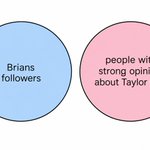


it's fun that cardamom's two effects are to 1 make fruit way fruitier by 2 making it taste like wrought iron
Noticing I use different moral frames for (investing) and (regular life). Like if a guy came to me and was like I'm gonna hypnotize people and then show them ads can you give me some seed money I'd be like...no??? But google, instagram are normal seeming investments

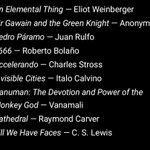
liking reading a lot again lately. does anyone wanna read / do a low effort book club on any of these with me?

and the fictional Mexican border city of Santa Teresa (closely modeled on Ciudad Juárez). It begins almost like an extremely funny satire of European literary academics and gradually opens outward into journalism, philosophy, war, murder, art, Nazism, sex, dreams, globalization, and evil.
The famous/infamous fourth section is an intentionally numbing catalogue of murdered women, based on the femicides around Juárez. That's the moral black hole around which much of the novel revolves.
What's fascinating is that Bolaño refuses to give you the satisfying conspiracy diagram where everything connects. Patterns emerge everywhere, but explanation continually recedes. Adam Kirsch described the book's real action as occurring on "poetic, even mystical planes of symbol and metaphor," while Jonathan Lethem called it a "landmark in what's possible for the novel" in a post-national world.
This might appeal particularly if you enjoy systems that generate enormous amounts of evidence without resolving into a legible system. It repeatedly tempts the pattern-recognizing part of your brain and then denies it epistemic closure.
Why read it: if Pedro Páramo is a haunted village in 120 pages, 2666 is a haunted civilization in 900.
Also: despite its reputation, the prose itself isn't especially difficult. The difficulty is cumulative and emotional rather than sentence-level. A New Yorker reading group similarly noted that it's intimidating-looking but surprisingly readable.
---
Accelerando — Charles Stross
Probably the most straightforwardly rationalist/old-school-transhumanist item here.
It follows three generations of one family as humanity blows through increasingly rapid technological change: ubiquitous computing → [wft chatgpt! redacted!!]
The fun is the idea density. Stross barely gives you time to digest one insane implication before throwing five more at you. Things other novels would build their entire premise around get used as throwaway jokes.
And this isn't accidental. Stross described it as his "in-your-face novel about the singularity" and used computing power per kilogram as a rough clock for technological acceleration. Cory Doctorow called it simply "magnificent"; contemporary SF commentary variously described it as "plausibly surreal," "mind-bending," and a book people interested in SF ought to read.
The interesting thing reading it now is almost archaeological. It captures a particular early-2000s transhumanist imagination—open source, reputation economies, smart agents, uploads, runaway computation—before deep learning changed everyone's picture of AI.
So you get two books simultaneously: a gonzo future history and a fossil of what very smart internet people circa 2001 thought the Singularity would feel like.
Why read it: if you want to mainline 2000s extropian/transhumanist internet culture in novel form.
---
Invisible Cities — Italo Calvino
Marco Polo describes 55 fantastical cities to Kublai Khan.
That's almost the entire "plot." Each city is only a page or three. One is constructed over an abyss; another consists of relationships between pipes; another is essentially its inhabitants' desires; cities mirror memory, language, death, signs, desire, and themselves.
Eventually it becomes apparent that you're not really reading about cities.
You're reading 55 different cognitive models for inhabiting reality.
Calvino called it his "most finished and perfect" book. Critic Paul Bailey called it a book that throws up "breathtaking imaginative insights on almost every page." John Updike's broader description of Calvino is also apt: beneath all the fantastical machinery, his investigations spiral toward the question "How shall we live?"
Why read it: possibly the best bedside book here. Read one
city before sleeping. Don't binge it.
---
Hanuman: The Devotion and Power of the Monkey God — Vanamali
This is the odd one out because it isn't primarily literary fiction. It's a devotional/mythological treatment of Hanuman drawing on the Ramayana, Puranic material, variant traditions, prayers, and oral stories. It contains 36 major Hanuman stories and commentary on their spiritual significance.
The interesting thing, particularly coming from rationalist-adjacent culture, is to not read it as "here are some ancient propositions; which are factually true?" Read it from inside the devotional technology.
Hanuman is an extraordinary religious archetype: immense power coupled to almost complete egolessness. He's a warrior, trickster, scholar, celibate ascetic, servant, monkey, and embodiment of bhakti. His strength comes precisely from orienting himself toward something other than himself.
So the interesting question becomes: what sort of human psychology is produced by devotion? Why have millions of people found this particular image of strength-through-surrender compelling?
Why read it: it's the book here most likely to expose you to an alien-but-coherent theory of mind and human flourishing rather than merely tell you a good story.
---
Cathedral — Raymond Carver
Carver looks almost absurdly plain next to Bolaño and Calvino.
That's the trick.
These are stories about drinking, marriages, unemployment, resentment, awkward conversations, shitty apartments, people eating dinner. The prose appears to be doing almost nothing. Then suddenly some tiny gesture cracks open the entire emotional reality of a person's life.
The title story is especially wonderful: an insecure, prejudiced man meets his wife's blind friend, and through the seemingly ridiculous act of drawing a cathedral together, something happens that the narrator himself barely has language for.
Carver said the story was "completely different from everything I'd written before" and that he'd "tapped into something." He specifically liked that it affirmed something and involved a kind of communion.
And a nice endorsement for your purposes: Haruki Murakami chose Cathedral as his selection for an artists' reading series. Murakami is also Carver's Japanese translator and a major admirer of his work.
Why read it: it's a corrective to intellectual overcomplexity. Carver demonstrates that you can get somewhere metaphysical without talking metaphysics at all.
---
Till We Have Faces — C. S. Lewis
Do not expect Narnia.
Lewis retells Cupid and Psyche from the perspective of Psyche's ugly older sister, Orual. Orual believes the gods have wronged her and essentially spends the novel assembling her case against them.
The brilliant conceit is that her complaint is the story. As she tells you how unfairly she has been treated, you slowly acquire enough information to see things she cannot see about herself: love becoming possession, rationalization disguising jealousy, self-sacrifice containing domination, resentment constructing an internally impeccable worldview.
It's almost a novel about motivated cognition.
The title eventually becomes the thesis: how can we encounter reality—or God—until we "have faces," i.e. until we've stopped hiding behind the stories we've constructed about ourselves?
Lewis himself repeatedly called it "far and away my best book." And it really is unusually unlike stereotypical Lewis: psychologically ambiguous, mythic, pagan-Christian, and considerably less interested in handing you explicit apologetics than in showing how a mind deceives itself.
Why read it: if the idea of C. S. Lewis writing a novel about self-deception, epistemology, eros, religious experience, and the unreliability of one's own moral narrative sounds interesting, that's basically what this is.

Psyched to go to this! Recommend Laura's stuff for anyone still trying to do embodiment rather than (or in addition to) merging with the machine god
She has really broad knowldge of tools humans use to talk to our bodies, and her classes are v information dense, I learn a lot

I am offering another Thrum: The Dragon's Breath. Join me! luma.com/9wamo89p via @LumaHQ
This will be an opportunity to do inner Autumn cleaning and release the soul tartar that builds up and would be healthiest outside of your system. This is a more intense breath with spinal/head-tail movement practice. It will allow a playful approach to setting free darker, sticky material.

I notice most people look at life’s challenges through a main lens or two - seeing the world as physical, logistical, social - but today I’m wondering what it would feel like to experience the substrate as all emotion, moving through the reality as swimming into semiviscous