

Marketing Professor @ChicagoBooth. Co-editor @QME_Journal. Tweeting about economics, advertising, dogs and sometimes soup. SSRN page: https://xitter.cf/t.co/LcTRerqE
@ChicagoBooth
Joined August 2011
- Tweets21.5K
- Following1K
- Followers7.3K
- Likes49.8K





Pinned Tweet
As lots of people are liking a post I wrote that has the word "advice" in it, I need to issue my periodic reminder that my advice may in fact be terrible. I know very little, in general.
Yikes UPL....

Where the Sabres defense ranks this season (ranking from fewest to most) @NatStatTrick
Shots allowed - 12th
Scoring chances allowed - 8th
High danger chances allowed - 12th
xGA - 9th
Save % - 30th
Would you look at that, Luukkonen *can* stop something!

Brad Shapiro retweeted

i dont know how you can read this and come away **pessimistic** about the future of ai and bio.
we dont need a magic box that you ask to cure cancer, we need to:
1) tighten up the lab loop (including on shoring synthesis) so you can design on monday and test on tuesday
2) combine data from many stages, health records, and other experiments into general models not just rely on fleets of one-task wonders
3) build platforms that allow small teams to iterate fast
we’re not going to magically cure everything instantly but given that the current baseline is 4 years in discovery and then 5+ years of trials with a 92% trial failure rate, we can have a huge impact by just compressing discovery (and there is a lot to compress!) and nudging the success rate up to 12-15%
this isn’t even taking into account what can be improved on the delivery side to take existing drugs that mostly work but are maybe a little too toxic at higher doses and targeting them efficiently

There’s a really pronounced divide between people who are on the AI side of things and people who are on the biology side of things. Even among people working in AI, the divide persists based on where they’re focused.
The AI side, adherents of scaling laws and the bitter lesson, believe that AI getting better means AI being more capable of novel discoveries in medicine (that go beyond discovering new drugs in well understood targets or speeding up dry lab work etc).
The biology people think the idea of a bitter lesson in biology is kind of ridiculous and that regardless of AI’s capabilities it’s going to be at least 5-10 years until you could hope to reliably simulate human toxicology in silico (right now AI/ML can’t even reliably simulate in vivo studies like binding affinities or functional assays).
Even the most AI pilled of them, who will list all the areas that AI can reduce the time spent on various areas, don’t think the concept of AI discovering novel targets or generating new understanding of causal biology is realistic in the near term. Most, in fact, will readily characterize the assumption that even an “ASI” level model could find cures hidden in our current understanding (without expanding that understanding with significantly more biological data) as patently false.
This was a big part of why we wanted to experience it ourselves by using AI for a (very) small portion of what it can do in biology. It was both mind blowing and revealed some poignant insights into how different the problem of making AI better at something like coding is to the problems of biology.
Even if it unlocked the ability to generate new molecules at a stunning pace, its simulation (in silico) of binding only had 49% accuracy. And if we wanted to improve that, we’d need to feed it back the data from the lab - data that took about 30x as long to get as it took to generate the molecules. And these were tests in a test tube (turn of phrase), imagine how long it would take if we wanted to improve the model with data that required recruiting humans and monitoring their reactions.
Human biology is very complex, and adding a drug - especially a novel drug and doubly so for a novel drug acting on a novel mechanism - means mapping interactions that have nth-order-effects that we don’t have the data to predict. Virtual cells have made advancements enabled by AI, but the perturbations equate to a small fraction of the possible.
This is before you even get into curing disease, especially uniquely human diseases. Brain function involves cellular identities that are unique to humans, meaning animal studies are of little use.
How long does it take to understand what the side effects of chronic administration of a drug in humans are? AI can speed up analyzing the data, or designing the trial or even getting it approved…but it can’t make a 6 month trial complete in 3 months.
I think its important to point out that significant advancements can be made in AI that contribute to biology, while also being realistic about how much it speeds up something as complex as curing a specific cancer or diseases of the brain.
Brad Shapiro retweeted

I was 38 when I first installed a dishwasher in my kitchen.
Most Americans massively underestimate the extent to which Europeans are simply much poorer.
We're ageing, racking up welfare costs, but without the productivity to pay for it, thus borrowing more, on adverse terms.

The internet told them Europe was a social paradise. Turns out the trains are awful, the health care isn’t free, and people can be really mean. buff.ly/5cLtnha

It makes zero sense that they are still fining him. The appeal found that the alleged behavior did not happen. There is no grounds for a fine.

Politicians portray very rich people as Scrooge McDucks swimming in a pool of gold coins when in reality they invest most of their assets in businesses, which helps a lot of regular people.
Somehow the very rich are also *very bad* at communicating this in their own defense.

Any chance to listen to and learn from @MikeGeruso is amazing!

Overpopulation has been the big worry for decades. So why should we care about population decline?
Economist @MikeGeruso makes the case for people: fewer people means fewer ideas, smaller markets, and less capacity to solve big problems.
Listen now → bit.ly/4y5Y9Nd
Watt is fantastic

More about JJ Watt landing a new deal as the full-time CBS lead analyst replacement for Tony Romo:
espn.com/nfl/story/_/id/5024…

Brad Shapiro retweeted
slowly and then all at once. this is way more important than bots that live in your text messages and book your flights or whatever

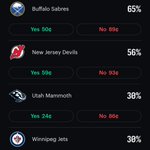
The betting market on Connor Hellebuyck's next team is nuts.
kalshi.com/markets/kxnexttea…

Brad Shapiro retweeted

Ramesh is the correct - that "big tax cut for data centers" was merely the renewal of a normal business expensing provision that all qualified investment purchases receive across industries.
Nothing unique was carved out for data centers. More slopulist outrage.

The hot new Democratic campaign tactic is to attack Republicans over a tax break that doesn't exist. @PostOpinions washingtonpost.com/opinions/…

Dear Lord.

NEW: Eagles quarterback Jalen Hurts out for the season after blood clots were found in his lungs and leg.
According to CBS Sports, Hurts was told not to sleep and was awake for about 36 hours before last week's London game.
The outlet reports that Hurts was initially diagnosed with a "superficial blood clot." Doctors told him not to sleep, but he was apparently allowed to play in the game.
Despite not sleeping for 36 hours, Hurts threw for 220 yards and 1 touchdown.
After the game, a follow-up scan found that Hurts had "bilateral pulmonary emboli," which means multiple blood clots are also now in his lungs.
Reporting suggests that the blood clot was "provoked" when Hurts was cleated in his calf in Week 4.
"Jalen was initially diagnosed by specialists in London with a left calf superficial vein thrombosis. After further testing and monitoring, the current diagnosis is a deep vein thrombosis, as well as bilateral pulmonary emboli," the Eagles said.
"He is clinically stable and has no significant functional limitations. His treatment should only involve anticoagulation (i.e. "blood thinners"). During this time, he will not be allowed to participate in any contact activities, including football."


Yikes... this sounds too similar to Chicago issues tbh...


Attn @MikeClayNFL @field


