

founder & GTM https://xitter.cf/t.co/Rroom0RF5p https://xitter.cf/t.co/jkf9d3n2AJ writing about AI, growth & video
San Francisco, CA
Joined December 2023
- Tweets3.7K
- Following931
- Followers2K
- Likes5.2K




Nominated my super talented friends for the Cosign Awards 2026! 🏆
Rising Stars
@heymikasagi & @caffeinum - Mika & Aleks, Firegoat co-founders who foresaw the Internet of Agents early
@daniel_dhawan - Daniel, co-founder of Rork (a16z speedrun 005)
Engineering
@katedeyneka - Kate, founder of Reelful (a16z speedrun 007), ex ML Eng Snapchat
@korzhov_dm - Dmitry, co-founder Ryze
@rebryk - Yurii, founder of Fluently (YC W24)
@sergeybunas - Sergey, co-founder of 21st.dev (YC W26)
Product
@korablev - Serafim, co-founder of 21st.dev (YC W26), has some of the best product taste I’ve seen
Marketing
@irabukht - Ira, marketing machine, co-founder Ryze
@promptbabe - Tanya, paid ads & creative production guru
Growth
@acooldora - Dora, driving growth at Rork
Poster of the Year
@nestymee - Nadia, founder of Aesty, with a 227-day streak of daily build-in-public videos, 8.5K+ followers, and a fully organic launch with 1.7M impressions!
AI Researchers
@sasha_borzunov - OpenAI researcher whose previous work on Petals was cited by Anthropic!
@aimalysheva - Sasha Malysheva, founder of Mostik AI, PhD in RL, ex-DeepMind & Google X
Also wanted to nominate @vargastartup and @ivanidze404 for Rising Stars, but couldn't find their profiles on Cosign @eriktorenberg


Excited to announce the Cosign Awards: celebrating exceptional people, companies, and products that had a massive impact in 2026.
cosign.co/awards
Anyone can nominate and vote. Award winners will be chosen by the public in conjunction with a panel of judges, including industry leaders like @lennysan, @packyM, @amasad, and many more. We’ll host an event in December honoring the winners (10 per category).
For people categories, we’re mostly focused on everyone except the CEO–everyone else building the company behind the scenes.
Companies with the most amount of people nominations will be listed on our “Top Companies to Work For” page.
True to form, at Product Hunt I helped launch the Golden Kitty awards a decade ago to recognize great products. Soon after I launched the Rise Awards, honoring executives and ICs building companies that make them. The Cosign Awards is the next iteration.
We have 41 categories across people, companies, and products.
People categories:
- Future Founders
- Rising Stars
- Engineering
- FDE
- Product
- Design
- AI Researchers
- Marketing
- Comms
- Growth
- Chief of Staff
- Operations
- Talent
- Finance
- Public Intellectuals
- Podcaster of the Year
- Newsletter Author of the Year
- Poster of the Year
Company categories:
- Rising Stars
- Best Place to Work
- Founder Mafia
- Talent Density
- Highest Aura
Product categories:
- Product of the Year
- Launch of the Year
- AI Assistant
- AI Language Model
- AI Coding
- Dev Tools
- Open Source
- Consumer
- Productivity
- Creative & Media Tools
- Product Design & UX
- Enterprise B2B
- Hardware
- Robotics
- Self-Driving
- Healthcare
- Vertical Fintech
- Legal

So proud to be surrounded by people building incredible things. Rooting for all of you! 💙

Nominated my super talented friends for the Cosign Awards 2026! 🏆
Rising Stars
@heymikasagi & @caffeinum - Mika & Aleks, Firegoat co-founders who foresaw the Internet of Agents early
@daniel_dhawan - Daniel, co-founder of Rork (a16z speedrun 005)
Engineering
@katedeyneka - Kate, founder of Reelful (a16z speedrun 007), ex ML Eng Snapchat
@korzhov_dm - Dmitry, co-founder Ryze.ai
@rebryk - Yurii, founder of Fluently (YC W24)
@sergeybunas - Sergey, co-founder of 21st.dev (YC W26)
Product
@korablev - Serafim, co-founder of 21st.dev (YC W26), has some of the best product taste I’ve seen
Marketing
@irabukht - Ira, marketing machine, co-founder Ryze.ai
@promptbabe - Tanya, paid ads & creative production guru
Growth
@acooldora - Dora, driving growth at Rork
Poster of the Year
@nestymee - Nadia, founder of Aesty, with a 227-day streak of daily build-in-public videos, 8.5K+ followers, and a fully organic launch with 1.7M impressions!
AI Researchers
@sasha_borzunov - OpenAI researcher whose previous work on Petals was cited by Anthropic!
@aimalysheva - Sasha Malysheva, founder of Mostik AI, PhD in RL, ex-DeepMind & Google X
Also wanted to nominate @vargastartup and @ivanidze404 for Rising Stars, but couldn't find their profiles on Cosign @eriktorenberg

There's a new version of this post

Here's how it works in action:
it took 2 weeks (!!!) to be approved
my friend who recommended it added $3-4M ARR in a month just from AI agents marketplaces like chatgpt, claude, grok bot, etc
I guess this is a real window because you can still grab keywords and I doubt approval will get any faster with a mass adoption (my bet is they'll take even longer)
but same as paid ads, it won't fix a pmf problem - just one more acq channel (organic btw)

Meta will happily take your $60K to teach you that nobody wants your product
Everyone in tech seems to be rediscovering paid ads.
I've spent the past 6 years working in and around B2C mobile, first on the product side and now with consumer app companies at varg.ai.
Some of the products I've worked on had multimillion-dollar ad budgets.
Here's what most people outside consumer mobile don't understand about paid acquisition:
1/ Paid ads don't fix bad economics. And finding out whether they work can be expensive.
One thing people underestimate is how much money you might need to spend before your acquisition starts working.
Meta needs conversion data to optimize delivery. Ideally, you want to optimize for actual purchases, not clicks, traffic, or cheap signups.
Otherwise, you might end up teaching the algorithm to find people who click on ads but never pay.
And collecting enough purchase data takes money.
When I was talking to people in the subscription-based mobile app industry, I kept hearing a rough benchmark: around $60K in ad spend before you can realistically expect to figure out whether your acquisition economics will work.
Not a universal rule, obviously. Some products get there much sooner, others never do.
But it's a useful reminder that paid acquisition requires a serious experimentation budget.
And spending that money doesn't guarantee anything.
CAC is under constant pressure. Consumer attention is finite, and advertisers keep competing for it.
Meanwhile, many consumer apps have relatively low LTVs.
Before scaling, you need to understand how much you can afford to pay for a customer, how quickly you recover that investment, and whether the economics hold as spend increases.
2/ The ad is only half the funnel.
One of the biggest things people outside B2C mobile miss is web-to-app acquisition.
Ever clicked on an ad for a mobile app and ended up taking a ridiculously long quiz instead of downloading it?
That's intentional.
The funnel often looks like this:
Ad → Web quiz → Subscription paywall → App download
The quiz creates the impression that the product has learned everything about you and is preparing something highly personalized.
(Spoiler: often, it hasn't.)
But you've already spent several minutes answering questions. You're invested. Paying to see the result starts to feel like the natural next step.
Then you're asked to subscribe before you even download the app.
Selling on the web can also improve unit economics by reducing certain app-store fees, depending on the setup.
These funnels are so important that larger consumer app companies often have dedicated PMs or entire teams optimizing them.
Quiz length, question order, progress bars, personalization, pricing, paywalls, checkout — everything gets A/B tested.
You can build a mediocre product and still make serious money with extremely optimized acquisition and monetization funnels.
Yes, sometimes that optimization involves questionable dark patterns.
3/ Creative is becoming the targeting.
Meta's Andromeda is changing how advertisers think about targeting.
As Meta's algorithms become better at matching ads to people, creative choices play an increasingly important role in reaching the right audience.
Your hook, message, format, and visual style all help determine who responds to your ad.
And here's the funny part:
Some of the best-performing ads look like absolute garbage.
A poorly lit phone video can outperform something that took a professional team weeks to produce.
Most consumer apps use variations of the same formats:
Street interviews
Podcast-style clips
Educational content and surprising statistics
Expert-led content
Before-and-after transformations
Product demos and tutorials
UGC and testimonials
Short dramas
What changes is the hook, the character, and the execution.
Sometimes an elderly woman talking about an app will break through banner blindness better than another attractive influencer in a perfectly lit studio.
People have learned to ignore polished advertising. Sometimes looking less like an ad is exactly what makes an ad work.
4/ Finding winning creatives is a numbers game.
Successful consumer apps can test hundreds or even thousands of creatives to find a handful of winners.
And one winning concept can drive a disproportionate share of revenue.
But winners don't last forever.
Creatives fatigue. Audiences get saturated. What worked last month might stop working next month.
So you need a constant stream of new ideas.
Copying competitors, watching trends, trying new hooks, testing different characters, experimenting with formats.
At scale, creative production is less about creativity and more about consistency.
The best creative producers aren't necessarily the people with the most brilliant ideas.
They're the people who can reliably deliver fresh, testable concepts every single week.
But volume without a learning system is just waste.
Before launching a test, define the hypothesis and success criteria.
Are you testing the hook, the format, the message, or the offer? What result would convince you to scale it?
Don't spend two weeks polishing one beautiful ad when you could use that time to test 30 decent ideas.
5/ You can find more growth without inventing more concepts.
Two underused opportunities:
First, organic UGC.
If your content is already performing organically, you have a useful signal about which hooks and stories resonate.
Try boosting those posts or adapting the concepts into paid creatives.
Organic virality doesn't guarantee profitable acquisition, but it's a much better starting point than guessing from scratch.
Second, localization.
The US is a major market for paid acquisition, but that doesn't mean you should only run English-language ads.
Even within the US, testing Spanish or other languages relevant to your audience can open up new opportunities.
And localization is more than translation. The creator, cultural references, delivery, and tone can matter as much as the script.
6/ There's a secret fifth quarter in paid acquisition.
It's called Q5, and it usually runs from December 26 to around mid-January.
Here's why it's special:
After Christmas, many big brands pull back their advertising budgets. Auction competition drops, and CPMs can become significantly cheaper.
Meanwhile, people are making New Year's resolutions.
They're going to get fit, lose weight, learn a language, fix their sleep, become more productive, or finally get their lives together.
And suddenly, they're willing to pay for an app that promises to help.
For some consumer apps, especially in self-improvement categories, this short window can generate an extraordinary share of annual revenue.
But you can't start preparing on December 26.
Your creatives, funnels, budgets, and testing strategy need to be ready before Q5 begins.
And Q5 isn't the only opportunity.
Halloween, Thanksgiving, Valentine's Day, back-to-school season - every occasion is an excuse to refresh your creative strategy.
Sometimes you don't even need a new concept. Take an existing winning creative, change the hook, add a few pumpkins for Halloween, and test it again.
The point is to adapt proven concepts to moments when people are more receptive to particular messages.
But if I were running acquisition for a fitness, wellness, or self-improvement app, Q5 would be one of the most important periods on my calendar.
7/ At scale, paid acquisition becomes an operations problem.
If you're testing hundreds of creatives, doing everything manually is impossible.
You need a creative factory.
This is where AI and automation become genuinely useful.
Competitor monitoring, trendwatching, concept generation, editing, localization, creative variations, bulk uploads, performance reporting - a lot of this can be automated.
Many large consumer app companies already build internal tools for these workflows.
And with AI agents, MCP, and better generation models, even smaller teams can start building similar systems.
But the goal isn't to produce the most ads.
It's to reduce the cost and time required to test a hypothesis, learn from the result, and launch the next one.
Your advantage isn't the number of creatives you generate. It's how quickly you find the ones that make money.
My takeaway
Paid acquisition isn't a magic growth channel.
It's a machine that combines unit economics, funnel optimization, creative testing, seasonality, and operational efficiency.
You can absolutely build a massive business with it. Some consumer apps have done exactly that with products that aren't particularly impressive.
But I wouldn't recommend jumping into paid ads just because everyone in tech seems excited about them again.
I'd consider it when you have proven or promising unit economics, enough budget to learn, a team that can iterate quickly, and a product that can retain and monetize the users you acquire.
Wispr Flow is an interesting example of the kind of product where I'd explore paid acquisition as a scaling channel.
For everyone else?
Just buy Meta stock. You'll probably make more money (NOT A FINANCIAL ADVICE!!)
my partner and i actually argue about this a lot because he thinks i move too slowly for this city
my version of friction maxxing:
> taking care of my home. i get a cleaner every 3–4 weeks and clean myself in between. i think of it as a way to give back to my home.
> cooking simple meals. every meal delivery plan i’ve tried stops feeling like food and care after about two weeks.
> paper books. always more pleasure than reading on a kindle or my phone.
> making tea in a teapot and drinking it from pretty cups instead of grabbing it in a plastic cup on the go
> candles! i leave the bathroom lights off in the evening and use candles instead. the smell is a lovely bonus.


Corgi’s hot girls playbook is pretty well known by now
Wispr decided to hire hot boys who are good at making videos
for the past couple of weeks, my feed has been full of GTM people from @WisprFlow, especially @hectorserrranoo.
17k followers in just 18 days.
what caught my attention was that X clearly wasn't his first platform (he came here from Instagram, tt, and YouTube).
this sent me to Claude Code to reverse-engineer his X content strategy. so here's his playbook (might not be 100% accurate):
1. posting consistently but not on a schedule
he doesn't follow a strict schedule. sometimes he posts 3–6 times in an hour, then replies to comments.
and he doesn't skip weekends.
2. marketing takes
roughly half his posts are simple text takes on marketing.
paid vs organic, UGC, hiring marketers, agencies, AI-generated creative.
before going viral, these posts were getting 1–5k views.
3. video is his obvious strength
in 18 days, he published 6 long-form video breakdowns.
that's only around 10% of his content, but it generated roughly 90% of his views.
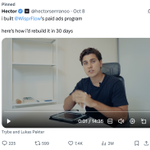
his paid ads breakdown hit 2M views and 20k bookmarks.
after that, even his regular text posts started getting 15–75k views.
4. he engages with his own audience, not random big accounts
around 85% of his replies are under his own posts (he gave me a thoughtful answer too, which is why I took notice of him!)
5. he mixes expertise with personality
between marketing breakdowns, he shares office photos, personal stories, and occasional mentions of Wispr Flow.
///
pretty wild that one marketing hire can generate this much attention for a company in less than three weeks.
@hectorserrranoo, did I get the playbook right?
congrats Mika and Aleks on the 2027 rebrand! genius name, and the new site looks so good ❤️🔥❤️🔥❤️🔥


Big news: 2027dev is now Firegoat! ❤️🔥🐐
For the next chapter of our company, @firegoat_ai felt like a name that reflects what we're here for.
Our mission is to empower teams to ship agent-ready products with confidence and ease.
We're already working with incredible agent-first developer teams at @browserbase, @e2b, @mastra, @clerk, @daytonaio , @sazabi & more.
The best part: it's only the beginning. We're launching exciting things this week - stay tuned!
Aaand we're hiring exceptional backend+infra/product engineers 👀 DMs are open
I’ve been testing wabi for the past week.
Used it to figure out a couple of things about my personal routine.
I haven’t tried Muse, Instinct, or Grok Bot yet, to be honest, but I’m loving my first experience with a personal assistant through wabi.
Congrats to the team on launching wabi 2.0! 🎉


Wabi 2.0 is live!
personal agents are one person, one chat. but the parts of life that matter run on more than one person
Wabi is an agent you use together. you talk to it, it does stuff, builds the apps you need, and anyone can join the thread - your partner, your best friend, the preschool moms groupchat
school changes pickup time → Wabi updates the family calendar, everyone sees it.
a show you’d both love → Wabi finds a night that works, gets the tickets.
the trip everyone keeps talking about → Wabi picks the dates, builds the itinerary, books it
go start a thread with your people 👇


Models used:
@GoogleDeepMind Nano Banana Pro (image generation)
Bria FIBO Edit 1.5 (image expansion), Aura SR (upscaling)
@fal MiniMax H3 Max (video generation)
@GoogleDeepMind Lyria 3.5 (music generation)
Editing and effects: @HyperFrames_