

Global Equities | AI Infrastructure | Occasionally contrarian Views my own, not investment advice
Joined September 2018
- Tweets87
- Following546
- Followers47
- Likes195





Tbf to Oracle, after some of the shoddy reporting around Jensen, I don’t blame them for getting ahead of the narrative.

Oracle has secured all the funding we need to fulfill our contract with OpenAI. With our final capital raise earlier this month, we became the first hyperscaler fully funded for this investment cycle. The financing we outlined at Oracle Investor Day, including vendor financing, is in place. Any further private discussions with vendors are just additional options. Our ability to deliver on our OpenAI contract does not depend on those discussions. Any media reports that will come out and say the contrary are incorrect and wrong.
Oracle and OpenAI are making rapid progress on our infrastructure partnership. Our Abilene campus, where Astra-6 was trained, is nearly complete. Shackelford, our next gigawatt-scale campus, is fully permitted. The handover of NVIDIA Vera Rubin racks in its data halls is on track for the coming weeks.
We continue to expect positive free cash flow in the second half of FY2028. We are targeting more than $30 billion in free cash flow in FY2029 and expect to self-fund future growth beginning that year.
18
One of the more interesting divergences in the market this year.
AI has absolutely hammered software stocks, yet cybersecurity seems almost immune.
I can see the logic - more AI means more sophisticated threats and more demand for security.
But as Druckenmiller recently pointed out, what's stopping Anthropic and OpenAI from eventually providing the defence themselves?
Cybersecurity might be a fantastic growth market but whether today's incumbents capture all that growth is another question.
Investors seem pretty convinced they will..

12
Callum retweeted

In 2000, investors paid 130x earnings for Cisco and 17x for consumer staples.
Today, they pay 4x for Micron and 40x for Walmart.
Read that again.
We're in the middle of potentially the largest AI infrastructure buildout in history, and Wall Street is paying 10 TIMES the earnings multiple for Walmart versus Micron.
In 2000, investors were terrified of missing the future.
In 2026, they're terrified of owning it.
The greatest risk in 2000 was paying too much for the future.
What if the greatest risk in 2026 is paying too much to avoid it?

Kudos to everyone at Anthropic who just became a (multi)millionaire. But I don't see many people asking what all that new wealth means for the company?
If your shares are suddenly worth $1m or $10m, are you as motivated to work as you were last week?
It shouldn't be a surprise that people whose net worth jumps to several million say money changes their relationship with work, or at least with their current workplace.
Shai Bernstein of Stanford studied tech companies after their IPOs and found the best inventors were more likely to leave, and the quality of what was invented in-house fell. For a company whose progress depends on a relatively small number of exceptional researchers, even a handful of departures matters.
It's not all bad news though, those people often go on to start new companies, which is great for the wider economy, just not great for the company they leave behind.
Meanwhile, the race for the top spot is only getting tighter...Google has released Gemini 4 Neon, and leading open-weight models are only 4 months behind the best closed models.
Anthropic needs the people who built its lead to keep extending it, just as some of them no longer need to work...
13
Something's off with this rotation.
CRWD is up 108%. Earnings estimates? Up 6 points. The rest is multiple.
NVDA is down 22% while estimates rose 20 points.
The market is paying for the story and selling the growth. That rarely ends well..
Not investment advice.

1
22


Callum retweeted

I want to thanks @SemiAnalysis_ for the motivation.
In the Gemini RL scaling team, we printed & put that article on our desks to be reminded daily of what used to be true at the time.
But the times they are changing :)


Gemini is Cooked but GCP is Cooking
GCP YoY rev growth >100%,
DeepMind's long term failure is Google Cloud's short term gain
newsletter.semianalysis.com/…

It was always questionable whether AMD would emerge unscathed from Nvidia's China troubles.
Both compete for many of the same customers and operate under the same US export-control regime.
The broader geopolitical risk is shared.
$AMD

Investors treated $AMD as the winner of Nvidia’s China crisis.
The problem: AMD has a China problem of its own.
Our investigation:
Readers added context they thought people might want to know
Hunterbrook reports AMD TurinPI firmware in post-Mar 2025 updates from Entity List-listed IEIT Systems (added 3/25/2025, denial policy) and linked firms. Report states it does not establish AMD violation or how firmware was obtained. Hunterbrook Capital is shorting $AMD. govinfo.gov/content/pkg/FR…
16
Callum retweeted

Investors treated $AMD as the winner of Nvidia’s China crisis.
The problem: AMD has a China problem of its own.
Our investigation:
Readers added context they thought people might want to know
Hunterbrook reports AMD TurinPI firmware in post-Mar 2025 updates from Entity List-listed IEIT Systems (added 3/25/2025, denial policy) and linked firms. Report states it does not establish AMD violation or how firmware was obtained. Hunterbrook Capital is shorting $AMD. govinfo.gov/content/pkg/FR…
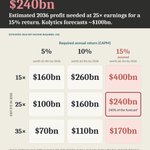
Anthropic has priced its IPO at $83 a share, around $1.5tn fully diluted.
For a 15% annual return from here, Anthropic would need ~$240bn of profit by 2036 at 25× earnings.
The full analysis is definitely worth a read:
substack.com/@kolytics/note/…


13


Callum retweeted

Everyone knows about the dotcom bubble 1995-2000, but very few know that internet-related infrastructure stocks had already had enormous runs of their own by 1994. Between 1985 and the end of 1994, a selected basket of infrastructure stocks had risen over 2,000%.
This phenomenon has been documented in all the major market-leading technology groups throughout the market's history. Railroads, automobiles, computers, and the internet groups have all undergone a cycle of infrastructure bull markets followed by even greater application layer bull markets (driven by wider economic productivity and broader adoption of the underlying tech).
This group of internet infrastructure stocks include PCs, software, fiber, telecoms, and datacenter stocks among others. The group is equal-weighted and quarterly rebalanced. Keep in mind they are hindsight-selected winners. Constituents are:
EMC Corp, Dell, Microsoft, Micron, 3Com, Compaq, Intel, Oracle, Cisco, Bell Atlantic, Sun Microsystems, Corning, Nortel Networks, Texas Instrument, and Sprint Corp.
The group continued to see incredible growth after the public release of the internet and the Mosaic browser in 1993. US internet usage is also tracked along with the index, as is the US Bureau of Economic Activity's computer equipment price index.
AOL's introduction of unlimited usage plans in December 1996, along with the Fed's lowering of interest rates and the Clinton administration's tax moratorium on internet commerce in 1998 sent the group on an 18-month-long parabolic rally.
Although the chart appears to go straight up and to the right the entire time, EMC fell over 50% in 1995. MU sold off 80% in 1995 before more than doubling its prior high. Compaq fell roughly 70% in 1991.
The application bull market was set to January 1995 although the group had already been rallying beforehand.
For more context on the infrastructure/application cycles, I will link my Substack below for anyone interested.

Biggest IPOs this year lose investors money as AI frenzy fades - giftarticle.ft.com/giftartic… via @FT

Callum retweeted

Today's forecast revision from SemiAnalysis is pretty interesting.
The TLDR is it calls for a 28% cut in AI accelerator capex in 2028 and then 41% and 40% cut the following two years respectively.
The composition of these cuts was about 17% on shipments, and it has NVIDIA taking the brunt (66%) of the cut.
Basically, demand in the past 10 days has been completely nuked? Remember, it was on election day that SA published this reiterating just how fast the build out is going.
“We wrote at length about how SpaceX’s plans for 10GW in 2027 was feasible, paving the way for +300b+ ARR. We received a lot of pushback from folks calling it impossible. Now, just two months later, we’re already seeing 3.6GW under construction across multiple sites, both existing and new. SpaceX has even revised its estimate up to ~13GW in 2027. This would be the largest amount of datacenter capacity ever built by any one company in that timeframe, roughly equivalent to all of Google’s datacenter capacity from 1999-2026 in just 1.5 years. We think it’s possible and have already identified >9GW of capacity.”
The forecast cut doesn't mention or reflect anything related to China exports or API use. But it does call for a significant slowdown in the growth of the frontier labs. This is also interesting in both the narrative and the timing given the Anthropic IPO this week.
The report as interpreted indicates that HBM pricing will see double digit % price declines and ASPs on Feynman SKUs would take a 40% haircut from estimates with Feynman dropping from $110k b78k and estimates on Feynman Next dropping from $191k to $118k.
A lot has to happen for demand to slow this much and for the semiconductor supply chain to normalize this much in a short period of time.
While the report claims that its revision is based on 3 factors.
1. Lab monetization slow down.
2. Stricter access to to capital
3. Election-based data center delays.
The revision is much harsher than a handful of GW being slowed by red tape.
The report basically insinuates that the demand asymmetry is drying up in 2027. That in-house silicon projects are taking off at a dramatic pace, but only so much so that the memory wall will have been climbed.
66% of the revision down comes from NVIDIA. But again, why would its margins suffer so badly?
In reality we have a lab IPO with $900 Billion in compute commits.
We have uncertain demand in China, but no matter how much exports are restricted or tightened, it is hard to believe it will just stop seeking compute. And don't tell me NVIDIA demand will be replaced by Huawei Ascend. (It won't)
It almost feels like SA is saying without saying that China is a MUCH BIGGER consumer of NVIDIA chips? And without it and its labs chewing up Inference on Anthropic and OpenAI and it using "NVIDIA" to train its models that the domestic demand will faulter substantially. If China really was utilizing a disproportionate amount of compute at peak prices this could cause a major downturn in margins for NVIDIA.
Our forecasts (@ETRnews and @TheFuturumGroup) see much more modest scenarios with some newly minted downside risk. We agree that 27 is locked in and we see the same for most of 28. Projects into 29 and beyond have time for negotiation, but the compute demand for inference and agents will continue to climb dramatically. Some GW could slip and elongate the cycle. But seeing ASPs drop 40% on roughly the same volume suggests a structural weakening and a supply chain overcorrection or an underlying symptom that simply isn't reflected in lab demand, financing, or election outcomes. Perhaps China holds the key?