Empowering smarter construction decisions with tools, data, and insight. Access our free templates through our website.

Joined January 2026
George Lucas's new museum floats over a park. The 300,000 sq ft building sits on steel arches spanning 185 ft, lifted so the plaza underneath stays open to everyone. Look up from below: an oval opening frames the sky, four stories overhead. Opened Sept 22 in Los Angeles.
2
You can climb this opera house without a ticket. Shanghai's Grand Opera House opened Oct 17. Its white roof spirals up from the ground like a folding fan: a public staircase, open 24/7. Under it: - 3 halls - 4,200 seats - a 2,000-seat main stage Opera or the roof?
6
Canada's birthplace was falling apart. In 2014, engineers found: - crumbling foundations - a leaking roof - peeling plaster Province House hosted the 1864 talks that created Canada. The fix touched every stone and every piece of wood. Closed: 2015. Reopened: Oct 24, 2026.
8
United was still flying out of a 1969 concourse in Houston. Not anymore. Opened Oct 22: three levels, 765,000 sq ft. - 22 new gates - a jet bridge for every flight - the largest airline lounge in the Americas $2.6 billion, for 40% more travelers on peak days.
10
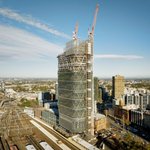
Skyscrapers are supposed to be steel and concrete. The world's tallest hybrid timber tower says otherwise. Sydney's Atlassian Central topped out in July: - 39 storeys, over 590 ft - 353,000 cu ft of engineered timber - ~330 ft taller than the old record Due to finish late 2026.
18
India's first bullet train will run 4 miles under the sea. That's one piece of a 316-mile line from Mumbai to Ahmedabad. By September: - 231 miles of elevated track done - 44 ft-wide machines digging a 13-mile tunnel 199 mph. Under 2 hours end to end. First trains in 2027.
33
China is building a six-lane highway under the sea. The deepest bore runs 344 ft below sea level, mostly through hard rock. Crews dug from both shores of Qingdao's bay. On Oct 2, the last tunnel machine reached its mark. Nearly 11 miles. China's longest undersea road tunnel.
11
Sydney shut a 130-year-old railway in 2024. This Friday, it reopens as a metro. Planned: 12 months. Actual: over two years of separating tracks and fitting platform screen doors. Now: a train every 4 minutes at peak. 50% more capacity. Bankstown to Central in 28 minutes.
38
Burbank just opened a $1.3 billion airport terminal. Passengers still walk across the tarmac to board. The old terminal dated to 1930, sat too close to the runway and failed quake codes. The new one: 355,000 sq ft. 14 gates. No jet bridges. Locals asked to keep the walk.
20
Four years ago, this was open sea. Since then, crews have pushed a railway out across it, span by span, against brutal tides. This month, two of its three main sea spans met in the middle. Hangzhou Bay bridge: 18 miles long. Built for 217 mph trains. Open late 2027.
18
Jeddah Tower just reached Level 118, about 1,555 ft up. Work restarted in Jan 2025 at Level 63. 55 floors in under two years. 39 floors left, and they're the hardest: stronger wind, longer concrete pumps, cranes climbing with the building. Target: 3,281 ft by late 2028.
🤖 Made with AI
88
A four-page landscape SWMS in the Safe Work Australia layout: the 18 high risk construction work tick boxes, compliance and review, a task-by-task hazard and control table, licences, a risk matrix and worker sign-on. capitalbuildcon.com/swms-tem…
48
A four-page RAMS in the format principal contractors expect: general details, high-risk activities, method, risk assessment with a 5×5 matrix, emergency arrangements and an operative sign-off sheet. capitalbuildcon.com/rams-tem…
41
Imagine driving an 1,800-tonne steel cylinder into the seabed. Now repeat that 95 times. That's what engineers have just completed at East Anglia THREE, one of Britain's biggest offshore wind projects. Located off the Suffolk coast, this £4 billion wind farm is being assembled on an extraordinary scale. The foundations alone are engineering monsters: - 95 steel monopiles - Up to 84 metres tall - Up to 10.6 metres in diameter - Weighing 1,200–1,800 tonnes each These are the largest monopiles ever installed from a jack-up vessel in Europe. But the foundations are only the beginning. Each supports a turbine rising approximately 262 metres above the sea, with blades stretching 115 metres long. That's longer than a Premier League football pitch. And 285 enormous blades are being manufactured in Hull for the project's 95 turbines. In August 2026, crews completed installation of every monopile and transition piece. Now the construction focus has shifted to installing the giant turbines and completing the electrical infrastructure. When operational, East Anglia THREE is designed to generate 1.4 GW of electricity - enough to power more than 1.3 million British homes. The remarkable part? This isn't a single enormous machine. It's an entire industrial-scale power station being assembled piece by piece in the North Sea.
50
Sweden is building a machine that fires protons at 96% of the speed of light. Not to smash atoms for the sake of it. To see inside materials in ways ordinary microscopes can't. It's called the European Spallation Source (ESS), under construction in Lund. The engineering is extraordinary. A 600-metre linear accelerator sends proton beams towards a rotating, five-tonne tungsten wheel. When the protons strike the metal, neutrons are released. Scientists will use those neutrons to study everything from batteries and new medicines to the structure of advanced materials. But getting the machine to work is the real challenge. In July 2026, engineers completed another major commissioning phase. They successfully sent proton beams through more than 540 metres of accelerator, achieving: - Beam energies of 800–860 MeV - Pulse frequencies of 14 times per second - Beam currents of 62.5 milliamps - Pulse lengths reaching 1.5 milliseconds More than 500 diagnostic instruments monitor the beam as it travels through the accelerator. The next major milestone is producing the first neutrons, planned for early 2027. And here's the remarkable part. Europe isn't simply building another laboratory. It's constructing one of the world's most powerful scientific microscopes - using an accelerator, a rotating metal wheel, and particles that can reveal the invisible structure of matter.
47
China built a highway tunnel in a factory. Then floated it out to sea and sank it. 32 enormous sections. Each standard section was 165 metres long, 46 metres wide and 10.6 metres high. This is how engineers constructed the underwater portion of the 24-km Shenzhen-Zhongshan Link. The problem was the Pearl River Estuary. Ships needed clearance above the crossing, while road traffic needed a direct connection between Shenzhen and Zhongshan. A bridge alone couldn't solve every part of the problem. So engineers built a combination of bridges, artificial islands and an underwater expressway. The most extraordinary work happened beneath the water. **Instead of excavating the entire tunnel underground, engineers manufactured huge steel-and-concrete sections on land.** Each completed section was sealed, floated into position and carefully lowered into a prepared trench on the seabed. Imagine trying to align a structure the length of a football field and a half while currents push against it. Now imagine repeating that operation 32 times. The final connection required particularly precise engineering. The construction team had to: - Manufacture massive tunnel sections in controlled conditions - Transport them across the water - Lower them to their designated seabed positions - Align and connect the sections underwater - Seal the joints and complete the roadway systems The immersed-tube portion alone stretches 5,035 metres. And some individual tube sections required approximately 29,000 m³ of self-compacting concrete. On June 11, 2023, the last underwater connection was completed. The entire crossing opened to traffic on June 30, 2024. The result? A journey that previously took around two hours was reduced to approximately 30 minutes. Most people driving through the tunnel will never think about how it was built. But beneath their tyres is a highway assembled from giant prefabricated structures, transported by water and joined together on the seabed. The road wasn't just built across the sea. Part of it was built elsewhere, floated into place and deliberately sunk.
36
Saudi Arabia built a roller coaster that breaks 3 world records. But the hardest part wasn't the speed. It was installing 2,500 tonnes of steel 165 metres above the desert. This is Falcon's Flight at Six Flags Qiddiya City, near Riyadh. The finished ride is extraordinary: - 195 metres tall - 250 km/h top speed - 4,325 metres of track - Approximately 3 minutes and 25 seconds per ride The world's tallest, fastest and longest roller coaster. But those records created a construction challenge unlike a conventional amusement park ride. The track climbs a towering steel structure, crosses the edge of a natural cliff and plunges toward the desert valley below. Engineers had to connect enormous steel sections across dramatically different elevations while maintaining the precise alignment required for high-speed operation. The most demanding element was the giant camelback hill. Its superstructure weighs around 2,500 tonnes. And its track had to align accurately at a height of 165 metres. Cranes lifted the enormous steel components into position while construction crews assembled the structure against the backdrop of the Tuwaiq Mountains. But completing the track was only half the challenge. **The ride also had to accelerate a train to 250 km/h.** Instead of relying on gravity alone, Falcon's Flight uses linear synchronous motor technology. More than 722 motor stators are distributed across three launch sections. They must work together with precise timing to accelerate the train smoothly. Even the long, straight launch sections required exceptional construction accuracy. Small deviations in alignment would affect the interaction between the train and propulsion system. The project reached three major milestones: April 2024 - The 165-metre camelback structure was completed. December 2024 - The final section of track was installed. April 2025 - Testing began. On December 31, 2025, Six Flags Qiddiya City opened to the public. The result wasn't simply a bigger roller coaster. It was a project that combined bridge-scale steel construction, cliffside engineering and precision electric propulsion. All so a train could travel more than 4 kilometres in just over 3 minutes. That's an extraordinary amount of engineering for a few minutes of excitement.
214
Hong Kong didn't just build another airport runway. It built the land underneath it first. 650 hectares of new land. A 3,800-metre runway. And an existing international airport that had to keep operating throughout construction. This is Hong Kong International Airport's Three-Runway System. The most important engineering work happened long before aircraft could land. Crews had to transform part of the seabed beside Chek Lap Kok into stable ground capable of supporting heavy aircraft. The process involved marine reclamation, deep cement mixing, seawall construction and extensive ground preparation. Why deep cement mixing? Because simply dumping fill onto weak seabed material wouldn't provide the foundation needed for an airport. Engineers mixed cement into the underlying ground to improve its strength and stability. Only then could the new land support the next stages of construction. The project eventually involved: - Forming 650 hectares of reclaimed land - Building a new 3,800-metre runway - Constructing taxiways and aircraft parking areas - Reconfiguring an existing runway - Expanding Terminal 2 and its supporting systems But the construction sequence was particularly demanding. The new runway began operating in November 2022. Then the airport temporarily closed its existing Centre Runway for reconfiguration. Crews adjusted pavement levels, constructed connecting taxiways and added supporting infrastructure. On November 28, 2024, all three runways began operating under the new system. Yet that wasn't the end of construction. Work continued on passenger facilities, the Terminal 2 expansion, transport connections and baggage-handling infrastructure through 2025. The ultimate capacity target is enormous. 120 million passengers annually. 10 million tonnes of air cargo. And here's what makes the project remarkable. Most airport expansions are constrained by the land around them. Hong Kong's engineers created hundreds of hectares of new land, stabilised it, protected it from the sea and connected it to an operating airport. The runway is the visible achievement. The artificial ground beneath it is the real construction story.
31
France has a construction site where modern cranes, power tools and cement aren't part of the plan. The workers are building a castle. And they've been doing it since 1997. Welcome to Guédelon, in Burgundy. The goal isn't to restore a medieval ruin. It's to build a new 13th-century fortress using the materials, tools and techniques available to medieval craftsmen. That means a completely different construction process. Stone is quarried and shaped by hand. Timber is worked using traditional carpentry techniques. Blacksmiths forge the ironwork. Heavy materials are raised using human-powered wooden lifting wheels. Even the mortar is part of the experiment. The team built a lime kiln to investigate how medieval builders produced this essential material. Each firing takes 72 hours. But the fascinating part is that construction is also research. When historians can't establish exactly how a medieval building component was made, the craftsmen test possible methods at full scale. In 2025, they completed two enormous oak doors for the castle's gateway. Each door measures: - 4.5 metres high - 1.9 metres wide - Approximately 750 kg The blacksmiths forged 192 large nails to secure their wooden cladding. And the carpenters shaped the oak using traditional tools. Nearly three decades after construction began, Guédelon is still unfinished. For 2026, the team is experimenting with medieval timber panelling for the vaulted ceiling of the lord's hall. They're also continuing work on the gateway chambers and the structure that will eventually house the portcullis mechanism. Most major construction projects measure success by how quickly they finish. Guédelon measures it by what builders learn along the way. It's one of the rare construction sites where working more slowly is part of the engineering mission. Because the finished castle isn't the only thing they're building. They're reconstructing the knowledge of how castles were built 800 years ago.
39
Paris had a transport problem that another road couldn't solve. Railway lines, major roads and a sprawling freight yard separated entire neighbourhoods from the metro. So engineers built public transport above the obstacles. Not a bridge. Not a tunnel. A 4.5 km cable car system. The €138 million Câble C1 opened on December 13, 2025, becoming the first urban cable car in the Île-de-France region. And its construction tells a fascinating story. The route passes through four municipalities, connecting five stations with 30 steel pylons. Some towers rise as high as 55 metres, including their distinctive V-shaped crowns. But erecting the towers was only the beginning. The construction team had to: - Relocate underground utilities before building foundations - Construct five stations and their surrounding transport connections - Install all 30 pylons - Thread and tension the cable system across the route - Attach and test 105 passenger cabins By January 2025, every pylon had been erected. Then came the delicate work of installing and commissioning the cabins. In June 2025, the final cabin arrived at the depot. Each cabin had to be fitted with suspension equipment and grips designed to connect it safely to the moving cable. The line then underwent months of mechanical, electrical and safety testing. Here's why the engineering matters. A cable car doesn't need continuous road space beneath its route. It can cross obstacles that would make a conventional surface transport project far more complicated. For residents, that changes the journey completely. The new line connects Créteil to Villeneuve-Saint-Georges in around 18 minutes. A comparable bus journey previously took about 40 minutes. The system carries ten seated passengers per cabin, with departures approximately every 30 seconds. And it was designed to accommodate around 11,000 daily passengers at opening. The remarkable part isn't that France built a cable car. It's where it built one. Instead of forcing another transport corridor through a densely developed urban landscape, engineers moved the corridor into the air. Sometimes the smartest construction solution isn't removing the obstacle. It's finding a way over it.
74