

i follow the money
buy what wall st is buying 👉
Joined August 2020
- Tweets24.8K
- Following379
- Followers7.8K
- Likes25.5K




Credit and financial conditions continue to tighten.
Credit spreads continue to widen to their highest market since March.
Financial conditions continue to tighten as well as lending becomes more difficult.
Another good note this morning in our State of the Market.


Credit and financial conditions continue to be a headwind for stocks.
Every Monday morning we run through our State of the Market during our live coaching call with members.
Randy brought up two great charts:
1. Credit spreads in relation to the S&P 500
2. The National Financial Conditions Index
Both are inversely correlated to the performance of $SPY and both are showing serious issues with a sustainable uptrend.
You can think of this pair of charts as the ease at which the market thinks liquidity can get to the companies that need it. And right now they're telling you to be very careful.
I'm going to cover this in more depth next week during a webinar that I am hosting on helping define the market environment before placing trades.
The goal is to help you save money by not overtrading when markets are punishing being aggressive.
It's free. If you're interested, DM me and I will send you the info. Limited spaces so first come, first served.


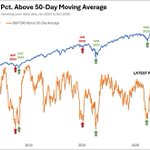
Breadth is improving.
Over 60% of stocks within the S&P 500 are above their 50-day moving average. That’s the highest reading since August.
Read more here: randysdailyprint.substack.co…

Don't forget to subscribe to Randy's Daily Print curated by @itmrandy. Designed to put you in front of facts, not opinions. In your inbox every morning before the market opens: randysdailyprint.substack.co…
Good run down on Brazilian debt, policy and projection through the end of the decade.
Seems very likely this will come true given current trajectories.

My new 2 cents about the Brazilian fiscal trajectory under Lula IV: stress assumptions looks increasingly unsustainable
I am assuming 1% real GDP growth (being optmistic here), a stable 12% Selic for the next four years (being optmistic here), and the primary deficit continuing to expand at its recent average quarterly pace, Brazil’s gross debt/GDP is projected to climb from 93% today (FMI Number) to roughly 120% by October 2030.
The nominal deficit would rise toward 13–15% of GDP, driven overwhelmingly by interest costs on a rapidly growing debt stock.
With nominal growth around 5–6% and interest rates stuck at 12%, the debt dynamics will turn into a classic snowball.
This raises serious questions about the medium-term value of Brazilian sovereign bonds and the attractiveness of long BRL exposure. A debt ratio heading toward 120% under high real rates increases both rollover risk and the probability of further currency depreciation or fiscal adjustment forced by markets.
Without a credible path to meaningful primary surpluses or substantially lower rates, the risk-reward on Brazilian duration and the real looks skewed.


I’m not surprised. Backside fades are lethal.
Many of the neocloud names are down 50% already. Just look at Nebius $NBIS
How much more will they fall? Long way to $0.
Remember who’s been telling you to buy on the way down. They aren’t your friend. ☺️

Pretty much.
As of the past few weeks, debt markets have almost entirely shut off access to money for any company that doesn’t have substantial revenue independent of AI data centers.
SpaceX closed $40B of debt for GPUs, but we’re investment grade and have Starlink & launch revenue.
That means the 200+ neoclouds are going to see guppy-level death and consolidation. Some will make it through, but not many.

"$635 million out of BTC ETFs on Oct 22..."
It means nothing. 99.9% of people who talk about ETF fund flows have no idea what they're talking about.
You can learn though. Here's a prompt:
Tell me how ETF fund flows can better prepare me for trades. Explain to me how consistency of flows and positioning, particularly at the extremes, better define the durability or fragility of the underlying trend.
Weekend homework for anyone who wants to learn how the most influential trading vehicle (ETFs) in the market can help you make more money trading individual stocks.
Or just join TTI and I'll tell you. Either way.


A new member asked me if I was going to buy $META shares prior to earnings this week.
My response below encapsulates how I think about both the markets and money.
No gambling. No YOLOing. And no reinforcing bad behaviors.
A dollar won with a bad decision process will cause you to lose hundreds more down the road as you continue to replicate the bad decision process. Now multiply that by thousands. Or tens of thousands. Or hundreds of thousands.
Treat every dollar like its your last. Because one day it might be.


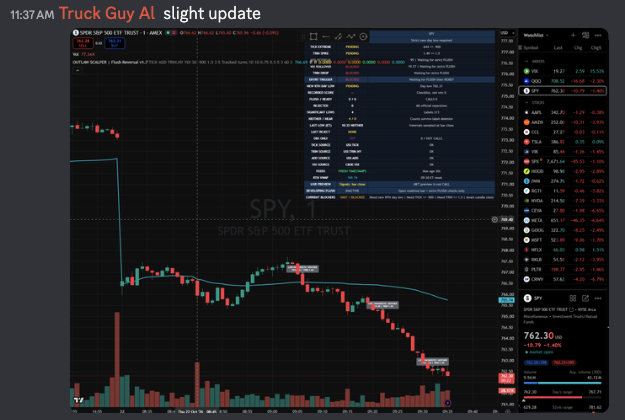
Our members are feeding my Flush Reversal tear sheet to their agents and having it actively scan the market for setups.
Last week one of them made $1,000 in a few minutes entirely with Grok Bot.
Here's another use case:
Build it into an indicator on TradingView.

The memory/photonics/neocloud blow up is the least of the markets concerns.
The real beast lurking under the surface are the companies building the electrical infrastructure to power the AI revolution.
And they’re breaking down.

5% away from a 100% move since our entry at 46.50.
RingCentral $RNG up another 13% afterhours.
Has sat in our top 10 leader board with a TTI score of 80+ since July. Incredible strength.
See where we're at in the morning.

