

Education researcher. Passionate about equity in school finance & foundational learning outcomes in low income countries & communities. Let's raise the floor!
Washington, DC
Joined July 2008
- Tweets1.1K
- Following167
- Followers463
- Likes398




Pinned Tweet
Our latest paper on teacher management in Malawi is now live at the International Journal of Educational Development! Where new teachers were allocated to schools in accordance with data-driven equity-focused rules, repetition and dropout rates improved.
sciencedirect.com/science/ar…
1
61

Ravinder Casley Gera retweeted

Podcast -- @rglenner @gamblingondev and I discuss Who Should and Shouldn't Get Aid? [TLDR: Stefan "countries that will use it for growth," me "poor countries."]
cgdev.org/blog/cgd-podcast-w…

Ravinder Casley Gera retweeted

New @caldercenter working paper w/ @david_blazar: we ask whether Maryland’s layered pay reforms changed who gets paid what.
Short answer: pay rose, but the structure barely moved, and dollars still flow to credentials that don’t predict achievement.
caldercenter.org/publication…

Ravinder Casley Gera retweeted

Parents really want their children to go to the best schools, with the best students as peers. But does it actually matter? In New York and Boston, students who just miss the cutoff to go to exam schools perform no worse than they would have been expected to. 1/

Ravinder Casley Gera retweeted

You can now play this for real with anyhumanever.com/. I just died of smallpox aged 7 in 1889.

People generally have no idea how much the past sucked. It's fun to study history but anyone who genuinely romanticizes the past I struggle to take seriously.
Even the recent past was miserable by comparison with today, but the pre-industrial era was a total horror show on every axis continually.
Reply here with your hypothetical pre-modern name, location, and year of birth and I'll give a quick summary of how your life went.
I'll start with a historical character, my 5th great grandfather John Jones, born ~1812 in northern Wales. Illiterate. Orphaned. Laborer. Married at age 33 (already ahead of 75% of other men in that era), 12 children, all but 2 died in childhood, moved (voluntarily) to Australia in 1849, financially ruined at least twice, alcoholic, wife died suddenly aged ~45, unable to care for surviving children, who variously ran away, ended up in some hellish convict era Australian orphanage, drowned, etc. Disappeared in custody c. 1860.
In all seriousness Mongolia is in the midst of a really major and serious depression and social isolation crisis

Mongolians apparently have their own version of Bowling Alone / the evils of modernity discourse, which they post as AI slop on Instagram. My favorite is lamenting the cars that didn't have seatbelts.


1
197
Ravinder Casley Gera retweeted

The marginal value of public funds for 1960s primary school construction in Chile was 13 to 1
sciencedirect.com/science/ar…


Ravinder Casley Gera retweeted

There is a trip that economists do too much research in Malawi but in fact we do far too little


“Attacks on education, pupils and staff around the world up by 40%” theguardian.com/global-devel…

15
Is there a pianist in the house? How audience members – and fellow musicians – have saved the show theguardian.com/music/2026/j…

24
This piece presents some compelling reasons to be sceptical of the “Mississippi Miracle,” but its mixing of limitations and alternative explanations reveals the same kind of wooly thinking of which the authors accuse the alleged miracle’s proponents
skeptic.com/article/mississi…

17
Ravinder Casley Gera retweeted

Thank you to Arnie Arnesen @pchowder for having me on her show, The Attitude, to talk about AI and when its ability to personalize feedback for students crosses the line into harmful stereotyping. podcasts.apple.com/us/podcas…

The buried lede: “For academic achievement, average effects on test scores are consistently close to zero. High schools see modest positive effects,
particularly in math, while middle schools see small negative effects.“

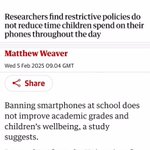
Schools across the U.S. have sharply restricted student smartphone use during the school day. A new paper evaluated the effects of these bans.
The main benefit was increasing student well-being.
Initially, student well-being falls, but the effects on well-being eventually become positive as kids adapt. This is the main positive effect.
But there is little evidence of effects on school attendance, self-reported classroom attention, or perceived online bullying.
tom-dee.github.io/files/w351…

44
Ravinder Casley Gera retweeted

Congratulations Kennedy Scholar and former Chair of the Trust, Lord Peter Hennessy (Harvard 1971) on his appointment to the Order of the Garter by King Charles III.


Forthcoming in AER: Insights: "The Missing Poor" by Torsten Figueiredo Walter, Niclas Moneke, and Ana Radu. aeaweb.org/articles?id=10.12…

64
Remedial classes, the forgotten 5th way

Good discussion. I would say my position is a 5th option that Claude did not mention: simply teach grade level standards, and don’t worry about students being behind for the purposes of that class. Provide extra support and intervention (separate class) to those who are behind.
25
Pretty useful: claude.ai/share/d50547e4-c80…
It’s time to abandon the false premise—and false promise—of differentiated instruction. We can teach the same thing to everyone at the same time. We can’t teach different content to different students at the same time. That’s magical thinking.
2
3
214
Ravinder Casley Gera retweeted
Podcast about the best school district in America & buried in the middle is a brief note that "they do TaRL"
@rglenner @Pratham_India @TaRL_Africa

Ravinder Casley Gera retweeted

A parasite that has been eating people for 3,500 years is about to be wiped off the planet. It infected 3.5 million people in 1986. Last year, it infected 10. And I have not seen it make a single front page.
It is called Guinea worm. You drink contaminated water from a pond in a poor village. A year later, a worm up to three feet long starts coming out of your leg through a burning blister. There is no pill that stops it and no surgery that works. You wrap the worm around a stick and pull it out slowly, over days or weeks, inch by inch. If you rush, the worm breaks inside you and causes a fresh infection.
Guinea worm is ancient. Preserved worms have been pulled out of Egyptian mummies from around 1000 BCE. The Ebers Papyrus, an Egyptian medical scroll from 1550 BCE, describes pulling the worm out with a stick. For three and a half thousand years, that was the best humans could do.
Then in 1986, public health workers decided to kill the parasite off. They had no vaccine and no drug. What they had was cheap cloth water filters and a small army of volunteers willing to walk from village to village for decades.
The plan was simple. Give everyone who drinks from a pond a cloth filter to strain out the tiny water fleas that spread the parasite. Then send volunteers walking house to house, year after year, teaching people how to use the filters and keeping anyone with an emerging worm out of the water.
It worked. From 3.5 million cases a year to 10. Four were in Chad, four in Ethiopia, two in South Sudan. The other four countries where the worm used to be common, Angola, Cameroon, the Central African Republic, and Mali, had zero human cases for the second year in a row. The World Health Organization has already certified 200 countries as Guinea worm free. Six are left.
The last hurdle is dogs. Cameroon had 445 infected animals last year and Chad had 147, so a lot of the remaining work is on animals, not humans. Strays get leashed, and crews treat ponds to kill any remaining worms. The campaign keeps watching until the number hits zero.
When Guinea worm hits zero, it becomes the second human disease ever erased from the planet. The first was smallpox. It will also be the first parasite humans have ever wiped out, and the first disease ever ended without a single dose of medicine. Volunteers walked village to village with cloth filters for 40 years. Now a plague from the age of the pharaohs is about to be gone.

