

On the limits of AI creativity | Building @oparine_ai
Paris
Joined September 2023
- Tweets295
- Following618
- Followers1.9K
- Likes2.2K




Pinned Tweet
Introducing Open Collider: an open-source engine that mechanically improves LLM creativity.
It generates non-trivial, high-quality ideas at scale, for any ideation problem.
LLMs collapse on the same ideas. Sample the same brief 100 times → most outputs land in the same place. Researchers call it the Artificial Hivemind (Jiang et al., 2025).
"Be more creative" moves the LLM's output by ~0.04 in embedding space.
Forcing structurally distant domain collisions moves it by ~0.28.
7× more. Same model, same brief.
So I built Open Collider: a pipeline based on the theory of bisociations (Koestler 1964), the same model that drives human creativity.
📊 Across 12 real-world ideation problems:
• 12/12 sign-test wins on embedding distance (p = .0002)
• 60%+ originality wins on 4,320 blind LLM-judge verdicts
• 4–13× further from the default cloud than "be original" prompts or longer context
• Idea relevance holds (win rate >50% on overall quality)
💻 Engine: first reply 👇
📝 Launch study: pinned tweet
Try it, Break it, Tell me what you find!


Richard Sutton: "Generative AI can be novel or good, but never both at the same time."
He just won the Turing award, and this is the clearest thing anyone has said about why LLMs can't discover (and how to fix it).
His argument: discovery is three steps: variation, evaluation, selective retention.
→ You try many things, you judge which work, you keep those. Evolution runs on it, and so does science.
He talks about scientific discovery, but it's the exact same for any ideation process, if you want to get good AND novel ideas:
Step 1: Variation
You can't get good novel ideas from one single prompt.
Just like humans have a bunch of crappy ideas before having a single good one, you need to generate a variety of ideas, in volume, to see good ones emerging.
Generative AI is already capable of some variation, because it's stochastic.
However, this is imperfect: LLMs collapse to the same handful of ideas, and struggle to produce high-quality diversity.
That's what researchers call the Artificial Hivemind (Jiang et al., 2025), and you need the right strategies to escape it properly (see the quoted article).
Step 2: Evaluation
That's where a simple LLM isn't enough. Producing diversity in volume will surely make good novel ideas emerge, but they'll be lost in the noise.
So you need an evaluation process, to spot the gems.
Step 3: Selective retention
That's where knowledge evolves. You follow the path your process has discovered, and dig deeper into the prolific directions you've identified.
So, to get good ideas from an LLM: generate diversity at scale, curate mechanically the gems, then dig deeper on what works.
Sounds simple, but nobody does it. Thanks Richard!
(full video link in reply 👇)
Those researchers built a model that predicts the ideas scientists are likely to explore, to find ideas that are out of their "cognitive availability".
Then they search for coherent ideas in those "unavailable ideas". So they systematically find ideas that scientists would not have easily reached.
This is brilliant!

(Current) LLM-based ideation is biased toward what the field already finds easy to think.
We formalize this bias as cognitive availability and use it to identify coherent but overlooked research directions: The Alien Space of Science. 🧵
arxiv.org/abs/2603.01092


Cédric Lion retweeted

Generates non-trivial ideas by colliding distant domains
github.com/CL-ML/open-collid…

How can we make AI more creative?
@OpenAI just answered that, and you can pull the EXACT same move in your everyday use of AI to generate better ideas.
For years the line was: "AI can't produce anything new. It's trained on the past, so it just parrots it."
And by default, LLMs do collapse onto the obvious: researchers have measured it, they call it the "Artificial Hivemind" (Jiang et al., 2025).
But that's a floor, not a ceiling.
Here's the ceiling: OpenAI's model just disproved a conjecture Erdős posed in 1946, one of the most famous open problems in geometry. It is NOT a remix of known answers; it's a genuinely new result.
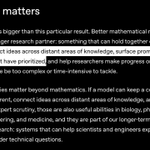
How did it get there? It bridged two fields nobody expected to connect: algebraic number theory and discrete geometry. In OpenAI's own words, the model can "connect ideas across distant areas of knowledge."
This isn't a new idea about creativity, it's one of the oldest ones. Koestler called it bisociation in 1964: novelty comes from colliding two distant frames of thought. Humans have always created this way, and turns out AI can too.
So the real question: can you do it on purpose, for any problem, instead of waiting for a frontier lab to point a model at a famous conjecture?
That's what I've spent the last 4 months building.
Open Collider: an engine that forces LLMs into distant-domain collisions to generate novel, non-trivial ideas at scale. With empirical evidence to back it.
Open source, just try it 👇

Introducing Open Collider: an open-source engine that mechanically improves LLM creativity.
It generates non-trivial, high-quality ideas at scale, for any ideation problem.
LLMs collapse on the same ideas. Sample the same brief 100 times → most outputs land in the same place. Researchers call it the Artificial Hivemind (Jiang et al., 2025).
"Be more creative" moves the LLM's output by ~0.04 in embedding space.
Forcing structurally distant domain collisions moves it by ~0.28.
7× more. Same model, same brief.
So I built Open Collider: a pipeline based on the theory of bisociations (Koestler 1964), the same model that drives human creativity.
📊 Across 12 real-world ideation problems:
• 12/12 sign-test wins on embedding distance (p = .0002)
• 60%+ originality wins on 4,320 blind LLM-judge verdicts
• 4–13× further from the default cloud than "be original" prompts or longer context
• Idea relevance holds (win rate >50% on overall quality)
💻 Engine: first reply 👇
📝 Launch study: pinned tweet
Try it, Break it, Tell me what you find!
Cédric Lion retweeted

Luc Julia en apoplexie : un modèle généraliste d'OpenAI vient de résoudre un problème mathématique vieux de 80 ans.
Mieux, pour atteindre ce résultat époustouflant le modèle a utilisé des approches novatrices et inattendues, qu'aucun mathématicien humain n'avait considéré auparavant.
On parle beaucoup de cette mystérieuse "créativité" dont les IA seraient dépourvues. Mais alors comment appeler la capacité à sortir du cadre et à faire fi des idées reçues ?

Cédric Lion retweeted

A breakthrough by OpenAI in a very famous Combinatorics problem, the Planar Unit Distance problem by Erdos 1946.
The problem is amazing because it can be described to a first-grader: Find a way to place n points on the plane to maximize the number of pairs that have distance exactly 1.
For example, if you have n=4 points on a square (of side-length 1) you have 4 pairs of distance 1. The diagonals have length sqrt(2) so don't count.
But you can squeeze one diagonal and create a point-set with n=4 points and 5 pairs of distance 1. And you can't get more than 5 pairs from n=4 points, so we are done with n=4 points.
Now, if you place n points on a line, you have n-1 pairs of distance 1. In general, all known constructions of n points had a number of pairs scaling essentially linearly: n^{1+something vanishing}
It seems that the model found a way to
place n points on the plane so that their unit distances scale super-linearly: like n^{1+delta} for some *constant* delta. Delta was not explicitly specified apparently, but a forthcoming refinement by Will Sawin shows delta=0.014 works, according to the announcement.
This is incredible progress for mathematics, since this is (unlike previous Erdos problems solved by AI) a major breakthrough, in one of the most studied problems in combinatorial geometry. If you're in mathematics research now, you feel the AGI.
Lijie Chen said it honestly in the video:
"It's very hard to sleep, man"

AI is capable of genuine novelty, in particular through distant-domain combinations.
Great to see it crack a real open problem!


Cédric Lion retweeted

The results of the research happening in my team @GoogleDeepMind have convinced me that the next era of scientific discovery will be aided by AI agents acting as force multipliers for human ingenuity.
That’s why I’m proud to introduce Gemini for Science - a collection of experimental science tools designed to support researchers at every stage of the research process. The tools include:
1️⃣ Literature Insights, built with Google NotebookLM, searches millions of scientific papers to synthesize findings and generate artifacts including data tables, slides, reports, and more.
2️⃣ Hypothesis Generation, built with Co-Scientist, simulates the scientific method via a multi-agent "idea tournament" to generate, debate, and rigorously evaluate research hypotheses.
3️⃣Computational Discovery, built with AlphaEvolve and ERA, is an agentic engine that generates and scores thousands of code variations in parallel, allowing researchers to test modeling approaches in fields like epidemiology in a fraction of the usual time.
Read more: blog.google/innovation-and-a…
Register for access here: labs.google/science


Try it yourself 👇
github.com/CL-ML/open-collid…
People think that "LLMs don't generate high-quality creative ideas with simple prompting" is proof that "LLMs can't be creative".
But that's nonsense: humans can't have wonderful creative ideas whenever they want either.
In humans' minds, good ideas emerge at fairly random moments, from random collisions of circumstances. Recreate that with LLMs, and you end up with impressive outputs.

Cédric Lion retweeted

C’est un peu technique, mais c’est très important. @cdriclion est la personne la plus inspirante que j’aie rencontrée récemment, et sa solution a été un game changer pour moi. @brivael a prouvé le pouvoir d’amplification des IA. Maintenant, il faut travailler à leur pouvoir d’inspiration et à la capacité des IA à développer des IA originales.
Introducing Open Collider: an open-source engine that mechanically improves LLM creativity.
It generates non-trivial, high-quality ideas at scale, for any ideation problem.
LLMs collapse on the same ideas. Sample the same brief 100 times → most outputs land in the same place. Researchers call it the Artificial Hivemind (Jiang et al., 2025).
"Be more creative" moves the LLM's output by ~0.04 in embedding space.
Forcing structurally distant domain collisions moves it by ~0.28.
7× more. Same model, same brief.
So I built Open Collider: a pipeline based on the theory of bisociations (Koestler 1964), the same model that drives human creativity.
📊 Across 12 real-world ideation problems:
• 12/12 sign-test wins on embedding distance (p = .0002)
• 60%+ originality wins on 4,320 blind LLM-judge verdicts
• 4–13× further from the default cloud than "be original" prompts or longer context
• Idea relevance holds (win rate >50% on overall quality)
💻 Engine: first reply 👇
📝 Launch study: pinned tweet
Try it, Break it, Tell me what you find!
Cédric Lion retweeted

Ce mec a théoriquement cracké un truc que je fais intuitivement dans tous mes posts. Je pense qu’il a compris quelque chose de fondamental sur le fonctionnement des LLMs.
C’est méga brillant :
Introducing Open Collider: an open-source engine that mechanically improves LLM creativity.
It generates non-trivial, high-quality ideas at scale, for any ideation problem.
LLMs collapse on the same ideas. Sample the same brief 100 times → most outputs land in the same place. Researchers call it the Artificial Hivemind (Jiang et al., 2025).
"Be more creative" moves the LLM's output by ~0.04 in embedding space.
Forcing structurally distant domain collisions moves it by ~0.28.
7× more. Same model, same brief.
So I built Open Collider: a pipeline based on the theory of bisociations (Koestler 1964), the same model that drives human creativity.
📊 Across 12 real-world ideation problems:
• 12/12 sign-test wins on embedding distance (p = .0002)
• 60%+ originality wins on 4,320 blind LLM-judge verdicts
• 4–13× further from the default cloud than "be original" prompts or longer context
• Idea relevance holds (win rate >50% on overall quality)
💻 Engine: first reply 👇
📝 Launch study: pinned tweet
Try it, Break it, Tell me what you find!