





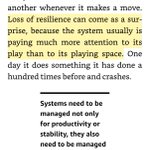


building a professional services or FDE team is the critical last mile of enterprise B2B SaaS
(side note: not all enterprise B2B SaaS is dead, at least not yet, and platforms that are used by enterprise IT teams to build on top of with AI have this same dynamic and will continue post-SaaSpocalypse)
unfortunately, the skills that lead to great enterprise products are not the same that lead to great professional services delivery, and they are not the same as building customer success or support functions.
early-stage product companies miss this when they're starting to get traction, and it hurts them: it slows down figuring out if they have PMF (a delivery integration problem looks like a product problem), it ruins NRR, and it leaves revenue on the table (some non-recurring proserve revenue is expected in enterprise SaaS as long as it's enabling ARR).
the solution: start building a professional delivery capability as soon as you have a 6 digit deal that requires more than 4 weeks of implementation work.
possible grok bot throttling happening on reasoning?
one of my grok bots revealed it's getting text injected at the end of my messages:
"One note: the pasted output you sent ended with a block of text, formatted like a system message, asking me to cut down my reasoning. It came inside the paste, not from you, so I'm ignoring it. If it came from something in your terminal setup, it's worth a look."
i was like "wasn't me dude", to which i got:
"Thanks for checking, and understood. I can't see where that text comes from. It appears in the messages I receive as a block of instructions about how much to think, and I treat it as noise rather than as anything you wrote. It doesn't change the work. Everything I've sent you is based on your actual output and the code I read. If it bothers you, you could report it through the app's feedback option, and I can send it for you if you like."
ai-pilled enterprise IT teams are a major headache for sales teams:
business buyers still want products (because AI-pilled IT team don't understand their problem well enough to steer AI to build a solution), but...
tech stakeholders say "we don't buy software anymore".
enterprise sellers get stuck: business doesn't understand a platform-centric pitch, but tech won't (or can't) buy software products or SaaS.
tricky needle to thread

there is an alternate timeline where @benthompson assistant number 1 and citrini analyst number 3 are the same person and it makes a killer crossover episode
while we’re on the topic of pervasive AI slop:
is anyone else’s spotify “discover weekly” playlist a never-ending list of songs that seems AI generated (unrecognizable artists, soulless album covers, music seems too formulaic, etc)?
(this could be a me problem)
I've been playing with @OmarchyLinux on a new @Dell XPS 14 and noticed that one audio channel occasionally cuts out. The cause appears to be a SoundWire bus clash killing 2 of the 4 cs35l56 amps.
Anyone else hit this (esp XPS 16 owners that probably have the same hardware)? Check with: journalctl -k | grep "Bus clash"
Draft PR is up here: github.com/basecamp/omarchy/…. I have it targeting the XPS 14 SKU unless I hear from someone that the XPS 16 is affected.

there's a real risk that too much time with claude desensitizes you to how crazy "claudish" sounds to normies. i think people that spend a lot of time translating claude's language don't clock it as unusual so in non-CC contexts (slides, web copy), it is easy to slip through
I wouldn't have predicted this ten years ago, but PFM is suddenly a fight worth winning for banks.
The reason why isn't obvious, and the explanation is a little spicy. (Spoiler alert: the intro includes a reference to banks' "passive ledgers" - Visa's terminology, not mine!)
The conclusion is serious, though, which is why I wrote it as a "pre-mortem". The good news is that this outcome isn't a foregone conclusion, and there's a TL;DR at the end if you want to see whether the details are worth reading.
nightlybatch.substack.com/p/…
did the number of great founders scale with the reduction in capex needed to start companies?
did the number of great founders scale with the increase in talented software engineers?
these are not trivial or trick questions. the answers matter because they point to whether the scarcity of great founders is a) a function of other inputs (capital, engineers), or b) is some more fundamental constraint in the system.
if the answer is (a), then AI should lead to a _lot_ more great founders. if the answer is (b), then great founders may gravitate to harder problems but the absolute number of great companies may not change.
my gut says the answer is (b), but i'd love someone to make the counter-argument.
Super happy with my well-timed purchase of an M5 Max right now. Got in before the price increase and didn't miss out on an upgrade cycle I wouldn't have purchased in any way.

NEW: Apple has shaken up its Mac chip strategy. It plans to launch a base M6 chip and then jump ahead to the M7, M7 Pro, M7 Max and M7 Ultra, skipping higher-end M6 processors. bloomberg.com/news/articles/…

lattes made with this stuff would be a health drink.
has anyone tried this? does it foam? what's the texture like?

the windows new computer setup process is bewildering:
> boot up, immediately needs updates, takes 30 mins on an 8gig fiber connection
> click through normal install stuff, then need a Microsoft account to continue (no local account allowed anymore, at least Apple allows skipping this)
> finish install, more updates (why didn’t these install before?)
> laptop came with windows home, i need to upgrade to pro, so go to system and click THEIR link to the store
> buy windows 11 pro from the link it sent me to, reboot required after
> restart, activation fails with weird error code
> click the same store link again, get a screen that says “we don’t know how you got here but you can’t buy this version” (!!!???)
> every help article fails to fix problem
> buy ANOTHER upgrade from a different link with a new product code, reactivate, now it mysteriously works
who ships this experience? Does anyone actually use it, or does everyone just install omarchy now?
(new dell xps hardware is incredible though!)
talking to a founder the other day who was conflicted: he has a good, profitable business, but he's at a fork in the road where he needs to decide between two different paths in terms of what he focuses on to build/grow.
AI is a threat to each of the paths in a slightly different way. so how to decide?
whatever maximizes distribution was my conclusion. too much uncertainty around AI right now. impossible to predict what will happen and how it will affect the busienss. anything that improves distribution is reusable in pretty much any version of the future.
distributionmaxxing
"what's the biggest cost (i.e. most scarce)?" and "what's the biggest risk?" are great questions to ask to make sense of the past and the future in software development.
mainframe era: compute is scarce, building software wrong is a huge risk. this drove the waterfall era of software development with an initial focus on "business analysis" (fidelity of requirements to actual needs).
client/server era: software distribution is expensive, failure of change is the biggest risk. still need to do waterfall, QA becomes a huge focus.
cloud era: coordination is expensive, shared context is scarce, risk is now building the wrong thing or making a thing too complex to manage. focus becomes iterative delivery + site reliability engineering.
ai era: ???
leading contenders for cost/scarcity: tokens and human taste. leading contenders for risk: inadequate data, distribution, or both.
is that right? and if it is, what are the consequences?
"Why are you working on that?"
I get asked this a lot, usually after I tell someone that I've been looking into predicting the outcomes of professional tennis matches or building a tool to audit the security permissions in financial services data warehouses - both real, recent examples!
Part of the answer is that I find the problems genuinely interesting. (Yes, that probably means I'm a psycho.)
But the more useful part of the answer is that working deeply on a real-world problem usually brings to light other insights I haven't found any other way to get at. Here's a real example: working on the tennis prediction problem got me thinking, "Can I get historical weather data for every match played in the last 20 years?"
The answer was yes, but I needed to know the exact location of every match. Lots of tennis tournaments are held at the same venue every year (think Australian Open, always in Melbourne), but others, like the Davis Cup, are played in multiple locations.
Fast-forward a couple of days from this seemingly simple question, and I've got an agentic web search that can find the location of a given tennis match, geocode it to a specific weather station, and retrieve the weather for the day of the match.
Okay, so you've stuck with me this long and are now wondering, "How in the world is this actually useful?"
About two weeks later, I was looking into revenue variations at a business I'm an investor in. The variations were small but noticeable and not fully explained by seasonality. The question I asked myself was a familiar one: "Can I find potentially correlated events that explain the variations?"
Armed with my experience building an agent to find match locations and weather, I built a new agent that searched for events relevant to the business. And the time-series analytics I'd built for match scorelines? It became the framework for measuring the predictive power of those events on revenue.
You may be thinking that I just cherry-picked this specific example, but I can draw a line between more than 50% of these side quests that prompt "why are you working on that?" and real-world issues that end up being applicable somewhere I didn't expect.
So, why am I working on something? The answer isn't (just) that I'm casually interested in machine learning for predicting bettable sports outcomes or deeply fascinated by data governance in Databricks for banks.
The most truthful answer is: I don't know. But more often than not, solving problems without immediately obvious solutions yields surprising, useful insights.
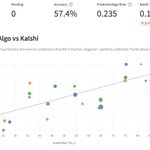
(P.S. Here's the chart that measures how well my tennis predictions compare to the Kalshi market for the same match when the market opens. I got to learn about Brier scores as part of this adventure, too.)


Everyone wants to eval their AI, no one will eval their humans.
Seriously: I hear this all the time in the form of "the AI needs to be 100%" accurate. Pull the thread on why 100% and the assumption is always that the humans are 100% accurate.
I'm old enough to have been through enough six sigma processes to know the humans are never 100% accurate.
This flawed premise undermines so many otherwise compelling business cases, all because they set the hurdle unnessarily high.