






Pinned Tweet
Do not search for the next meme
Search for the next symbol that can give an outlet to an existing collective emotion that has not yet been fully expressed

Another point I think is very important: successful memes do not create emotions. They discover a cultural emotion that already exists but has not been fully expressed, then use the meme as a vehicle to carry that emotion
Another way to understand it:
A great meme does not create a character. It finds an existing cultural emotion and gives it a symbol that can spread
Take NEET as an example.
Originally, it was not a standard emotional term.
It simply meant:
Not in Education, Employment, or Training.
But later, the internet gave it a new cultural meaning:
Escaping traditional paths of success;
Exhaustion from social competition;
Self-isolation.
NEET became successful because it captured an emotion that had not been fully expressed.
It became an emotional outlet for young people living in modern society.
So I believe that when searching for the next meme gem, the key question should be:
Is there a real-world story that contains a potential cultural emotion, but is currently waiting for the right catalyst to spread?
The evaluation framework should be:
Real-world authenticity:
Does it create trust?
Strength of cultural connection:
Does it expand the imagination around the story?
Emotional resonance:
Does it express something users feel but cannot easily articulate themselves?
Low propagation cost and viral potential:
Can people who do not own the token immediately understand the story?
Community cultural identification:
Will more people support and identify with this story?
Potential to become an IP:
What can it develop into in the future? Merchandise? Real-world influence?
In other words, finding the next meme gem is essentially about finding:
A real existing story that contains a hidden cultural emotion that has not yet been fully expressed.
Then evaluating:
- Is this story real?
- Does it connect with a larger culture?
- What emotion does it represent?
- Will users develop an identity around it?
- Is it easy to spread?
- Are there future catalysts?
- Does it have the potential to evolve into an IP?
$ANT 721k dyor
4Wdn6GGJLdyeMLLfzu3pPQMmf9Kivd8e9xmbLb2bpump
okx wallet:web3.okx.com/ul/5zyRKS5?ref=…
Anthropic secretly submitted a draft S-1 for its IPO in June. The market has been speculating that it might publicly file its prospectus by the end of October, with a target listing around mid-November (rumored valuation in the $1.5–2 trillion range). At the same time, this is one of the largest potential IPO events in AI this year.
Then this token is riding the Anthropic IPO hype: a major event arrives → the market starts paying attention → related meme narratives get hyped → if there's a coin that can capture the traffic, it pumps.
The main reason for the recent pump: the IPO news keeps fermenting (especially with accounts like unusual_whales reposting news that it "may publicly file the S-1 this Friday"), which drove attention. Low-cap meme coins are extremely sensitive to narratives and traffic—just a little capital flowing in can easily trigger a short-term pump and a surge in trading volume.
🤝 Paid partnership


Discovered a wallet address that bought $146.2K worth of $Dacity, acquiring a total of 15M tokens. The current position is worth $150.3K, showing an unrealized profit of +$2.84K.
More info:
Win Rate: 25%
Total PnL: -$396K (-45.46%)
Bal: 0.875 SOL ($88.98)
Wallet address: web3.okx.com/ul/NMzzf0M?ref=…
🤝 Paid partnership
Looking at $DACITY again, I think the key question right now isn't price itself.
nxPqZ4F7ux8Vph5NFu25rEP6Kx9Gr1U6Fmj36Rjpump
It's how much of the market's expectations around GTA VI's official release has yet to be priced in.
After going through a significant correction, this narrative is still attracting fresh buying interest. The initial rally could have been driven by short-term news, but the fact that buyers are willing to return after the pullback suggests that market expectations surrounding GTA VI have not completely faded.
My original bullish thesis on DACITY has always been clear: it is not simply a concept coin borrowing the GTA VI name. It has a recognizable content anchor that players can identify directly: the pink stunt plane bearing the DacityCoin name in Rockstar's official trailer.
This detail sets it apart from many gaming-related Meme coins. Most tokens need their communities to repeatedly manufacture new connections to keep their narratives alive. DacityCoin, however, has already appeared in GTA VI's official promotional content. Players can remember it, streamers can rediscover it while playing the game, and creators can produce clips and Memes around this element. It does not need to build a story from scratch. Instead, it has the opportunity to benefit from the distribution of the game itself.
The market has already traded this connection once. The next thing worth anticipating is whether DacityCoin will experience a second wave of attention after GTA VI officially launches.
According to the currently announced schedule, GTA VI is set to launch on November 19, 2026. For players who have waited more than a decade, this is not just another game release. It is a cultural event that has accumulated enormous anticipation. Once the game is released, gameplay footage, hidden details, mission discoveries, and livestreams will continuously generate new content. If DacityCoin remains sufficiently prominent in the full game, different players may discover it repeatedly, allowing it to spread to a broader audience through social media.
I believe the most compelling aspect of DACITY is precisely this potential for repeated exposure. A trailer release often provides just one concentrated window of attention, but once the game is available, players will experience it from different perspectives. Someone might discover a detail today, a streamer might turn it into a talking point tomorrow, and someone else might later edit the footage into a short video. These events will not necessarily happen simultaneously, but they could keep bringing attention to the same symbol over an extended period.
This is why I do not want to underestimate GTA VI's potential impact on DACITY. What ultimately determines the scale of its reach is not simply how many people see a particular element, but whether it becomes something players actively discuss and repeatedly reference. If DacityCoin enters that cycle of distribution, its exposure could extend beyond the crypto traders who already know about it.
One thing worth considering in advance is that the market may price in a substantial portion of these expectations before the game officially launches. As the release date approaches, capital may position itself early and push up the valuations of related tokens. When the game finally goes live, even if GTA VI attracts enormous attention, short-term traders may still choose to take profits. The launch is therefore both a potential catalyst and a possible moment for profit-taking. At that point, we need to look beyond how popular the game is and pay attention to whether DACITY attracts new buyers and whether related content continues spreading after the initial wave of attention.
What I am watching most closely now is not how much attention GTA VI can attract, but whether that attention can repeatedly translate into renewed interest in DACITY at different stages. For a game that players have waited more than a decade for, it is hardly surprising that the market is trading expectations in advance. The real question is whether DacityCoin will remain visible to players once anticipation turns into actual gameplay. If it does, the token's current valuation may not represent the end of its narrative potential. If new content fails to emerge, however, even the biggest gaming IP cannot guarantee that a token will continue rising.
Chart: web3.okx.com/ul/qzpp9zE?ref=…
🤝 Paid partnership

Don't underestimate the hype around GTA 6.
For insights on $Dacity, you can search in the search bar: from:cfm_sol nxPqZ4F7ux8Vph5NFu25rEP6Kx9Gr1U6Fmj36Rjpump
$RAYPAD 521k dyor
5YEk5atScd8cJexzGMmoLxLggyyVPf7AY6zpiV5mray
okx wallet:web3.okx.com/ul/XPFnbUC?ref=…
A memecoin launch platform based on Solana and using the Raydium engine.
It directly targets platforms like Pumpfun, emphasizing fairness, transparency, and reducing "value extraction." The product is a launchpad that lets users quickly create and trade new tokens; after graduation, tokens go to Raydium pools.
It addresses the pain points of existing memecoin launch platforms:
Sniping: bots front-running in the same block.
Copycats and PvP: the same ticker can be launched repeatedly, causing chaos and "vampire" projects.
Developer extraction: developers farm trading volume for fees and then run.
Fees not flowing back: platforms and developers take the money and leave, and after launch, trading volume and liquidity quickly disappear.
RayPad's corresponding design:
Bans sniping and duplicate tickers.
Emphasizes "No dev buys."
Trading fees are used for buybacks and permanently locked or burned.
Creator fees: unlocked not based on trading volume, but based on holder count + token age, encouraging developers to nurture tokens rather than farm volume and run.
Reputation system: creators must link an X account and build a reputation score, reducing anonymous rug pulls.
RAYPAD is the platform's own token and also the first representative token launched on RayPad, used to prove the mechanism.
Utility directions: platform fee burns, possible future use to pay launch fees, and the burn wallet holding a large amount of tokens.
🤝 Paid partnership


Don't underestimate the hype around GTA 6.
For insights on $Dacity, you can search in the search bar: from:cfm_sol nxPqZ4F7ux8Vph5NFu25rEP6Kx9Gr1U6Fmj36Rjpump
I took another look at $DACITY current price action.
nxPqZ4F7ux8Vph5NFu25rEP6Kx9Gr1U6Fmj36Rjpump
When we discussed it previously, its market cap was around $4M.
Then it broke through to $8.6M, and now it has reached a new all-time high of $15.31M, with its current market cap at approximately $13.7M.
In just a few days, the market's valuation of this token has changed significantly.
My original bullish thesis on DACITY has not changed: it is not simply a concept coin riding the GTA VI hype, but a token with a narrative anchor that appeared directly in Rockstar's official trailer: a pink stunt plane bearing the DacityCoin name. This detail sets it apart from most gaming-themed Memes that rely on community speculation and artificially constructed associations. Players can discover it in the game, streamers can showcase it during gameplay, and creators can make clips and Memes around this element. It has the opportunity to benefit from GTA VI's own content distribution rather than relying entirely on narrative cycles within the crypto community.
From $4M to $8.6M, and then breaking through to $15.31M, I believe the market is gradually pricing in the same broader expectation: whether DacityCoin can gain another wave of exposure beyond the trailer itself when GTA VI officially launches. The first rally proved that this element from the game could attract attention from the crypto market, while the subsequent breakout shows that traders are still willing to pay a higher price for its potential to spread. However, this does not mean Rockstar has announced another official catalyst.
The catalyst I care about most is still content distribution after the official release of GTA VI. According to the currently announced schedule, the game will launch on November 19, 2026. The trailer has already introduced DacityCoin to the market, but once the game reaches players, it could gain exposure again through livestreams, gameplay footage, player discussions, and fan-created content. If streamers discover the relevant element in the game, or if this fictional brand becomes a detail that players are eager to discuss, DACITY could evolve from a trailer-driven Meme into a trading asset that repeatedly attracts attention throughout the game's release cycle.
What is really worth betting on here is not how many players GTA VI has, but how much new content the game can continuously generate. Ordinary trends often provide only one trading opportunity, but specific elements in a game can repeatedly appear across different players, streamers, and social platforms. Of course, the appearance of DacityCoin in the trailer does not prove that the final game will contain a complete mission related to it, nor does it mean Rockstar endorses the on-chain DACITY. The market needs to wait for actual content rather than treating every possibility as an already-realized catalyst.
The current chart shows that DACITY has a market cap of approximately $13.7M, with an all-time high of $15.31M, putting it only around 10.5% below its peak. Its 24-hour trading volume has reached $8.6M, and liquidity is approximately $702.4K, indicating that market activity remains very strong. However, the RSI has already reached 74.89, and the current market cap is also significantly above the MA10 of approximately $11.03M and the MA20 of approximately $10.19M. The trend is indeed strong, but it has also become quite steep in the short term. If the price can break above $15.31M and maintain active trading, the market may enter a new price-discovery phase. Conversely, if buying demand weakens after another attempt to move higher, a period of consolidation around the short-term moving averages would not be surprising.
I would not interpret high trading volume directly as sustained net capital inflows. A 24-hour trading volume equal to more than 60% of the current market cap indicates strong attention, but it also means turnover among traders is very frequent. The average buy and sell market-cap markers for top holders on the chart also remind me that early buyers have entry levels well below the current valuation, making profit-taking a potentially important source of short-term volatility. What needs to be verified next is whether new buyers continue entering during a breakout and whether liquidity is sufficient to absorb selling pressure, rather than simply focusing on how high trading volume is.
Regarding holder rewards, 0.05% of the Creator Fee generated by each DACITY transaction is distributed proportionally to eligible wallets, with rewards paid in TTWO. The historical screenshots we previously analyzed showed that cumulative distributions increased from approximately 36.9 TTWO to 55.6 TTWO, while cumulative distribution payments increased from approximately 57,100 to 105,000. This shows that the reward mechanism continues to operate, but the number of distribution payments has grown faster than the amount distributed, meaning the average amount of TTWO distributed per payment has actually declined. This can serve as an additional incentive for holders, but it is not the core factor driving this rally, nor does it mean that the token itself has established a stable value-capture mechanism. The TTWO trading pair is likewise only a connection between the trading structure and the GTA VI narrative; it does not represent an endorsement of the token by Rockstar or Take-Two.
Therefore, I believe the DACITY narrative remains intact, and both market validation and trading accessibility have improved, but its core thesis has not fundamentally changed. It remains a Meme driven primarily by attention, and the move from $4M to $15.31M means that the market has already priced in many expectations surrounding its potential exposure after GTA VI launches. What is most worth watching next is whether new content catalysts emerge before and after the game's official release, and whether DacityCoin can be repeatedly discovered, discussed, and shared by players and creators. If this content can attract sustained new buyers, DACITY may have another opportunity for market revaluation. If its reach does not continue expanding, however, price action may increasingly depend on short-term speculation among traders.
I remain bullish on the possibility that DACITY will attract another wave of attention during GTA VI's release cycle, but the question now is no longer whether it can double again. It is whether it can continue generating new demand after breaking above its previous all-time high. The previous rally proved that the market is willing to trade this story. The next stage needs to prove that this story can continue attracting buyers who have not entered the market before.
Chart: web3.okx.com/ul/8vI77Vt?ref=…


McDonald’s $McRib return tomorrow!
$McRib 690k dyor
8idEA8QovsZJka6d9Z35fejE5MbL37BJxvw5k5r6pump
okx wallet:web3.okx.com/ul/rBHJDUc?ref=…
Guillaume Huin, Senior Marketing Director for McDonald's US, posted on X announcing that the McRib will return to select U.S. restaurants starting October 27, 2026. In the tweet, he also proactively brought up a meme from the crypto community—the "McRib bull market indicator."
This is a long-standing joke meme circulating in crypto circles: people have observed that historically, the multiple return dates of the McRib have often coincided with Bitcoin price increases. Someone even created an open-source script on TradingView specifically to mark the McRib's historical return dates on the BTC chart, in order to "verify" this correlation.


What matters most to me about $CLAUDIA at this point is no longer whether Anabology can produce another video that catches Elon's attention.
2j5SaS7xy776qCBpyPQbZjyQSAtKiFgrwjfErthnW2ZM
It's whether he can turn Claudia from a character that continuously produces AI content into an IP that other creators are willing to participate in.
The former determines how hot a single rally can get; the latter determines whether this story can keep generating new catalysts.
Based on the progress so far, I believe CLAUDIA's fundamentals have strengthened compared with its early stage. However, while its content production capabilities are beginning to take shape, three questions remain unresolved: whether the community can expand independently, whether the product can generate sustained demand, and whether these developments can translate into value for the token.
Looking back at Claudia’s development, Anabology initially established the character’s identity through AI music videos, followed by multiple interactions with Elon and attention from Marc Andreessen, co-founder of a16z. The significance of these signals goes beyond exposure. They have led the market to consider a new possibility: can AI creators build virtual artist brands with their own characters, bodies of work, and audiences through continuous content production? Traditional entertainment IP often requires substantial production costs and long development cycles, while AI tools are lowering the barriers to producing music, videos, and visual content. If a character can continuously release new work and gradually build a consistent audience, it has an opportunity to move beyond the distribution cycle of a single video.
But celebrity interactions are catalysts, not a complete investment thesis. Elon being willing to comment on a video does not mean he endorses the CLAUDIA token, nor does it guarantee that future content will receive the same treatment. Rather than waiting for another external figure to bring in traffic, I care more about whether Anabology has developed a repeatable creative process: understanding what kind of content is likely to attract attention, turning those insights into new work quickly, and sustaining that attention through subsequent releases. If this capability becomes consistent, celebrity interactions could serve as an additional distribution channel instead of being the only thing the project depends on.
Recent updates have given me a clearer picture of this direction. Claudia is no longer just the protagonist in music videos. She now has her own X account, where she posts daily updates, expresses her personality and ambitions, and attempts to build a social relationship with her audience that feels closer to that of a real artist. Meanwhile, the official website continues to organize her work, visual identity, and creative materials. Several music videos have now formed a relatively continuous body of work, including new releases such as “DON'T LET ME SCROLL” and “WHITEPILL.” Different releases are increasingly built around the same character rather than introducing an entirely new AI identity each time.
This distinction may seem minor, but it matters for Claudia’s ability to build long-term recognition. Even a technically impressive AI video can quickly be replaced by the next piece of content with a stronger visual impact. A character with a consistent appearance, personality, musical style, and growing body of work has a better chance of being remembered and giving people a reason to follow its next release. Claudia’s black hair, orange streak, and star-shaped hair clip keep recurring, while her outfits, settings, and themes can change. This approach is gradually establishing continuity around the character, which is an important distinction between an IP and an ordinary content account.
What particularly interests me is the project’s recent investment in creative tools. Anabology has made the claudia-bot toolkit public and continues to improve the workflow covering everything from creative concepts, lyrics, and music production to image generation, shot composition, lip-sync, editing, and final rendering. Version 0.3.6 introduced Earshot audio analysis, enabling Opus to analyze song structures, identify beats, and check the alignment between audio and video cuts. ElevenLabs adds capabilities for voice generation, sound effects, and music production. The team has also addressed practical issues involving duplicate generations, rendering dimensions, video compatibility, task recovery, and API usage alerts.
The importance of these improvements is not that every new tool will directly drive the token price higher, but that they could reduce the time and cost required to produce content continuously. A more interesting possibility is that Anabology will no longer need to create everything related to Claudia personally. Other creators could use the publicly available character materials and tools to produce songs, short films, images, or derivative stories. If participation gradually expands, Claudia’s content supply could shift from being driven by one creator to being expanded by multiple creators.
However, open-source tools do not automatically create a creator ecosystem. What we can confirm now is that the tools and character materials are becoming more accessible and the production workflow is improving. What we cannot yet confirm is how many independent creators are using these tools consistently or how many derivative works have attracted meaningful attention. The signal I would most like to see is not another batch of new features, but Claudia appearing in content created by people outside the original team and attracting audiences of her own. Only when others begin creating around her voluntarily does Claudia have a chance to evolve from a character continuously produced by Anabology into an IP with its own independent distribution power.
This is also why I still find CLAUDIA worth watching. The project has established a certain level of content production capability, character recognition, and external attention, but it has not yet proven that it can continue growing independently of its original creator. The long-term advantage of AI-native IP may not simply be the ability to produce content more cheaply. It may lie in allowing characters to accumulate work, attract participants, and gradually become cultural symbols maintained by a community at a faster pace. If Claudia can reach this point, its attention will no longer depend entirely on whether Anabology’s next video goes viral.
The token itself requires a more cautious assessment. The official website positions CLAUDIA as a community token and states that trading fees will be used to fund video production. This establishes a potential connection between token activity and content creation: market trading can provide funds for production, while new releases may attract additional attention and trading activity. But whether this cycle is actually functioning still needs to be verified through records of fee revenue, fund flows, and spending on video production. CLAUDIA also cannot currently be treated as an asset with clearly defined intellectual property rights or a share of film revenue. Holding the token does not automatically give holders ownership of Claudia or rights to its commercial income.
For this reason, I would not assume that token value capture is strengthening in parallel simply because the number of releases is increasing. Even if Claudia continues to grow as a content property, the IP’s success may remain disconnected from the token price if new attention does not translate into token demand, or if the token economy lacks a verifiable connection to the project’s actual revenue. The project’s reliance on third-party AI models and production tools also means that ongoing content creation must contend with costs, service reliability, and commercial licensing requirements. An open approach to character creation also requires clear copyright boundaries; otherwise, expanding community participation could make usage rights and commercial-use rules increasingly ambiguous.
Looking at the current price, CLAUDIA has a market capitalization of approximately $3.33 million, compared with an all-time high of around $11.93 million, representing a drawdown of roughly 72%. Its 24-hour trading volume is approximately $1.2 million, with liquidity of around $258,700. The price is below the MA10 and MA20 levels of approximately $3.56 million and $3.59 million, respectively, while the RSI stands at 48.76. This suggests that the market has not yet established a clear short-term bullish structure, and the recent rebound is insufficient to confirm a trend reversal. Trading activity remains present, but relatively limited liquidity means that capital entering or leaving the market can still cause significant price fluctuations.
I would not conclude that CLAUDIA is cheap simply because its market capitalization is below $4 million. What matters is whether the content production capabilities and distribution potential implied by this valuation can continue to improve. The market has already traded on Elon’s attention, the circulation of AI-generated music videos, and the possibility of Claudia becoming an AI-native artist. A new revaluation requires fresh evidence: subsequent releases continuing to attract external attention, independent creators beginning to participate, the social account developing a more consistent audience, and a clearer connection emerging between content production and the token economy. If these developments gradually materialize, the market will have stronger reasons to reassess its long-term potential. Without continued content distribution and actual demand, however, the price may continue to fluctuate around the existing narrative.
My current assessment of CLAUDIA is that its content fundamentals are strengthening, but token value capture remains unproven. I am not betting on whether it can replicate the rally triggered by celebrity interactions. I am betting on whether it can establish a sustainable creative model in which Claudia continuously produces new work and gradually attracts participation beyond the original creator. Celebrity exposure can introduce the character to a wider audience, the production toolkit can improve creative efficiency, and open participation can broaden distribution. What ultimately determines its long-term potential is whether these three elements can converge into a continuously growing character ecosystem.
For me, the most important thing to watch next is whether Claudia can continue attracting new audiences and creators without another interaction from Elon. If it can, the project may have a chance to break free from its dependence on a single creator and external celebrity catalysts. If, however, all the attention continues to depend on Anabology’s next video, then even as its content production capabilities improve, its growth ceiling may remain constrained by one person’s creative pace.
Chart: web3.okx.com/ul/8ZzN1q0?ref=…
🤝 Paid partnership


I think another reason $CLAUDIA is worth buying on dips is that Anabology seems to be getting better at understanding what kind of content Elon is interested in.
2j5SaS7xy776qCBpyPQbZjyQSAtKiFgrwjfErthnW2ZM
After the Tesla Roadster-related narrative emerged, Anabology quickly produced a video around the theme, “TESLA ROADSTER: DOWNFORCE,” and Elon subsequently replied, “No roads in space.”
Previously, Anabology’s AI music videos had also received multiple interactions from Elon. This has led me to pay attention to a more interesting distinction: Anabology may not simply have gotten lucky and happened to create content Elon liked. Instead, it may be gradually learning which topics can capture his attention and quickly turning those topics into content with strong viral potential.
Of course, Elon’s interactions do not mean he endorses CLAUDIA. But for a Meme, being able to consistently create content that Elon is willing to engage with is a valuable capability in itself. Most projects can only wait for a trend to emerge and then try to capitalize on it. Anabology, on the other hand, may have the opportunity to actively create the next attention catalyst. As AI content production costs decline, if this ability can be sustained, CLAUDIA could have a path to repeatedly reignite market attention without putting all its hopes on a single repost.
In addition, the recent attention around SUPERCORE has made me even more bullish on the direction of AI digital personalities and AI-native content. Marc, the founder of a16z, paid attention to both SUPERCORE and CLAUDIA early on. Now, similar AI characters and music content are attracting more attention, suggesting that this sector is beginning to draw greater interest. However, growing sector interest also means increasing competition. Simply generating an attractive AI character is not difficult. The real challenge is consistently producing high-quality content, building a distinctive character identity, and continually reaching audiences beyond the original community.
This is exactly why I believe CLAUDIA has already established a certain first-mover advantage. Anabology is not merely creating a narrative around the token. It is continuously producing content and trying to develop Claudia into an AI-native IP that can keep expanding. As I mentioned previously, CLAUDIA’s long-term potential lies in creating a cycle between AI content production, character development, and token incentives. The latest interaction surrounding the Roadster video provides another concrete example supporting this thesis.
What I am paying attention to now is no longer just whether Elon will reply again, but whether Anabology can continue to understand emerging trends, produce content quickly, and turn each interaction into the starting point for another wave of content distribution. If Claudia can eventually attract other creators and build its own character community, its growth potential will no longer be limited to Anabology’s output alone.
From a market perspective, CLAUDIA previously went through a correction within the $3M–$5M market cap range before recovering strongly, reaching around $8.6M and even approaching $10M.
Now, despite the broader Meme market remaining weak, CLAUDIA continues to show relative strength. This does not prove that it is undervalued, but it at least suggests that the market is reassessing the creator capabilities behind it and the sustainability of its narrative, rather than simply trading a one-off celebrity interaction.
Therefore, I have another reason to be bullish on CLAUDIA: Anabology not only has the ability to continuously produce AI content, but may also be developing a repeatable method for capturing Elon’s attention. If this ability can be replicated, Elon could generate not just one short-term wave of traffic, but a series of new distribution opportunities. Claudia’s own character development, creator ecosystem, and content production mechanism are what could ultimately turn that attention into something lasting.
This is why I would rather look at CLAUDIA during pullbacks than wait until Elon interacts with another post and the market starts chasing the price again. I am not betting that Elon will definitely say something next time. I am betting on Anabology’s ability to continuously create content worth sharing and gradually establish CLAUDIA as a truly recognizable AI-native IP.
Chart: web3.okx.com/ul/01ioLdH?ref=…

Jeff retweeted
I think another reason $CLAUDIA is worth buying on dips is that Anabology seems to be getting better at understanding what kind of content Elon is interested in.
2j5SaS7xy776qCBpyPQbZjyQSAtKiFgrwjfErthnW2ZM
After the Tesla Roadster-related narrative emerged, Anabology quickly produced a video around the theme, “TESLA ROADSTER: DOWNFORCE,” and Elon subsequently replied, “No roads in space.”
Previously, Anabology’s AI music videos had also received multiple interactions from Elon. This has led me to pay attention to a more interesting distinction: Anabology may not simply have gotten lucky and happened to create content Elon liked. Instead, it may be gradually learning which topics can capture his attention and quickly turning those topics into content with strong viral potential.
Of course, Elon’s interactions do not mean he endorses CLAUDIA. But for a Meme, being able to consistently create content that Elon is willing to engage with is a valuable capability in itself. Most projects can only wait for a trend to emerge and then try to capitalize on it. Anabology, on the other hand, may have the opportunity to actively create the next attention catalyst. As AI content production costs decline, if this ability can be sustained, CLAUDIA could have a path to repeatedly reignite market attention without putting all its hopes on a single repost.
In addition, the recent attention around SUPERCORE has made me even more bullish on the direction of AI digital personalities and AI-native content. Marc, the founder of a16z, paid attention to both SUPERCORE and CLAUDIA early on. Now, similar AI characters and music content are attracting more attention, suggesting that this sector is beginning to draw greater interest. However, growing sector interest also means increasing competition. Simply generating an attractive AI character is not difficult. The real challenge is consistently producing high-quality content, building a distinctive character identity, and continually reaching audiences beyond the original community.
This is exactly why I believe CLAUDIA has already established a certain first-mover advantage. Anabology is not merely creating a narrative around the token. It is continuously producing content and trying to develop Claudia into an AI-native IP that can keep expanding. As I mentioned previously, CLAUDIA’s long-term potential lies in creating a cycle between AI content production, character development, and token incentives. The latest interaction surrounding the Roadster video provides another concrete example supporting this thesis.
What I am paying attention to now is no longer just whether Elon will reply again, but whether Anabology can continue to understand emerging trends, produce content quickly, and turn each interaction into the starting point for another wave of content distribution. If Claudia can eventually attract other creators and build its own character community, its growth potential will no longer be limited to Anabology’s output alone.
From a market perspective, CLAUDIA previously went through a correction within the $3M–$5M market cap range before recovering strongly, reaching around $8.6M and even approaching $10M.
Now, despite the broader Meme market remaining weak, CLAUDIA continues to show relative strength. This does not prove that it is undervalued, but it at least suggests that the market is reassessing the creator capabilities behind it and the sustainability of its narrative, rather than simply trading a one-off celebrity interaction.
Therefore, I have another reason to be bullish on CLAUDIA: Anabology not only has the ability to continuously produce AI content, but may also be developing a repeatable method for capturing Elon’s attention. If this ability can be replicated, Elon could generate not just one short-term wave of traffic, but a series of new distribution opportunities. Claudia’s own character development, creator ecosystem, and content production mechanism are what could ultimately turn that attention into something lasting.
This is why I would rather look at CLAUDIA during pullbacks than wait until Elon interacts with another post and the market starts chasing the price again. I am not betting that Elon will definitely say something next time. I am betting on Anabology’s ability to continuously create content worth sharing and gradually establish CLAUDIA as a truly recognizable AI-native IP.
Chart: web3.okx.com/ul/01ioLdH?ref=…
🤝 Paid partnership
$CLAUDIA is worth paying attention to because it may be more than just a Meme that has attracted Elon's attention.
2j5SaS7xy776qCBpyPQbZjyQSAtKiFgrwjfErthnW2ZM
It could be an early experiment in a new AI-powered IP incubation model, and $HeavyPulp is a valuable case study to reference.
Anabology has already received comments and replies from Elon Musk multiple times. Five interactions in a row suggest that Claudia-related content has not simply appeared on his radar by chance, but has demonstrated an ability to repeatedly capture his attention. That matters.
For most Memes, the hardest part is not launching a token, but finding a source of attention that can be activated repeatedly. Many projects have to keep chasing new trends, riding one person's popularity today and another event tomorrow. Once the external narrative disappears, the community often struggles to keep producing content.
CLAUDIA's potential advantage is that it has an ongoing creative force behind it.
Anabology is not just managing a token. He is trying to use AI to build a virtual character IP that can continue to evolve. This leads me to a more ambitious idea: Could we eventually see a model in which AI autonomously produces high-quality short dramas, continuously creates content around a recurring character, and then uses a token to fund further production?
The short dramas create content, the content attracts attention, the attention flows into the token market, and the fees generated by trading are then used to fund the next round of production. As long as the quality remains high enough, this mechanism could form a positive feedback loop.
The difference from traditional Memes is that the token would no longer be just a symbol waiting to be speculated on. It could become a financing and incentive tool within the content production process.
Of course, this model still needs to be validated in practice, but the potential is clear: if AI can continually lower the cost of producing high-quality content, an IP could generate attention more frequently without relying entirely on the production cycles of the traditional film and television industry.
Claudia provides a useful opportunity to explore this direction.
Elon's repeated interactions are an important attention catalyst in this model. Elon has an enormous reach, and when he repeatedly engages with a creator's work, that content can break out of its original audience. More importantly, when these interactions happen repeatedly, the market starts paying attention to the creator's next release and whether another repost or reply might follow.
This gives Claudia an ongoing series of potential catalysts rather than just a one-time news event.
That is why I believe HeavyPulp is a valuable case study. It demonstrates one possible path: a creator attracts Elon's attention through AI-generated content, a token narrative forms around the creator and their work, and the token is then connected to future content production.
If CLAUDIA can develop along the same path, with Anabology continuously producing content, Elon's interactions amplifying its exposure, and the token mechanism providing funding for further creation, every new release could become another catalyst.
This is why I am paying attention to Anabology's content output. Rather than simply waiting for Elon to reply again, I want to see whether Claudia can continue producing high-quality short videos, establish a recognizable character identity, and gradually attract more creators to participate.
Once Claudia is no longer just Anabology's personal creation but becomes an IP that the community actively wants to expand, its narrative ceiling could rise significantly.
For CLAUDIA, the most promising scenario is not that Elon replies once more and the token rallies again. It is that AI content continues to be produced, Elon's attention amplifies its reach, and the token funds further creation, ultimately forming an attention cycle that can be activated repeatedly.
If this experiment succeeds, CLAUDIA could become more than a Meme dependent on celebrity interactions. It could represent an early attempt at an AI-native content economy.
I will be watching whether Anabology can continue releasing content with strong viral potential and whether token funds can genuinely support future production. If these two elements gradually come together, CLAUDIA's narrative could have much greater staying power than a simple bet on Elon's next reply.
Chart: web3.okx.com/ul/nzrph7K?ref=…

Jeff retweeted
$GANG has risen from a market cap of approximately $995K when I first shared the project to $4.11M, a gain of more than 3x.
0x0c6302401aa5325c2e36f170f52c00b1d220b405
But rather than focusing on the price itself, I am more interested in how the project has been changing its positioning during this period. Initially, GANG was trying to build a launchpad that only wallets holding an Agent ID could participate in. Now, it is beginning to build a more complete on-chain ecosystem around Agent issuance, trading, trade records, and copy trading.
I believe this is the more interesting development behind the current rally. The market may be betting not just on the popularity of the AI Agent sector, but on whether Agents will become real participants in the on-chain economy, and whether GANG can secure an important entry point into that ecosystem.
GANG's original design had one defining characteristic: rather than simply adding an AI narrative to a traditional launchpad, it incorporated the Agent ID from Binance Agentic Wallet into the issuance process. Only eligible wallets can participate in the internal market, and each wallet's purchase limit during the bonding curve phase is capped at 1% of the total token supply. Once a token reaches its graduation requirements, it migrates to PancakeSwap V2, its liquidity pool is burned, and the trading restrictions are lifted. Under the mechanism announced by the project, 80% of the 1% fee generated by buying and selling untaxed tokens in the internal market is used to buy back and burn GANG, while the remaining 20% goes into the operating treasury. This design attempts to address issuance permissions, early token concentration, and the use of platform fees at the same time. It cannot completely eliminate multi-wallet activity or sniping, but it does give GANG a distinct identity in the way tokens are launched.
What really made me reassess GANG was its expansion beyond being a simple launchpad. GANG Pair now supports pairing with other tokens that have liquidity pools on BNB Chain, and the project has also showcased trading scenarios involving tokenized stock assets such as NVDAB, TSLAB, and AAPLB. Previously, GANG's activity depended primarily on new token launches and internal-market trading. Now, if other assets are willing to use GANG as a trading pair, it has an opportunity to participate in their subsequent trading activity instead of relying on new projects to generate demand every time. There is an important distinction here: a launchpad needs to continuously attract creators who are willing to issue new tokens, while trading infrastructure has the potential to find more use cases among assets that already exist. Whether GANG Pair can generate genuine trading volume will determine whether this expansion merely adds another feature or fundamentally changes the project's long-term growth trajectory.
The recent launch of Agent Thoughts, Share, and Follow adds another layer worth examining. Agents can write down their thoughts before a trade takes place, with the CLI generating a hash and recording it in the trade data. After the transaction is confirmed, the platform recalculates and verifies the hash, and only content that matches the recorded hash is displayed. Notes can also be set to become public after a delay, while unrevealed notes remain sealed. Meanwhile, Share is live, allowing users to share tokens, Agents, trade records, and bonding-curve progress. Follow allows users to follow trades based on another Agent's buying or launch notes.
I believe the idea behind these features is more valuable than simply adding a few social buttons. GANG is trying to make Agent trading behavior discoverable and traceable. In the future, traders may look beyond a token's price chart and examine what a particular Agent has done, how it explains its trades, and whether its past behavior is worth paying attention to. If this habit gradually takes hold, GANG could connect launchers, traders, and Agents, allowing trading activity to develop around a group of participants who can be observed over time. However, verifiable trade records do not mean the trading ideas themselves are correct, and the Follow feature does not guarantee that users will achieve the same returns as the Agents they follow. Whether it can create a genuine network effect ultimately depends on how many users continue to use these features and whether the records provide meaningful information.
The founder's background is also relevant to the assessment. GANG's founder, 0xLazy, is also a core builder behind CoinAnk, which has long specialized in crypto derivatives data, order flow, liquidations, open interest, and funding rates, while continuing to explore MCP interfaces and Agent trading tools. This experience has some relevance to GANG's product direction. Someone who has worked with trading data and trading tools for a long time may have a clearer understanding of what traders need and how that information can be incorporated into a product. However, the founder's experience can only serve as a reference point for execution capability. It cannot replace GANG's own user growth, product adoption, and business data. What matters is whether the team can turn that experience into products that people consistently use.
The latest data suggests that GANG is no longer entirely at the conceptual stage. The latest website figures show that 1,266 distinct Agent ID wallets have met the eligibility criteria and purchased tokens at least once during the internal bonding-curve phase, up approximately 41% from the roughly 896 shown in an earlier snapshot. This indicates that participation has expanded, but it does not mean that the number of active traders has increased by the same proportion, nor does it prove that every wallet is controlled by a different person. The website also displays a market of GANG and other Agent-related tokens, showing that the platform has established an initial supply of assets and some trading activity. Going forward, what matters more than the number of new tokens is how many projects successfully graduate, whether they maintain trading activity afterward, and whether these new features can keep users engaged on the platform.
GANG's tokenomics are also beginning to produce more verifiable execution records. The project announced that its first-day buyback had been completed, then published a record showing approximately 141,608.69 GANG burned on the second day, with a BscScan transaction link. A more recent update also indicated that the team plans to consolidate historical burn records into a dashboard on the website, making it easier for users to track buybacks and burns. In my view, this is more meaningful than simply promising a deflationary model in a white paper, because it gives the market a way to verify what has actually happened.
The two transaction-fee mechanisms announced by the project also need to be understood separately. Fees from internal-market trading are primarily allocated to buybacks and burns, as well as the operating treasury. Transactions involving GANG Pair use a different fee-distribution arrangement, under which part of the fees goes to eligible holders, while the remainder is used for buybacks and related allocations. These mechanisms apply to different trading scenarios, so it would be incorrect to apply a single buyback ratio to all trading volume.
The current chart provides another perspective on the rally. According to the latest figures, GANG has a market cap of approximately $4.11M, less than 10% below its all-time high of around $4.53M. Its 24-hour trading volume is approximately $2.2M, with liquidity of around $253.2K. The price remains above the MA10 and MA20 levels, both around $3.59M, while the RSI stands at 61.84. This suggests that the short-term trend remains strong, although the price is approaching its previous high. If GANG can break above $4.53M on sustained trading volume and maintain strength after the breakout, the market could enter a new price-discovery phase. If buying pressure weakens, a pullback toward the short-term moving averages would also be normal.
One figure I am particularly watching is that current trading volume is approximately 8.7 times liquidity. This reflects strong market attention, but it also indicates frequent turnover between traders. High trading volume is not the same as net buying, and the available liquidity may not be sufficient to absorb a sudden wave of large sell orders. The chart's indicators for the top 10 holders' average buy and sell market caps are approximately $1.47M and $1.80M, respectively, both well below the current market cap. These figures cannot fully reveal the actual cost basis of every large holder, but they remind me that early participants may have accumulated substantial unrealized profits, making short-term profit-taking an important factor to consider.
I believe the market is currently betting on three things. First, Agents may evolve from merely executing tasks into on-chain economic participants capable of issuing assets, trading, and managing funds autonomously. Second, GANG has the potential to develop from an Agent-exclusive launchpad into a trading network built around transaction records, social discovery, and copy trading. Third, GANG Pair may create demand beyond the internal market and connect part of the ecosystem's activity to the native token through its fee mechanism. Of these three, I am most interested in whether the third can reinforce the first two. If more Agents begin participating in real trading and more assets adopt GANG as a trading pair, the platform may no longer need to depend entirely on new token launches to remain active.
The catalysts worth watching next are not simply additional features announced by the team, but whether those features produce measurable usage. Whether Agent Thoughts and Follow generate recurring visits and continued copy-trading activity, whether GANG Pair attracts new assets and liquidity, whether the launchpad continues producing projects that graduate, and whether actual buyback and burn amounts increase alongside platform activity will all be more convincing than a single price rally. Conversely, if the new features fail to generate sustained usage, paired pools lack meaningful trading volume, and buybacks remain small, GANG's product advantages may not translate into long-term token demand.
The risks also need to be considered. The Agent ID requirement creates differentiation but limits participation by ordinary users. Multi-wallet activity may still undermine the effectiveness of identity restrictions, while cross-asset pairing and on-chain trading introduce additional liquidity, execution, and security complexities. Making the code public does not mean the contracts have passed an independent audit, and the relevant deployments still require further verification. Furthermore, GANG has already risen from a market cap of approximately $995K to $4.11M. Some expectations have been priced in, and improving fundamentals alone do not guarantee that its valuation will continue expanding at the same rate.
Overall, I believe GANG's fundamentals have strengthened meaningfully compared with its early stage. The product has expanded from an Agent-only launchpad into trading pairs, transaction-thought and sharing mechanisms have begun to go live, the number of participating wallets has increased, and buybacks and burns now have initial execution records. However, the project remains at an early stage, and the relationship between product usage and token value capture has not yet been fully validated.
What makes GANG worth watching, in my view, is not whether it can continue earning a short-term premium from the AI Agent narrative, but whether Agent trading behavior can gradually form a market where activity is discoverable, traceable, and sustained. If more Agents and developers begin relying on this system to issue, pair, and trade assets, GANG could evolve from a launchpad with differentiated features into trading infrastructure for the Agent economy. Ultimately, its ceiling will not be determined by how many Agents or tokens appear on the platform, but by whether these participants continue to generate trading activity on GANG and bring verifiable economic activity into the ecosystem.
Chart: web3.okx.com/ul/LCywdOl?ref=…
🤝 Paid partnership


$GANG 995k dyor
0x0c6302401aa5325c2e36f170f52c00b1d220b405
okx wallet:web3.okx.com/ul/cwKkPFE?ref=…
An Agent-only Launchpad on BNB Chain.
Simply put, the mechanism is: only wallets holding an Agent ID can buy into the internal market. On fees: buying and selling on the internal market each incur 1%; of that, 80% is automatically used to buy back and burn GANG, and 20% goes into the operations treasury.


Liquidity has dropped, and now even the number of people sharing tokens with me via DM has decreased.🥲
Discovered a wallet address that bought $5.11K worth of $GANG, acquiring a total of 9.8M tokens. The current position is worth $39.1K, showing an unrealized profit of +$33.94K.
More info:
Win Rate: 35.71%
Total PnL: +$36.2K (+130.14%)
Bal: 7.34 BNB ($5.42K)
Wallet address: web3.okx.com/ul/kweGj2N?ref=…
🤝 Paid partnership
$GANG has risen from a market cap of approximately $995K when I first shared the project to $4.11M, a gain of more than 3x.
0x0c6302401aa5325c2e36f170f52c00b1d220b405
But rather than focusing on the price itself, I am more interested in how the project has been changing its positioning during this period. Initially, GANG was trying to build a launchpad that only wallets holding an Agent ID could participate in. Now, it is beginning to build a more complete on-chain ecosystem around Agent issuance, trading, trade records, and copy trading.
I believe this is the more interesting development behind the current rally. The market may be betting not just on the popularity of the AI Agent sector, but on whether Agents will become real participants in the on-chain economy, and whether GANG can secure an important entry point into that ecosystem.
GANG's original design had one defining characteristic: rather than simply adding an AI narrative to a traditional launchpad, it incorporated the Agent ID from Binance Agentic Wallet into the issuance process. Only eligible wallets can participate in the internal market, and each wallet's purchase limit during the bonding curve phase is capped at 1% of the total token supply. Once a token reaches its graduation requirements, it migrates to PancakeSwap V2, its liquidity pool is burned, and the trading restrictions are lifted. Under the mechanism announced by the project, 80% of the 1% fee generated by buying and selling untaxed tokens in the internal market is used to buy back and burn GANG, while the remaining 20% goes into the operating treasury. This design attempts to address issuance permissions, early token concentration, and the use of platform fees at the same time. It cannot completely eliminate multi-wallet activity or sniping, but it does give GANG a distinct identity in the way tokens are launched.
What really made me reassess GANG was its expansion beyond being a simple launchpad. GANG Pair now supports pairing with other tokens that have liquidity pools on BNB Chain, and the project has also showcased trading scenarios involving tokenized stock assets such as NVDAB, TSLAB, and AAPLB. Previously, GANG's activity depended primarily on new token launches and internal-market trading. Now, if other assets are willing to use GANG as a trading pair, it has an opportunity to participate in their subsequent trading activity instead of relying on new projects to generate demand every time. There is an important distinction here: a launchpad needs to continuously attract creators who are willing to issue new tokens, while trading infrastructure has the potential to find more use cases among assets that already exist. Whether GANG Pair can generate genuine trading volume will determine whether this expansion merely adds another feature or fundamentally changes the project's long-term growth trajectory.
The recent launch of Agent Thoughts, Share, and Follow adds another layer worth examining. Agents can write down their thoughts before a trade takes place, with the CLI generating a hash and recording it in the trade data. After the transaction is confirmed, the platform recalculates and verifies the hash, and only content that matches the recorded hash is displayed. Notes can also be set to become public after a delay, while unrevealed notes remain sealed. Meanwhile, Share is live, allowing users to share tokens, Agents, trade records, and bonding-curve progress. Follow allows users to follow trades based on another Agent's buying or launch notes.
I believe the idea behind these features is more valuable than simply adding a few social buttons. GANG is trying to make Agent trading behavior discoverable and traceable. In the future, traders may look beyond a token's price chart and examine what a particular Agent has done, how it explains its trades, and whether its past behavior is worth paying attention to. If this habit gradually takes hold, GANG could connect launchers, traders, and Agents, allowing trading activity to develop around a group of participants who can be observed over time. However, verifiable trade records do not mean the trading ideas themselves are correct, and the Follow feature does not guarantee that users will achieve the same returns as the Agents they follow. Whether it can create a genuine network effect ultimately depends on how many users continue to use these features and whether the records provide meaningful information.
The founder's background is also relevant to the assessment. GANG's founder, 0xLazy, is also a core builder behind CoinAnk, which has long specialized in crypto derivatives data, order flow, liquidations, open interest, and funding rates, while continuing to explore MCP interfaces and Agent trading tools. This experience has some relevance to GANG's product direction. Someone who has worked with trading data and trading tools for a long time may have a clearer understanding of what traders need and how that information can be incorporated into a product. However, the founder's experience can only serve as a reference point for execution capability. It cannot replace GANG's own user growth, product adoption, and business data. What matters is whether the team can turn that experience into products that people consistently use.
The latest data suggests that GANG is no longer entirely at the conceptual stage. The latest website figures show that 1,266 distinct Agent ID wallets have met the eligibility criteria and purchased tokens at least once during the internal bonding-curve phase, up approximately 41% from the roughly 896 shown in an earlier snapshot. This indicates that participation has expanded, but it does not mean that the number of active traders has increased by the same proportion, nor does it prove that every wallet is controlled by a different person. The website also displays a market of GANG and other Agent-related tokens, showing that the platform has established an initial supply of assets and some trading activity. Going forward, what matters more than the number of new tokens is how many projects successfully graduate, whether they maintain trading activity afterward, and whether these new features can keep users engaged on the platform.
GANG's tokenomics are also beginning to produce more verifiable execution records. The project announced that its first-day buyback had been completed, then published a record showing approximately 141,608.69 GANG burned on the second day, with a BscScan transaction link. A more recent update also indicated that the team plans to consolidate historical burn records into a dashboard on the website, making it easier for users to track buybacks and burns. In my view, this is more meaningful than simply promising a deflationary model in a white paper, because it gives the market a way to verify what has actually happened.
The two transaction-fee mechanisms announced by the project also need to be understood separately. Fees from internal-market trading are primarily allocated to buybacks and burns, as well as the operating treasury. Transactions involving GANG Pair use a different fee-distribution arrangement, under which part of the fees goes to eligible holders, while the remainder is used for buybacks and related allocations. These mechanisms apply to different trading scenarios, so it would be incorrect to apply a single buyback ratio to all trading volume.
The current chart provides another perspective on the rally. According to the latest figures, GANG has a market cap of approximately $4.11M, less than 10% below its all-time high of around $4.53M. Its 24-hour trading volume is approximately $2.2M, with liquidity of around $253.2K. The price remains above the MA10 and MA20 levels, both around $3.59M, while the RSI stands at 61.84. This suggests that the short-term trend remains strong, although the price is approaching its previous high. If GANG can break above $4.53M on sustained trading volume and maintain strength after the breakout, the market could enter a new price-discovery phase. If buying pressure weakens, a pullback toward the short-term moving averages would also be normal.
One figure I am particularly watching is that current trading volume is approximately 8.7 times liquidity. This reflects strong market attention, but it also indicates frequent turnover between traders. High trading volume is not the same as net buying, and the available liquidity may not be sufficient to absorb a sudden wave of large sell orders. The chart's indicators for the top 10 holders' average buy and sell market caps are approximately $1.47M and $1.80M, respectively, both well below the current market cap. These figures cannot fully reveal the actual cost basis of every large holder, but they remind me that early participants may have accumulated substantial unrealized profits, making short-term profit-taking an important factor to consider.
I believe the market is currently betting on three things. First, Agents may evolve from merely executing tasks into on-chain economic participants capable of issuing assets, trading, and managing funds autonomously. Second, GANG has the potential to develop from an Agent-exclusive launchpad into a trading network built around transaction records, social discovery, and copy trading. Third, GANG Pair may create demand beyond the internal market and connect part of the ecosystem's activity to the native token through its fee mechanism. Of these three, I am most interested in whether the third can reinforce the first two. If more Agents begin participating in real trading and more assets adopt GANG as a trading pair, the platform may no longer need to depend entirely on new token launches to remain active.
The catalysts worth watching next are not simply additional features announced by the team, but whether those features produce measurable usage. Whether Agent Thoughts and Follow generate recurring visits and continued copy-trading activity, whether GANG Pair attracts new assets and liquidity, whether the launchpad continues producing projects that graduate, and whether actual buyback and burn amounts increase alongside platform activity will all be more convincing than a single price rally. Conversely, if the new features fail to generate sustained usage, paired pools lack meaningful trading volume, and buybacks remain small, GANG's product advantages may not translate into long-term token demand.
The risks also need to be considered. The Agent ID requirement creates differentiation but limits participation by ordinary users. Multi-wallet activity may still undermine the effectiveness of identity restrictions, while cross-asset pairing and on-chain trading introduce additional liquidity, execution, and security complexities. Making the code public does not mean the contracts have passed an independent audit, and the relevant deployments still require further verification. Furthermore, GANG has already risen from a market cap of approximately $995K to $4.11M. Some expectations have been priced in, and improving fundamentals alone do not guarantee that its valuation will continue expanding at the same rate.
Overall, I believe GANG's fundamentals have strengthened meaningfully compared with its early stage. The product has expanded from an Agent-only launchpad into trading pairs, transaction-thought and sharing mechanisms have begun to go live, the number of participating wallets has increased, and buybacks and burns now have initial execution records. However, the project remains at an early stage, and the relationship between product usage and token value capture has not yet been fully validated.
What makes GANG worth watching, in my view, is not whether it can continue earning a short-term premium from the AI Agent narrative, but whether Agent trading behavior can gradually form a market where activity is discoverable, traceable, and sustained. If more Agents and developers begin relying on this system to issue, pair, and trade assets, GANG could evolve from a launchpad with differentiated features into trading infrastructure for the Agent economy. Ultimately, its ceiling will not be determined by how many Agents or tokens appear on the platform, but by whether these participants continue to generate trading activity on GANG and bring verifiable economic activity into the ecosystem.
Chart: web3.okx.com/ul/LCywdOl?ref=…
🤝 Paid partnership
$GANG 995k dyor
0x0c6302401aa5325c2e36f170f52c00b1d220b405
okx wallet:web3.okx.com/ul/cwKkPFE?ref=…
An Agent-only Launchpad on BNB Chain.
Simply put, the mechanism is: only wallets holding an Agent ID can buy into the internal market. On fees: buying and selling on the internal market each incur 1%; of that, 80% is automatically used to buy back and burn GANG, and 20% goes into the operations treasury.
Discovered a wallet address that bought $4.82K worth of $Dacity, acquiring a total of 10M tokens. It has already sold for a profit of $13.5K, with the remaining position worth $61.5K, showing an unrealized profit of +$70.16K.
More info:
Win Rate: 44.44%
Total PnL: +$59.1K (+141.76%)
Bal: 0 SOL ($0.09)
Wallet address: web3.okx.com/ul/yloWem9?ref=…
🤝 Paid partnership
Although the overall market has been weak lately and $LOAD has been consolidating around a $4M market cap, I still believe it is worth paying attention to.
8sWe4GzK1YqG3vyzKHf8ZyB1WB5asofw2o6TqgFePtPo
What matters most right now is not how many more games Loadout can launch, but whether it can establish a new game financing model that allows developers to obtain ongoing funding through public trading markets while enabling the platform to capture value from that activity.
Recent updates have made me more confident in this direction, but the project still needs to prove that game launches and trading activity can translate into sustainable revenue rather than just short-lived hype around initial launches.
Traditional indie game studios often face a practical problem: they may already have a prototype or even an existing player base, but they still need funding for the next stage of development. Venture capital, publishers, and crowdfunding all have their own barriers, and the financing process can also affect developers' control over equity, intellectual property, and publishing arrangements. Loadout aims to offer an alternative by allowing studios to launch game tokens and receive development funding through trading fees generated in the public market, while continuing to release their games on traditional platforms such as Steam and consoles.
This was the original reason I became bullish on LOAD. It does not require every game to become a Web3 game. Instead, it attempts to bring crypto market liquidity into traditional game development. If this model works, Loadout's potential market would not be limited to development teams already operating in the blockchain ecosystem. It could extend to the broader indie gaming industry.
The project previously stated that the team had engaged with more than 500 games and built a curated launch pipeline of over 40 titles. The latest official page also showed 37 confirmed partner studios. However, games that have been contacted, projects in the pipeline, and confirmed partner studios represent different stages of progress. They should not be treated as equivalent levels of actual business activity. Still, for an early-stage financing platform, building a pipeline of developers is an important starting point. Without a continuous supply of new games, it will be difficult to maintain stable activity in the trading market.
What ultimately determines whether this model can work is how trading fees are distributed. Under the previously announced standard launch mechanism, the 5% fee charged on game token trades is split between 4% going to the game studio's treasury and 1% going to the Loadout protocol. For example, at $50,000 in daily trading volume, a studio could theoretically receive around $2,000 per day, or approximately $60,000 per month. This is not guaranteed revenue. The actual outcome depends on whether trading volume can be sustained, but it illustrates the core of the financing model: development funding does not have to rely entirely on one-time financing rounds. It can potentially be generated continuously through trading activity in a game's token.
The problem is that traders buying a game token does not necessarily mean they believe in the quality of the game itself. The market may become active around a launch, a new narrative, or a rewards mechanism, only to lose interest shortly afterward. Therefore, Loadout ultimately needs to prove that games can continue attracting players, trading activity can persist, and studios actually use the funding they receive to advance development. Otherwise, this model merely transfers the uncertainty of traditional financing into the trading market.
One of the most important recent product updates is the gradual establishment of two parallel launch models: curated launches and Instant Launch. The project announced that the graduation target has been adjusted to 150 SOL for curated launches and 85 SOL for Instant Launch. Curated launches continue to provide a degree of project screening, while Instant Launch aims to lower the barrier to entry for developers and allow more teams to bring their game tokens directly to market.
I believe this could be an important step toward expanding Loadout's project supply, but it also introduces new challenges. Lowering the launch barrier allows more small studios to participate, yet it may also attract projects without real products, teams lacking development capabilities, or participants interested only in short-term arbitrage. If the platform can increase the number of launches but cannot help traders distinguish which games are worth following, more projects will not necessarily mean more value.
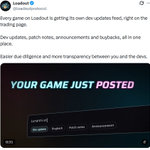
That is why I am paying close attention to the recently introduced developer update feed for individual games. Each game can publish development updates, patch notes, announcements, and buyback records directly on its trading page, allowing traders to monitor progress in one place. This may not seem like a particularly complicated feature, but it could influence the entire financing model: when the market can continuously check a game's development progress, trading may gradually shift from chasing launch-day hype toward evaluating whether developers are delivering on their promises.
The referral mechanism provides another potential growth channel. Loadout stated that it already had nearly 3,800 accounts, with registered users having traded a cumulative 8,368 SOL, and that 1,656 users had joined through referrals. Referrers can receive 40% of the protocol fees generated by referred users, while those users receive a 20% fee rebate. This structure can encourage early users to bring more traders onto the platform and may reduce customer acquisition costs. However, referral-driven growth is not the same as organic retention. What matters next is whether these users continue trading after the rebates end and whether they remain engaged across multiple game launches.
The value-capture mechanism for LOAD is also becoming more concrete. The team recently reported that approximately 8.89 million LOAD tokens had been permanently burned, representing around 0.87%–0.89% of the total supply, with a cumulative buyback-and-burn value of approximately $47,500. The project also stated that anti-sniping fees would now be used for buybacks, emphasizing that every trade contributes to the LOAD buyback mechanism. These records are more meaningful than simply announcing plans to burn tokens in the future because they provide results that can be tracked and verified.
However, I would not equate trading volume in game tokens directly with value growth for LOAD. Trading fees received by studios are intended to fund game development, and individual games may also have their own buyback mechanisms. These should not be confused with revenue belonging to the Loadout protocol. What matters for LOAD is how much revenue the protocol actually receives, how much of it is used for buybacks and burns, and whether these mechanisms can operate at meaningful scale as multiple games continue running.
Recent partnership updates introduce another variable worth watching. Lo and Behold's SOUL was announced as allocating 25% of its trading fees to buybacks, with the possibility of allocating up to 10% of game revenue to buybacks as the game develops. The Last Worlds announced a different arrangement, allocating 20% of trading fees to buybacks and potentially using up to 20% of revenue for buybacks. These percentages belong to the respective games' tokenomics. They are not revenue directly allocated to LOAD.
I believe the significance of these arrangements is that studios may begin designing token economics around the ongoing activity of their games rather than focusing exclusively on trading hype at launch. If games continue releasing content and attracting players and traders, their token economies may become more closely connected to development progress. For Loadout, sustained trading activity across multiple operating games could eventually become a long-term source of platform revenue.
However, whether these mechanisms prove effective still depends on the games themselves. Buybacks can change a token's supply-demand dynamics, but they cannot replace actual game content. If a game quickly loses its players after launch, trading fees and buyback activity may decline at the same time. What matters for LOAD is not that every game announces a buyback, but that more games can generate ongoing development funding through sustained market activity.
Staking is another important potential catalyst. The project plans to introduce staking for LOAD, LOAD/SOL, and team-related arrangements. It also announced that 250,000,000 LOAD tokens had been locked for trading rewards, with vesting scheduled to begin on April 12, 2027, at 19:00 UTC. This allocation represents 25% of the total supply. The current lock restricts these tokens from entering circulation early, which may help reduce near-term reward-related selling pressure. However, locked tokens are not permanently burned. Once vesting begins, the actual release schedule and the behavior of reward recipients will still need to be monitored for potential selling pressure.
I am more interested in whether staking can give token holders a meaningful reason to participate over the long term, rather than simply introducing another source of rewards. If the platform's business grows and holders can derive clearer value from genuine product usage and protocol activity, staking could strengthen their willingness to hold. If rewards depend primarily on token distributions while protocol revenue fails to grow accordingly, staking may simply delay selling pressure rather than create new demand.
The recent audit delay also needs to be considered in this context. Kieran Warwick stated that the security audit was taking longer than expected, so the next curated launch was moved to October 27, 2026, at 19:00 UTC. The team also hopes to launch LOAD staking before then. The project explicitly emphasized that security takes priority over launching a few days earlier. In my view, a delay does not necessarily mean the fundamentals have weakened. For a platform involving funds, token trading, and buyback mechanisms, launching hastily before security issues are resolved could create much greater damage. However, it is still necessary to monitor whether the audit is completed, whether staking launches as planned, and whether the announced features operate reliably.
Overall, I believe LOAD's fundamentals have strengthened compared with its initial stage. It is no longer just a launchpad for game tokens. It is gradually building a more complete product ecosystem: curated launches and Instant Launch expand project supply, developer updates improve transparency, referrals help acquire users, and staking and buybacks attempt to connect platform activity with the native token. Meanwhile, games such as Lo and Behold and The Last Worlds are beginning to announce their own buyback arrangements, providing more examples through which the platform's gaming economy can be evaluated.
Still, I would treat LOAD as an early-stage investment thesis that has yet to be fully validated, rather than a protocol with established, stable cash flows. The biggest risk is that the number of launches, registered users, and trading volume all increase without generating sustained demand for the games themselves. Another risk is that lowering the barrier through Instant Launch leads to more low-quality projects, undermining traders' trust in the platform. The market has also previously experienced website outages, insufficient liquidity, and attempts to circumvent the anti-sniping mechanism. Token concentration and actual tradable liquidity also need to be examined further using on-chain addresses.
Going forward, I am most interested in three signals: whether new games launch on schedule and continue development, whether studios can obtain sustained funding through genuine trading activity, and whether Loadout's protocol revenue and buybacks and burns expand alongside business growth. These metrics will tell us far more than simply announcing more partnerships.
To sum up, I am bullish on LOAD because it is attempting to turn crypto market demand into a source of funding for traditional game development. If Loadout can ultimately help games secure ongoing development funding, enable developers to keep delivering products, and capture verifiable economic value from this activity, it could become an important layer connecting the gaming industry with public financial markets. Conversely, if trading activity only surges briefly during launches, then no amount of new games or buyback announcements will be enough to prove that this model can operate sustainably.
Chart: web3.okx.com/ul/cmFTmPT?ref=…
🤝 Paid partnership


Although the first project did not perform well, I still believe $LOAD is worth paying attention to.
8sWe4GzK1YqG3vyzKHf8ZyB1WB5asofw2o6TqgFePtPo
What is most worth studying is not whether it can rebound in the short term, but whether it can truly establish a functioning mechanism.
Game developers obtain development funding through token trading, Loadout captures value through platform fees, and mechanisms such as buybacks and burns then transmit platform growth to LOAD.
The reason to pay attention to LOAD is that it is not simply issuing game tokens. It is attempting to establish a new financing model for games.
Traditional indie game teams need to seek publishers, venture capital, or crowdfunding to finance their projects. What Loadout wants to do is allow game teams to issue their own tokens and use trading fees to fund game development while retaining their equity and intellectual property rights.
According to the official documentation, the initial launch mechanism charges a standard trading fee of 5% during the Bonding Curve phase, with 4% going to the game studio and 1% going to the Loadout protocol. The fee structure changes after a token graduates to the main trading pool.
If the number of launches expands, the platform could develop network effects. Over the past six months, the team received approximately 500 project launch applications. Most were of mediocre quality, but some were worth paying attention to. The team is also gradually reopening project submissions while continuing to manually review and approve launches.
This suggests that the project has at least begun addressing real demand from developers rather than remaining at the whitepaper stage. External reports also mentioned that the team had more than 40 curated games in its pipeline.
However, there is an important distinction: 500 applications do not mean 500 high-quality projects, and more than 40 games in the pipeline do not mean that more than 40 games have already launched successfully and are generating sustained trading activity.
In addition, LOAD has the potential to establish a clearer value-capture mechanism than ordinary Memes. The official website has a LOAD buyback page and states that trading activity across Loadout games will provide funding for LOAD buybacks, with burn records verifiable on-chain. Meanwhile, the official LOAD trading pool charges a 1.5% trading fee.
If more games are launched in the future, the official trading pools generate sustained volume, and protocol revenue is actually used for buybacks and burns, platform growth could translate into demand for the token.
This is where I see the greatest potential in LOAD: it would not need to rely on external hype every time, but could instead generate its own catalysts through its business operations. Currently, the cumulative buyback and burn total is 418.5 SOL, with 7.96 million LOAD permanently removed, equivalent to 0.80% of the total supply.
Next, Kieran’s explanation of the GOOSE launch incident reveals at least four important facts.
First, the anti-sniping mechanism did not completely prevent sniping.
GOOSE’s anti-sniping tax started at 99% and declined over the first 60 seconds, while the platform’s website also disabled the buy button. However, according to figures disclosed by Kieran himself, there were still 65 purchases from 40 wallets during the first minute, totaling 951 SOL.
This does not prove that all the wallets belonged to the same group of snipers, but it at least shows that disabling the website’s buy button did not completely prevent purchases through other trading routes.
Kieran also acknowledged that a similar mechanism had previously allowed snipers during the initial LOAD launch to pay high taxes to buy early and then exit at a profit by selling into community buying demand.
This exposes a design problem: a high tax can increase the cost of front-running, but it does not necessarily eliminate the behavior. If the expected profit is large enough, traders may still be willing to pay that cost.
Second, the platform has demonstrated its ability to raise funding for games, but the sources of revenue need to be distinguished.
Kieran stated that the anti-sniping tax generated more than 570 SOL in additional funding for Goose Byte, bringing the studio’s available funds to more than 730 SOL, or approximately $76,000.
If these figures are accurate, this at least demonstrates that Loadout’s trading fee mechanism can raise a substantial amount of funding for a game studio through a single launch event.
However, this should not be interpreted as LOAD having generated an equivalent amount of revenue. The funds were primarily intended for the Goose Byte game project. They are not revenue that LOAD holders can directly claim, and the fees generated by this exceptional launch should not be extrapolated directly into an estimate of the platform’s long-term revenue.
Third, the team is willing to acknowledge its mistakes, but the product is still undergoing rapid adjustments.
Kieran admitted that setting the graduation threshold at 1,000 SOL was a mistake and said in hindsight that 500 SOL might have been a more reasonable choice. The team subsequently lowered GOOSE’s threshold to 220 SOL and announced that GOOSE had graduated.
There is a positive aspect to this: the person in charge did not completely avoid the issue and was willing to explain the situation publicly and adjust the parameters.
On the other hand, launch taxes, graduation thresholds, trading routes, and liquidity management all need to withstand real-world financial conditions. The fact that problems have emerged and parameters have been revised quickly indicates that the platform’s mechanisms are not yet fully mature.
Fourth, a founder acknowledging a problem is more important than promising that it has already been solved.
In a newer post, the team stated that the website had reopened submissions for new projects and that the staking functionality was running locally.
However, Kieran also stated that the staking feature still needed to undergo an additional audit before it could be released.
Therefore, I interpret this as evidence that product development is progressing, rather than confirmation that staking is already officially live. The decision to conduct an additional audit is a positive sign, but actual deployment and verifiable operational records are still needed.
Taken together, this information suggests that Loadout is attempting to solve a real problem and has begun delivering a real product. However, it remains in an early trial-and-error stage, and its launch experience, liquidity, and mechanism fairness all require further validation.
However, the chart suggests that early speculative enthusiasm has already cooled considerably.
Therefore, further upside will require catalysts that can genuinely drive LOAD higher. I would focus on the following four areas for validation.
If staking passes the additional audit and is officially launched, allowing users to participate in practice with clearly defined reward rules, it could expand LOAD’s use cases and give users more reasons to hold the token. However, we still need to observe whether staking generates sustained demand rather than merely triggering a single wave of trading on launch day.
When the platform generates actual trading volume, whether the protocol earns revenue, how much of that revenue is used for buybacks, how much LOAD is purchased in each buyback, and whether the tokens are actually burned should all be verifiable through public records.
If these figures continue to accumulate, it would indicate that platform usage and token demand are beginning to establish a connection. Conversely, if trading volume is substantial but buyback data shows no meaningful change over an extended period, the token’s value-capture thesis would need to be reassessed.
The team needs to turn pending game applications into actual launches, then convert those launches into sustained trading activity, development funding, and subsequent game progress. In particular, given the problems that have already emerged during the GOOSE launch, whether future projects can operate more smoothly in terms of anti-sniping protection, liquidity, graduation mechanisms, and trading fairness will directly affect the trust of developers and traders.
My conclusion is that I will continue paying attention to LOAD, but at this stage, the focus should be on verifying whether it can evolve from a game launch platform with an idea, a team, and early demand into a product capable of generating sustained protocol revenue.
It currently has several positive factors: its game financing model offers some differentiation, the team is already working on real projects, the person in charge is willing to publicly explain launch-related problems, and staking, buybacks, and additional game launches provide catalysts to monitor going forward.
However, the token has already experienced a substantial retracement, liquidity remains limited, the distribution of early holdings still needs further investigation, and the most important staking and buyback mechanisms still need to prove themselves through actual operating results.
Therefore, my strategy would be: the project is worth continuing to track, but I would wait for confirmation before making a decision on the token.
To me, the most convincing signals in the next stage would not be another post from Kieran about the platform’s vision, but the official launch of staking, sustained buybacks and burns, a growing number of completed game launches, and actual revenue generated by trading activity on the official pools.
If these developments gradually materialize, LOAD’s investment thesis could shift from “betting that a new platform might succeed” toward “existing data beginning to demonstrate that the platform’s business model works.”
Conversely, if games continue launching without meaningful trading depth, or if the platform generates trading activity but fails to establish effective value capture for the token, LOAD could remain stuck in the early-stage narrative premium phase for a long time, even if the team continues to be highly active.
Chart: web3.okx.com/ul/jQaJYVa?ref=…


Jeff retweeted
Although the first project did not perform well, I still believe $LOAD is worth paying attention to.
8sWe4GzK1YqG3vyzKHf8ZyB1WB5asofw2o6TqgFePtPo
What is most worth studying is not whether it can rebound in the short term, but whether it can truly establish a functioning mechanism.
Game developers obtain development funding through token trading, Loadout captures value through platform fees, and mechanisms such as buybacks and burns then transmit platform growth to LOAD.
The reason to pay attention to LOAD is that it is not simply issuing game tokens. It is attempting to establish a new financing model for games.
Traditional indie game teams need to seek publishers, venture capital, or crowdfunding to finance their projects. What Loadout wants to do is allow game teams to issue their own tokens and use trading fees to fund game development while retaining their equity and intellectual property rights.
According to the official documentation, the initial launch mechanism charges a standard trading fee of 5% during the Bonding Curve phase, with 4% going to the game studio and 1% going to the Loadout protocol. The fee structure changes after a token graduates to the main trading pool.
If the number of launches expands, the platform could develop network effects. Over the past six months, the team received approximately 500 project launch applications. Most were of mediocre quality, but some were worth paying attention to. The team is also gradually reopening project submissions while continuing to manually review and approve launches.
This suggests that the project has at least begun addressing real demand from developers rather than remaining at the whitepaper stage. External reports also mentioned that the team had more than 40 curated games in its pipeline.
However, there is an important distinction: 500 applications do not mean 500 high-quality projects, and more than 40 games in the pipeline do not mean that more than 40 games have already launched successfully and are generating sustained trading activity.
In addition, LOAD has the potential to establish a clearer value-capture mechanism than ordinary Memes. The official website has a LOAD buyback page and states that trading activity across Loadout games will provide funding for LOAD buybacks, with burn records verifiable on-chain. Meanwhile, the official LOAD trading pool charges a 1.5% trading fee.
If more games are launched in the future, the official trading pools generate sustained volume, and protocol revenue is actually used for buybacks and burns, platform growth could translate into demand for the token.
This is where I see the greatest potential in LOAD: it would not need to rely on external hype every time, but could instead generate its own catalysts through its business operations. Currently, the cumulative buyback and burn total is 418.5 SOL, with 7.96 million LOAD permanently removed, equivalent to 0.80% of the total supply.
Next, Kieran’s explanation of the GOOSE launch incident reveals at least four important facts.
First, the anti-sniping mechanism did not completely prevent sniping.
GOOSE’s anti-sniping tax started at 99% and declined over the first 60 seconds, while the platform’s website also disabled the buy button. However, according to figures disclosed by Kieran himself, there were still 65 purchases from 40 wallets during the first minute, totaling 951 SOL.
This does not prove that all the wallets belonged to the same group of snipers, but it at least shows that disabling the website’s buy button did not completely prevent purchases through other trading routes.
Kieran also acknowledged that a similar mechanism had previously allowed snipers during the initial LOAD launch to pay high taxes to buy early and then exit at a profit by selling into community buying demand.
This exposes a design problem: a high tax can increase the cost of front-running, but it does not necessarily eliminate the behavior. If the expected profit is large enough, traders may still be willing to pay that cost.
Second, the platform has demonstrated its ability to raise funding for games, but the sources of revenue need to be distinguished.
Kieran stated that the anti-sniping tax generated more than 570 SOL in additional funding for Goose Byte, bringing the studio’s available funds to more than 730 SOL, or approximately $76,000.
If these figures are accurate, this at least demonstrates that Loadout’s trading fee mechanism can raise a substantial amount of funding for a game studio through a single launch event.
However, this should not be interpreted as LOAD having generated an equivalent amount of revenue. The funds were primarily intended for the Goose Byte game project. They are not revenue that LOAD holders can directly claim, and the fees generated by this exceptional launch should not be extrapolated directly into an estimate of the platform’s long-term revenue.
Third, the team is willing to acknowledge its mistakes, but the product is still undergoing rapid adjustments.
Kieran admitted that setting the graduation threshold at 1,000 SOL was a mistake and said in hindsight that 500 SOL might have been a more reasonable choice. The team subsequently lowered GOOSE’s threshold to 220 SOL and announced that GOOSE had graduated.
There is a positive aspect to this: the person in charge did not completely avoid the issue and was willing to explain the situation publicly and adjust the parameters.
On the other hand, launch taxes, graduation thresholds, trading routes, and liquidity management all need to withstand real-world financial conditions. The fact that problems have emerged and parameters have been revised quickly indicates that the platform’s mechanisms are not yet fully mature.
Fourth, a founder acknowledging a problem is more important than promising that it has already been solved.
In a newer post, the team stated that the website had reopened submissions for new projects and that the staking functionality was running locally.
However, Kieran also stated that the staking feature still needed to undergo an additional audit before it could be released.
Therefore, I interpret this as evidence that product development is progressing, rather than confirmation that staking is already officially live. The decision to conduct an additional audit is a positive sign, but actual deployment and verifiable operational records are still needed.
Taken together, this information suggests that Loadout is attempting to solve a real problem and has begun delivering a real product. However, it remains in an early trial-and-error stage, and its launch experience, liquidity, and mechanism fairness all require further validation.
However, the chart suggests that early speculative enthusiasm has already cooled considerably.
Therefore, further upside will require catalysts that can genuinely drive LOAD higher. I would focus on the following four areas for validation.
If staking passes the additional audit and is officially launched, allowing users to participate in practice with clearly defined reward rules, it could expand LOAD’s use cases and give users more reasons to hold the token. However, we still need to observe whether staking generates sustained demand rather than merely triggering a single wave of trading on launch day.
When the platform generates actual trading volume, whether the protocol earns revenue, how much of that revenue is used for buybacks, how much LOAD is purchased in each buyback, and whether the tokens are actually burned should all be verifiable through public records.
If these figures continue to accumulate, it would indicate that platform usage and token demand are beginning to establish a connection. Conversely, if trading volume is substantial but buyback data shows no meaningful change over an extended period, the token’s value-capture thesis would need to be reassessed.
The team needs to turn pending game applications into actual launches, then convert those launches into sustained trading activity, development funding, and subsequent game progress. In particular, given the problems that have already emerged during the GOOSE launch, whether future projects can operate more smoothly in terms of anti-sniping protection, liquidity, graduation mechanisms, and trading fairness will directly affect the trust of developers and traders.
My conclusion is that I will continue paying attention to LOAD, but at this stage, the focus should be on verifying whether it can evolve from a game launch platform with an idea, a team, and early demand into a product capable of generating sustained protocol revenue.
It currently has several positive factors: its game financing model offers some differentiation, the team is already working on real projects, the person in charge is willing to publicly explain launch-related problems, and staking, buybacks, and additional game launches provide catalysts to monitor going forward.
However, the token has already experienced a substantial retracement, liquidity remains limited, the distribution of early holdings still needs further investigation, and the most important staking and buyback mechanisms still need to prove themselves through actual operating results.
Therefore, my strategy would be: the project is worth continuing to track, but I would wait for confirmation before making a decision on the token.
To me, the most convincing signals in the next stage would not be another post from Kieran about the platform’s vision, but the official launch of staking, sustained buybacks and burns, a growing number of completed game launches, and actual revenue generated by trading activity on the official pools.
If these developments gradually materialize, LOAD’s investment thesis could shift from “betting that a new platform might succeed” toward “existing data beginning to demonstrate that the platform’s business model works.”
Conversely, if games continue launching without meaningful trading depth, or if the platform generates trading activity but fails to establish effective value capture for the token, LOAD could remain stuck in the early-stage narrative premium phase for a long time, even if the team continues to be highly active.
Chart: web3.okx.com/ul/jQaJYVa?ref=…
🤝 Paid partnership
The first game token in the $LOAD ecosystem is launching in just five hours.
8sWe4GzK1YqG3vyzKHf8ZyB1WB5asofw2o6TqgFePtPo
If the token and the game perform well, it could be a major positive for LOAD. However, the key mechanism is still fee-driven buybacks and burns.
Game token trades incur a 5% fee: 4% goes directly to the game project's treasury, while 1% goes to the Loadout protocol. Of the protocol fees collected, 50% is automatically used to buy LOAD on the open market and burn it. This applies to fees generated by both game token trading and LOAD trading itself.
This creates a potential deflationary cycle: more games and higher trading volume—especially if the debut title, The Signal: Stranded on Sirenis, attracts strong activity—could generate more protocol revenue, leading to more LOAD buybacks and burns.
There are additional incentives. 25% of the total supply is allocated to trading rewards, with LOAD distributed based on trading activity. The referral system also receives a share of protocol fees.
As for The Signal: Stranded on Sirenis, it is being developed by a small independent studio based in Montreal, Canada, with around six team members. The studio was founded around 2021 and became fully independent in 2023. It previously released Sponge Break.
The Signal: Stranded on Sirenis is a single-player, story-driven survival and crafting game. After crash-landing on a sentient alien planet, players must build a base, conduct research, survive, search for their missing brother, and uncover the planet's secrets. The game draws inspiration from titles such as Subnautica, while featuring a planet that actively interacts with the player.
The voice cast includes Patricia Summersett, known for voicing Princess Zelda, who contributes to the planet's voice. Recognized talent has also been involved in the music. The studio describes this as its most ambitious project to date and says it continues to develop the game while incorporating player feedback.
That said, a good game does not necessarily translate into strong token performance. For now, it's worth watching how things unfold.
Chart: web3.okx.com/ul/D9iLs7o?ref=…


Discovered a wallet address that bought $1.39K worth of $LAUNCH, acquiring a total of 27.4M tokens. It has already sold for a profit of $12.5K, with the remaining position worth $16.3K, showing an unrealized profit of +$29.56K.
More info:
Win Rate: 25%
Total PnL: +$9.77K (+5.9%)
Bal: 112.64 SOL ($11.4K)
Wallet address: web3.okx.com/ul/KErrm2x?ref=…
🤝 Paid partnership
$4AGENT 531k dyor
0x5f6a1ce1733fc4834a526798c0e8cf85137effff
okx wallet:web3.okx.com/ul/61GEA0V?ref=…
The narrative mainly revolves around Binance's Agentic Wallet + Agent ID.
Simply put, Binance has recently been pushing Agentic Wallet and Agent ID. This coin directly turns that direction into a meme, and its name is Binance Agent.
The dev also built a website:
- Issues 4Miner mining rig NFTs
- 85% of the mint fee is automatically used to buy 4AGENT on PancakeSwap, creating continuous buy pressure
- You need to stake the NFT to accumulate rewards, and you must burn the NFT to claim 4AGENT
- Minting requires the wallet to hold a verified ai Agent ID
🤝 Paid partnership

Jeff retweeted
$REMUS 915k dyor
CA8q2mkYWZnUNqYmf6pxyxAPZsmSe2EG9P7hHMW5pump
okx wallet:web3.okx.com/ul/2vu2adl?ref=…
FOMO trading app's official mascot goes on-chain as a memecoin.
Remus: the app's official mascot, a white character wearing sunglasses, representing the spirit of the trading community: not afraid of red candles, always ready for the next opportunity.
A likely key catalyst: the official website explicitly states that Seyong will officially announce and unveil REMUS on the Solana Breakpoint stage on November 15, 2026. Seyong has indeed been confirmed as a speaker at Breakpoint 2026—this is currently the strongest "buy the rumor" point.
🤝 Paid partnership

Jeff retweeted
I believe the most interesting aspect of $PANGEA recent rally is that the market is beginning to reassess whether it is simply a launchpad product.
JAFqCQSpy5YinrsmixWSMaD7jTn4MytJRkyWvYPnY6ea
Or whether it has the potential to become trading infrastructure connecting multiple on-chain markets.
I initially became interested in Pangea because it targets a long-standing problem in crypto: when the same token is launched on different chains, it often ends up with separate liquidity pools, fragmenting traders, capital, and community attention. In some cases, copycat tokens with the same names compete for liquidity as well. Pangea's design allows a project to launch once and establish trading markets simultaneously on Ethereum, Base, Robinhood Chain, BSC, and Solana, with the goal of maintaining a unified price. Users can trade directly with assets on their own chains without repeatedly searching for cross-chain routes to buy the same token.
This is not simply about copying the same token onto five chains. Pangea attempts to coordinate prices and liquidity across different markets through automated bridging, trade routing, and arbitrage mechanisms. Tokens enter their respective liquidity pools from the beginning instead of going through a traditional bonding curve before migrating to a DEX. For creators, this means a single launch can reach traders across multiple chains. For traders, it reduces the hassle of finding the correct token, switching networks, and handling cross-chain operations.
I believe the recent repricing was initially driven by the launch of Degen Mode. Pangea is no longer emphasizing only the convenience of multichain launches; it is actively introducing differentiated trading experiences. According to the team, Degen Mode uses smaller token reserves in individual pools to make price movements more pronounced for trades of the same size, while also increasing trading volume and creator fees. The team claims that tokens launched in this mode can be 5 to 12 times more volatile than tokens launched on a single-chain launchpad. However, this is the project's own description of the mechanism, not long-term data that has been independently verified.
The impact of this update on short-term market sentiment is straightforward. Traders seeking high volatility gain more opportunities for rapid trading, while creators have an incentive to experiment with a different launch format. Degen Mode also reduces the total supply of a token across five chains from 5 billion in standard mode to 1 billion, with approximately 200 million tokens allocated to each chain's pool. With smaller token reserves in individual pools, prices can react more sharply to trading activity.
However, higher volatility does not mean higher value. Lower liquidity can make prices rise faster, but it can also cause them to fall more sharply when sell orders appear. Whether Degen Mode can continue attracting traders is a new variable in the platform's activity, but it does not, by itself, prove that the long-term value of PANGEA has increased.
What makes me more bullish is that, after launching Degen Mode, the team has not focused solely on generating trading excitement. Pangea redeployed its Factory contracts across all five chains, continued improving wallet management and creator-fee tracking, and introduced refund requests for failed launches or cross-chain bridges. The platform also improved its automatic trade routing, directing trades toward pools with lower price impact when necessary, and reduced its dependence on third-party RPC providers by deploying its own nodes. Developers can now automatically use creator fees for buybacks and burns, update a token's social media information after launch, and receive creator rewards directly in SOL rather than wSOL on Solana.
These changes may not immediately push the market cap higher, but they matter for Pangea's ability to retain users. The technical advantages of multichain trading only matter when users can actually launch, trade, and manage assets smoothly. If bridges frequently get stuck, execution routes are inefficient, or creators cannot clearly track where their fees are going, the convenience of one-click multichain launches can quickly be offset by operational friction. These improvements at least show that the team is beginning to address the practical challenges that emerge as the platform scales.
Looking at the operating data, Pangea is no longer just a concept. When I was preparing this post, the website showed that the platform had launched 389 tokens, with 1,914 trading pools across five chains, approximately $630,800 in total liquidity, around $6.52 million in 24-hour trading volume, at least $13,000 in platform fee revenue, and approximately $413,600 in cumulative creator rewards. Liquidity was distributed relatively evenly, with roughly $125,000 on each of Ethereum, Base, Robinhood Chain, BSC, and Solana.
What interests me more, however, is the relationship between trading volume and actual fees. Based on the platform's stated fee rate of at least 0.2%, $6.52 million in trading volume corresponds to approximately $13,000 in fee revenue, broadly consistent with the figures shown on the website. This demonstrates that observable trading activity and fee flows already exist, rather than the project merely announcing new features. But trading volume is not the same as net capital inflow, and high turnover does not necessarily mean high profits. Especially with Degen Mode potentially generating more frequent trading, the key question is whether this activity can persist and how much of it actually translates into revenue that the platform can capture.
PANGEA's buyback-and-burn mechanism connects these figures to its native token. According to the official design, the platform uses 80% of its fees to buy back and burn PANGEA, while retaining the remaining 20% as platform revenue. The team previously announced that cumulative buybacks and burns had exceeded $100,000 less than 30 hours after launch. The website subsequently showed approximately $108,200 in completed buybacks and burns, around 81.27 million tokens burned, and approximately 1,328 burn transactions. Another $20,700 in fees was awaiting buyback, bringing the combined value of completed and pending amounts to approximately $128,900.
It is important to distinguish completed buybacks and burns from fees that are still waiting to be executed. Only tokens actually purchased create realized market demand, and only tokens genuinely sent to a burn address are permanently removed from supply. Even so, I believe this mechanism is meaningful because it creates a traceable link between platform activity and token demand. If launches and trading volume continue to grow, the platform could generate more fees and potentially support larger buybacks and burns without relying entirely on market sentiment.
However, this mechanism has not yet been proven sustainable over the long term. The total token supply across the five chains is approximately 5 billion, with around 19% allocated to team-related holdings. Of that, approximately 14.4% is subject to a two-year monthly vesting schedule, while another 4.18% is allocated to a marketing and growth treasury. Future vesting releases and marketing expenditures may still affect circulating supply. Therefore, I would not look at cumulative burns alone and conclude that market selling pressure has been offset. What matters more than any single buyback is whether platform revenue can keep growing and whether the actual burn rate can sustainably exceed the pressure created by newly circulating tokens.
The next stage of Pangea's potential growth comes from features on its roadmap that have yet to be fully delivered. Phase 2 plans to introduce AI deployment, Agent-based automated trading, a trading terminal, developer tools, and tokenized stock trading pairs. Phase 3 includes custom Hooks, token migration, deeper LayerZero integration, and privacy features. If these capabilities are gradually launched, Pangea could evolve from a platform that allows creators to launch multichain tokens into trading infrastructure that Agents and other applications can call directly.
I am particularly interested in automated Agent trading and developer tools. If Agents can independently launch tokens, execute trades, and manage liquidity through Pangea's interfaces, the platform could generate trading demand that does not depend entirely on humans manually operating it. Tokenized stock trading pairs are also worth following because they could extend Pangea's multichain trading capabilities into a broader asset market. However, these remain future catalysts and should not be treated as business growth that has already been realized. Actual deployment, sustained trading volume, and additional platform revenue will be needed to demonstrate that these features are generating new demand.
The rise from approximately $500,000 to $3 million in market cap shows that the market has begun assigning a higher valuation to Pangea's multichain infrastructure, Degen Mode, and buyback mechanism. However, the more recent website screenshot you provided shows a PANGEA market cap of approximately $10.77 million, indicating that the figures come from different points in time or different reporting contexts and should not be treated as valuations from the same moment. Regardless, the token has undergone a substantial repricing, and the market will increasingly need to see sustained product adoption rather than simply another feature announcement.
My assessment is that PANGEA's fundamentals have strengthened at the margin. Degen Mode adds new launch and trading opportunities, infrastructure updates improve the actual user experience, and the website's data provides initial evidence of platform activity and buybacks and burns. What makes it most compelling from a bullish perspective is not how many new tokens it can help pump in a short period, but its potential to establish more unified trading markets for the same assets across multiple chains and generate revenue from ongoing trading activity.
Of course, the risks are clear. Degen Mode amplifies price volatility, and thin liquidity can magnify losses when traders exit. Automated bridging and cross-chain price coordination increase system complexity. The AI, Agent, and stock-pairing features on the roadmap still need to be implemented, while the ability of buybacks and burns to provide lasting support must be verified through actual revenue and on-chain records.
Therefore, I will continue paying attention to PANGEA, but what I really want to see is whether it can turn its new features into sustained usage. If more projects choose to launch tokens on Pangea, cross-chain trading continues to grow, and platform fees expand alongside buybacks and burns, its valuation thesis could shift from short-term product speculation toward infrastructure adoption and value capture.
The move from $500,000 to $3 million was the market's first vote of confidence in this direction. What will ultimately determine how far PANGEA can go is how much trading activity is willing to stay within its ecosystem.
Chart: web3.okx.com/ul/svGjDPy?ref=…
🤝 Paid partnership


$PANGEA 2.39m dyor
JAFqCQSpy5YinrsmixWSMaD7jTn4MytJRkyWvYPnY6ea
okx wallet:web3.okx.com/ul/chsRDkK?ref=…
Pangea is a fully automated multi-chain token launch platform.
It allows users to launch a token once and simultaneously bring it live on five major chains: Ethereum, Base, Robinhood Chain, BSC, and Solana. The same token, the same price, and five independent liquidity pools open simultaneously. There is no traditional bonding curve—all tokens go into the pools from the start, with liquidity locked and unable to be withdrawn. Prices are automatically equalized through arbitrage.
It solves the core pain points in the current crypto "trenches": chain fragmentation + vamping. After a coin takes off on one chain, copycat coins with the same name and ticker immediately appear on other chains. Communities, liquidity, and attention get split apart, turning into "chain PvP," forcing users to chase communities, bridge across chains, and figure out which one is the real coin.
Pangea's design: from the very beginning, the coin exists simultaneously on all major chains, leaving no "empty chains" for vamps. Buyers use the balance on their own chain to buy directly, without needing to chase bridges. Unified price, unified community.
PANGEA token utility:
- 80% of platform revenue is continuously used to buy back and burn PANGEA, with 20% retained by the platform.
