

Professor at Northwestern University. Teach finance at UC-Booth. Former Economist and Senior Policy Advisor at Federal Reserve and Professor at UMich and Yale.
Chicago
Joined June 2014
- Tweets1.7K
- Following263
- Followers5.8K
- Likes242




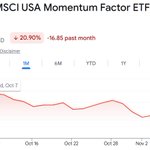


I wrote about models of stock market crashes and how they fit the current Ai/Tech/Momentum selloff in the blog:
thepriceofrisk.substack.com/…
We've covered theories of stock market crashes in my Financial Crises class this Fall.
The recent sell-off in AI/Tech/momentum stocks has all the tell-tale signs of the class of models that explain large drops in stock price as a consequence of market frictions that make only the optimistic investors the marginal price setter until some bad news forces the optimist to sell to investors with higher discount rates or less optimism about earnings growth.


It's been a tough month for momentum. The momentum factor was down 10% for the week and 20% over the past month.
These things happen. Momentum is a strategy that over the past 150+ years has consistently generated nice returns with little correlation to the overall market. But these returns and diversification benefits are not a free lunch. Momentum is subject to occasional steep crashes (Chabot, Ghysels & Jagannathan (2014) and Daniel (2016)).
These crashes are predictable but, nonetheless, difficult to avoid because the conditional return of momentum increases in the same states of the world where momentum crash risk increases. This makes it difficult for managers who compete for the funds of return chasing investors to exit the strategy when crash risk is high.
To make matters worse, many quant strategies that don't appear to be a momentum strategy in many states of the world become exposed to momentum when they become crowded. After the past week's momentum bloodbath, I suspect we will hear about shops that are sophisticated in risk management announcing surprising losses.
These losses don't reflect a lack of skill on the part of the shops. Instead, momentum exposure is very difficult to hedge because the factor loading behaves in almost a regime switching manner. A value, or news, or earnings-based quant strategy can have little exposure to the momentum factor until enough crowd in and then an unobservable (from past data) asymmetric exposure to momentum builds up that is hard to quantify and hedge.
Funds are aware of this but, in equilibrium, this crash risk is part of the reason momentum generates such nice returns on average. Think of it as compensation for being exposed to the occasional week like we just lived through.

The California wealth tax may or may not be a good idea but I find the argument that the tax is designed in such a way that the government won't face the standard trade-offs confusing.
Below Zucman criticizes the Hoover Institute paper that estimates the tax will raise little (perhaps negative) revenue because billionaires leave the state. His critique argues that billionaires won't exit because it's a one-time retroactive tax. By this logic the tax is already a sunk cost for billionaires living in California and any who leave would violate rational expectations.
I don't see how the Hoover paper's assumptions of billionaire exit violate rational expectations. To use some examples from the literature - how is the promise that the tax will be a one-time event different from a government that promises it will deal with a funding shortfall by only inflating a little this one time only or defaulting on its debt this time only?
Yes, if billionaires believe it's a one-time tax and the tax is retroactive, they shouldn't leave, but why would a billionaire rationally believe that? There's a huge literature on this in the context of borrowing or committing to stable prices and the time-inconsistency of government commitment is well know.
Governments face a time-inconsistency problem that prevents them from committing to one-time taxes (or defaults or inflation). If, in fact, the tax raised lots of revenue with no billionaire exit (and no dynamic impact on the amount of future billionaires in the state) then future governments face a recursive problem when choosing optimal taxes and are likely to choose to repeat the wealth tax with a promise that this time it really is the last time. But rational taxpayers recognize that, absent a commitment mechanism, the promise is not creditable and exit the state.
The argument that because of the promise the tax is one-time agents would have to violate rational expectations to exit appears to run exactly counter to my understanding of the literature. Perhas I'm missing something unique to the tax literature that isn't present in the borrowing and inflation literature where I'm much more of a consumer (and sometime producer). What am I missing?
Perhaps this tax is optimal. Perhaps not. It depends on how elastic the supply of billionaires is. But I don't see how arguing any exit violates rational expectations and therefore we should expect billionaires to be inelastically supplied is the proper way to evaluate the revenue estimates ex-ante. Ironically, the mere belief the claim is true undermines the credibility of the promise not to tax them again (at least in the Kydland time-inconsistency sense).
When I teach time-inconsistency it is in the context of borrowing and promising not to "tax" the perfectly inelastically supplied wealth of past bondholders by inflating or defaulting. Commitment mechanisms are very difficult and require repeated games with threats of exit that don't seem available in the context of the California tax.
Of course, history is rife with examples of governments that overcome the time-inconsistency problem with inventive methods of commitment. But I doubt the California legislator will follow the example of the government of Manresa and send a group of prominent citizens to live under the control of lenders or Medieval kings who sent their offspring as hostages to assure commitment to loan and treaty agreements.

This Hoover Institution study, which has fueled the deluge of ads (more than $200 million spent by billionaires so far) to defeat the California billionaire tax, is spectacularly misleading.
Let me explain its crucial flaw. 🧵
Readers added context they thought people might want to know
Zucman argues that the tax will raise his projected revenue because billionaires who leave CA after 1/1/26 will be taxed anyway.
At least $542B of net worth (Page, Brin, Thiel) departed the state by 12/31/25.
The entire thread is a misleading denial of this fact.
ft.com/content/d66976…
nytimes.com/2026/04/27/us/…
forbes.com/sites/forbeswe…
And these are the Entrepreneurs that make it through the VC funding filter. Starting a company is not for the faint of heart…

(b) that a person that is 'roughly indifferent' between being an entrepreneur and taking a salary wage would have a coefficient of risk aversion around the 10th percentile of the popluation (lower is less risk averse).
aeaweb.org/articles?id=10.12…

1
1,102
Bob Hall and Michael Woodford have won the 2026 Nobel Prize in Economics.
We talk about Bob's random walk of consumption and stochastic Euler equations in my Economic History class. My students learn about precautionary savings and the consumption declines of the Great Depression. The lectures before and after the Euler equation lecture are readings from one Nobel Prize winner after another as we discuss the Diamond-Dybvig model (bank runs), Kydland's time inconsistency and commitment (gold standard), Milton Friedman (A Monetary History) and Bernanke's financial accelerator work.
When we begin the Great Depression readings, I jokingly call it the Nobel section of the class and have been telling them for years that Bob would join the other authors soon. It's good to see the Committee finally agrees.

7
1,074

It's bank panic week in my Financial Crises class.
We learned the Diamond-Dybvig model on Tuesday. Today we embed it in an economy and look at how changes in the probability of a liquidity shock decrease investment and output (even if the shock or bank run does not occur).
Then we impose a safety and soundness liquidity requirement and see how altering the requirement is a tradeoff between expected consumption and the volatility of consumption (crash risk).
Finally, we learn how pooling reserves and having an interbank market provides idiosyncratic liquidity insurance and results in an equilibrium with more investment and consumption without more risk. Of course, the converse is true. When counterparties don't trust each other and stop lending each bank must self-insure against liquidity runs and the resulting hording of liquidity results in the economy endogenously contracting.
These kids will go home for Thanksgiving able to explain bank panics and the rationale for bank regulations in a model simple enough for their non-econ parents to understand.
Treasury hit the $6B cap in their buyback auction today for 20-30year maturities.
This was the first time Treasury has received sufficient acceptable bids to hit the cap since they expanded the size of the buyback auctions. Dealers offered $14.9B (up from $10.5B last month). Treasury does not report how many of these offers were at acceptable prices beyond the fact that $6B were accepted.
This was the second buyback auction for the 20-30 year maturity bucket since announcing the expansion of the buyback program. Previous auctions at the 10-20y and 20-30y maturity buckets did not contain a sufficient number of fair bids to meet the cap.
Remember, these are reverse auctions to purchase off-the-run issues. The Treasury uses a non-disclosed model to determine what an acceptable liquidity premium is to determine how much is a "fair" discount for off-the-run issues. If someone tenders a bid considered fair, they get filled (or put on the demand curve if the number of fair bids exceeds the auction cap). Treasury did receive enough fair bids today to buy back the entire $6B offered.
On Sept 24th the Treasury held its first buyback of the 20-30year maturity bucket since expanding the buyback cap to $6B. At the September reverse auction, Treasury received 10.5B in offers but only deemed $4.1B of these bids acceptable. The $10.5B in September was a ~50% reduction in offers from the $19.9B in August and $21.9B in July.

2
12
1,640
The Fed is examining private credit loan exposure at SIFIs. Expect to see doom and gloom posts like the one embedded below.
I highly doubt Repo desks have anything to do with this. Repo funding trouble is like having a patient that can't breathe. Fix it fast or the patient will soon be dead. An exam of wholesale lending is like sending a patient to get an MRI on their knee. If I told you my doctor told me to get an MRI you would be right to think I have a knee problem, but you would be foolish to assume I'm in danger of dropping dead from it tomorrow.
The news article says they are reviewing loans. My educated guess (and just a guess) at what's going on...
From news reports we know the Fed included special PC questions on reviews and sent out a PC exposure data collection in the spring. For every SIFI bank included in the stress tests, the Fed knows exposure to PC from the stress testing Y-14 collection of all loans with commitments above $1m. A special collection would include questions not included in the regular Y-14 collection. Media reports make it sound like the questions dealt with customer withdrawal risk which would show up in the EAD of any loans the SIFI banks had extended.
The natural next step after data collection is a horizontal exam to assess the banks internal risk ratings and collateral. This sounds like what is currently going on.
The report embedded below sounds like a LISCC & LFBO horizontal exam. The MAP (monitoring and analysis program) monitors risk in the SIFI banks and probably sees a lot of growth in NBFI lending in the FoF data (which comes from the stress test Y-9 collection) and media reports that PC loans have been written down.
My guess (and it's only a guess) is that this raised red flags and triggered a horizontal exam to check the quality of the banks' internal risk ratings, the value of the collateral in default and the potential draws on the bank's credit facilities should a withdrawal run happen.
It's public knowledge that exposure at default (EAD) and bank internal risk ratings and loss at default are key modeled inputs to the supervisory stress tests and CCAR reviews. On site examinations are how the Fed makes sure the data submitted for these reviews are accurate and consistent with model assumptions. SIFI banks have embedded Fed examination teams for normal reviews, but when a new risk emerges, horizontal exams teams with subject matter experts visit multiple banks to assess the banks' exposure to the new risk.
So, what does this mean? No. It's not a repo run. Instead, it's likely the Fed reads the same headlines the rest of us read, and wants to be sure banks are setting aside sufficient capital for a tail event. Don't deduce that this means the tail event is more likely. Fed stress testing does nothing but worry about tail events and try to assure banks have enough capital to withstand them.

How will AI investments drive up Treasury yields?
In a new post on the blog, I look at the channels through which AI investments will increase Treasury Yields.
Blog: thepriceofrisk.substack.com/…
The AI investment boom is expected to increase yields through the traditional channel of increased bond supply and the general equilibrium channel of intertemporal consumption smoothing.
The supple channel depends critically on the amount and maturity of AI debt issuance, and the elasticity of demand for duration risk. Although the size of debt issuance needed to finance the AI infrastructure boom is massive, recent evidence suggests shifts in bond market participation has made the market less sensitive to supply shocks.
Overall, the expected change in yield is highly uncertain but to-date the evidence suggests a notable amount of the AI boom is crowding out other investments and therefore muting its impact on equilibrium yields.

Today's the first day of my fall-term Financial Crisis class and the WSJ quotes me in their article about the bond market sell-off. The research I reference isn't mine - I just teach it to my class - but it's nice timing for my intro lecture claim that knowledge about financial crises is always a timely topic.
wsj.com/economy/could-there-…

Should we worry that Ai agents will cause a bank run? Maybe!
Torsten Slok has an interesting note worrying about increased competition for deposits potentially causing bank runs. Slok’s worry is households will rely on AI agents to allocate deposits to the highest yielding bank. The result will either be runs on the deposits of banks with uncompetitive rates or (more likely IMO) new equilibrium deposit rates that are uniform across banks and much closer to wholesale funding rates (close to SOFR).
Obviously, the run scenario is bad but it's unlikely, in my opinion, that technology for moving deposits will advance faster than banks' ability to raise deposit rates.
Nonetheless, we should worry about the run possibility.
Even if runs don’t occur, the increase in competition for deposits will depress lending, investment and economic growth.
Deposit beta – the change in bank deposit rates as policy rates change - is a key input into both banks' internal risk models and the Fed’s Stress Test models (the PPNR estimates). These deposit betas range from .40-.55 at all DFAST banks and are even lower at the G-SIBs. Should deposit betas increase to .75-.85 these banks would be required to hold materially more capital and a large literature shows increased stress test capital requirements are passed through to lower lending and less economic growth (see Shahhosseini (2022) or Berrospide & Edge (2024)).
Bank deposits pay below market rates and are notoriously sticky. If competition suddenly forced banks to pay deposit rates 100 bps closer to SOFR, we would see bank ROE fall between 30-50% for the US G-SIBs and more for regional and smaller less diversified banks. Again, there is a large literature showing unexpected shocks to bank profits result in credit rationing and slower economic growth (for example see Chava & Purnanandam (2011), Repullo, & Suarez (2013), Gropp et. al. (2024))
In equilibrium, a move to close-to-perfect competition for deposits would result in less lending, higher bank capital ratios, higher credit spreads on bank loans and a small probability of a costly bank run as we transition from the current sticky deposit regime to a competitive wholesale market for deposits.


You guys don't know what real bond vigilantes look like...
(a story from my paper with Mitu Gulati about the origins of Pari Passu clauses)

All macro traders think of themselves as bond vigilantes, but did they ever threaten to hire a ship to shell the ports of the offending issuers?
Mexico issued a sovereign bond in 1843 that promising to use custom duties to secure payment. When the bond defaulted a group of private British bondholders tried to buy canons and ships and wrote to the British Foreign Secretary to see if he would “raise no objection or place no bar to the bondholders fitting out armed vessels to make reprisals on the Mexican Government”!
The Foreign Secretary did in fact object in no uncertain terms

Should the Fed raise rates if demand is AI driven and Ai expected returns are potentially so high that Ai investment is interest rate insensitive? Yes!
Let's ignore whether the current price pressure comes from AI demand or an energy supply shock and work through the general equilibrium effects of an AI investment demand shock alone with a thought experiment where a new technology creates inflation…
Imagine a new miracle machine is invented. This machine is costly to build - we have to divert goods and services from consumption today to investment to build these machines. But if we invest a few percent of our output today and build these machines, the economy will produce much more output (100%+ increase) a few years in the future.
How does the unexpected invention of these machines alter market prices and inflation today?
First these new machines increase scarcity today because they consume resources to build but don’t deliver more output until the future. The return to building these machines is so high that firm's issue lots of stocks and bonds offering high expected returns to attract resources from other investment options or consumption. This moves real resources from consumption today into investment today.
Second, we have a general equilibrium conflict if interest rates don't change. Humans are risk averse. We generally think about risk aversion as preferring a constant stream of consumption over a more variable stream with the same average (Prefer $1000 to a coin flip that pays $0 or $2000). But the human preference for smooth consumption works across time as well as across states of the world. Because of these new machines everyone now expects to be much richer in the future, and they prefer to smooth consumption by selling claims to their future consumption and using those sales to buy more consumption today. Think about what would happen if I told a worker who makes $100K and has a $1m stock portfolio that I was raising his income to $1m per year starting five years from now. That worker would not want to consume the same as before this news. He would want to move some of that future consumption to today so he could smooth consumption over time. i.e. he would sell his stock portfolio and consume more today. The worker can do this because he is one man and he can find others who will buy his stock (they consume less today to purchase stock and consume more in the future because they have more stock).
But in the aggregate, we can’t all consume more today! Remember these machines don’t increase production until the future. Output today hasn't increased and some of our consumption today must now be invested in building these machines. To clear the market the real interest rate must go up sufficiently high that workers see such a high real return on savings that they are willing to work and consume less today even knowing that they will be very rich in the future. i.e. the return must be high enough that they are happy with a variable consumption stream.
The general equilibrium effect is why interest rates must rise to finance the investment boom and the real increase in rates is made even worse by the desire of workers to smooth consumption by selling claims (bonds) to future consumption. Bonds aren’t time machines! They don’t move output across time. You and I could use a bond to smooth our consumption but in the aggregate we can’t all consume more today so rates have to rise until people are happy consuming much less today than in the future.
So now we know real interest rates have to rise. How do we get there? We could just let rates rise. But if the short end is an administered rate (like Fed Funds) what would happen if the fed kept the rate fixed? The real rate has to increase but the nominal rate can’t move. Therefore, we would need expected deflation in the future or some other asset to offer much higher returns. Therefore, we need long bond prices to fall a lot, or we need the price of goods and services today to move up a lot relative to their prices in the future (or a combination of the two). If the Fed keeps the nominal short rate fixed and everyone wants to consume more today, the price of goods and services today must rise relative to the price of stocks and bonds or the price of goods and services in the future. i.e. inflation or long bond rout or a combination of both.
We saw these dynamics during COVID when the government said don’t work and also gave sufficient income support that almost no one was poorer. People wanted to consume the same, but output was way down so the price of goods had to rise to clear the market.
If the FED wants price stability they can arrest some of the price increase by increasing the nominal interest rate. This will make consumers that expect AI to make them much richer in the future happy to forgo more consumption today and prevent the rationing of today’s scarce resources via higher prices. This is a thought experiment to illustrate how interest rates increase can arrest inflation even when the demand for AI investment is so strong that it remains virtually unchanged in the face of the rate increase. In my opinion, there’s definitely some of these general equilibrium effect in play. We see it in security issuance to fund AI investment and the diversion of resources. But we also have a good old fashion energy shock as well. Whether we should raise interest rates because of that is another question.

The presumption that the Fed raising short-term rates reduces inflation is predicated on the belief that higher rates reduce demand and investment.
But what if higher rates don’t reduce demand and investment because the demand for intelligence and energy is unaffected by higher rates because winning the race for super intelligence has a near infinite ROI and the demand for compute will remain incalculable.
Why won’t higher rates at this unique moment in history therefore lead to more inflation as interest costs are embedded in everything?
And the problem is compounded as the more the Fed raises rates, the more inflation we will have and the more the Fed will need to raise rates further and so on.
But what if the old models don’t apply to the current paradigm and the Fed is wrong?
I think the Fed might have just made a mistake. Am I right or am I wrong?