

make software | founder @montereyai (acq by @reforge) @ycombinator @scaleai @uber @cornell
🐳
Joined August 2013
- Tweets2.1K
- Following782
- Followers2.5K
- Likes4.2K





Pinned Tweet
One and half year ago on our 1:1 with @paulg , before @ChatGPTapp came out; PG said this: “Every company will start their product with @montereyai. If they don’t, they would lose the competition”
Building a reliable ai product for high stake decision is hard. But we are making it happen.

Every PM and CEO should use @montereyai
Truly essential product analytics to tell you what is actually happening to your app
Every product in the world will be 10X better if everyone used it

The launches of @ChatGPT’s Intelligent UI and @AnthropicAI’s Motion and Dashboards show a pretty striking difference in product DNA. Probably also a glimpse into the org designs.
- OpenAI is pushing toward a new interaction model. Why force users into predefined interfaces when AI can build one on the fly?
- Anthropic is making existing workflows smarter. More immediately useful, but still largely operating within familiar software paradigms.
Making the software itself adaptive is the bigger better bet.
Benchmarks are becoming a new growth channel.
They used to be academic infrastructure or a few like @huggingface put those in core. Now every ai company realizes if you can own the benchmark, you can help define what the best means for an entire category.
The playbook:
- Build a benchmark around the capability your product wins at
- Make it credible enough that others want to compete
- Become the scoreboard the industry references
- Turn every model launch into distribution for your benchmark, and your company
Competing on benchmarks is becoming competing to own the benchmark.

The current AI personal assistants prioritize task efficiency as the primary goal for activities like shopping and traveling.
What if having fun is the goal, aligning with what the general public seeks from these activities?
Miss the early days of builders sharing ai products + knowledge.
Now it’s all endless metaphysical discussions of ai.


Stockholm is an incredibly bustling city. changed my perspective on the Euro tech scene. – at Stockholm, Sweden

How timely xitter.cf/techcrunch/status/2093…

Sweden is perhaps one of the world’s hottest tech hubs right now.
And Sophia Bendz, a general partner at Cherry Ventures, stopped by Equity to break down the latest in Stockholm’s startup ecosystem.
Her answer for why the country has produced so many buzzy startups? Being a founder is actually cool. spr.ly/6016B1FJUn


Everyone wants to build a painkiller. Sometimes being a really, really good vitamin is enough!

P&G just acquired Thorne for $3.8B - a massive win for Thorne's management team and L Catterton.
Thorne will do ~$650M in sales in 2026 (30% YoY), representing a 5.8x multiple. Very good price for Thorne, suggesting this was a competitive process and P&G really wanted to get a deal done.
Thorne is the #2 seller of creatine on Amazon, doing about $100M/year on the platform alone. I'd estimate their current creatine business is probably about $150M -$200M and growing quickly, around about 25-30% of their total business.
Much respect, great outcome, good for the industry...and we're coming for that creatine business 🤝🫡
To people who are fascinated by @bendingspoons’s action on @airtable, this is a great piece covering Bending Spoon’s operation machinery, and founding principles.

Patiently waiting for custom voice mode so my codex pet's inner monologue has a matching sound @OpenAI 😁
Midjourney is absolutely the best building and acquiring communities.
- AI Spa: A community in the health space, physically.
- Co-Star: A community in the Astro/social space, psychologically.

Midjourney is acquiring Co-Star. CEO @banu__guler is now Chief Design Officer at Midjourney. She's building a cross-functional design, product and frontend team for all our efforts. The Co-Star app will continue to operate under Banus complete control. Welcome Banu and team <3
Elizabeth is a remarkably calm and clear thinker. Absolutely love the episode.

Elizabeth Stone's first visit to the podcast was my second most popular episode of all time (right behind @bchesky). Her second visit is already trending far beyond that.
A lot has changed since I first spoke with Elizabeth 2.5 years ago. She was promoted to CPTO at @Netflix, taking on product and design orgs, on top of the engineering and data orgs she already led. Also, AI.
In our in-depth conversation, we discuss:
🔸 Why all the top AI labs converged on Netflix’s culture
🔸 Why Netflix is hiring more "systems thinkers" — and fewer narrow specialists
🔸 How she protects quality when AI makes output nearly infinite ("If I had more time, I would've written a shorter letter")
🔸 The most impactful AI use cases internally
🔸 How Elizabeth builds "excellence as an operating system"
Listen now 👇
youtu.be/t0GiTyz4syY

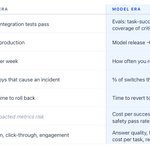
The New "Change a Button" Test 💊
Something @ravi_mehta said at @MiroHQ Canvas stuck with me. For years, the classic test of product / company velocity was one question: "How long would it take you to change a button on your homepage?"
It measured how fast a company can make a decision and ship it, and of course the infrastructure that lets it.
Today I think the question has changed: "How long does it take your product to move to a new AI model?" It means:
- knowing when a new model is genuinely better for your use case
- catching regressions before your users do
- updating the prompts and workflows built around the old model
- rolling it out safely
- building enough confidence for the team to trust the change
What amazes me is watching companies at millions-of-users scale do this elegantly while new models ship every few days.
How long does it take your company to switch?

Market is converging on a two-layer AI coding stack:
- Orchestrator: understands the codebase, plans work, manages context, delegates tasks.
- Execution engine: writes code, edits files, runs tests, and iterates.
If Codex continues to widen the gap as the execution engine, the orchestrator becomes increasingly interchangeable.
And we are back to the old principle: value follows active usage.
Execution agents are in the critical path of every edit, every test, every debugging session, and every iteration.
Orchestrators, by comparison, are consulted far less frequently. Once the work is decomposed, the majority of token usage, compute, and user time shifts to the execution layer.
If that pattern holds, it changes the economics of AI coding.

Anthropic has given us an engineering manager and OpenAi has gifted us a top 1% engineer ❤️
Use the two together in your work to get the best of both worlds.
Prompt:
Tell Claude “install the codex CLI and use it within Claude code as a sub agent. Default to GPT 5.6 Sol (or Terra). Use it whenever I tell you use to codex.
Announced investments / partnerships since the post:
@EliLillyandCo x @nvidia
@A24 x @GoogleDeepMind
😉
