

Born and raised in NYC. Wherever I may travel - Always a New Yorker at heart. My passion: History #nuyorican. Inappropriate tweets & people will be blocked
Manhattan, NY
Joined May 2010
- Tweets22.5K
- Following2.2K
- Followers1.1K
- Likes12.5K






November 5th
National Doughnut Appreciation Day: A Sweet Celebration of a Timeless Treat
#NationalDoughnutAppreciation Day is celebrated annually on November 5, offering a delightful occasion dedicated to one of the world’s most beloved sweet treats. Whether glazed, powdered, chocolate-covered, jelly-filled, or topped with colorful sprinkles, doughnuts have earned a special place in American food culture. This celebration offers the perfect excuse to visit a favorite bakery, share a box with friends or coworkers, or simply enjoy a freshly made doughnut with a cup of coffee.
The history of doughnuts stretches back centuries, long before they became a staple of American bakeries. Early versions of fried dough appeared in various European cultures, particularly among Dutch settlers who brought a pastry known as olykoeks, meaning “oil cakes,” to colonial America. These sweetened balls of dough were fried in fat and sometimes filled with fruit or nuts. Over time, these treats evolved into the doughnuts familiar today.
One popular story credits American sailor Hanson Gregory with introducing the hole in the center of the doughnut in 1847. According to the legend, Gregory found that traditional doughnuts often remained undercooked in the middle, so he removed the center to help them cook more evenly. Although historians debate the precise origin of the doughnut hole, the ring-shaped design eventually became one of the pastry’s most recognizable features.
Doughnuts gained additional cultural significance during World War I, when Salvation Army volunteers served them to American soldiers stationed in France. These women, affectionately called “Doughnut Lassies,” prepared the treats to provide comfort and a taste of home to troops facing difficult wartime conditions. Their efforts helped establish the doughnut as a symbol of generosity, encouragement, and American tradition.
In 1938, the Salvation Army established National Doughnut Day, traditionally observed on the first Friday in June, to honor these volunteers and support charitable efforts during the Great Depression. Although National Doughnut Appreciation Day is a separate, less formally documented observance, it shares the same spirit of celebrating the doughnut’s history and enduring popularity.
During the 20th century, doughnuts became increasingly popular as automated production made them easier to prepare and distribute. The invention of commercial doughnut-making machines helped transform the pastry from a homemade specialty into an everyday favorite. Bakeries and famous chains such as Krispy Kreme and Dunkin’ further contributed to their popularity, introducing generations of customers to a growing variety of flavors, fillings, and toppings.
Today, doughnuts are enjoyed around the world, with different cultures offering their own delicious variations. From traditional glazed rings and Boston cream doughnuts to fruit-filled pastries and inventive gourmet creations, there is a doughnut to satisfy nearly every sweet tooth.
The November 5 doughnut observance also appears on American food-holiday calendars, although its exact origins remain uncertain. Unlike the well-documented June celebration, no definitive founder has been established.
National Doughnut Appreciation Day is ultimately about more than indulging in a sugary snack. It celebrates culinary creativity, nostalgic traditions, local bakeries, and the simple happiness that comes from sharing something delicious. Whether enjoying a classic glazed doughnut or discovering an exciting new flavor, the occasion reminds us that life’s sweetest pleasures are sometimes the simplest.

Today in History
November 5th
1968
Shirley Chisholm Becomes the First African American Woman Elected to Congress
On November 5, 1968, Shirley Anita Chisholm made history as the first African American woman elected to the United States Congress. A Democrat representing Brooklyn, New York, she won a seat in the House of Representatives at a time when racial discrimination and unequal opportunities for women remained deeply rooted in American politics. Her election expanded the possibilities for representation in the nation’s government.
Chisholm was born on November 30, 1924, in Brooklyn to parents who had immigrated from the Caribbean. She spent part of her childhood in Barbados, where she attended school before returning to New York. She graduated from Brooklyn College in 1946 and earned a master’s degree in elementary education from Columbia University in 1952. Working as a teacher, childcare center director, and educational consultant gave her firsthand knowledge of the challenges facing children and working families.
Her political career began in local Democratic organizations. In 1964, she was elected to the New York State Assembly, where she worked on issues involving education, employment, and social services. Four years later, a redrawn congressional district in Brooklyn created an opportunity for her to run for the House. She campaigned under the slogan “Unbought and Unbossed,” promising to speak for her constituents rather than answer to political power brokers.
Chisholm faced prejudice as both a Black candidate and a woman. After winning the Democratic primary, she ran against Republican James Farmer, a prominent civil rights activist and former national director of the Congress of Racial Equality. She defeated him in the November general election, becoming the first Black woman elected to Congress. Her victory came during a turbulent year marked by the assassinations of Martin Luther King Jr. and Robert F. Kennedy, protests against the Vietnam War, and demands for civil rights and political change.
When Chisholm took office on January 3, 1969, she refused to accept the idea that a new member should remain silent. She objected to her initial assignment to the House Agriculture Committee because it seemed disconnected from the needs of her urban district. She was moved to the Veterans’ Affairs Committee and later served on the Education and Labor Committee, where she could focus on issues important to her constituents.
During seven terms in the House, from 1969 to 1983, Chisholm advocated for equal rights, education, childcare, better employment opportunities, and assistance for low-income families. She opposed the Vietnam War and worked to make government more responsive to people often excluded from political decisions. In 1971, she helped found the Congressional Black Caucus, which brought Black lawmakers together to advance shared legislative priorities.
In 1972, Chisholm sought the Democratic nomination for president, becoming the first Black candidate to pursue a major party’s presidential nomination and the first woman to seek the Democratic nomination. Although she did not win, her campaign brought new attention to barriers faced by women and people of color in national politics. She continued serving in Congress until 1983, then returned to teaching and public speaking.
Chisholm died on January 1, 2005. In 2015, she was posthumously awarded the Presidential Medal of Freedom. Her 1968 election remains a landmark in American history, remembered not only for breaking a barrier but also for her insistence that elected officials serve the people they represent. Her motto, “Unbought and Unbossed,” continues to symbolize her political independence. #OTD

Today in History
November 5th
1913
Born on this Day
Vivien Leigh was a British actress celebrated as one of the most beautiful and talented performers of Hollywood’s Golden Age. Best remembered for portraying Scarlett O’Hara in Gone with the Wind (1939) and Blanche DuBois in A Streetcar Named Desire (1951), she won two Academy Awards for Best Actress. Behind her glamorous public image was a remarkable life marked by artistic ambition, passionate romance, serious illness, and personal struggles.
Vivian Mary Hartley was born on November 5, 1913, in Darjeeling, British India, to Ernest Richard Hartley, a British businessman, and Gertrude Mary Frances Yackjee. Raised in a privileged environment, she developed an early fascination with acting. At six, she was sent to a convent school in England, where she befriended future actress Maureen O’Sullivan. Her education continued across Europe, exposing her to different languages, cultures, and theatrical traditions.
In 1932, she married lawyer Herbert Leigh Holman, and their daughter, Suzanne, was born in 1933. Despite becoming a young mother, Leigh remained determined to pursue acting. She studied at London’s Royal Academy of Dramatic Art and began appearing in British films and stage productions. Adopting the professional name Vivien Leigh, she attracted attention for her striking appearance and growing dramatic abilities.
Her career changed dramatically when she met actor Laurence Olivier in the mid-1930s. Their professional admiration developed into a passionate relationship, although both were married to other people. They eventually divorced their respective spouses and married in 1940. Together, they became one of Britain’s most celebrated theatrical couples.
Leigh achieved international fame when producer David O. Selznick selected her to portray Scarlett O’Hara in Gone with the Wind, adapted from Margaret Mitchell’s bestselling novel. Her casting followed an extensive search involving numerous actresses. Released in 1939, the film became a monumental cinematic success, and Leigh’s portrayal of the determined, complicated Southern heroine earned her the Academy Award for Best Actress in 1940.
Although Hollywood offered enormous opportunities, Leigh considered theater her greatest artistic passion. She performed Shakespearean roles alongside Olivier, including Juliet, Cleopatra, and Lady Macbeth. Her dedication to classical theater demonstrated that her abilities extended far beyond her celebrated screen beauty.
Throughout her adult life, Leigh experienced bipolar disorder, then commonly called manic depression. She also suffered recurring tuberculosis and endured miscarriages that deeply affected her. Her illnesses sometimes interrupted performances and placed considerable strain on her marriage. Nevertheless, she continued working with extraordinary determination.
In 1951, Leigh delivered another unforgettable performance as Blanche DuBois opposite Marlon Brando in A Streetcar Named Desire. Her emotionally intense portrayal earned her a second Academy Award, establishing her reputation as one of cinema’s finest dramatic actresses.
Her marriage to Olivier ended in divorce in 1960 after two decades together. She subsequently found companionship with actor Jack Merivale, who remained devoted to her during her final years. Leigh continued performing, winning a Tony Award in 1963 for the Broadway musical Tovarich. Her final film appearance came in Ship of Fools (1965).
Vivien Leigh died in London on July 8, 1967, aged 53, following a recurrence of tuberculosis. London’s West End theaters dimmed their lights in tribute to her extraordinary career.
Her legacy endures through performances distinguished by emotional depth, elegance, vulnerability, and fierce determination. More than a Hollywood beauty, Vivien Leigh was an accomplished artist whose achievements helped shape twentieth-century cinema and theater. #OTD

Today in History
November 5th
1872
Susan B. Anthony Defies the Law and Votes in a Presidential Election
On November 5, 1872, American women’s rights activist Susan B. Anthony made history by casting a ballot in the presidential election in Rochester, New York, despite laws prohibiting women from voting. Her act of civil disobedience challenged the nation’s political and legal system and became a defining moment in the struggle for women’s suffrage.
At the time, women were denied voting rights in most of the United States. Anthony, a prominent abolitionist and advocate for women’s equality, believed that the Fourteenth Amendment, ratified in 1868, guaranteed citizenship rights that included voting. She argued that denying women the ballot violated the Constitution’s promise of equal citizenship.
On November 1, 1872, Anthony and several other women successfully registered to vote after challenging election officials about their constitutional rights. Four days later, Anthony joined 14 other women in casting ballots in the election between incumbent President Ulysses S. Grant and Democratic-backed candidate Horace Greeley. Although election inspectors accepted their votes, their actions attracted the attention of federal authorities. National Archives +1
On November 18, 1872, Deputy U.S. Marshal E. J. Keeney arrested Anthony at her Rochester home. She was charged under the Enforcement Act of 1870 with knowingly voting without having the legal right to do so. Rather than retreat, Anthony used her arrest to draw national attention to women’s disenfranchisement.
Before her trial, she delivered speeches throughout the region, asking audiences whether it was a crime for an American citizen to vote. Her arguments emphasized that women were citizens who deserved equal participation in government.
Anthony’s trial began in June 1873 in Canandaigua, New York. Presiding Judge Ward Hunt rejected her constitutional defense and directed the jury to return a guilty verdict without deliberation. The proceedings drew criticism because Anthony was effectively denied an independent jury decision.
The court fined her $100, along with prosecution costs, a substantial amount at the time. Anthony refused to pay, declaring, “I shall never pay a dollar of your unjust penalty.” She remained true to her word, and the fine was never collected.
Her conviction did not end her activism. Anthony continued campaigning for women’s voting rights, working alongside reformers such as Elizabeth Cady Stanton and helping build a nationwide movement for constitutional change.
Anthony died on March 13, 1906, at age 86, without witnessing the achievement of her lifelong goal. Fourteen years later, in 1920, the Nineteenth Amendment was ratified, prohibiting the denial of voting rights on the basis of sex. Although discriminatory laws and practices continued to prevent many women, particularly women of color, from voting, the amendment represented a major constitutional victory.
Susan B. Anthony’s decision to vote in 1872 became one of the most enduring symbols of the American women’s suffrage movement. Her arrest, trial, and refusal to pay the fine demonstrated how an individual act of resistance could expose inequalities in the law and help inspire generations seeking equal political rights. #OTD

Today in History
November 5th
1991
Died on this Day
beloved American actor Fred MacMurray died of pneumonia at St. John’s Hospital in Santa Monica, California, at the age of 83, following a long battle with cancer and declining health. His wife, actress June Haver, and their daughter Kate were reportedly at his bedside. His death marked the end of an extraordinary Hollywood career spanning nearly five decades. Remembered for his distinctive voice, easygoing charm, and remarkable versatility, MacMurray left behind a legacy of classic films and one of television’s most beloved family sitcoms.
Frederick Martin MacMurray was born on August 30, 1908, in Kankakee, Illinois. Raised primarily in Beaver Dam, Wisconsin, he was the son of a concert violinist and developed an early passion for music. A talented athlete and musician, he played violin and saxophone during his youth. He attended Carroll College in Wisconsin but left before graduating to pursue a career in entertainment.
During the late 1920s, MacMurray worked as a saxophonist and singer with various dance bands before making his way into show business. He performed with the California Collegians and appeared on Broadway before signing with Paramount Pictures. His breakthrough came in 1935 opposite Claudette Colbert in The Gilded Lily, establishing him as a promising Hollywood leading man.
Throughout the 1930s and 1940s, MacMurray became one of Hollywood’s most dependable stars. His handsome appearance, natural comedic timing, and relaxed personality made him a favorite alongside actresses such as Carole Lombard, Barbara Stanwyck, and Claudette Colbert. His notable films included The Trail of the Lonesome Pine (1936), Remember the Night (1940), and The Egg and I (1947).
In 1944, MacMurray delivered one of his finest performances in Billy Wilder’s Double Indemnity, portraying insurance salesman Walter Neff, who becomes entangled in a deadly murder plot with a married woman played by Barbara Stanwyck. The dark role demonstrated his dramatic abilities and remains one of the defining performances of classic film noir.
He further displayed his versatility in The Caine Mutiny (1954) and Billy Wilder’s The Apartment (1960). His portrayal of an unscrupulous corporate executive in The Apartment was especially memorable because it contrasted sharply with his wholesome screen image. The film won the Academy Award for Best Picture.
A new generation discovered MacMurray through Walt Disney’s The Shaggy Dog (1959). He subsequently starred in The Absent-Minded Professor (1961), Son of Flubber (1963), Follow Me, Boys! (1966), and The Happiest Millionaire (1967). His humorous, absent-minded characters made him a favorite among family audiences.
His greatest television success began in 1960 when he starred as widowed father Steve Douglas on My Three Sons. The popular sitcom followed a single father raising his boys and ran for 12 seasons until 1972. MacMurray’s gentle humor and reassuring presence made him one of America’s most recognizable television fathers.
Away from Hollywood, MacMurray was known for his modest lifestyle, financial intelligence, and devotion to family. He married Lillian Lamont in 1936, and they adopted two children, Susan and Robert. Following Lillian’s death in 1953, he married actress June Haver in 1954. Together, they adopted twin daughters, Kate and Laurie. Their marriage lasted until his death.
MacMurray was also a successful investor who accumulated considerable wealth through real estate and ranching. Despite his financial success, he preferred a quiet private life, enjoying outdoor activities and time with his family.
In 1987, he became the first recipient of the Disney Legend honor, recognizing his contributions to Disney entertainment. His final years were marked by declining health, including a serious stroke in 1988.
#OTD

Today in History
November 5th
1935
Parker Brothers Begins Marketing Monopoly
On November 5, 1935, Parker Brothers began marketing Monopoly, a board game that would become one of the most popular and recognizable games in history. Introduced during the Great Depression, Monopoly offered Americans an entertaining escape from economic hardship by allowing players to buy properties, build houses and hotels, collect rent, and accumulate imaginary fortunes.
The Origins of Monopoly
Although Monopoly became a commercial sensation in 1935, its origins date back more than three decades.
In 1903, American inventor and political activist Elizabeth Magie created The Landlord’s Game, which she patented in 1904. Inspired by economist Henry George, Magie designed the game to demonstrate the dangers of concentrated landownership, monopolies, and economic inequality.
Her original game included different sets of rules intended to illustrate how wealth could either become concentrated among a few individuals or benefit an entire community.
Over the following decades, the game spread through households, universities, and social circles. Players modified its rules and introduced new property names, gradually transforming it into the familiar game of real estate competition.
Charles Darrow and Parker Brothers
During the early 1930s, Charles Darrow, an unemployed salesman from Pennsylvania, encountered a version of the game and began producing his own sets.
Darrow’s version featured streets from Atlantic City, New Jersey, including Boardwalk, Park Place, and Baltic Avenue.
He initially approached Parker Brothers, a Massachusetts-based game manufacturer, but the company rejected his proposal, citing numerous design flaws.
Undeterred, Darrow continued selling handmade copies. Their growing popularity eventually convinced Parker Brothers to reconsider.
In 1935, the company acquired the rights to Darrow’s version and began mass-producing and marketing Monopoly. Parker Brothers also secured rights to earlier related games, including Magie’s original creation.
November 5, 1935: A Landmark in Gaming History
November 5, 1935, is associated with Parker Brothers’ marketing of Monopoly, marking an important milestone in the game’s commercial history.
The timing proved extraordinary. During the Great Depression, millions of Americans faced unemployment, financial insecurity, and the loss of their homes and savings.
Yet Monopoly allowed families to experience an imaginary world of financial opportunity, property ownership, and tremendous wealth.
The game’s combination of strategy, negotiation, luck, and competition made it especially appealing.
By the end of 1935, approximately 250,000 copies had been sold. Sales reportedly exceeded 1.7 million copies in 1936, establishing Monopoly as a nationwide phenomenon.
The Forgotten Inventor
For decades, Charles Darrow was widely credited as Monopoly’s sole inventor.
However, Elizabeth Magie’s earlier contributions were largely overlooked. Parker Brothers had purchased her patent rights for $500, without ongoing royalties.
The game’s commercial success also created a historical irony: an educational tool originally designed to criticize monopolies had become a celebration of acquiring wealth and driving competitors into bankruptcy.
Magie’s role gained greater public recognition decades later, particularly following legal disputes involving the game Anti-Monopoly during the 1970s.
A Worldwide Legacy
Monopoly eventually expanded beyond the United States, becoming an international entertainment phenomenon.
Numerous editions featuring different cities, countries, fictional characters, and popular franchises introduced the game to generations of players.
In 1991, Hasbro acquired Parker Brothers, bringing Monopoly under its ownership.
Today, Monopoly remains one of the world’s best-known board games.
#OTD

Today in History
November 5th
1956
American entertainment history was made when singer and pianist Nat King Cole debuted The Nat King Cole Show on NBC. The groundbreaking program became the first nationally broadcast television variety series hosted by an African American, marking a milestone in the struggle for racial equality and representation in American media.
Born Nathaniel Adams Coles on March 17, 1919, in Montgomery, Alabama, Cole rose to international fame through his musical talent, smooth baritone voice, and timeless recordings such as “Unforgettable,” “Mona Lisa,” and “Nature Boy.” By the 1950s, he was among America’s most celebrated entertainers, yet racial segregation and discrimination continued to limit opportunities for Black performers.
The show’s debut came during a turbulent period in American history. Just two years earlier, the Supreme Court’s landmark Brown v. Board of Education decision had declared racial segregation in public schools unconstitutional. In December 1955, Rosa Parks’ refusal to surrender her bus seat sparked the Montgomery Bus Boycott. Against this backdrop, Cole’s appearance as the host of a national television program represented an important cultural breakthrough.
The program initially aired for just 15 minutes every Monday evening at 7:30 p.m. It featured Cole performing popular songs, playing piano, and welcoming major stars. Guests included Ella Fitzgerald, Pearl Bailey, Tony Bennett, Peggy Lee, Mahalia Jackson, and Mel Tormé. The show presented Black and white performers sharing the same stage as respected equals, challenging the racial customs of the era.
Despite its artistic excellence, the program faced a major obstacle: corporate racism. National advertisers refused to sponsor the show, fearing that associating their products with a Black television host would alienate white consumers, particularly in the segregated South. NBC initially financed the production, hoping sponsors would eventually recognize its commercial potential.
In April 1956, only months before the premiere, Cole had been physically attacked by white supremacists while performing in Birmingham, Alabama. The incident demonstrated the dangers Black entertainers faced even at the height of their fame.
In July 1957, NBC expanded the program to 30 minutes, reflecting confidence in Cole’s talent and appeal. Although some regional advertisers eventually provided support, the show never secured the major national sponsorship necessary for long-term survival.
On December 17, 1957, The Nat King Cole Show aired its final episode. Frustrated by the advertising industry’s racial prejudice, Cole famously declared, “Madison Avenue is afraid of the dark.”
Although the program lasted only thirteen months, its historical importance extended far beyond its cancellation. Cole helped challenge the belief that African Americans could not successfully lead nationally televised entertainment programs. His pioneering work helped open doors for later Black television personalities, including Sammy Davis Jr., Diahann Carroll, and Flip Wilson.
Cole died of lung cancer on February 15, 1965, at age 45, but his influence on American music, television, and racial representation remains profound.
One important historical distinction is that pianist Hazel Scott hosted a network television program in 1950, preceding Cole. Nevertheless, Cole’s 1956 series is widely recognized as the first nationally broadcast variety program hosted by a major African American entertainer.
Today, The Nat King Cole Show stands as a powerful reminder that breaking racial barriers requires more than talent. It also demands courage, perseverance, and the willingness to challenge institutions resistant to change. Cole’s elegance, dignity, and extraordinary artistry helped transform American television and created opportunities for generations of Black entertainers who followed. #OTD
youtu.be/JACQ9OXGAp4?is=0js3…

Today in History
November 4th
1960
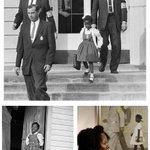
Ruby Bridges: A Six-Year-Old Girl Who Helped Change America
On November 4, 1960, six-year-old Ruby Nell Bridges was preparing to make history in New Orleans, Louisiana. Her mother, Lucille Bridges, encouraged her to be brave, telling her, “Don’t be afraid.” Ruby was about to become one of the first Black children to integrate an all-white elementary school in the American South, challenging generations of racial segregation.
The historic event actually took place on November 14, 1960, ten days after the date often mistakenly associated with her first day of school.
Ruby was born on September 8, 1954, in Tylertown, Mississippi, the same year the United States Supreme Court ruled in Brown v. Board of Education that racial segregation in public schools was unconstitutional. Despite this landmark decision, many Southern communities resisted integration and continued operating separate schools for Black and white children.
In 1960, Ruby was among six Black children who passed an examination designed to determine which students could attend previously all-white schools in New Orleans. Her parents understood the dangers involved. Her father, Abon Bridges, initially feared for her safety, but her mother believed their daughter deserved the same educational opportunities as white children.
On November 14, four federal marshals escorted Ruby to William Frantz Elementary School. Outside, an angry crowd of segregationists screamed insults, shouted threats, and protested her arrival. Ruby, wearing a neatly pressed dress, walked past the hostility with extraordinary composure.
The opposition was so intense that white parents removed their children from the school. For much of that academic year, Ruby was taught alone by Barbara Henry, a white teacher from Boston who refused to participate in the discrimination.
Every morning, federal marshals escorted Ruby through the threatening crowds. Her family also suffered retaliation. Her father lost his job, and her grandparents were forced off the Mississippi land they had farmed. Yet Ruby continued attending school.
One of the most remarkable moments occurred when Ruby appeared to stop and speak near the angry crowd. A marshal later learned that she had been praying for the people who threatened her. Rather than responding with hatred, the young girl demonstrated compassion beyond her years.
Ruby’s courage became a powerful symbol of the Civil Rights Movement. In 1964, artist Norman Rockwell immortalized her historic walk in his painting The Problem We All Live With, depicting the young girl surrounded by federal marshals as she passed a wall marked by racist graffiti.
Ruby was not alone in integrating New Orleans schools that day. Three other courageous Black first graders—Leona Tate, Gail Etienne, and Tessie Prevost—entered McDonogh No. 19 Elementary School. Together, they became known as the New Orleans Four.
As an adult, Ruby continued fighting racial injustice. In 1999, she established the Ruby Bridges Foundation to promote tolerance, respect, and equal educational opportunities. Her story has inspired books, films, monuments, and Ruby Bridges Walk to School Day, observed annually on November 14.
Today, Ruby Bridges remains a living reminder that the struggle for civil rights was not fought only by famous leaders and powerful organizations. Sometimes, history changed because a six-year-old child simply wanted to attend school.
Her journey demonstrated that courage has no age limit and that even the smallest footsteps can leave an enormous mark on history. #OTD

Today in History
November 4th
1842
33-year-old Abraham Lincoln married 23-year-old Mary Todd in an intimate ceremony in Springfield, Illinois, beginning one of the most historically significant marriages in American presidential history. Their union brought together two individuals from remarkably different backgrounds whose relationship would be shaped by political ambition, personal tragedy, the American Civil War, and ultimately assassination.
Mary Todd was born on December 13, 1818, in Lexington, Kentucky, into a wealthy, politically influential family. She received an unusually extensive education for a woman of her era, studying literature, history, French, and politics. Intelligent, outspoken, and socially accomplished, Mary moved to Springfield in 1839 to live with her sister Elizabeth Edwards and her husband, Ninian Edwards.
Abraham Lincoln, born on February 12, 1809, in a Kentucky log cabin, came from considerably humbler circumstances. Largely self-educated, he had established himself as a respected Illinois lawyer and rising Whig politician. By the time of his marriage, Lincoln had served in the Illinois legislature but had not yet been elected to Congress. His single term in the U.S. House of Representatives would begin in 1847.
Lincoln and Mary met in Springfield’s lively political and social circles, probably in late 1839. Despite their contrasting backgrounds, they shared an enthusiasm for politics, intellectual conversation, and public affairs. Mary recognized Lincoln’s extraordinary potential and reportedly believed he would someday become president.
Their courtship, however, was anything but straightforward. The couple became engaged but experienced a painful separation around 1841. Historians continue to debate the precise circumstances, including Lincoln’s emotional uncertainty and opposition from members of Mary’s family, who considered him socially beneath her.
After reconciling in 1842, the couple arranged their wedding with little advance notice. The ceremony took place at the Springfield home of Mary’s sister Elizabeth and brother-in-law Ninian Edwards. Reverend Charles Dresser, an Episcopal minister, officiated before a small gathering of relatives and friends.
Lincoln presented Mary with a gold wedding ring traditionally associated with the inscription “Love Is Eternal.” Their wedding marked the beginning of a partnership that would endure for more than 22 years.
The newlyweds initially lived in a modest room at Springfield’s Globe Tavern. Their first son, Robert Todd Lincoln, was born on August 1, 1843. In 1844, they purchased a house on Eighth and Jackson Streets, which became their family home until Lincoln departed for Washington in 1861.
The couple eventually had four sons: Robert, Edward, William, and Thomas, affectionately called Tad. Tragically, only Robert survived into adulthood. The deaths of Eddie in 1850 and Willie in 1862 brought devastating grief to the family.
Mary became First Lady following Lincoln’s presidential inauguration in March 1861. Throughout the Civil War, she faced intense public criticism, particularly because several of her Kentucky relatives supported the Confederacy. Nevertheless, she remained devoted to her husband’s political career and the Union cause.
Their marriage ended tragically on April 15, 1865, when Lincoln died after being shot by John Wilkes Booth at Ford’s Theatre the previous evening. Mary, who had been sitting beside him, was devastated.
Mary Todd Lincoln died on July 16, 1882, in Springfield, nearly 40 years after their wedding.
What began as a modest ceremony in an Illinois family home ultimately became part of the personal history of America’s 16th president. Their marriage remains a powerful story of love, ambition, sacrifice, and sorrow during one of the nation’s most turbulent periods. #OTD

Today in History
November 4th
1922
British archaeologist Howard Carter made one of the most extraordinary discoveries in archaeological history when his workers uncovered the first steps leading to the tomb of the ancient Egyptian pharaoh Tutankhamun in the Valley of the Kings, near Luxor, Egypt. The discovery would reveal a nearly intact royal burial chamber, offering an unprecedented glimpse into the wealth, religious beliefs, and burial traditions of ancient Egypt.
Tutankhamun ruled Egypt during the 18th Dynasty, approximately 1332–1323 BCE, ascending to the throne as a child around the age of nine. His reign was relatively brief, and he died around age 18 or 19. Although he was not considered one of Egypt’s most powerful pharaohs, his tomb would eventually make him the most recognizable ruler of ancient Egypt.
Howard Carter had spent years searching the Valley of the Kings, convinced that Tutankhamun’s burial place remained undiscovered. His excavations were financed by George Herbert, the 5th Earl of Carnarvon, a wealthy British aristocrat fascinated by Egyptian antiquities. By 1922, after years of disappointing results and considerable expense, Carnarvon was reluctant to continue funding the search. Carter persuaded him to finance one final excavation season.
On November 4, Egyptian workers uncovered a stone step beneath the debris near the entrance to the tomb of Ramesses VI. Further digging revealed a staircase descending toward a sealed doorway bearing ancient Egyptian markings. Carter immediately recognized the potential importance of the discovery and sent word to Carnarvon, who was in England.
Carnarvon arrived in Egypt later that month. On November 26, Carter carefully opened a small hole in a second sealed doorway and peered inside by candlelight. When Carnarvon asked whether he could see anything, Carter famously replied, “Yes, wonderful things.”
Beyond the doorway lay an astonishing collection of ancient treasures, including gilded furniture, ceremonial chariots, elaborate jewelry, statues, weapons, and objects intended to accompany the pharaoh into the afterlife. Many items had remained undisturbed for more than 3,000 years, although evidence showed that ancient robbers had entered the tomb shortly after its original sealing.
On February 16, 1923, Carter opened the sealed entrance to the burial chamber, revealing enormous gilded shrines surrounding Tutankhamun’s stone sarcophagus. Inside were three nested coffins, the innermost made of solid gold, containing the pharaoh’s mummified remains. His magnificent golden funerary mask became one of the world’s most celebrated archaeological treasures.
The discovery sparked worldwide fascination with ancient Egypt, inspiring a cultural phenomenon known as “Tutmania.” Newspapers followed the excavation closely, while Egyptian-inspired jewelry, clothing, architecture, and decorative art became fashionable internationally.
On April 5, 1923, Lord Carnarvon died following an infection associated with a mosquito bite. His unexpected death fueled sensational stories about a supposed “curse of the pharaohs,” although no scientific evidence supports the existence of such a curse.
The excavation and conservation of more than 5,000 objects continued for nearly a decade. Egyptian workers, conservators, photographers, and specialists played essential roles in documenting and preserving the treasures.
Tutankhamun’s tomb transformed modern Egyptology, providing extraordinary evidence about royal life, craftsmanship, religion, and funerary practices during Egypt’s New Kingdom. More than a century later, the discovery remains one of archaeology’s greatest achievements, forever connecting the young pharaoh’s name with the mysteries and magnificence of ancient Egypt. #OTD

Today in History
November 4th
2008
The United States witnessed one of the most historic moments in its political history when Barack Obama became the first African-American elected President of the United States. The 47-year-old Democratic senator from Illinois defeated Republican Senator John McCain of Arizona, breaking a racial barrier that had stood since the nation’s founding in 1776. Obama’s victory represented a turning point in American politics and a powerful milestone in the country’s long struggle for racial equality.
Obama’s journey to the White House began years earlier. Born on August 4, 1961, in Honolulu, Hawaii, he worked as a community organizer in Chicago before becoming a civil rights attorney and entering politics. He served in the Illinois State Senate from 1997 to 2004 and gained national attention with his inspiring keynote address at the 2004 Democratic National Convention. Later that year, he was elected to the United States Senate.
In February 2007, Obama announced his presidential candidacy in Springfield, Illinois, emphasizing hope, unity, and political change. His campaign slogan, “Yes We Can,” became a rallying cry for millions of Americans. He faced a difficult Democratic primary contest against Senator Hillary Clinton, ultimately securing the party’s nomination in June 2008. His nomination was itself historic, making him the first African-American presidential nominee of a major American political party.
The 2008 election unfolded during a period of extraordinary national challenges. The United States was struggling with the wars in Iraq and Afghanistan, rising unemployment, and a devastating financial crisis that threatened the global economy. The collapse of major financial institutions in September 2008 intensified public concerns about economic stability. Obama campaigned on economic recovery, healthcare reform, ending the Iraq War responsibly, and restoring America’s international reputation.
McCain, a decorated Vietnam War veteran and longtime senator, emphasized experience, national security, and conservative economic policies. His selection of Alaska Governor Sarah Palin as his running mate made her the first woman nominated for vice president by the Republican Party. Obama selected Delaware Senator Joe Biden, whose extensive foreign policy experience strengthened the Democratic ticket.
On Election Day, millions of Americans participated in an election marked by extraordinary enthusiasm and voter engagement. Obama won 365 electoral votes to McCain’s 173 and received approximately 69.5 million popular votes, compared with McCain’s nearly 60 million. He captured several traditionally Republican states, including Virginia, North Carolina, and Indiana, while receiving strong support from young voters, African Americans, and a diverse coalition of Americans seeking change.
That evening, enormous crowds gathered in Chicago’s Grant Park, where Obama delivered his victory speech before an estimated 240,000 supporters. He acknowledged the historic significance of his election while emphasizing the enormous challenges ahead. His victory inspired celebrations across the United States and around the world.
For many African Americans, the moment carried profound emotional significance. Just 143 years after the abolition of slavery and 44 years after the Civil Rights Act of 1964, a Black American had been elected to the nation’s highest office. Obama’s victory reflected generations of struggle and sacrifice by civil rights leaders, including Martin Luther King Jr., whose dream of greater racial equality had helped transform American society.
January 20, 2009, Obama was inaugurated as the 44th President of the United States before an enormous crowd in Washington, D.C. His election did not end racial inequality or political division, but it permanently changed American history, demonstrating that a barrier once considered insurmountable could be overcome through democratic participation.
#OTD

Today in History
November 4th
1946
Happy 80th Birthday
Laura Bush
Former First Lady of the United States and Advocate for Literacy and Education
Laura Lane Welch Bush was born on November 4, 1946, in Midland, Texas. She is best known as the wife of George W. Bush, the 43rd president of the United States, and served as First Lady from 2001 to 2009. A former teacher and librarian, she dedicated much of her public life to promoting literacy, education, women’s health, and children’s welfare.
Laura was the only child of Harold and Jenna Welch. Her parents encouraged her love of reading and learning from an early age. She attended Southern Methodist University, earning a bachelor’s degree in education in 1968. She later received a master’s degree in library science from the University of Texas at Austin in 1973. Before entering public life, she worked as an elementary school teacher and librarian in Texas.
In 1977, Laura married George W. Bush. The couple welcomed twin daughters, Barbara and Jenna, in 1981. When her husband became governor of Texas in 1995, Laura served as the state’s First Lady until 2000. During this period, she promoted childhood education, family literacy, and public libraries. In 1996, she helped establish the Texas Book Festival to encourage reading and support libraries throughout the state.
When George W. Bush became president in January 2001, Laura assumed the role of First Lady of the United States. Education and literacy became central priorities of her work. She supported the No Child Left Behind Act and introduced the Ready to Read, Ready to Learn initiative, which encouraged early childhood education and improved teacher preparation.
One of her most notable accomplishments was helping establish the National Book Festival in 2001 in partnership with the Library of Congress. The annual event brought together authors, educators, and readers to celebrate books and encourage Americans of all ages to develop a lifelong love of reading. She also established the Laura Bush Foundation for America’s Libraries to provide financial assistance to school libraries.
Beyond education, Laura advocated for women’s rights and improved healthcare worldwide. Following the September 11, 2001, terrorist attacks, she spoke publicly about the treatment of women and girls under Taliban rule in Afghanistan. In November 2001, she became the first First Lady to deliver the president’s weekly radio address. She also supported international efforts to combat breast cancer, heart disease, HIV/AIDS, and malaria.
After leaving the White House in 2009, Laura continued her charitable and educational work. In 2010, she published her memoir, Spoken from the Heart, which describes her childhood, marriage, and experiences as First Lady. She also became involved with the George W. Bush Presidential Center in Dallas, Texas, supporting initiatives focused on education, women’s empowerment, and global health.
Laura Bush’s legacy is closely associated with her commitment to literacy and education. Through book festivals, library funding, and educational programs, she has worked to expand opportunities for children and families. Her contributions as First Lady and her continued public service have made her an important figure in American educational advocacy and philanthropy. #OTD

Today in History
November 4th
1918
Born on this Day
Art Carney was an American actor and comedian best remembered for his portrayal of Ed Norton, the lovable, wisecracking sewer worker and best friend of Ralph Kramden on the classic television sitcom The Honeymooners. With his remarkable comic timing, expressive face, and natural charm, Carney became one of the most beloved performers in American television history.
Born Arthur William Matthew Carney on November 4, 1918, in Mount Vernon, New York, he was the youngest of six sons. He developed an interest in entertainment early in life and began his professional career in the late 1930s as a singer and comedian with bandleader Horace Heidt. His talent for impersonations and comedy soon led to opportunities in radio.
During World War II, Carney served in the United States Army. He was wounded in the leg during the Battle of Normandy in 1944, leaving him with a permanent limp. After returning home, he resumed his entertainment career, working in radio and eventually transitioning to television.
Carney achieved national fame in the early 1950s when he joined Jackie Gleason’s television programs. His portrayal of Ed Norton opposite Gleason’s Ralph Kramden became legendary. Norton’s playful mannerisms, infectious laughter, and hilarious exchanges with Ralph helped make The Honeymooners one of television’s most enduring comedies. Carney received multiple Emmy Awards for his television performances.
Although widely recognized for comedy, Carney demonstrated impressive dramatic abilities. In 1974, he starred in the film Harry and Tonto, portraying an elderly widower who travels across America with his beloved cat. His sensitive, heartfelt performance earned him the Academy Award for Best Actor, defeating a field of prominent nominees that included Jack Nicholson, Al Pacino, Dustin Hoffman, and Albert Finney.
Carney also enjoyed a successful stage career, appearing in Broadway productions including The Odd Couple, in which he played Felix Unger, and The Prisoner of Second Avenue. His later films included The Late Show (1977), Going in Style (1979), Firestarter (1984), and The Muppets Take Manhattan (1984).
Behind his professional success, Carney struggled with alcoholism and personal difficulties. He married his first wife, Jean Myers, in 1940, and they had three children. After their divorce and his subsequent marriage to Barbara Isaac ended, he reunited with Jean, remarrying her in 1980.
Art Carney died on November 9, 2003, in Chester, Connecticut, just five days after his 85th birthday. His extraordinary career earned him six Emmy Awards, an Academy Award, and a place in the Television Academy Hall of Fame. He remains celebrated as a gifted entertainer whose warmth, versatility, and unforgettable performances helped shape the golden age of American television. #OTD

Today in History
November 3rd
1957
The Soviet Union Launches Sputnik 2, Carrying Laika, the First Animal to Orbit Earth
On November 3, 1957, the Soviet Union made history by launching Sputnik 2, carrying a small dog named Laika into orbit around Earth. The mission marked a major milestone in the Space Race between the Soviet Union and the United States, demonstrating that a living creature could survive the initial forces of a rocket launch and experience weightlessness in space. However, the achievement came at a tragic cost: Laika would never return home.
Laika was a stray dog found wandering the streets of Moscow. She was a mixed-breed female, commonly described as part Siberian Husky and part terrier, weighing approximately 13 pounds (6 kilograms). Soviet scientists deliberately selected stray dogs because they believed animals accustomed to harsh conditions, hunger, and extreme temperatures would better withstand the stresses of spaceflight.
Originally named Kudryavka, meaning “Little Curly,” she became internationally known as Laika, the Russian word for “Barker.” She underwent rigorous training alongside other dogs, including confinement in increasingly small spaces, exposure to loud noises and vibrations, and simulations of rocket acceleration. Scientists also trained her to eat a specially prepared nutritious gel, since ordinary food could not be used easily in weightlessness.
The launch occurred just one month after the Soviet Union successfully launched Sputnik 1 on October 4, 1957, the world’s first artificial satellite. Soviet leader Nikita Khrushchev wanted another spectacular achievement to commemorate the 40th anniversary of the Bolshevik Revolution. Consequently, Soviet engineers, working under chief designer Sergei Korolev, had only weeks to prepare Sputnik 2.
The spacecraft weighed approximately 1,120 pounds (508 kilograms), considerably more than Sputnik 1. It contained a pressurized cabin equipped with oxygen supplies, temperature controls, food, and instruments designed to monitor Laika’s heartbeat, breathing, and movements.
Unlike later space missions, Sputnik 2 was never designed to return safely to Earth. Soviet scientists knew before launch that Laika would die in orbit because the technology necessary to recover a spacecraft from orbit had not yet been developed.
As the rocket ascended, Laika’s heartbeat increased dramatically from the stress and acceleration. Once in orbit, instruments confirmed that she had survived the launch, providing valuable information about the physiological effects of spaceflight.
However, a malfunction in the spacecraft’s thermal-control system caused temperatures inside her cabin to rise dangerously. Laika died from overheating and stress within approximately five to seven hours after launch, likely during the spacecraft’s fourth orbit.
For decades, Soviet officials claimed that Laika had survived for several days before being humanely euthanized or dying when her oxygen supply ran out. The true circumstances of her death were publicly clarified in 2002 by Russian scientist Dimitri Malashenkov, who revealed that overheating had killed her much earlier than officially reported.
Sputnik 2 continued orbiting Earth long after Laika’s death. On April 14, 1958, after 162 days in orbit, the spacecraft reentered Earth’s atmosphere and burned up, carrying Laika’s remains with it.
Laika’s mission generated worldwide admiration but also sparked protests from animal welfare organizations, raising ethical questions about sacrificing animals for scientific advancement.
Despite its tragic outcome, the mission contributed to understanding how living organisms respond to launch acceleration, weightlessness, and the conditions of space. These early experiments helped pave the way for later Soviet missions, including the successful return of the dogs Belka and Strelka in 1960 and Yuri Gagarin’s historic flight as the first human in space on April 12, 1961.
#OTD

Today in History
November 3rd
1639
Died on This Day
St. Martin de Porres, a Peruvian Dominican lay brother renowned for his extraordinary humility, charity, and devotion to the poor, died in Lima, Peru, at the age of 59. After suffering from a serious illness, he passed away surrounded by his fellow Dominican brothers, who prayed at his bedside. His death brought widespread sorrow to the people of Lima, where he had spent his life caring for the sick, feeding the hungry, and comforting the forgotten. His funeral drew religious and civic leaders, reflecting the deep respect he had earned through his remarkable life of service.
Martin was born on December 9, 1579, in Lima, Peru. He was the son of Juan de Porres, a Spanish nobleman, and Ana Velázquez, a formerly enslaved woman of African descent. Born into poverty and facing racial discrimination, Martin experienced hardship from an early age. Nevertheless, he developed a profound compassion for those who suffered.
At the age of 12, Martin became an apprentice to a barber-surgeon, learning basic medicine, wound treatment, and the preparation of remedies. These skills would later become essential to his religious vocation and his lifelong mission of caring for the sick.
In 1594, at approximately 15 years old, Martin entered the Dominican Convent of the Holy Rosary in Lima as a lay helper. Because of racial restrictions, he was initially prevented from becoming a fully professed religious brother. He accepted humble responsibilities, including sweeping floors, cleaning rooms, and performing manual labor. His dedication eventually led to his profession as a Dominican lay brother in 1603.
Martin became widely admired for his tireless charity. He cared for people regardless of race, wealth, or social position, treating enslaved people and nobles with equal dignity. He helped establish an orphanage and a hospital for abandoned children, distributed food to impoverished families, and devoted himself to nursing the sick.
His compassion extended even to animals, which he treated with unusual tenderness. Religious traditions attribute numerous miracles to him, including extraordinary healings, bilocation, and remarkable encounters with animals.
Despite his growing reputation for holiness, Martin remained deeply humble. He spent long hours in prayer, practiced personal sacrifice, and considered serving others his greatest privilege. His familiar image holding a broom symbolizes his belief that even the simplest tasks could become acts of love and devotion to God.
Following his death, devotion to Martin spread throughout Peru and beyond. Stories of his kindness and miraculous intercession strengthened his reputation for sanctity.
St. Martin de Porres was beatified on October 29, 1837, by Pope Gregory XVI. He was canonized on May 6, 1962, by Pope John XXIII, at St. Peter’s Basilica in Vatican City, becoming the first Black saint from the Americas to be canonized by the Roman Catholic Church.
Today, St. Martin de Porres is honored as the patron saint of people of mixed race, barbers, public health workers, and those devoted to social justice. His feast day is celebrated annually on November 3, the anniversary of his death.
More than three centuries after his passing, his legacy continues to inspire compassion, racial harmony, humility, and service to humanity. His life remains a powerful reminder that true greatness is found not in wealth or status, but in love, kindness, and selfless devotion to others. #OTD

Today in History
November 3rd
1954
72 Years Ago
Godzilla Makes Its Theatrical Debut in Japan
On November 3, 1954, Japanese cinema changed forever with the theatrical release of Godzilla (Gojira), a groundbreaking monster film produced by Toho Studios and directed by Ishirō Honda. More than a simple creature feature, the film reflected Japan’s lingering trauma from World War II, the atomic bombings of Hiroshima and Nagasaki, and growing fears surrounding nuclear weapons. Its enormous, radioactive monster would become one of the most recognizable figures in cinematic history, launching a franchise that has endured for more than seven decades.
The origins of Godzilla were closely connected to the nuclear anxieties of the 1950s. Earlier in 1954, the Japanese fishing vessel Daigo Fukuryū Maru (Lucky Dragon No. 5) was exposed to radioactive fallout from an American hydrogen bomb test at Bikini Atoll. The incident shocked Japan and intensified public fears about nuclear testing. Producer Tomoyuki Tanaka drew inspiration from these events, envisioning a prehistoric creature awakened and transformed by nuclear radiation.
Director Ishirō Honda, who had witnessed the devastation of war firsthand, approached the story with unusual seriousness. Rather than portraying Godzilla as merely an evil beast, Honda presented the monster as a terrifying embodiment of humanity’s destructive technological power. Godzilla’s radioactive breath, enormous size, and unstoppable destruction echoed the horrors of nuclear warfare.
The film’s revolutionary special effects were supervised by Eiji Tsuburaya, who developed techniques that would help define Japanese monster cinema. Actor Haruo Nakajima portrayed Godzilla inside a heavy rubber suit, moving through carefully constructed miniature cities and landscapes. This technique, later known as “suitmation,” allowed filmmakers to create spectacular scenes of destruction without relying on expensive stop-motion animation.
The original film follows Godzilla’s emergence from the Pacific Ocean and devastating attack on Tokyo. As military weapons prove ineffective, scientist Dr. Daisuke Serizawa faces a moral dilemma over using his experimental Oxygen Destroyer, a weapon potentially even more dangerous than the monster itself. The story ultimately raises profound questions about scientific responsibility, sacrifice, and humanity’s ability to control its own inventions.
Composer Akira Ifukube contributed another essential element to the film’s identity, creating its thunderous musical score and helping develop Godzilla’s unforgettable roar. Together, the sound design, special effects, and haunting imagery transformed the creature into a symbol of national anxiety and collective memory.
Although some Japanese critics initially dismissed Godzilla as sensational entertainment, audiences embraced it. The film became a major commercial success, attracting millions of moviegoers and establishing Toho as a leader in special-effects filmmaking. Its success quickly inspired the 1955 sequel Godzilla Raids Again, which introduced battles between giant monsters as a recurring feature of the franchise.
In 1956, an American adaptation titled Godzilla, King of the Monsters! introduced the creature to wider international audiences. Featuring newly filmed scenes with actor Raymond Burr, the edited version reduced much of the original film’s political and nuclear commentary. Nevertheless, it helped transform Godzilla into a worldwide cultural phenomenon.
Over subsequent decades, Godzilla evolved from a terrifying symbol of nuclear destruction into an occasional defender of humanity, battling creatures such as King Ghidorah, Mothra, and Mechagodzilla. The franchise helped establish the modern Japanese kaiju film tradition, influencing generations of filmmakers, television productions, comics, and video games.
#OTD

Today in History
November 3rd
1926
Died On This Day
Annie Oakley, the legendary American sharpshooter and one of the most celebrated women of the Wild West, died at the age of 66 in Greenville, Ohio. Known around the world as “Little Sure Shot,” Oakley had captivated audiences with her extraordinary marksmanship, remarkable precision, and fearless determination. Her death marked the end of an extraordinary life that had challenged traditional expectations of women and established her as an enduring symbol of American frontier history.
Born Phoebe Ann Mosey on August 13, 1860, in Darke County, Ohio, Annie grew up in poverty. Her father died when she was young, leaving her family struggling to survive. By the age of eight, she had begun hunting with her father’s rifle, developing the shooting skills that would eventually make her famous. She sold game to local businesses and restaurants, helping support her family financially.
In 1875, Annie entered a shooting competition against Frank E. Butler, an accomplished professional marksman. Despite Butler’s experience, the teenage Annie defeated him. Their meeting blossomed into romance, and they married in 1876. Butler became her devoted partner and manager, supporting her career rather than competing against her growing fame.
Annie adopted the stage name Oakley and began performing professionally alongside her husband. Her astonishing ability to hit moving targets, shoot objects from great distances, and perform seemingly impossible tricks quickly attracted attention.
In 1885, she joined Buffalo Bill Cody’s famous Wild West Show, becoming one of its greatest attractions. Despite standing only five feet tall, her talent was enormous. She could split playing cards edgewise with bullets, shoot cigarettes from her husband’s lips, and hit targets while looking into a mirror. Her performances earned her international fame and the admiration of audiences across America and Europe.
During European tours, Annie performed before royalty, including Queen Victoria of Britain. The legendary Lakota leader Sitting Bull admired her abilities and reportedly gave her the nickname “Little Sure Shot,” which became forever associated with her.
Beyond her performances, Annie was a pioneer for women’s independence. At a time when shooting was considered a man’s pursuit, she demonstrated that women could achieve extraordinary success through skill, discipline, and determination. She encouraged women to learn firearms safety and marksmanship, believing these abilities could provide confidence and independence.
In 1901, Annie suffered injuries in a train accident, forcing her to reduce her performances. In 1903, she successfully fought false newspaper accusations that threatened her reputation, pursuing numerous libel lawsuits to defend her name.
During World War I, she offered to organize a regiment of female sharpshooters for the United States military, although the proposal was rejected. She continued supporting charitable causes and helping wounded veterans.
A serious automobile accident in 1922 left her with further injuries, but her determination remained unshaken. She continued demonstrating her shooting abilities whenever her health permitted.
By 1925, Annie’s health had deteriorated significantly. She returned to Ohio, where she spent her final months near family. Her husband, Frank Butler, died just 18 days after her death, ending a remarkable marriage of 50 years. They were buried beside one another in Greenville, Ohio.
Annie Oakley’s legacy extends far beyond her astonishing marksmanship. She became an international celebrity, inspired generations of women, and helped redefine what women could accomplish in a male-dominated world. Her life later inspired the celebrated Broadway musical Annie Get Your Gun.
More than a century after her greatest performances, Annie Oakley remains an unforgettable American legend #OTD

Today in History
November 3rd
2024
Died on this Day
Quincy Delight Jones Jr., the legendary American music producer, composer, arranger, conductor, and entertainment executive, died on November 3, 2024, at his home in Bel Air, Los Angeles, California. He was 91 years old. His death marked the end of an extraordinary career spanning more than seven decades, during which he transformed popular music, broke racial barriers, and helped shape the careers of some of the world’s greatest entertainers.
Born on March 14, 1933, in Chicago, Illinois, Jones grew up amid poverty and family hardships. His mother, Sarah Frances Wells, struggled with mental illness, and his father, Quincy Delight Jones Sr., worked as a carpenter. After his family relocated to Washington state, Jones discovered his passion for music. He learned to play the trumpet and developed a friendship with a young Ray Charles, who became an important musical influence.
As a teenager, Jones performed with local bands before joining jazz bandleader Lionel Hampton’s orchestra in the early 1950s. His exceptional talent as a trumpeter and arranger soon brought him international recognition. He later studied music in Paris, worked with prominent jazz musicians, and became one of the first Black executives at a major American record company when Mercury Records appointed him a vice president in 1964.
Jones collaborated with legendary performers, including Frank Sinatra, Count Basie, Ella Fitzgerald, Sarah Vaughan, and Dizzy Gillespie. His arrangement of Sinatra’s “Fly Me to the Moon” became one of their most celebrated collaborations. He also composed music for numerous films and television productions, including In the Heat of the Night, The Pawnbroker, and the television miniseries Roots.
His greatest commercial success came through his partnership with Michael Jackson. Jones produced Jackson’s groundbreaking albums Off the Wall (1979), Thriller (1982), and Bad (1987). Thriller became the best-selling album in history, establishing Jones as one of the most influential producers in modern music.
In 1985, Jones organized and produced “We Are the World,” the historic charity recording featuring dozens of major artists. The song raised millions of dollars for humanitarian relief in Africa and became a defining moment in music history.
Jones also produced the acclaimed film The Color Purple (1985), directed by Steven Spielberg, and helped launch the television series The Fresh Prince of Bel-Air. His business ventures included founding Qwest Records and establishing Vibe magazine, which became an influential voice in hip-hop and contemporary Black culture.
Throughout his lifetime, Jones received 28 Grammy Awards, an Emmy Award, the Grammy Legend Award, and numerous other honors. He was also recognized with the Kennedy Center Honors and the Jean Hersholt Humanitarian Award.
Jones married three times, to Jeri Caldwell, Ulla Andersson, and Peggy Lipton, and was the father of seven children, including actresses Rashida Jones and Kidada Jones. Despite serious health challenges, including two brain aneurysms in 1974, he continued creating music and supporting humanitarian causes.
Quincy Jones left behind an unparalleled legacy of artistic innovation, cultural influence, and mentorship. His ability to bridge jazz, pop, soul, funk, and film music made him a visionary whose contributions reshaped the entertainment industry. His influence continues to inspire generations of musicians, producers, and artists worldwide. #OTD

Today in History
November 3rd
1954
Died on this Day
Henri Matisse died on November 3, 1954, in Nice, France, at the age of 84. His death marked the end of an extraordinary career that transformed modern art. Celebrated for his brilliant colors, expressive forms, and innovative compositions, Matisse became one of the most influential artists of the 20th century, alongside Pablo Picasso.
Born Henri-Émile-Benoît Matisse on December 31, 1869, in Le Cateau-Cambrésis, France, he initially studied law. His artistic journey began in 1889 while recovering from an illness, when his mother gave him a box of paints. Fascinated by painting, he abandoned law and moved to Paris in 1891 to study art.
Influenced by Vincent van Gogh, Paul Cézanne, and Paul Gauguin, Matisse developed a revolutionary style emphasizing vivid colors, simplified shapes, and emotional expression. In 1905, he became a leading figure of Fauvism, an artistic movement whose name means “wild beasts.” Fauvist painters rejected realistic colors in favor of bold, unconventional combinations.
His painting Woman with a Hat (1905) shocked audiences with its unusual colors and energetic brushwork, establishing his reputation as a daring innovator.
Throughout his career, Matisse explored painting, sculpture, drawing, printmaking, and decorative arts. His favorite subjects included women, flowers, landscapes, interiors, and still lifes. During the 1920s and 1930s, he worked extensively in Nice, where Mediterranean sunlight inspired his colorful interiors and elegant figures.
In 1941, Matisse underwent major surgery for cancer, leaving him with serious physical limitations. Unable to paint standing for extended periods, he developed his celebrated paper-cutout technique, which he called “drawing with scissors.” Using painted paper and scissors, he created remarkable compositions filled with movement and color.
One of his final masterpieces was the Chapel of the Rosary in Vence, France, completed in 1951. He designed its stained-glass windows, murals, and furnishings, considering it a crowning achievement of his artistic life.
His Most Famous Works
Woman with a Hat (1905) revolutionized portraiture through its striking, unnatural colors and helped establish Fauvism.
The Open Window, Collioure (1905) depicts a Mediterranean harbor through an open window, capturing sunlight through brilliant colors and expressive brushstrokes.
The Joy of Life (1905–1906) portrays nude figures dancing, relaxing, and playing music in a dreamlike landscape, celebrating harmony and pleasure.
Blue Nude (Memory of Biskra) (1907) presents a reclining woman in powerful blue tones, challenging traditional representations of the human body.
The Dance (1910), one of his greatest masterpieces, depicts five red figures holding hands in a circle against a blue and green background, symbolizing movement, unity, and joy.
The Red Studio (1911) portrays his workspace almost entirely in vibrant red, transforming an ordinary interior into a revolutionary modern composition.
Jazz (1947) is an illustrated book featuring colorful paper-cut designs inspired by music, performance, and imagination.
Blue Nude II (1952) demonstrates his mastery of paper cutouts, depicting a seated female figure through elegant blue shapes.
The Snail (1953) features brightly colored geometric paper shapes arranged in a spiral, revealing his extraordinary ability to create beauty through simplicity.
Matisse believed art should bring beauty, balance, and serenity into people’s lives. His fearless exploration of color and form helped redefine modern painting. More than seven decades after his death, his masterpieces remain enduring symbols of artistic freedom, creativity, and the transformative power of imagination. #OTD
