

Founder, New Work Foundation and Host of dearCC. Conditional AI optimist. Advisor/founder, Meta Business AI. Founder, Hearsay. ex-CEO Salesforce AI
San Francisco
Joined December 2008
- Tweets7.6K
- Following366
- Followers27.8K
- Likes7.2K




Pinned Tweet
I've spent 20 years building AI at Meta, Salesforce, and startups.
Last fall my team's AI agents started really working. I knew everything had changed.
Then my nieces, nephews, cousins started asking me how to get hired.
I haven't been able to stop thinking about it since. So I decided to leave and build something.
Today at #TIME100 Summit, we’re launching #NewWorkFoundation– free, open source AI tools for Gen Z navigating the worst entry-level job market in 37 years.
→ @dearCChq: what AI is doing to your profession
→ Field Report: best jobs for your major
→ JobClaw: match your strengths to roles + AI skills you need
Every job is becoming an AI job. Direct it, or be directed by it.
The future isn't automatic. I want to help #GenZ write theirs.
Grateful to have @AndrewYang joining as a Founding Advisor– someone who's been sounding the alarm on this longer than almost anyone.
dearcc.org
@TIME
Clara Shih retweeted

“If AI is going to take over more jobs, we need to rebuild how people get that purpose and connection,” says AI insider Clara Shih. Shih is concerned about the impact of AI on jobs and founded a nonprofit, New Work Foundation, to help young people navigate this new economy.
Clara Shih retweeted
“AI was so much more capable just right out of the gate than a lot of people that we could hire out of school. And so we changed our hiring,” says Clara Shih, former AI lead at Salesforce and Meta. Shih is concerned about the impact of AI on jobs and founded a nonprofit, New Work Foundation, to help young people navigate this new economy.
Clara Shih retweeted
The AI labor market shift we are witnessing will be the most consequential of our lifetimes.
For now, the impact is hitting entry-level and white-collar roles the hardest, but over time it will be felt across all industries and experience levels.
I had the opportunity to represent @dearcchq on @60Minutes to discuss this transition. We're taking a startup approach, because we will need to try many things before we find what works.
The future hasn’t been written. We can still choose a better ending.

Clara Shih retweeted
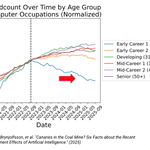
Hiring has slowed for young people in jobs highly exposed to AI, like software development. Workers in their 20s are feeling the squeeze.
Watch 60 Minutes tonight.
Clara Shih retweeted
“I think AI is going to have a profound impact on every profession,” says @ClaraShih, who oversaw major AI divisions at Salesforce and Meta and now runs a nonprofit helping young people navigate this new economy.
“I think, you know, sugarcoating this AI utopia—maybe we'll get there, but there's a lot of hurt that could happen between now and there,” she warns. cbsn.ws/4xZj4By
Clara Shih retweeted
Today, grads are navigating one of the toughest hiring environments in decades. Staring down 500 unanswered applications in isolation isn't a rite of passage. It's a broken system.
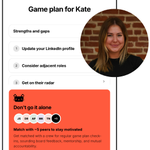
Today, alongside our incredible team at the @dearcc_official, I’m proud to announce the launch of dearCC: a free platform designed to give Gen Z job seekers the roadmap and the network they need to break through.
Supported by an anchor partnership with @SchultzFamilyFd @TheBGInstitute , dearCC replaces guesswork with an actionable playbook.
We are giving young professionals:
📊 Field Report: AI-powered labor intelligence to see which roles are growing and which are flatlining.
🗺️Game Plan: A personalized, step-by-step sprint to build AI capabilities and execute a targeted search.
🤝Community: Real mentorship from industry leaders and peer Crews to provide accountability.
AI changed the rules of the job hunt. We built the new playbook. If you know a recent grad navigating this market or experienced professional who wants to mentor a young person, send them our way. All resources are completely free and live today at dearcc.org.
#FutureOfWork #GenZ #ArtificialIntelligence #CareerDevelopment #dearCC
Clara Shih retweeted

@TIME interviewed my sister @clarashih about how to prepare job applicants and employers for the AI era time.com/partner-content/cha…

Clara Shih retweeted
What jobs will AI replace? That's the wrong question.
History shows that automation’s effect on jobs is never uniform. The impact on a job depends on which specific tasks gets automated: when automation causes the work remaining to require more expertise, wages rise because it’s harder to qualify for the job. When automation results in less expertise being needed, wages fall because many more people can enter the job, competing down wages (@MIT @davidautor).
Case 1. Direct replacement and displacement. Examples: translation work, customer support.
Case 2. Augmentation from automation of bottleneck tasks. Examples: radiology, software engineering.
Case 3. Job commoditization from automation of expert tasks and flooding of labor supply. Examples: taxi drivers, content creators.
Jevons paradox occurs in all of these scenarios, but the impact on jobs is very different. Especially now with self-improving AI, the evolution of jobs into these scenarios is dynamic and often hard to predict.


Clara Shih retweeted

This is wonderful guidance from @clarashih on when students should start using AI. If you use it when you’re beginning something, you’ll make fewer mistakes—but never get the opportunity to learn from them. The best time to adopt it is when you have enough expertise to judge whether an output is good or bad, and use it as a tool to take your skills to the next level.
I very much enjoyed talking to Clara about how young people should prepare for the AI era. Watch here: youtube.com/watch?v=a90ZNYc8…
Clara Shih retweeted
When a new technology comes along, it’s often young people who are most excited and old people who are most wary. For a time, this was true of AI. That is no longer the case. The Gen Z backlash to AI is one of the most fascinating developments in recent years. This is not a group of people rejecting something they don’t understand. They’re turning on something they know and use often.
Some of the concern is about what AI will do to the environment, but much of it is based on what the technology means for their job prospects. The data is still murky, but those worries are well founded. To get a sense of what young people are against, I sat down with @clarashih. Clara spent two decades in Big Tech before starting @dearcc_official to help young people get hired in the age of AI. We talked through what she’s seeing with the entry-level job market; which jobs are most exposed and which are most resilient; and what parents and universities should do. I was particularly intrigued by some of the interesting distinctions she drew between how one should use AI in different fields, such as computer science and media.
The issues we talked through, of course, don't just apply to young people. Entry-level jobs are disproportionately affected right now, but that’s going to change. Clara outlines a potential future where white-collar work falls into one of three buckets: people who make AI, people who use AI, and people who are managed by AI. The first bucket will command exorbitant salaries. But the second bucket, which includes most knowledge workers, is shrinking, and it might not be too long until many of them are in bucket three, and “shocked that the only jobs available to them are not nearly as desirable as the job that they've had.”
It was a fascinating, occasionally distressing, conversation that ended on a note of optimism. I hope you watch and subscribe.
youtube.com/watch?v=a90ZNYc8…

What jobs will AI replace? That's the wrong question.
History shows that automation’s effect on jobs is never uniform. The impact on a job depends on which specific tasks gets automated: when automation causes the work remaining to require more expertise, wages rise because it’s harder to qualify for the job. When automation results in less expertise being needed, wages fall because many more people can enter the job, competing down wages (@MIT @davidautor).
Case 1. Direct replacement and displacement. Examples: translation work, customer support.
Case 2. Augmentation from automation of bottleneck tasks. Examples: radiology, software engineering.
Case 3. Job commoditization from automation of expert tasks and flooding of labor supply. Examples: taxi drivers, content creators.
Jevons paradox occurs in all of these scenarios, but the impact on jobs is very different. Especially now with self-improving AI, the evolution of jobs into these scenarios is dynamic and often hard to predict.
Clara Shih retweeted

After seeing first-hand how artificial intelligence can transform hiring, tech exec Clara Shih started the New Work Foundation to help young people build careers using AI, rather than be replaced by it. forbes.com/sites/courtney-co…
📸: New Work Foundation

Clara Shih retweeted
History tells us automation is rarely one-size-fits-all. Some roles will disappear like elevator operators of yesterday. For most, it’s more nuanced. AI chips away at some tasks within each occupation, often changing who can do the job.

History tells us automation is rarely one-size-fits-all. Some roles will disappear like elevator operators of yesterday. For most, it’s more nuanced. AI chips away at some tasks within each occupation, often changing who can do the job.
This is @dearcc_official's stack, except we use @neondatabase instead of Supabase
New era of efficiency and impact for nonprofits 📈

If you want to start a startup:
Claude = coding. ($20/mo)
Supabase = backend. (Free)
Vercel = deploying. (Free)
Namecheap = domain. ($12/yr)
Stripe = payments. (2.9%/transaction)
GitHub = version control. (Free)
Resend = emails. (Free)
ProductBridge = feedback (Free)
Clerk = auth. (Free)
Cloudflare = DNS. (Free)
PostHog = analytics. (Free)
Sentry = error tracking. (Free)
Upstash = Redis. (Free)
Pinecone = vector DB. (Free)
Total monthly cost to run a startup: ~$20
Clara Shih retweeted
Designers use AI more for engineering than for design.
Sales uses AI more for marketing than for sales.
HR uses AI more for finance than for hr.
If you think your job isn’t changing in the next three years because of AI, you are out of your mind.


