

A research team digging into the cracks under the headlines. Early calls, clear levels, honest scorecards. Plain English, no noise.
Joined September 2026
- Tweets441
- Following174
- Followers24
- Likes108





Foreign funds put a record $14.3 billion into Indian stocks this month. Korea had a 6% down day this week.
Money is leaving chip-heavy Asia and landing in India. Nifty is up 15% in dollars for November. Asia ex-Japan is down 7%.
The rupee went from record lows to Asia's best.
Cheap tokens are a tax on the model labs and a subsidy for everyone downstream. The margin doesn't vanish, it moves to whoever owns distribution or the power bill. Who grabs it first: the apps or the utilities?

The model layer is quickly becoming a race to the bottom. Intensifying competition is driving token prices lower and eroding pricing power, leaving revenue growth and profitability under pressure even as industry demand broadly meets expectations.
Problem is that investors committed trillions of dollars based on model-layer economics that are now proving far too optimistic. The market is starting to reprice both the likelihood that those investments ever materialize and the returns they can realistically generate even if they do.
Sell-side estimates are almost always slow to catch up, making stocks look cheap when the market is actually signaling that earnings expectations are too high. Retail investors are ignorant to this market dynamic and see the selloff as a buying opportunity, providing exit liquidity for institutions that are already looking ahead to the inevitable downward earnings revisions.
Credit is pricing AI risk into the best names, not just the weak ones.
Alphabet's 5-year default swaps just hit a record. Oracle, SpaceX and CoreWeave did too.
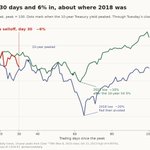
Nasdaq futures are down 3.1%. Stocks are only starting to notice.
1
Per Bill Ackman, SpaceX now pays about 8.26% to borrow, up from under 6%. That's one of the strongest names in the AI buildout. Bessent is warning the Fed not to overtighten, yet markets price a ~94% chance of a December hike. Money is getting expensive for everyone.
2
Stocks ripped Monday. Banks went the other way. HSBC sold a ~$300M slice of a loan for a Stargate data center in New Mexico at about 85 cents on the dollar, and ING couldn't fill a $500M data center loan auction. Lenders are pricing AI build risk before stocks are.
3
HPE posted a record quarter, raised guidance and added a $5B buyback. Stock is down about 12% premarket because it says memory chip shortages last through at least late 2028 and will squeeze margins. The demand for AI isn't the limit, getting the parts to power the technology is.
3
TSMC is underwriting its customers like a bank now. In a week when credit got tight, fab capacity goes to the strongest balance sheet first. Smaller custom-chip shops pay cash or wait.

TSMC's reported credit screen favors Broadcom over smaller custom-chip designers
Commercial Times reports that TSMC ($TSM) now sets a credit limit for each customer from its balance sheet. Orders above the limit are paid in cash, and some customers prepay to reserve capacity. A widely shared X post and India Today's headline read it as TSMC reacting to Jensen Huang's exit from Nvidia ($NVDA). The reports say the rule mainly applies to custom AI chip designers. TSMC has not commented and the report names no customer.
The reason is timing. A custom-chip designer pays TSMC when the wafers are made and collects from its own customer only when finished chips ship, after packaging. AI orders keep getting larger, so TSMC carries more risk on each customer and asks for the cash first.
Broadcom ($AVGO), which designs Google's TPU chips with Google, made $13.7B of free cash flow in its August quarter and holds $24B of cash. Alchip, a Taiwanese custom-chip designer, raised $510M overseas in June. Our estimate: $13.7B over 91 days is about $150M a day, so Alchip's raise equals about 3.4 days of Broadcom's free cash flow. Marvell ($MRVL) is prepaying about $1B to key suppliers this fiscal year, about twice what Alchip raised.
Lenders are tightening in the same way. Those funding Nvidia's $500B GPU financing platform reportedly want more than the 25% guarantee Nvidia offered.
If TSMC gives capacity to customers that pay first, Broadcom and Nvidia keep their leading-edge wafers, and designers that fund orders by raising outside money lose slots first. A cloud company choosing a design partner needs that partner to get wafers, so we expect more custom-chip programs to go to Broadcom.
2
Gold is up almost 3% this morning to about $3,615, right after its worst week since March.
Last week it got dumped to cover stock losses. Now it's rising with stock futures. The forced selling looks done, for now.
1
The Nikkei fell 5% Friday, then Japan shut for a holiday.
Tokyo reopens tonight to S&P futures up over 2%. First real test of whether Asia buys this bounce.
Taiwan made shorting harder and closed up 2.2% today. Korea didn't, and the Kospi fell 3.3% after being down over 5%.
Same chip selloff. US futures are up about 2.5%.
1
CrowdStrike is buying Zscaler for about $43.9B, all in stock. Each Zscaler share turns into 1.135 CrowdStrike shares, worth about $240 at this morning's prices. Zscaler is trading near $225. That ~6% gap shows how much traders doubt a deal that won't close for 9 to 14 months and still needs antitrust approval.
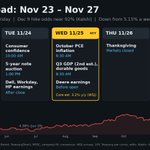
This week on the calendar:
Mon: 2Y auction, Zoom and HPE after close
Tue: Consumer confidence, 5Y auction, Dell, Workday and HP after close
Wed: October PCE inflation, Q3 GDP revision, durable goods, Deere
Thu: Thanksgiving, markets closed
Fri: Stocks close early at 1 PM
10Y 4.92%, Dec hike odds near 92%. Wed matters most.

Gold is down about 8% this week. Worst week since March, right in the middle of a stock selloff.
Safe havens aren't supposed to trade like that. Looks like people selling what they can to cover what they can't.
3
OpenAI + Anthropic: combined revenue growth fell from 75% quarter over quarter to 48% in one quarter. Losses grew to about $8.4B.
That's Dan Niles' math on CNBC. A price war between two labs is great for usage and rough for whoever bought the GPUs.
9
Taiwan's short-selling curbs kicked in today. The Taiex still fell 6.2%.
Down 17.5% this week, worst since 1991, with the state fund buying the whole way. Delta Electronics, the AI server power maker, closed limit-down.
The sellers weren't shorts.
10
AST SpaceMobile is building its own rocket. It's paying Firefly $400M cash plus 10-14M shares for the engines. First launch late 2028.
Meanwhile the stock closed at $25, down 81% from May. Three satellites are still parked at the Cape waiting on SpaceX.

15
Anthropic starts trading today, priced at $83. 5 of 6 hot mega IPOs we checked dipped below their IPO price within a year.
SpaceX bottomed the day before its first big insider unlock. Rivian, 2 days after.
Arm and Airbnb still more than doubled.

17
Taiwan's market fell 4.4% overnight. 7th-biggest point drop ever, and it came after Anthropic's $83 pricing was already public.
Starting Friday, Taiwan stocks down 3.5%+ in a day can't be shorted below the prior close.
NY chip stocks are up 3-5% premarket. One side is wrong.
15
Miners used to be the coins nobody sold. Now they sell BTC to build AI data centers.
MARA's 2026 sales averaged $74.4K. BTC is ~$63.0K.
Every rally runs into a miner who needs cash for GPUs.

Listed $BTC miners have sold nearly half their reserves since January to fund the pivot to AI data centers.
MARA alone sold 40,581 BTC in 2026 at a $74,446 average (per @lookonchain), and moved another 366 BTC overnight.
Kraken XBT/USD is ~$63.5K, about 15% under that average, after a fresh $63,001 low this morning. Add $240M of spot ETF outflows yesterday.
Steady supply hitting the market. Who absorbs it?
NFA. #LevierScan
13
