

Books: Strong Towns | Confessions of a Recovering Engineer | (Bestseller) Escaping the Housing Trap
Brainerd, MN
Joined September 2008
- Tweets13.2K
- Following618
- Followers21.2K
- Likes23.8K







Pinned Tweet
If you're wondering where I'm spending my time online these days, it's the Strong Towns Commons.
Smart people. Challenging conversations. No outrage machine. Just people trying to better understand how to build stronger places.
commons.strongtowns.org

There are no banks that have, as their reserves, bundled securities of 30-year auto loans. Nobody buys a car thinking it will appreciate in value and be worth more in 30 years. It's an absurd talking point. – at Long Beach, MS

Institutionalizing decline and devaluing large swaths of America so that housing becomes affordable is a strategy, it's just not my strategy. – at Metairie, LA
This might be the reality in a few core cities, but for nearly all Americans, there is a massive difference in price between the home they start in and the place they end.
We shouldn't make policy nationally based on Silicon Valley economics. – at Metairie, LA

Charles Marohn retweeted

One of the best podcasts I've done on the public transit challenge in the US. A great conversation with @clmarohn, the founder of @strongtowns. Please share. podcast.strongtowns.org/e/th…

One last thing on the disingenuousness of the housing discourse here.....
This dude uses quotes as if I've said this. I haven't. I've literally written 2.5 million words available online -- just quote me. You don't have to make shit up.
This quoted post is unavailable.
I've literally said that every neighborhood everywhere should be upzoned. I've been saying that since Strong Towns was formally founded in 2009.
Why is saying filtering + building more entry level housing so threatening?
This quoted post is unavailable.
Dude, keep sharing my stuff. You're demonstrating my point.
Going from starter home to luxury condo is a choice for a select few. It's not the common path for nearly all Americans, but perhaps most Americans you know. – at Metairie, LA


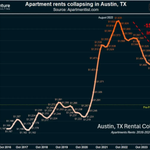
I'm puzzled by this as a response @aarmlovi. I didn't argue that falling rents cause builders to stop building. I argued that as rents decline, production slows. Your chart seems to show exactly that. Metro permits have fallen from 50.9k to 24.4k and the line is still declining.


Also that “pre-pandemic average” is the 2000–2019 average. That includes the housing crash and years of depressed permitting that followed. If we're comparing to pre-pandemic rate of housing production, wouldn't something like 2012–2019 be the more meaningful comparison?
This is really brilliant work. – at Brainerd, MN

Download the report here. It's chalk full for practical strategies to create beautiful walkable places without turning drivers against the idea.
mobyconacademy.com/files/how…

Charles Marohn retweeted

Why can't we just build high-speed, high-proximity streets? This is the original sin of North American street design: too fast for compact growth, too slow for long-distance travel. These "stroads" work work well for nothing, as argued by @clmarohn @StrongTowns

Charles Marohn retweeted
Which has better travel times for cars: Amsterdam or Atlanta? Remarkably, it's Amsterdam.
There's a critical lesson here: it's possible to design great places for walking, biking, and transit that are also better for drivers. We just published a report on how.


"Building more housing can’t just mean building wherever is easiest...."🎯

Building more housing is only half an idea. You also have to address what kind and where.
smartgrowthamerica.org/knowl…


A federal court ruled that Minnesota’s engineering licensing board violated the First Amendment when it tried to regulate my public advocacy.
It took six years to get here.
This ruling matters far beyond me.

Here are all the details, including a link to the ruling and a timeline.
strongtowns.org/journal/2026…

And you can listen to @johntreuter and me discuss it on this week's Strong Towns Podcast.
podcast.strongtowns.org/e/ch…

The next book in the Strong Towns collection, titled "Grow Strong", went to the publisher this week.
It’s about job creation, economic development and the @StrongTowns approach to building a durable local economy.
I’m excited to share this one with you next spring.
