
Director of Kusher Consulting. Independent property research and consulting. Partnering with the best in property.
Joined August 2012
- Tweets12.1K
- Following1.2K
- Followers10.3K
- Likes13.1K




Pinned Tweet
I’ve spent 25 years researching and commenting on the Australian residential property market, working with some of the sector’s biggest names.
Now, I’m offering my expertise directly to businesses and individuals through Kusher Consulting. 1/
Cameron Kusher retweeted
Housing demand limits supply not construction productivity.
kusherconsulting.substack.co…
Housing demand limits supply not construction productivity.
kusherconsulting.substack.co…
It’s just very disappointing the RBA didn’t have the gumption to seriously tackle inflation in 2022 and 2023, sure the Middle Easy would be causing issues now but domestic inflationary pressures (of which there are still many) would have largely been contained.

Just reading the transcript of the Sarah Hunter interview with 60 Minutes, another rate hike is clearly coming, quite possibly several more too.
Is it just me or is it very weird how many times it is mentioned in this article that Tim Gurner is a billionaire?

Lol. Lmao even.
File under delusions that you do not see at the bottom. afr.com/property/commercial/…
<insert:giant_bong_rip.jpeg>


I think this is spot on.
Albo and Chalmers are big fans of Keating, what if they actually came out and said our economy needs a reset and it’s going into a downturn?
It will be painful w’re going to do what we can to help those struggling but we’ll come out the other side stronger.
Never in a million years do I think they would do that but it’d probably be the right thing to do.

We have gone from a world where economic downside was a part of life and even directly confronted when necessary (Volcker, Keating etc)
To one where it is avoided like the plague, even if it means blowing hundreds of billions for little good long term reason.
This is part of the origin of Burnout Economics.
The theory that economic downside is now so politically unacceptable that govt will gladly keep their foot planted on the accelerator while central banks slam their foot on the brakes.
The problem is economic downside is never fully avoided, only deferred.
And that is where Australia is now.
A nation where housing market reckonings have been avoided again and again for almost two decades.
Where in the process of avoiding that downside growth in the per capita private sector economy is more or less non-existent in the post-mining boom era.
Now those same policymakers are trapped in a world of their own making, where there are no more good options, only less bad ones.
Welcome to late stage Burnout Economics, where things get challenging until the cycle starts all over again.
Double whammy predicted for new home building - from the AFR.
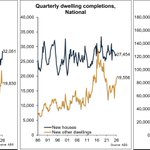
It's hard to see how there is a short-term recovery in the new homes market.
Interest rates are up, construction costs are still rising for new homes whilst established prices are falling, substantially and rapidly in some markets.
Buyer numbers have evaportated and for those that are still looking to buy it is going to be hard for them, when borrowing capacity is reduced, to justify the premium for new homes if existing homes are cheaper (even if they aren't getting exactly what they want in an established property).
My sense is that what is going to happen is rates will increase again and then possibly another time next year. Buyer numbers will reduce even further, some developers will end up selling sites and projects at a discount to what they purchased it for and land prices will reset lower.
It's hard to imagine construction prices reducing but there is certainly scope for land prices to fall especially considering how much they have escalated over recent year.
What do you think?
afr.com/property/residential…

Our cities have to grow and we have choices how that should be but I think it is a discussion that needs to be had with the whole community. How do we want our cities to look in 50 years? High rise towers everywhere? Medium density everywhere? Urban sprawl? A mix of all three?
People are just trying to impart their preferences on the rest of the community I think it is a very important discussion that needs to be had and not just at an individual council area or city level, nationwide.

Cameron Kusher retweeted

Why did the RBA take the narrow path, and why is it now talking tough?
A balancing clause that treats jobs as a short-run trade-off against inflation. Two definitions of full employment. And a NAIRU estimate in the low 4s that was always wishful.
Three errors, all pointing the same way. Trimmed mean inflation persistent at 3.6 per cent is the bill.
markthegraph.blogspot.com/20…


Good summary of Hauser's comments this morning.
In terms of the dual mandate, we accepted an unemployment rate of 5% or more every single month except for two months between Feb 09 and Jun 21.
Jobs werr still created and the economy still grew too.
The dual mandate is putting too much focus on the unemployment rate when it is still sub 5%.
Annual underlying inflation has now only been back in the RBAs target range for two months since March 2022.
I don't want to sound heartless because unemployment sucks (I've been through it I know) but unemployment hurts some people, ongoing high rates of inflation hurt everyone.
IMO the RBA and the government should get serious of doing whatever they can do to curtail inflation.
Even still I think they won't hike in November but may in December.
afr.com/policy/economy/hard-…

Hauser with some extremely hawkish comments in this Fireside Chat.
I wonder if the RBA reflects on their narrow path and realises they have made things worse for longer?
(I realise even if inflation was back in target we'd possibly be looking at rate hikes still).
Yesterday I shared some thoughts about rising construction costs, the Housing Accord target and the outlook for home construction with @MackenzieJScott at @australian.
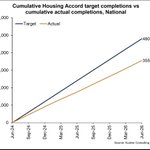
In basic terms construction costs are rising, this along with rising interest rates is probably going to result in a dmapening of commencements and leave the Housing Accord target further away.
For developers and builders it is going to be hard to pass these additional costs on to purchasers given how much costs have risen in the past five years and the fact that established housing prices are falling.
theaustralian.com.au/nation/…
The RBA can’t get inflation under control and is offering staff below inflation wage increases. No wonder staff are rejecting it. afr.com/policy/economy/bullo…

Some of these academics are seriously no good at critical thinking. Advocate if you want public housing, I think we should have a lot more, but when almost all new housing is delivered by the private sector and most agree we need more housing, why would you slam the brakes on it

The Housing Accord Target has been a complete failure but it is the government that has been unambitious in trying to ensure the target was met, or that we even got close to it.

The unambitious describe the target of 1.2 million homes as a failure.
But it is encouraging more homes.
Not as many as hoped. But blame the weak level of support; not the target.
Victoria gets $350m for progress towards the target.
pm.gov.au/media/speech-ages-…

Lending for new housing is collapsing. What I want to know is it collapsing because of the CGT and NG changes or is it actually collapsing because established prices are falling and new housing prices aren't?
If I was the government I would be doing whatever I could do to try and bring down the cost of delivering and subsequently the end cost of new housing whilst making new housing supply more feasible.
How to do that is the hard part but figuring this stuff out is the job of government.
theaustralian.com.au/nation/…


My absolute favourite political discourse, typically from the conservative side TBF, is great ideas about what could be done about tax reform from people no longer in politics that had the power to introduce such reform for years.

📣 No signs of rental growth accelerating, yet
The latest rental data shows that rental growth over the September quarter was weaker than at the same time last year, allaying fears, for now, of an uplift in rental growth.
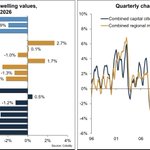
Over the three months to September 2026, rents increased by just 0.5%. The rate of growth was down from a 1.6% increase over the June 2026 quarter and a slower rate of growth than the 0.9% increase over the September 2025 quarter. In fact, it was the slowest growth in rents over a three-month period since December 2024 when rents rose by 0.4% over the quarter.
In most regions of the country, rents have increased at a rate above inflation, which is adding further pressure to the budgets of rental households. These households have seen their spending power diminished by an elongated period of heightened inflation.
Rental vacancy rates have eased a little and, when you consider how much rents have increased in recent years, even though demand is strong and supply is tight, it is likely there are limits to how much more renters can pay, especially when inflation remains elevated, pushing up the cost of living for households.
I expect rents will continue to rise, but over the short term we are unlikely to see rents rise as rapidly as they have in recent years. Rental households will respond to the cost-of-living pressures by moving to less ideal locations where rents are cheaper or forming larger households to be able to afford to rent in more ideal locations.
Longer term, I expect we will see pressure on rents if the level of investment remains lower than in the past due to these taxation changes. The other challenge the market is likely to see over the coming years is less additional rental supply in the form of new housing.
Although the Federal Government is trying to funnel future investment into new housing supply, ongoing feasibility challenges which stem from high interest rates, high and increasing construction costs, delays in getting projects approved and challenges achieving sufficient presales to commence construction are likely to see fewer commencements in the coming period. This will eventually translate into fewer new homes being built.
kusherconsulting.substack.co…
