
Organic chemist. Art enthusiast. Mainly motivated by food. Assistant Professor at 🇸🇪 @Stockholm_Uni.
Joined February 2020
- Tweets69
- Following166
- Followers104
- Likes365

Matteo Costantini retweeted

We are proud to introduce Hypoboric Acid Catecholates (HACs)! 📢 Hidden diborons with surprising properties revealed by mechanistic studies! A great collaboration with Himo @Stockholm_Uni and Wei @WUT1898 from @ICMol_UV 👉 Still hot in ChemistryEurope! doi.org/10.1002/ceur.70363

We are hiring! Fully funded PhD position in Organic Chemistry: come join our team at @Stockholm_Uni and develop innovative methodologies!
Attach your CV and cover letter, deadline January 20th!
Link for application: su.varbi.com/what:job/jobID:…

Matteo Costantini retweeted

📢We are hiring! We offer a fully funded 2-year #Postdoc position to join our team at
@Stockholm_Uni
Do you want to work in heterogeneous catalysis with MOFs and make organic synthesis more sustainable? Apply here until 28/12 #chemtwitter RTs appreciated!
su.varbi.com/en/what:job/job…

Matteo Costantini retweeted
💰⌚️The group is announcing today a *** postdoctoral research associate position ***. 🗓️Deadline application Nov 12. Please spread the word! Details and electronic application link --> uv.es/uvweb/servicio-recurso…
Matteo Costantini retweeted
Congratulations to @BeaMeana for her Best Presentation award at ECSAMM!! We are all so proud of you! :)

🏆 Congratulations to the winners of the ECSAMM Awards at the 1st Early Career Symposium on Advanced Molecular Materials (ECSAMM).
👏 We were proud to recognize the outstanding work of our early-career researchers with 3 awards for Best Posters (Maria Lucía Tamayo Fraile, Carmen Rosales Martínez and Ana Torres Suay) and 2 awards for Best Talks (Beatriz Meana Baamonde and Shoaib Azeem) celebrating excellence in scientific communication and research.
These awards were generously sponsored by the @RoySocChem @DaltonTrans

Matteo Costantini retweeted

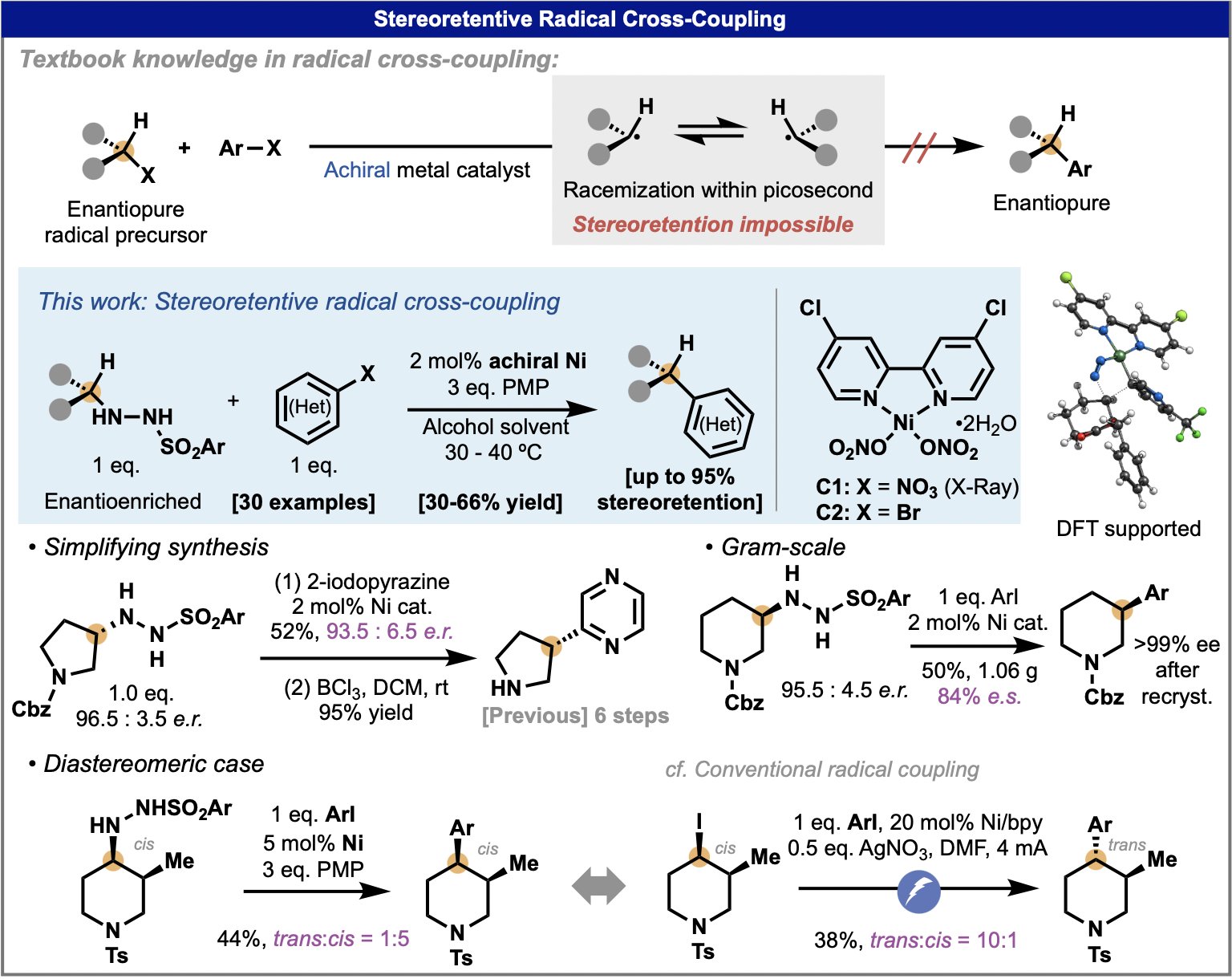
🚨RADICAL RETHINK: STEREORETENTIVE CROSS COUPLING UNLOCKED🚨 Today in @ChemRxiv (chemrxiv.org/engage/chemrxiv…) the first method for stereoretentive radical cross-coupling is disclosed. No fancy ligands or redox needed—just a Ni-diazene twist. 120 years after Gomberg, a new chapter begins.
Quick summary:
Since Gomberg discovered free radicals over 120 years ago and Kochi pioneered radical cross-coupling in the 1970s, this field has surged with interest for linking C(sp3) fragments. Unlike traditional polar methods (e.g., Suzuki), radical cross-coupling excels with saturated systems, offering mild conditions and chemoselectivity to build complex molecules from common fragments. Until now, enantiospecific radical cross-coupling was deemed impossible due to rapid racemization, but today that changes with readily available sulfonylhydrazides and a simple Ni-catalyst. This stereoretentive approach, enabled by a unique Ni-diazene transition state and driven by loss of N2, skips chiral ligands and redox steps, opening new possibilities for synthesis.
Matteo Costantini retweeted

Stereoretentive Radical Cross-Coupling — a pioneering achievement in the field! It's not every day that you get to work on a project that's the first of its kind. 🚀

🚨RADICAL RETHINK: STEREORETENTIVE CROSS COUPLING UNLOCKED🚨 Today in @ChemRxiv (chemrxiv.org/engage/chemrxiv…) the first method for stereoretentive radical cross-coupling is disclosed. No fancy ligands or redox needed—just a Ni-diazene twist. 120 years after Gomberg, a new chapter begins.
Quick summary:
Since Gomberg discovered free radicals over 120 years ago and Kochi pioneered radical cross-coupling in the 1970s, this field has surged with interest for linking C(sp3) fragments. Unlike traditional polar methods (e.g., Suzuki), radical cross-coupling excels with saturated systems, offering mild conditions and chemoselectivity to build complex molecules from common fragments. Until now, enantiospecific radical cross-coupling was deemed impossible due to rapid racemization, but today that changes with readily available sulfonylhydrazides and a simple Ni-catalyst. This stereoretentive approach, enabled by a unique Ni-diazene transition state and driven by loss of N2, skips chiral ligands and redox steps, opening new possibilities for synthesis.
Matteo Costantini retweeted
Finally, RADICAL CROSS COUPLING without the exogenous REDOX. We disclose in @ChemRxiv (chemrxiv.org/engage/chemrxiv…) a broadly general platform for achieving transformations that normally required excess metallic or chemical reducing agents or photochemical setups (and their requisite catalysts) or potentiostats for electrochemistry. Now, such transformations can be accomplished with the same ease that one conducts a Suzuki coupling. You can scale up (its homogeneous) or scale down (use cheap parallel screening plates). Moisture is tolerated and base metal catalysis is used. As the best engineers like to say, "The best part is no part". Now, chemists have the option to remove the redox part from radical couplings.
Quick Summary: Sulfonyl hydrazides are disclosed as versatile radical precursors as exemplified with seven new C–C bond forming, redox-neutral cross-couplings with: (1) activated olefins, (2) alkyl halides, (3) redox active esters, (4) aryl halides, (5) alkenyl halides, (6) alkynyl halides, and (7) a trifluoromethylating reagent to forge C(sp3)-C(sp3), C(sp3)-C(sp2), and C(sp3)-C(sp) bonds. Sulfonyl hydrazides are stable and usually crystalline substances that can be accessed in a variety of ways including transiently from hydrazones to achieve a net reductive arylation of carbonyl compounds. Exogenous redox (chemical, photo/electrochemical) additives are not necessary as these functional groups serve the dual role of radical precursor and electron donor. The operational simplicity (homogeneous, water tolerant, dump-and-stir) and practicality of the method are demonstrated as well as applications to streamlining synthesis and mild late-stage functionalization.

Matteo Costantini retweeted
I'm thrilled to announce our breakthrough in synthesizing gem-diaryl 4-membered rings through a novel sequence of nickel-electrocatalytic couplings.
A huge thank you to everyone who contributed to this immense work!
Triply Convergent Ni-Electrocatalytic Assembly of 1,1-diaryl Cyclobutanes, Azetidines, and Oxetanes, appearing today in @ChemRxiv :chemrxiv.org/engage/chemrxiv…
Increasingly complex, three-dimensional leads for drug discovery are testing the limits of modern organic synthesis. In this context, the need for new methods to access gem-diarylated cyclobutanes, azetidines, and oxetanes is apparent. The present study outlines a modular, scalable, chemoselective approach to solve this problem using simple alpha-bromoacids and aryl halides as intuitive starting materials. As demonstrated herein, a sequential series of Ni- electrocatalytic cross-couplings can be enlisted to enable rapid access to such structures, many of which have never been accessible before, without recourse to time-consuming polar bond disconnections that are inherently limiting in terms of accessible chemical space. The scalability of this new reaction sequence is demonstrated, alongside direct applications to known patented structures. A simple user guide is also presented to accelerate adoption of this strategy in medicinal chemistry.
A super fun collaboration with BMS, Pfizer, Biogen, Enamine, and Abbvie.

Matteo Costantini retweeted
Triply Convergent Ni-Electrocatalytic Assembly of 1,1-diaryl Cyclobutanes, Azetidines, and Oxetanes, appearing today in @ChemRxiv :chemrxiv.org/engage/chemrxiv…
Increasingly complex, three-dimensional leads for drug discovery are testing the limits of modern organic synthesis. In this context, the need for new methods to access gem-diarylated cyclobutanes, azetidines, and oxetanes is apparent. The present study outlines a modular, scalable, chemoselective approach to solve this problem using simple alpha-bromoacids and aryl halides as intuitive starting materials. As demonstrated herein, a sequential series of Ni- electrocatalytic cross-couplings can be enlisted to enable rapid access to such structures, many of which have never been accessible before, without recourse to time-consuming polar bond disconnections that are inherently limiting in terms of accessible chemical space. The scalability of this new reaction sequence is demonstrated, alongside direct applications to known patented structures. A simple user guide is also presented to accelerate adoption of this strategy in medicinal chemistry.
A super fun collaboration with BMS, Pfizer, Biogen, Enamine, and Abbvie.
Matteo Costantini retweeted
🚨 Less than one week left to apply! 🚨 Deadline 4th of November
Remember that your application has to be submitted through the official online system!
👉 lnkd.in/dphJEDHe 👈

📢We are hiring! We offer a fully funded #PhD position to join our team at @Stockholm_Uni
Do you want to work at the interface between organic chemistry and materials and make polymers more sustainable? Apply here until 04/11
su.varbi.com/en/what:job/job…
#chemtwitter RTs appreciated!

Matteo Costantini retweeted

Highlighting some great chemistry done with our ElectraSyn 2.0 from @BaranLabReads
We'll be sharing some e-chem fundamentals & how to get started with the ElectraSyn 2.0 alongside this series! Stay tuned.
Want your e-chem reaction featured? DM us!
linktr.ee/ikaworldwide

Matteo Costantini retweeted
Grateful to @LcsoLab and all the faculty @EPFL for hosting me at Lausanne! Visiting Switzerland it’s always amazing time for me :)

Organic seminars are back @EPFL_CHEM_Tweet : first Prof Mendoza @MendozaLab from the university of Valencia

Matteo Costantini retweeted
Introducing a new electrode material for synthetic organic electrochemistry: Pyrolytic Carbon, appearing today in @ChemRxiv : chemrxiv.org/engage/chemrxiv… . Order PC electrodes today, made by @KULRTech , sold by @IKAworldwide for #electrasyn.

Matteo Costantini retweeted
📢We are hiring! Looking for talented & motivated researchers to join our team at
@Stockholm_Uni as #PhD students.
Are you excited about catalysis, organic chemistry and materials? Apply here until 23/04 #chemtwitter
web103.reachmee.com/ext/I007…
📢RTs appreciated!

Matteo Costantini retweeted
Degrade proteins, not your work schedule! A new method appearing today @ChemRxiv (chemrxiv.org/engage/chemrxiv…) simplifies access to molecular glues (like PROTACS) to save medicinal chemists valuable time. One-step access from cheap commercial materials, a trivial experimental setup, and superb chemoselectivity enabled by Ni-electrocatalysis. Another fun collaboration with BMS.

Matteo Costantini retweeted
Honoured to receive @RSEQUIMICA Group Leader Award in Murcia! Big thanks to all the students and collaborators that made our journey possible throughout the years! This award is mostly theirs 🙌🤩 @ICMol_UV

Enhorabuena a los premiados por la RSEQ en la modalidad Líder de Grupo. Gracias a Merck y a la @RSEQUIMICA por apoyar a los jóvenes investigadores.


Matteo Costantini retweeted

Enhorabuena a los premiados por la RSEQ en la modalidad Líder de Grupo. Gracias a Merck y a la @RSEQUIMICA por apoyar a los jóvenes investigadores.
Matteo Costantini retweeted

Come join us in Valencia😃😃👇👀

We're hiring! 4-year fully funded FPI PhD position in sustainable organic synthesis (redox-active carbene chemistry and photoorganocatalysis) @ICMol_UV in Valencia! Call will be live very soon. Interested? Contact information at icmol.es/soc/ Pls spread the word!
Matteo Costantini retweeted
We're hiring! 4-year fully funded FPI PhD position in sustainable organic synthesis (redox-active carbene chemistry and photoorganocatalysis) @ICMol_UV in Valencia! Call will be live very soon. Interested? Contact information at icmol.es/soc/ Pls spread the word!