
Head of AI/ML at @adaptivesec | Ex-Stripe, Etsy Thoughts my own
New York, USA
Joined December 2012
- Tweets37
- Following171
- Followers20
- Likes22


Akhil retweeted

One perk of working at huge scale at @AdaptiveSec: there’s no shortage of interesting data to dig into.
Our team just pulled attack-timing data from our agentic email security to determine what day of the week most malicious attacks arrive.
Turns out, cybercriminals like to maintain a good work life balance 🧘. 90% of malicious attacks land during business hours
Check it out:

that's a really funny bug. I guess I've never let my mac run for 50 days then

Did you know that running your Mac for more than 50 days without a reboot will fuck with your internet connection?
Yes, really. There is a 32-bit integer timing your TCP connections and if you let it overflow MacOS will run into all kinds of fucky issues with its TCP stack.
For example I was unable to upload things bigger than 4MB. I was wondering why my Claude sessions started to hang seemingly at random.
The fix? Literally just reboot your machine. That's it.
What the fuck
photon.codes/blog/we-found-a…

Readers added context they thought people might want to know
The TCP issues after ~50 days uptime were a kernel bug only in early macOS 26 Tahoe versions, fixed by Apple starting in 26.4; current systems are unaffected.
nevyn.dev/blog/20261030-…
photon.codes/blog/we-found-…
portal.greenmini.host/help/macos-tah…
1
22
Every week

BREAKING: A cyberattack hit 178 major organizations, including Zoom, CNN, BBC, Fox News, HSBC, Ledger, Equifax, Salesforce, IKEA and Air France-KLM, by loading malware on the Optimizely Web platform, exposing visitors to scripts built to steal payment data and exploit iOS devices, per security firm Report URI.
Banking and finance was the hardest-hit sector, with 32 organizations affected, including the UK's HSBC across multiple markets such as the US, Hong Kong, Mexico, Singapore, Australia and the UAE.
10
Akhil retweeted

BREAKING: A cyberattack hit 178 major organizations, including Zoom, CNN, BBC, Fox News, HSBC, Ledger, Equifax, Salesforce, IKEA and Air France-KLM, by loading malware on the Optimizely Web platform, exposing visitors to scripts built to steal payment data and exploit iOS devices, per security firm Report URI.
Banking and finance was the hardest-hit sector, with 32 organizations affected, including the UK's HSBC across multiple markets such as the US, Hong Kong, Mexico, Singapore, Australia and the UAE.
Asked Codex and Claude the same question - "Claude vs Codex - $100 plan, which one should you use for the best ROI. You can only have 1 answer"
And both said Codex via ChatGPT pro.


1
40


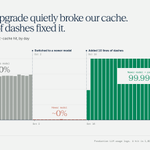
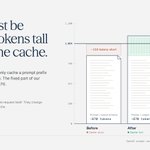
Pull up the usage numbers for your highest-volume LLM call and look at cached_tokens.
If it’s near zero and your system prompt (tools and schema included) is under 1,024 tokens, you’re likely paying full price on most calls. Pad it, check the outputs hold, and ship.
1
1
17
If you're interested in working on hard problems in cybersecurity, come join us: adaptivesecurity.com/careers
1
18
Congrats to @drfeifei and the entire world labs team - this is incredible

Atlas is now available to everyone!! I’m very excited to see what users can build with our newest world model! 🤩🌎
1
32
really interesting and insightful post. seems to confim what most people in the industry have suspected this entire time - most of these labs are circumventing the bans on chips

I have a major result to share.
I’ve found conclusive forensic evidence that the top 4 Chinese AI labs—DeepSeek, Moonshot, MiniMax and Ant Group—have built their newest models on NVIDIA’s most advanced Blackwell chips, which are barred from export to China.
This sounds insane, but I discovered that almost every AI model carries a hidden signature of the GPU that trained it. When a model is first set up, the starting values of its weights are laid out in a pattern that depends on the exact GPU. Each combination of GPU and seed number produces a unique pattern—a sort of fingerprint of the hardware used to create the model. Traces of that pattern survive training into the published model.
Again, this evidence isn’t based on any insider information or leaking. It’s based on a forensic analysis of the model weights released by the companies themselves.
I searched more than six trillion combinations of chip layout and seed number and matched them to open-weights models. In doing so, I found conclusive evidence that six Chinese AI models—including DeepSeek-V4-Pro, Kimi K3, and MiniMax-M3—were initialized on NVIDIA Blackwell systems. Four of the models match Grace Blackwell, the GB200 and GB300 parts in NVIDIA’s flagship liquid-cooled rack-scale systems.
I then verified these results on real hardware. Running unmodified PyTorch with the seeds I’d recovered, a Blackwell B300 reproduced DeepSeek-V4-Flash’s untouched starting weights bit for bit, and a rented GB200 reproduced Kimi K3’s to a correlation of 0.999995. A Hopper H100 reproduced none of DeepSeek-V4-Flash’s, and changing the seed by one broke the match. (DeepSeek’s seed is 953049583 by the way.) The method also was verified to match 24 known open-weights models to the hardware that developers said they used.
It is exceedingly unlikely that these results are a coincidence. Across six trillion combinations, the best accidental match should reach only about 8 sigma (i.e., eight standard deviations above what random chance would produce). The real matches range from 49 to 1,385 sigma, and even the weakest single test hits 20.
These were data-center-scale training runs. With some analysis of release schedules and model details, I estimate that the largest, Kimi K3 and DeepSeek-V4-Pro, used 2,000 to 3,000 Blackwell GPUs each. Clusters of this size cost on the order of $150 to $200 million each to buy, and across these labs alone would add up to more than half a billion dollars of export-controlled GPUs, not counting experimental compute or otherwise. It’s quite likely that we see multi-billion dollar expenditure on export-controlled GPUs.
I am highly confident in this result, and it has been independently verified by senior researchers at OpenAI and Anthropic. You can read the full report at unemploymentlabs.com/checkpo….
There is much more I’ve identified about these models through other forms of checkpoint forensics like this, and will have more to share soon.

1
32
Might be one of the coolest (and most unexpected) things I’ve seen this year

1/4
Meet Qwenputer: Qwen3.5-4B with a full RISC-V CPU inside its weights, using the model's own Gated DeltaNet layers as RAM.
It runs C and MicroPython in its forward passes, no external runtime.
On DeepMind math: base 55–90%, base + Python tool 95–100%, Qwenputer 97.5–100%.
26