







RBA retweeted

Bessent’s Golden Move: Is Judy Shelton’s Appointment a Turning Point for Gold? robertsinn.substack.com/p/dr…
The Friday afternoon announcement from Treasury that Dr. Judy Shelton will serve as a Counselor in Secretary Scott Bessent’s office was one of those moments in which I felt the world change. Even though most people don’t even know who Judy Shelton is, those who understand the context probably felt the earth shake a little on Friday.
The U.S. Treasury announcement states that Shelton will be advising Bessent on currency policy with a particular focus on financial conditions in China. It’s all about China, and more precisely orchestrating a restructuring of the global monetary order. Shelton’s role at Treasury opens the door for new ideas that could change how Washington uses its gold reserves and how it markets its debt.
The real significance lies in the combination of her assignment and the monetary ideas she has spent years developing. Fortunately, she has spent years producing a significant body of work which we can sift through for clues.... $GLD $SLV $TLT
Featuring @RonStoeferle @LukeGromen @judyshel
RBA retweeted

Toronto’s 80-Year Affordability Collapse (Kondratieff's LongWave Four 1946-Sept 2026)
For most of the post-war era, Toronto homes traded around 2–4× household income.
1989’s housing bubble briefly pushed that ratio to 5.7×.
Then came three decades of falling rates, expanding mortgage credit and financialization.
By 2022: 12.7× income.
Even after the correction, Toronto remains near 9.4× income in September 2026 still roughly 122% above its 80-year average.
That is the point many are missing.
🏠 Prices have fallen.
💳 Affordability has not normalized.
📉 Leverage remains embedded in the system.
Economic Autumn rewarded ever-rising asset prices and ever-expanding credit.
Economic Winter is the opposite process: deleveraging, repricing and a return toward economic fundamentals.
The question is no longer whether Toronto has corrected.
The question is how much adjustment is still required before incomes, credit and housing values reconnect with one another.
History suggests the reset is not finished.

RBA retweeted

Asia's Gold Producers Start Hoarding Their Own Metal As Faith In The Dollar Erodes zerohedge.com/precious-metal…

RBA retweeted

Americans now own over $60 trillion in stocks & mutual funds, more than 3x higher than a decade ago.
That huge wealth surge has helped keep consumer spending strong.
The risk: the more the economy depends on rising asset prices, the more vulnerable it becomes when they fall.

RBA retweeted

Is oil the reason for the global explosion in yields?
No.
Oil is simply the trigger exposing a financial system that was already fragile.
For decades, governments ran persistent deficits, central banks suppressed interest rates, and every crisis was answered with more debt, more liquidity and more money creation.
That worked as long as inflation stayed low and global supply remained abundant.
The entire system became dependent on cheap energy, cheap goods, cheap capital and continuously falling interest rates.
Now hit that system with a genuine supply shock.
Oil rises → inflation expectations rise → rate-cut expectations disappear → yields rise → government interest costs increase → fiscal deficits become even larger.
And this time central banks cannot easily suppress yields without risking another inflation wave and further currency depreciation.
They are trapped.
Oil did not create the sovereign debt problem.
Oil is exposing what decades of deficits, monetary expansion and artificially cheap capital built underneath the surface.
A healthy financial system can absorb an energy shock.
A highly leveraged system built around permanently cheap money cannot.
Oil is the match.
The debt structure is the fuel.
RBA retweeted

This is not the first trading session where sovereign bond yields and oil prices have decoupled. In fact, it is happening with greater frequency—a reminder that:
• The protracted surge in yields is driven by forces far beyond energy markets; and
• It is increasingly only a matter of time before borrowing costs for households and corporates face the additional headwind of even wider credit spreads.
#economy #markets

RBA retweeted

The $AEM Juggernaut is something else.😌
After the staggering 40% gain in August, she's taking her time assessing the metals pause and geopolitics, but make no mistake: the 2026 high at 255.24 is the next obvious target, unless a risk-off armageddon takes everything down.🫣


RBA retweeted

There’s every reason to believe that this pattern is in the early stages of repetition today
goldmoney.com/research/credi…

RBA retweeted

Hycroft Strengthens Board for Its Next Phase of Growth
Read the release: hycroftmining.com/news/hycro…
$HYMC #silver #gold #mining


RBA retweeted

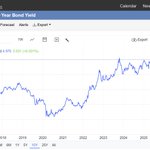
High Alert - A hundred basis point (1.00%) move higher in US Treasury bond yields today can pack the punch of three hundred basis points (3.00%) back in the 1990s, because the bond market is so much bigger and the duration is much longer.

RBA retweeted
This - precious metals miners like $AEM up 9% today.

If Chair Warsh is arrested politically from hiking rates before the U.S. midterm elections + the Fed is in a new “No Forward Guidance” regime - this is a size bullish tailwind for Gold. More at [email protected]

RBA retweeted
It's not often that $AEM rises 9% in a single trading session--once per year trading session for the gold mining sector 📈
Days like today can happen when the market flips from temporarily bracing for lower gold prices, to beginning to resume its belief that we are in a secular gold bull market.

RBA retweeted
Yesterday’s post-FOMC move told the real story:
The 2-year yield fell, while the 30-year yield surged higher.
The front end interpreted the Fed as less willing to tighten aggressively. But the long end saw something very different: persistent inflation risk, fiscal pressure and inadequate protection against currency debasement.
This is not a clean dovish reaction.
It is the yield curve saying:
“The Fed will control overnight rates, but it is losing control over the price of long-term money.”
Falling 2-year yields can support liquidity-sensitive assets temporarily, but rising 30-year yields tighten mortgages, corporate borrowing costs and equity valuations.
That is the fractured regime we have been discussing:
Liquidity is protected at the short end.
Inflation and fiscal risk are transferred to the long end.
Sovereign bonds lose their ability to absorb shocks.
Gold benefits as confidence in long-duration government debt weakens.
The most important signal from yesterday was not that the Fed held rates.
It was that the bond market refused to treat the hold as reassuring.


RBA retweeted

LOOKOUT: Tether Gold has now passed $1.5 billion in market cap
Stablecoins are coming after the gold sector

RBA retweeted
Heading to nyc - meetings with our publisher, a blockbuster book is coming in Q1 2024…
Tell a friend …
*Gratitude, Penguin - Random House…

RBA retweeted
What’s credit telling us about equities? Bonds, where is the trade? Join us here:
youtu.be/PExA1zuPM2I?si=B4w-…
