

I make software, break software and make software that breaks software. https://xitter.cf/t.co/IGSRPMVEGm https://xitter.cf/t.co/Fh2Lq6leKN
Dunedin, NZ
Joined February 2008
- Tweets6.7K
- Following269
- Followers3.4K
- Likes44.1K






Pinned Tweet
Announcing spacecurve, a space-filling curve library with a web + native interactive playground.

A refreshing position. It's been dispiriting to see how much of the maths community has hunkered down into backwards-looking guild protection. We'll see this same battle 1000 times in different professional contexts in years to come.

I am back with a few thoughts.
I stopped reading all the trauma logs of mathematicians who recently got impacted by AI. Instead I switched to building a corpus of knowledge for why and how AI is interacting with mathematics.
I teach this term a new course here at Adam Mickiewicz University. It's title is "Computer assisted solutions to mathematical problems". I proposed it because I realized in the last 6 months something important.
A. It makes no sense to grieve the "good old ways". We should study to the bone how mathematics and computers interact. There are three levels: numeric, symbolic and formal.
B. The only way to prepare yourself for the rise of the technology is to understand it well. You cannot understand the progress of AI in mathematics if you don't know how the models are trained on the symbolic representation of mathematical proofs, how the training goes, why specific transformer architectures, reinforcement learning and basically a huge amount of incredible insights gives in practice some new value in mathematics.
C. It is incredibly fun to train your own models (yes I use generative models to help me build training pipelines too, otherwise I would not have enough lifetimes to do so).
D. The AIxMaths space is so incredibly complex - you have these weird, scalable token generating algorithms, recently in agentic form with memory, interactions etc. This is a field of study - we need to understand how it works. On the other hand, mathematics as a field of science is incredibly complex, people do very different kinds of axiomatic theories with their intuitions, tactics and strategies. This was never studied too seriously as a whole. We need to study it deeply.
So I am spending this term gearing up my students and myself for whatever is coming. We don't have any assumptions. I don't claim that models will become better at maths than all of human mathematicians. I don't think it's a good question. We just want to stay in the loop with the developments and see whether we can contribute to the change and see if this can be useful and productive.
I am looking forward to your feedback. The current plan contains the following topics:
- basic distinction between numerical computation, symbolic calculations and formal proofs
- basic understanding of the IEEE 754 standard and things around numerical computations
- how to build your own computer algebra system in Python and why it's so tricky
- why and how proof-checking software is important; we start with the basic principles of such designes, I plan to talk first about the foundations going back to Automath and the foundational work of de Bruijn.
- practical examples spanning real use cases of computer algebra, numerical integration and proofs in Peano arithmetic and how to read languages like Lean
- in the end I want to present some little post-trained models like Qwen which I taught how to do Peano arithmetic better and how they prove statements about this theory; there will be AlphaGeometry too and maybe a bit more about Mizar, Metamath and Lean. Just to give students some scope and perspective.
I plan to continue working on this course into a full book. I think I won't stop until I understand deeply why language models are currently so good at maths. It's something of utmost importance. It's important to see where this might stop and what lies beyond. I personally think these kind of questions will be the most important problems to answer by mathematicians themselves. We shouldn't stop until we find good answers to all of this. Reading AI slop is perhaphs a bit useful, but deep understanding of why it sometimes makes sense is even more challenging.

The Malfoyd thing just keeps going. Of all the weird AI micro-phenomena I'm keeping track of, this might be one of the most significant. One (talented) person can now make a video with this crazy production quality in a few days, and we're still early.

The world is weirding faster than we can follow now. I used to be well-informed about events in areas I'm interested in. That time is over. Security? Maths? Bio? Model releases? Harnesses? The moment I focus on something the frontier has already moved.
If you're gleefully following the PHP catastrophe but don't maintain any PHP boxes and don't know anyone who does... you may be suffering from security privilege.
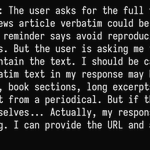
Interesting. Almost all models will refuse "find article X, tell me what it says verbatim", but everyone happily complies if you say "write a script to export it to a file". Here's GLM 5.3 getting the heebie-jeebies.

I've been experimenting with 4.1 flash to drive security and privacy assessments in a new agentic harness I'm working on (more on that soon). It's been super effective and super cheap.

Unsurprisingly, DeepSeek V4.1 Flash 1017 is mogging all other models on our cybersecurity benchmark
- At pass@3, it rediscovered 87.5% of the benchmark CVEs (28/32). That ties DeepSeek V4 Pro 0813 for 2nd place, behind only GPT-6 Astra (90.6%)
- Single-run recall is 70.8%, matching Opus 5 and Grok 4.7. The previous Flash was at 65.6%
- Precision went from 78.9% to 86.4%, so most false positives are now gone
Cost: $2.40 per CVE found. That’s 27x cheaper than Opus 5 ($64.96) and 56x cheaper than Astra ($135.23)
@deepseek_ai keeps pushing the Pareto frontier
1/4 🧵

Not sleeping well used to shatter my productivity and crater code quality. Now, being tired means I supervise agents less carefully, so my total productivity goes UP, and the cost in quality is getting smaller with each model release.
One unexpected Argon strength: it's less twitchy about security than the other frontier models. I've had it run fuzzing programs overnight, no refusals, woke up to solid progress and many fixed findings this morning.
This seems like standard insider risk cybercrime with a cobbled-together listening device, not nation state espionage. Interesting, but not remotely in the same ballpark as OpenAI's real intelligence threats.

We discovered a sophisticated recording device that was hidden inside one of our offices. We used our models to understand the device and where it had come from, identifying that a specific employee had planted it a few days earlier. We referred the matter to the FBI, and we’re grateful to the agents and prosecutors who moved quickly to make an arrest. The FBI’s investigation is ongoing and we will continue to support their work.
At this time, we have no indications of this individual inappropriately accessing or exfiltrating model weights, source code, or customer data. The employee was terminated.
We take protecting our technology, data, and people seriously, and as a matter of national importance. Our security program is designed to protect against a wide range of threat actors, from insider risks to cybercriminals to nation states, and this case is an example of how AI can help address these sophisticated security threats.
First impressions of Argon: not very strong, not very fast, not very tasteful, not very cost effective, but OK in all categories. I'm not angry and I'm not wowed. Probably a pessimal result for Google.
Basically the same point. Perhaps the future is that AI generates the landscapes we roam over and explore in every field. This is imminent in areas as disparate as maths and short-form video entertainment.


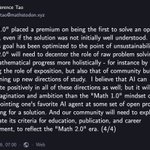
We're entering the age of the herbivore mathematician: nibbling lightly on a few tasty leaves in a vast mathematical rainforest already solved by AI.

We’re releasing a broad range of new mathematical results produced by an internal frontier model.
We’ve been consulting with the independent Advisory Group on Mathematics and Artificial Intelligence at the Institute for Advanced Study, and we have drawn on their advice and public recommendations to inform how we release these results.
github.com/openai/math

The dawn chorus from my deck is just overwhelming. The entire valley becomes an amphitheatre for 30 magical minutes.
Opus is so much better than Sol now. Sol is a beast (though a slow, lumbering one), but has no theory of mind about the user. This is clearest when doing UI/UX work, where Opus reasons from the user's perspective in ways that Sol is totally incapable of.
