




You open your wallet. You have euros, in a stablecoin.
You hit pay. "Network fee: needs CCD." So now you're off to an exchange to buy a second coin, just to spend the first one.
On @Concordium , the merchant can cover that fee instead. When they do, you never touch CCD.
Anthropic's day-one report card IPO price $83 → open $111.50 (+34%) → first-day close $97.17 (+17%) It hit about $115 intraday, briefly topping a $2T market value, and closed at roughly $1.8T .
At about $81.3B raised, it's the biggest IPO on record. The Nasdaq 100 fell 2.2% that day, and ANT still closed above its IPO price. Listing day is just the start; next up is whether it holds $83.

Soon your AI agent will do things on your behalf. And services will ask it the same questions they ask you: is the person behind this over 18? Allowed in this country?
On @Concordium, an agent working through your verified wallet inherits your verified status, not your personal data. It can present the same zero-knowledge proofs you would.
Verify once. Prove what's needed.
Worth being clear: this shows who's behind the agent. It doesn't make every agent safe 👇
Age checks are spreading, from the UK to France and beyond.
The problem: when a check asks for your passport, a lot of people simply route around it. Workarounds, less careful sites. That's worse for privacy and worse for safety.
The fix isn't to drop the checks. It's to make them something people don't need to avoid.
Prove you're over 18. Keep your documents to yourself. That's what @Concordium's identity layer is built for 👇
Zero-knowledge proofs are powerful. Here's the fine print people skip:
• A ZK proof shows a statement about your credential is true. It doesn't check whether the original info was true. That's the identity provider's job.
• Sharing less data means less to leak. It doesn't make every breach impossible.
• Private doesn't mean unaccountable. On @Concordium, there's a lawful disclosure process.
Strong privacy, honest limits. That's how you build trust 👇
First scorecard of the post-Huang era: passed, and then some Revenue: $115.8B (expected ~$109B) Adj. EPS: $2.68 (expected ~$2.47) Gross margin: 74.9% (guidance 74%) Q4 revenue guidance: $130B (expected ~$125.3B)
After hours: +4.8% Interim CEO Kress also raised next year's revenue growth outlook from ~70% to ~75%.
The fear before the report was that new leadership would play it safe. That didn't happen. $NVDA

8
75
Privacy, anonymity and accountability get mixed up all the time.
Privacy: others don't see your details.
Anonymity: nobody can ever know who you are, not even a court.
Accountability: someone answers when the law requires it.
Uploading your ID everywhere gives you accountability, no privacy. Anonymous wallets give you privacy, no accountability.
@Concordium aims for both. Your identity stays private, and it can only be revealed through a lawful process: a court order, with independent Privacy Guardians acting together 👇
Agreed. The numbers might hold, but the real question is whether investors still trust the story without Huang’s presence. 13 years as CFO is solid, but this is a different role.
3
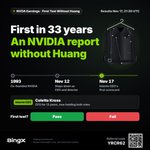
First time in 33 years: NVIDIA reports without Jensen Huang on stage.
He co-founded $NVDA in 1993 and stepped down as CEO and director on Nov 12. Colette Kress, CFO for 13 years, is now also interim CEO. This report is the first test of the post-Huang era.
Pass or fail? Tell me in the comments.
Results Nov 17, 21:20 UTC.

Fun fact: @Concordium never sees your passport.
The document check is done by independent identity providers, once. The resulting credential stays in your wallet. And no personal data goes on-chain.
That split matters. No single party holds the full picture of who you are and what you do.
It also means a ZK proof is only as reliable as that first check. Which is exactly why it's done properly, against real documents 👇
How do you prove you're over 18 without giving away your birthday?
With @Concordium it looks like this:
1. You get verified once by an independent identity provider
2. A site asks one question: over 18?
3. You approve the request in your app
4. Only a cryptographic proof is sent
5. The site verifies it and gets a yes or no
No documents shared. Nothing for the site to store 👇
Zero-knowledge proofs sound complicated. The idea isn't.
Give a color-blind friend two balls that look identical to them. They hide them, maybe swap them, show you again. You call it right 20 times in a row.
Now they're sure the balls are different. They still don't know which color is which.
That's a ZK proof: the fact, without the data. On @Concordium, the same idea lets you prove you're over 18 without sharing your birthday.
One caveat worth knowing: a proof is only as good as the identity check behind it 👇
A website wants to know one thing: are you over 18?
Yes or no.
And to answer it, you hand over your name, birth date, address, photo and document number. Every one of those copies ends up sitting in someone's database.
What if you could just prove the answer, and keep everything else?
That's the idea behind @Concordium's privacy-preserving identity: prove what's needed, reveal nothing unnecessary 👇