
Not every ETH vault wants to be opened. Some bite back. Ξ
World Wide
Joined September 2014
- Tweets1.8K
- Following125
- Followers468
- Likes295

MimicVault retweeted

I'm building in crypto/Web3 and always looking to meet more people who are serious about shipping.
If you're building something or looking for your next opportunity in the crypto/Web3, drop a reply with what you're working on or what you're looking for.
let's build together 🤝
MimicVault retweeted
I got tired of creating a Foundry project just to answer one stupid Solidity question.
So I built @SolidityREPL.
Browser-based. No install. No setup.
Write Solidity.
Run it instantly.
Fork any EVM-compatible chain.
Inspect storage, calls, logs, reverts, and opcodes.
solidity-repl.dev/

MimicVault retweeted

Last stretch for EVM Chronicle in the @Giveth Ethereum Security QF Round.
If you want to help push better Ethereum state research infrastructure forward, now is the time to support it.
qf.giveth.io/project/evm-chr…

MimicVault retweeted
A lot of Solidity code still treats extcodesize as if it were a security feature.
Checking extcodesize(addr) == 0 only tells you one thing: at that exact moment, the address has no deployed code.
Usually developer use this feature cause they wants to block smart contracts and allow only regular wallets.
The thinking is simple: "If the caller is not a contract, the function is safer."
That is where the mistake begins.
On the surface, it looks strict and intuitive: if the caller has no code, then it must be safe to treat it like a normal user. But that assumption breaks in one of the most important edge cases.
The most well-known issue is constructor bypass.
During contract construction, the contract's code is not yet stored on-chain. That means if a contract calls another contract from its constructor, extcodesize(address(this)) is still zero during that call.
So code like this:
require(msg.sender.code.length == 0, "no contracts");
can still be bypassed by a contract calling in from its constructor.
That alone should be enough to kill the idea that this is a reliable security boundary. The check looks strict, but it can fail in one of the most important edge cases.
MimicVault retweeted
Using dork to find vulnerable Solidity contracts
One way to find vulnerable Solidity contracts is by using a dorking mindset.
For example, before Solidity 0.8, integer overflow and underflow on uint was still possible because arithmetic did not automatically revert.
So if we want to search for this vulnerability, we can search for an old Solidity version like:
pragma solidity 0.7
And to make it more accurate, we can look for contracts that do not use SafeMath. We can make it more specific by adding arithmetic patterns like:
+= or -=
So one way to search for this type of bug is to combine multiple clues in a dork.
That gives us a search idea like this:
site:etherscan*io "pragma solidity 0.7" "-="
or more specifically:
site:etherscan*io "pragma solidity 0.7" "accounts[_from].balance -= _value;"
But sometimes Google does not give accurate results for what we really want.
Because Google mostly searches exact text.
This is where EVM Chronicle has a dedicated feature for this kind of search.
It does not just search the exact words we type. It can search for the pattern we actually want.
So if you search:
pragma solidity 0.7
accounts[_from].balance -= _value;
it can return contract address results with similar logic, like:
balance[address] -= wad;
or other similar arithmetic patterns in old Solidity version 0.7.x.
With EVM Chronicle, you do not have to stress out selecting the exact words to match the data you want.
You can just place a line of code, and EVM Chronicle can extract the logic from there and search on its own dedicated database.
If you want a clearer picture, watch the video to see exactly how I do it in practice.
MimicVault retweeted
Address Impersonation Simulation = run transactions as any address.
Great for testing admin paths, whale interactions, and real protocol state during audits.
Some bugs only appear when the right address calls the function.
MimicVault retweeted
First, the most important step is to read the code to understand how it works.
And test some common patterns where we usually catch something.
In this kind of pattern case, I go to Chronicle to find addresses that often interact with the target contract.
Those repeated transactions give different sets of input amounts.
Choose a few transactions with different set integer input amount.
The fastest way is to look address balance History at Chronicle and pick different balance changes like 9, 13, 16, 19 digit change.
Then trace each transaction and jump to the specific function that doing the math.
I capture all variable values from SLOAD and compare the computation result in SSTORE with my manually calculated result. (see image)
When a mismatch happens, we can explore a way to increase or decrease the difference.
Simplest method we can start from the input set that produces the largest difference.
Then tweak the first integer input segment, add or subtract depending what increases the difference, and increment step by step to find the edge.
After that, move to the next integer input segment to go deeper on the edge.
On some old contract overflow often occur with this method. For the underflow focus on decrease the difference and start from input set that produces lowest difference.

ALT sload and store pointing to source code variable

MimicVault retweeted
Security tools should minimize metadata leakage.
When people are analyzing exploits or authorization logic, even browsing patterns can reveal intent. Self-hosted analytics is the right default.

MimicVault retweeted
Serious bug bounty hunters do not stop at the ABI.
They inspect storage.
EVM Chronicle lets you see the contract state the way the EVM does.
evmchronicle.io
MimicVault retweeted
If you're a blockchain researcher, smart contract security auditor, bug bounty hunter, or Web3 developer who investigating edge cases, let's connect.


MimicVault retweeted
I strongly prefer that infrastructure should be open, free, and built for long-term usefulness. Not "open" in name only, and not shaped by monetization pressure. When that holds, the community often finds its own ways to give back and sustain it.
The harder part is sustainability: how do we keep critical infrastructure alive without turning it into an API business or a VC-backed product?
Hopefully @thedaofund can help bring back the values that made the ecosystem community-driven in the first place.

In these five years, the Ethereum Foundation is entering a period of mild austerity, in order to be able to simultaneously meet two goals:
1. Deliver on an aggressive roadmap that ensures Ethereum's status as a performant and scalable world computer that does not compromise on robustness, sustainability and decentralization.
2. Ensures the Ethereum Foundation's own ability to sustain into the long term, and protect Ethereum's core mission and goals, including both the core blockchain layer as well as users' ability to access and use the chain with self-sovereignty, security and privacy.
To this end, my own share of the austerity is that I am personally taking on responsibilities that might in another time have been "special projects" of the EF. Specifically, we are seeking the existence of an open-source, secure and verifiable full stack of software and hardware that can protect both our personal lives and our public environments ( see vitalik.eth.limo/general/202… ). This includes applications such as finance, communication and governance, blockchains, operating systems, secure hardware, biotech (including both personal and public health), and more. If you have seen the Vensa announcement (seeking to make open silicon a commercially viable reality at least for security-critical applications), the ucritter.com/ including recent versions with built in ZK + FHE + differential-privacy features, the air quality work, my donations to encrypted messaging apps, my own enthusiasm and use for privacy-preserving, walkaway-test-friendly and local-first software (including operating systems), then you know the general spirit of what I am planning to support.
For this reason I have just withdrawn 16,384 ETH, which will be deployed toward these goals over the next few years. I am also exploring secure decentralized staking options that will allow even more capital from staking rewards to be put toward these goals in the long term.
Ethereum itself is an indispensable part of the "full-stack openness and verifiability" vision. The Ethereum Foundation will continue with a steadfast focus on developing Ethereum, with that goal in mind. "Ethereum everywhere" is nice, but the primary priority is "Ethereum for people who need it". Not corposlop, but self-sovereignty, and the baseline infrastructure that enables cooperation without domination.
In a world where many people's default mindset is that we need to race to become a big strong bully, because otherwise the existing big strong bullies will eat you first, this is the needed alternative. It will involve much more than technology to succeed, but the technical layer is something which is in our control to make happen. The tools to ensure your, and your community's, autonomy and safety, as a basic right that belongs to everyone. Open not in a bullshit "open means everyone has the right to buy it from us and use our API for $200/month" way, but actually open, and secure and verifiable so that you know that your technology is working for you.
MimicVault retweeted

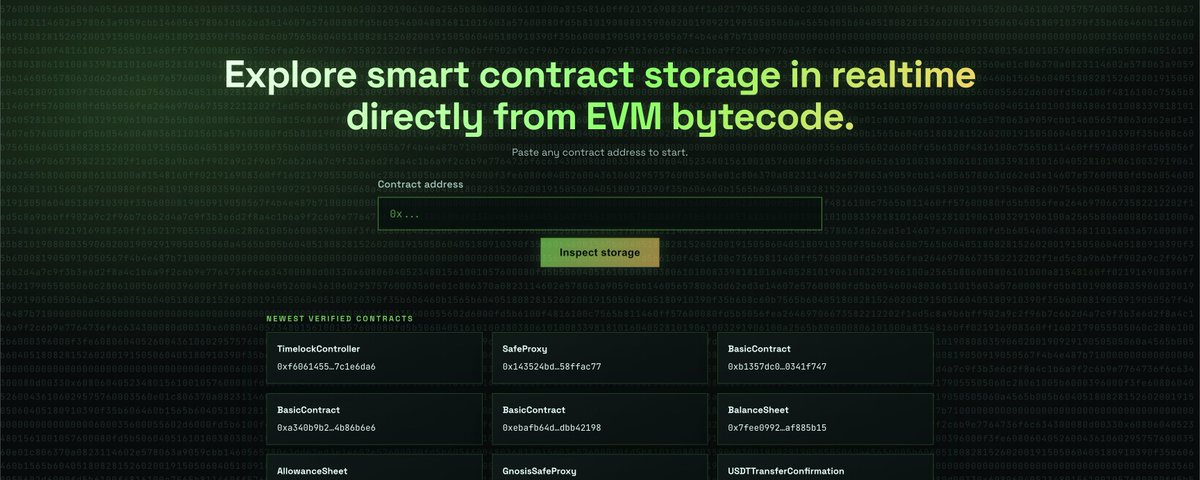
We finally have an EVM storage tool that is easy to use and reads storage slots from on-chain contracts.
Very useful for auditing and debugging, and eliminates all the manual work required (after evm.storage was taken down).
Check it out
evmchronicle.io/

MimicVault retweeted
Small improvements today on EVM Storage Chronicle — mostly around decoding edge cases and cleaning up assumptions.
MimicVault retweeted
I just published Introducing EVM Storage Chronicle: Rebuilding a Missing Piece of Ethereum Infrastructure medium.com/p/introducing-evm…
MimicVault retweeted
As of today, EVM Storage Chronicle is the only publicly available Ethereum storage explorer providing realtime, full-history reconstructed contract storage.
Still early — testing, feedback, and bug reports are very welcome.
👉 evmchronicle.io
MimicVault retweeted
When evm.storage shut down last year, a critical piece of EVM infrastructure disappeared.
Today, i am launching evmchronicle.io — Ethereum Storage Explorer
It’s early, and i’d love help from the community — please test it and report bugs if you find any
